
The Science of the Strike: How Smart Gloves and Sensors Are Making Combat Sports Safer
Miniaturized sensors and machine learning algorithms are transforming boxing and MMA, providing real-time data on punch force while helping coaches monitor accumulated impact to prevent injuries.
By Factlen Editorial Team
- Sports Scientists & Engineers
- Advocates for the precise quantification of biomechanics to optimize athletic performance.
- Fighter Safety Advocates
- Focuses on using technology to monitor accumulated damage and prevent long-term neurological decline.
- Traditional Coaches
- Maintains that fighting is an art form that cannot be entirely reduced to data points.
- Equipment Manufacturers
- Focuses on market growth, consumer demand, and product innovation in the combat sports sector.
What's not represented
- · Amateur Fighters
- · Athletic Commissions
Why this matters
For decades, combat sports have relied on intuition, leading to a culture of overtraining and hidden neurological damage. The integration of precise biometric sensors is finally providing the objective data needed to protect fighters' brains and extend their careers.
Key points
- Smart gloves use miniaturized IMUs and force sensors to measure punch velocity, acceleration, and peak impact.
- Machine learning algorithms can automatically classify specific strike types with over 90% accuracy.
- Sensor-based mouthguards track the frequency and severity of impacts absorbed by a fighter's head.
- The technology helps coaches monitor physiological stress and prevent overtraining and sub-concussive damage.
- Traditional coaches warn that sensors cannot teach defensive timing, balance, or ring generalship.
- The global boxing equipment market is projected to reach nearly $8 billion by 2034, driven by smart tech.
Combat sports have historically relied on the "eye test" and the heavy thud of a punching bag to gauge a fighter's power and fatigue. For decades, trainers evaluated progress based on intuition, while fighters pushed through pain under the guise of traditional toughness. In 2026, that era of guesswork is rapidly giving way to the era of quantification, fundamentally altering how athletes prepare for the ring or the cage.[1]
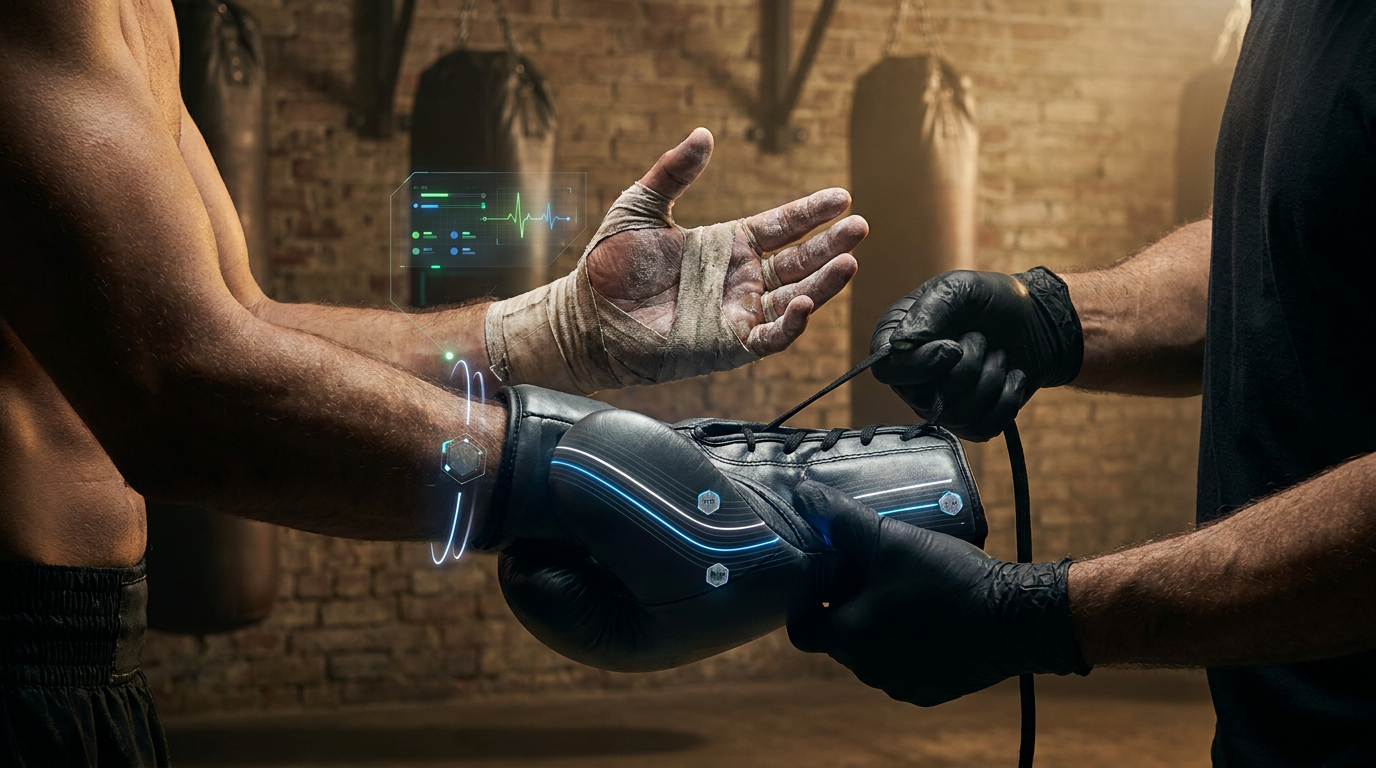
The driving force behind this shift is the widespread integration of "smart gloves" and wearable impact sensors into daily training camps. Moving far beyond the basic fitness trackers of the past decade, these specialized devices are engineered specifically for the extreme forces of combat sports. They represent a bridge between raw physical violence and precise biomechanical science, offering insights that were once confined to elite university laboratories.[2][6]
At the core of this technological leap are miniaturized Inertial Measurement Units (IMUs) and highly calibrated force sensors embedded directly into the padding of boxing gloves or hand wraps. These microscopic components measure a staggering array of metrics in real-time, capturing data at hundreds of frames per second. As a fighter throws a combination, the sensors instantly calculate punch velocity, acceleration, peak impact force, and the total output volume over the course of a round.[4][8]

Gathering raw data is only half the equation; interpreting it requires advanced software. Modern smart glove systems utilize sophisticated machine learning algorithms, such as Support Vector Classifiers, to analyze the kinetic chain of a fighter's movement. By recognizing the unique physical characteristics and limb trajectories of different punches, these models can automatically distinguish a jab from a lead hook or an uppercut with over 90 percent accuracy, providing a highly detailed map of a fighter's offensive arsenal.[4][9]
While the ability to measure knockout power makes for excellent marketing, the most profound impact of this technology lies in fighter safety and injury prevention. Combat sports are inherently punishing, and the culture has long normalized fighting through exhaustion. Overtraining and the accumulation of sub-concussive impacts during daily sparring sessions have served as the sport's silent epidemic, often causing more long-term neurological damage than the actual sanctioned bouts.[5][6]
While the ability to measure knockout power makes for excellent marketing, the most profound impact of this technology lies in fighter safety and injury prevention.
To combat this, safety advocates are pairing smart gloves with sensor-based combat mouthguards. These advanced mouthpieces track the frequency, direction, and severity of impacts absorbed by a fighter's head. By quantifying the invisible toll of a hard sparring session, coaches can monitor physiological stress markers and adjust training intensity before a fighter sustains permanent damage, effectively bringing modern concussion protocols into the MMA gym.[5]
The commercial appetite for these connected devices is exploding. Industry analysts project that the global boxing equipment sector will approach $8 billion by the 2030s, driven heavily by the adoption of smart technology. To accommodate these delicate electronics without compromising hand protection, manufacturers are moving away from traditional foam padding. Modern gloves increasingly feature advanced gel technologies and breathable microfibers that distribute impact evenly while housing the necessary hardware.[2][3]

However, the sudden influx of biometric data has sparked a philosophical debate within traditional boxing and MMA circles regarding the limits of technology. Skeptics and veteran coaches warn that while a sensor can accurately report that a punch landed with 740 grams of force, it cannot correct a fighter's stance, balance, or defensive timing. They argue that fighting is an art form heavily reliant on instinct and spatial awareness.[7]
A flashing app interface might reward a fighter for a high output of mathematically perfect strikes, but it cannot account for the defensive vulnerabilities those punches create. Traditionalists stress that ring generalship, distance management, and the ability to read an opponent's tells remain the deciding factors in combat sports—nuanced elements of the game that no current algorithm can measure, teach, or replicate.[7]

Furthermore, the reliance on proprietary software and expensive hardware threatens to create a technological divide within the sport. Many advanced punch-tracking platforms lock their most valuable insights behind monthly subscription fees. This economic barrier raises concerns that elite, well-funded training facilities will gain an insurmountable data advantage over the gritty, grassroots amateur gyms that have historically served as the lifeblood of boxing and MMA.[7]
Despite these reservations, the integration of biometric data is already reshaping how audiences consume combat sports. Broadcasters and athletic commissions are beginning to experiment with displaying real-time punch force and velocity metrics on screen during live pay-per-view events. This adds a new layer of objective analysis for fans and commentators, transforming the subjective debate over who hits harder into a verifiable statistical fact.[8]

Ultimately, the future of combat sports lies in a hybrid approach that respects both the science and the art of fighting. The most successful camps will be those that leverage advanced sensors to protect their athletes, optimize conditioning, and prevent overtraining, while continuing to rely on experienced coaches to instill the strategic nuances of the game. Technology will not replace the fighter's heart, but it is finally providing the data needed to protect their brain.[1]
How we got here
Early 2010s
Basic wearable accelerometers are introduced to track overall movement in fitness routines.
2017
Early punch trackers enter the market, offering basic speed and volume metrics but lacking precise force measurement.
2020
Researchers successfully apply machine learning to IMU data to accurately classify specific boxing strike types.
2025
Advanced smart gloves with direct force measurement and sensor-based mouthguards become widely adopted in elite training camps.
2026
Broadcasters and athletic commissions begin exploring real-time biometric data integration for live events and safety protocols.
Viewpoints in depth
Sports Scientists & Engineers
Advocates for the precise quantification of biomechanics to optimize athletic performance.
This camp views the integration of machine learning and miniaturized sensors as the ultimate tool for unlocking human potential. By capturing exact data on limb trajectory, acceleration, and kinetic chaining, engineers argue that fighters can bypass the guesswork of traditional training. They emphasize that algorithms can now classify strike types with over 90% accuracy, providing an objective baseline for technique refinement that was previously only available in million-dollar biomechanics labs.
Fighter Safety Advocates
Focuses on using technology to monitor accumulated damage and prevent long-term neurological decline.
For safety advocates, the true value of smart gear lies not in hitting harder, but in knowing when to stop. They champion the use of sensor-based mouthguards and impact-tracking gloves to measure the invisible toll of daily sparring. By quantifying sub-concussive impacts and monitoring physiological stress markers, this group argues that technology can end the sport's dangerous culture of overtraining and provide concrete data to protect athletes from chronic traumatic encephalopathy (CTE).
Traditional Coaches
Maintains that fighting is an art form that cannot be entirely reduced to data points.
While acknowledging the utility of punch counters, traditionalists warn against an over-reliance on screens. They argue that a sensor might reward a fighter for throwing a mathematically perfect hook, but it cannot account for the defensive vulnerability that punch creates. This camp stresses that ring IQ, timing, distance management, and mental resilience remain the deciding factors in combat sports—elements that no current algorithm can measure or teach.
What we don't know
- Whether athletic commissions will eventually mandate sensor-based mouthguards for all sanctioned bouts.
- How the high cost of smart equipment will impact grassroots amateur gyms in the long term.
- The exact threshold of sub-concussive impacts required to definitively predict long-term neurological damage.
Key terms
- Inertial Measurement Unit (IMU)
- An electronic device that measures and reports a body's specific force and angular rate, used in gloves to track punch trajectory.
- Support Vector Classifier
- A machine learning algorithm used by smart gloves to analyze sensor data and automatically identify whether a punch was a jab, cross, or hook.
- Sub-concussive Impact
- A physical blow to the head that does not result in a full concussion but can cause long-term neurological damage if accumulated over time.
Frequently asked
What do smart boxing gloves actually measure?
They use embedded sensors to track punch speed, acceleration, peak impact force, and the total volume of strikes thrown during a session.
Can wearable technology prevent injuries in MMA?
While it cannot stop acute injuries from a single blow, sensor-based mouthguards and gloves track accumulated impact, helping coaches identify overtraining and reduce long-term concussion risks.
Do sensors replace the need for a boxing coach?
No. Sensors provide objective data on power and speed, but they cannot teach balance, defensive timing, or ring strategy.
Sources
Source coverage
9 outlets
4 viewpoints surfaced









[1]Factlen Editorial TeamFighter Safety Advocates
Synthesis by Factlen editorial team
Read on Factlen Editorial Team →[2]FightstyleEquipment Manufacturers
The rise of technology in the ring: Smart gloves and real-time feedback
Read on Fightstyle →[3]Fortune Business InsightsEquipment Manufacturers
Boxing Equipment Market Size, Share & Industry Analysis
Read on Fortune Business Insights →[4]MDPISports Scientists & Engineers
Smart Boxing Glove “RD α”: IMU Combined with Force Sensor for Highly Accurate Technique and Target Recognition Using Machine Learning
Read on MDPI →[5]RDX SportsFighter Safety Advocates
How Smart Tech Innovations Are Transforming Boxing and MMA Training
Read on RDX Sports →[6]Joya GearFighter Safety Advocates
The Future of Combat Sports Gear: Technology That Will Change Your Performance
Read on Joya Gear →[7]London Boxing TrainerTraditional Coaches
Wearable Tech for Boxers – Are Smart Gloves & Rings Worth It?
Read on London Boxing Trainer →[8]Fraunhofer IISSports Scientists & Engineers
Smart boxing glove: Real-time punch analysis
Read on Fraunhofer IIS →[9]Semantic ScholarSports Scientists & Engineers
Wearable inertial sensors for strike classification in boxing
Read on Semantic Scholar →


Every angle. Every day.
Get sports stories with full source coverage and perspective breakdowns delivered to your inbox.