
The 2026 Guide to the Electric Road Trip: How NACS and New Tech Solved Range Anxiety
With the universal adoption of the NACS charging standard and smarter route-planning apps, taking an EV on a cross-country road trip is easier and faster than ever.
By Factlen Editorial Team
- EV Adopters & Enthusiasts
- Embrace the new rhythm of travel and the seamless integration of technology.
- Infrastructure Planners
- Focus on standardizing hardware and reinforcing the electrical grid for peak travel days.
- Automotive Traditionalists
- Remain skeptical of the logistical overhead and highway range limitations.
What's not represented
- · Rural gas station owners
- · Drivers in extreme cold climates
Why this matters
With the unification of charging standards and the rise of ultra-fast infrastructure, the electric road trip has transitioned from a stressful logistical puzzle to a mainstream summer activity. Understanding how to leverage this new technology saves drivers hours of travel time and eliminates range anxiety.
Key points
- The NACS charging standard has unified the industry, giving most EVs access to Tesla's massive Supercharger network.
- Drivers are advised to follow the 20-80% rule, as charging speeds drop dramatically once the battery is 80% full.
- Route-planning apps like ABRP calculate exact range needs by factoring in elevation, temperature, and vehicle weight.
- Highway speeds significantly reduce EV range due to aerodynamic drag; slowing down extends range.
- New integrated energy storage chargers are being deployed to support rural routes with weak electrical grids.
The great American road trip has long been defined by the spontaneous pull of the open highway and the familiar glow of gas station signs. But in the summer of 2026, a new paradigm has officially taken hold. Electric vehicle (EV) road-tripping, once a logistical puzzle reserved for early adopters and meticulous planners, has transitioned into the mainstream.[1]
The shift is not just about newer cars with larger batteries, though the average 2026 EV now boasts a real-world range of 280 to 350 miles. The true catalyst is a sweeping overhaul of the infrastructure that supports them. The dreaded "range anxiety"—the fear of being stranded on a rural interstate with a dead battery—has been largely neutralized by industry-wide standardization and highly intelligent software.[3][7]
Taking an EV across the country still requires a different mindset than driving a combustion-engine vehicle. It demands a shift from the "drive until empty" mentality to a rhythm of strategic, shorter stops. However, for drivers who understand the mechanics of modern charging, the electric road trip is no longer a pioneer's gamble; it is simply a quieter, smoother, and often cheaper way to travel.[1][2]
The most significant turning point in North American EV travel is the near-universal adoption of the North American Charging Standard (NACS), formally codified as SAE J3400. Originally developed by Tesla as a proprietary connector, NACS was opened to the industry, triggering a domino effect. By early 2026, nearly every major automaker—including Ford, General Motors, Rivian, and Hyundai—had committed to the standard.[1][5]

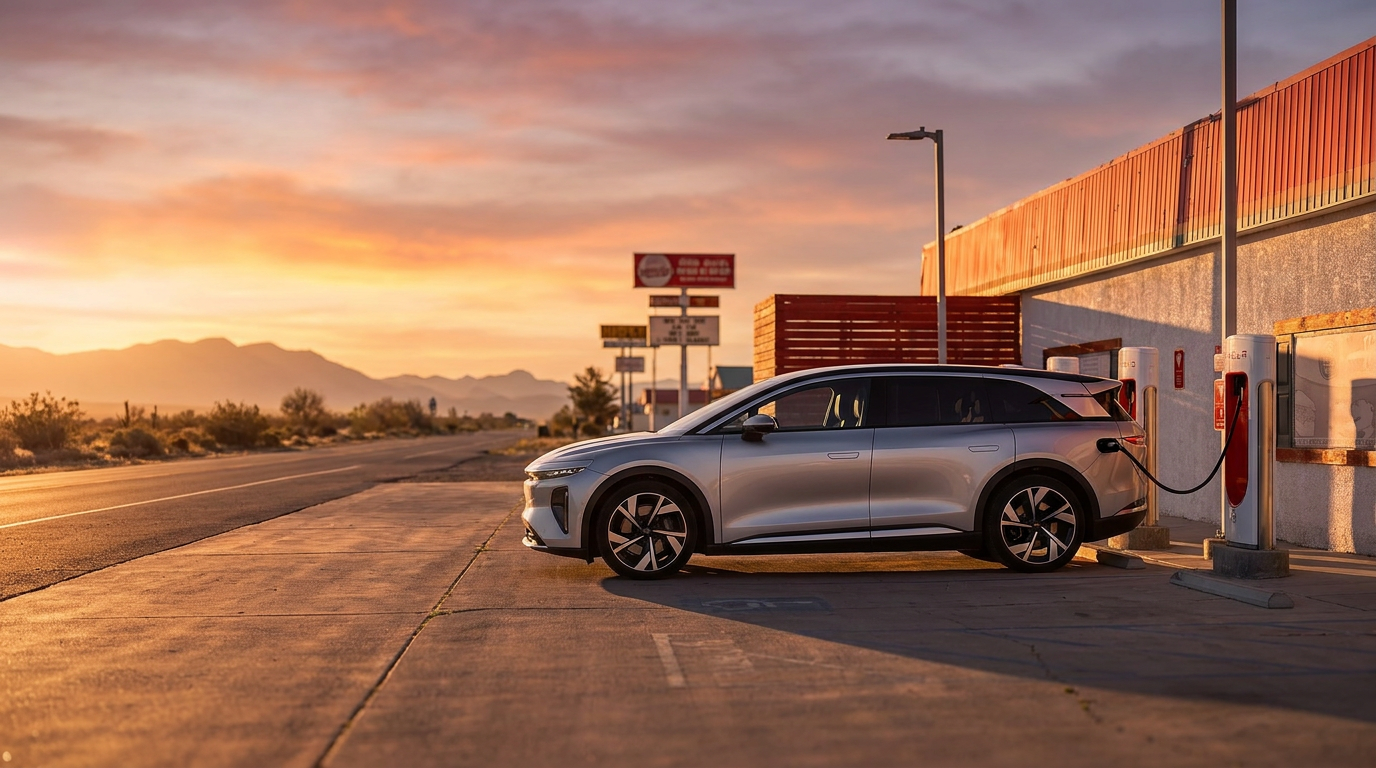
For drivers, this unification means the end of connector fragmentation. Hundreds of thousands of non-Tesla EV owners can now seamlessly access Tesla's vast Supercharger network, which boasts over 34,000 fast-charging ports in the United States alone. Whether through native NACS ports built into 2026 models or manufacturer-approved adapters for older vehicles, the sheer volume of available, reliable chargers has fundamentally altered the road trip map.[4][5]
The rest of the charging industry is rapidly catching up. According to the Alternative Fuels Data Center, non-Tesla networks like ChargePoint, Ionna, and BP Pulse are aggressively rolling out NACS-compatible stalls. In the first quarter of 2026, nearly 32% of all new non-Tesla fast chargers installed featured the NACS connector. This dual-network expansion means drivers are rarely more than 50 miles from a high-speed charging hub on major interstates.[3][4]
Despite the abundance of chargers, the secret to a successful EV road trip lies in understanding battery chemistry—specifically, the "20-80% rule." Unlike a gas tank, which fills at a constant rate from empty to full, an EV battery charges on a curve. When the battery is low, it can accept massive amounts of electricity, but as it fills, the vehicle's software intentionally slows the charge rate to prevent overheating and battery degradation.[2][6]
At a modern 250-kilowatt DC fast charger, an EV might surge from 10% to 80% capacity in just 20 to 25 minutes. However, pushing that charge from 80% to 100% can take an additional 30 to 45 minutes. For road trippers, the math is clear: it is significantly faster to make two 20-minute stops to charge to 80% than to make one agonizingly long stop to reach a full battery.[2][3][6]

At a modern 250-kilowatt DC fast charger, an EV might surge from 10% to 80% capacity in just 20 to 25 minutes.
This charging curve changes the cadence of travel. Instead of treating charging as an inconvenience, veteran EV drivers treat it as a scheduled break. A 20-minute pause aligns perfectly with the time it takes to use the restroom, grab a coffee, and stretch. By the time the driver returns to the vehicle, the car has typically added over 150 miles of range and is ready for the next leg.[2][6]
While the hardware has standardized, software remains the ultimate co-pilot for the electric road trip. Built-in navigation systems from automakers have improved dramatically, but third-party applications like A Better Routeplanner (ABRP) have become indispensable tools for long-distance travel.[6]
ABRP and similar platforms do not just draw a line on a map; they run complex physics simulations. Users input their specific vehicle model, and the software calculates the route based on the car's exact efficiency profile. Crucially, these apps factor in variables that drastically affect EV range, such as elevation changes, ambient temperature, and even real-time headwind data.[6][7]
If a route involves climbing a steep mountain pass in freezing temperatures, the software automatically adjusts the range prediction and routes the driver to an earlier charger. Furthermore, integrations with Apple CarPlay and Android Auto mean these dynamic route plans now live directly on the vehicle's dashboard, automatically rerouting if a planned charging station goes offline.[1][6]

To verify that a charger is functional before arriving, drivers rely on crowd-sourced apps like PlugShare. Operating much like Waze for EV infrastructure, PlugShare allows users to "check in" at chargers, leaving real-time reviews and photos. If a specific charging stall is broken or delivering slower-than-expected speeds, the community flags it, allowing approaching drivers to pivot to a backup location.[6][7]
Even with perfect planning, drivers must respect the physical realities of highway driving. In a combustion engine, highway cruising is often more efficient than city driving. In an EV, the opposite is true. Aerodynamic drag increases exponentially with speed, meaning that cruising at 75 mph consumes significantly more battery power than driving at 65 mph.[2][3]
The International Energy Agency notes that a battery electric car with a nominal 250-mile range might only cover 200 miles on a highway stint before needing a charge. Drivers looking to stretch their range to reach a distant charger can often do so simply by reducing their speed by 5 to 10 mph.[2][3]

Looking ahead, the infrastructure is evolving to handle even greater demand. To support rural corridors with weak electrical grids, companies are deploying integrated energy storage chargers. These stations feature built-in battery packs that slowly sip power from the grid all day, then dump it rapidly into an EV when it pulls up, bypassing local grid limitations.[4][7]
The 2026 electric road trip is a testament to how quickly technology can solve its own bottlenecks. By combining standardized NACS hardware, the strategic 20-80% charging rule, and predictive routing software, the modern EV driver can traverse the continent with confidence. The open road remains as inviting as ever—it just requires a slightly different map.[7]
How we got here
2012
Tesla launches its proprietary Supercharger network to support long-distance travel.
Nov 2022
Tesla open-sources its connector design, renaming it the North American Charging Standard (NACS).
2023–2024
Major automakers, including Ford and GM, announce they will adopt NACS for future vehicles.
Early 2026
NACS becomes the de facto industry standard, with native ports and adapters unlocking universal access.
Viewpoints in depth
EV Adopters & Enthusiasts
Embrace the new rhythm of travel and the seamless integration of technology.
This camp argues that the 20-minute charging stops actually improve the road trip experience by forcing healthy, scheduled breaks. With intelligent routing software and the massive expansion of NACS chargers, they view range anxiety as a relic of the past, celebrating the quiet, emission-free miles and lower operating costs.
Automotive Traditionalists
Remain skeptical of the logistical overhead and highway range limitations.
Traditionalists point out that EVs still require significantly more planning than gas cars. The loss of range at 75 mph and the necessity of managing multiple apps, adapters, and charging curves can feel like a step backward in convenience for drivers accustomed to spontaneous five-minute gas station stops.
Infrastructure Planners
Focus on standardizing hardware and reinforcing the electrical grid for peak travel days.
Planners are concerned with macro-level challenges. While NACS solved the connector war, they are now focused on deploying battery-integrated chargers in rural corridors and ensuring the local electrical grids can handle megawatt-level demand during busy holiday travel weekends.
What we don't know
- How well the unified charging network will handle peak capacity during major 2026 holiday travel weekends.
- The exact timeline for when all non-Tesla fast chargers will fully transition to native NACS cables.
Key terms
- NACS (North American Charging Standard)
- The universal charging connector standard, originally developed by Tesla, now adopted by nearly all major automakers.
- DC Fast Charging
- High-power charging (often 150kW to 350kW) that can refill an EV battery to 80% in 20 to 30 minutes.
- State of Charge (SoC)
- The current battery level of an electric vehicle, expressed as a percentage.
- Charging Curve
- The rate at which an EV battery accepts power, which intentionally slows down as the battery gets fuller to protect its health.
- Range Anxiety
- The fear that an electric vehicle will run out of battery power before reaching a charging station.
Frequently asked
Do I need to charge my EV to 100% at every stop?
No. Fast charging slows down significantly after 80%. It is much faster to make two shorter stops and charge to 80% than to wait for a single 100% charge.
What happens if a charging station is broken?
Apps like PlugShare provide crowd-sourced, real-time reliability updates. Route planners also monitor live station status and will automatically suggest backup locations along your route.
Does driving faster reduce my EV's range?
Yes. Aerodynamic drag increases exponentially at highway speeds. Cruising at 65 mph instead of 75 mph can significantly extend your range.
Can non-Tesla vehicles really use Superchargers now?
Yes. Thanks to the NACS transition, most non-Tesla EVs can now access the Supercharger network using either a native port or a manufacturer-approved adapter.
Sources
Source coverage
7 outlets
3 viewpoints surfaced







[1]The VergeEV Adopters & Enthusiasts
How NACS adoption changed the 2026 summer road trip
Read on The Verge →[2]MotorTrendAutomotive Traditionalists
Testing the 20-80% charging rule on a cross-country EV trip
Read on MotorTrend →[3]International Energy AgencyInfrastructure Planners
Global EV Outlook 2026: Highway Charging Infrastructure
Read on International Energy Agency →[4]Alternative Fuels Data CenterInfrastructure Planners
Q1 2026 NACS Deployment Data
Read on Alternative Fuels Data Center →[5]CharINInfrastructure Planners
SAE J3400 Standardization and Interoperability
Read on CharIN →[6]PlugIn AmericaEV Adopters & Enthusiasts
Comprehensive Guide to EV Route Planning
Read on PlugIn America →[7]Factlen Editorial TeamInfrastructure Planners
Synthesis by Factlen editorial team
Read on Factlen Editorial Team →
Every angle. Every day.
Get automotive stories with full source coverage and perspective breakdowns delivered to your inbox.