
Why Consumers Are Ditching Smartwatches for Screen-Free Wearables
A growing wave of consumers is abandoning glowing smartwatches in favor of traditional timepieces and screen-free health trackers. Driven by 'smartwatch fatigue,' this shift is prompting major tech companies to design invisible, passive wearables that monitor wellness without constant interruptions.
By Factlen Editorial Team
- Digital Minimalists
- Argue that constant wrist notifications cause anxiety, preferring analog watches to reclaim their attention.
- Health Optimizers
- Value continuous biometric data but want the technology to be invisible and comfortable.
- Traditional Horologists
- View smartwatches as disposable tech that ages poorly, preferring the craftsmanship and longevity of mechanical watches.
- Wearable Manufacturers
- Adapting to smartwatch fatigue by pivoting product lines toward screenless, passive-tracking devices.
What's not represented
- · Medical professionals who rely on real-time smartwatch alerts (like fall detection or AFib warnings) for high-risk patients.
- · App developers whose business models depend on wrist-based screen engagement.
Why this matters
As digital burnout reaches new highs, the shift toward screen-free wearables offers a blueprint for how we can maintain our health without sacrificing our attention. Understanding this trend helps consumers make more intentional choices about the technology they allow onto their bodies.
Key points
- Consumers are increasingly abandoning smartwatches due to 'smartwatch fatigue' and notification overload.
- Screen-free wearables, like the Oura Ring 5 and Fitbit Air, are surging in popularity.
- These devices track health metrics passively, requiring users to opt-in via a smartphone app to see data.
- Removing the screen extends wearable battery life from one day to over a week.
- Traditional analog and digital 'dumbwatches' are seeing a resurgence among digital minimalists.
When the modern smartwatch era began in the mid-2010s, the pitch was utopian: a glowing screen on your wrist would free you from the tyranny of your smartphone. By glancing at a text or an email without breaking stride, users were promised a more present, engaged life. But a decade later, the reality for many has been the exact opposite. Instead of a tool for liberation, the smartwatch has become a second digital leash, tethering users to a relentless stream of notifications, calendar alerts, and health nudges. Now, a quiet rebellion is brewing. Across the technology landscape, a growing cohort of consumers is actively ditching their glowing wrist-computers in favor of something radically simpler.[1][5]
This shift is being driven by a phenomenon industry insiders are calling "smartwatch fatigue." The psychological toll of constant wrist-taps is real; what was meant to be a gentle convenience often morphs into a persistent source of low-grade anxiety. Users report feeling overwhelmed by the sheer volume of data and the expectation of immediate replies. In response, the market is bifurcating. While ultra-capable smartwatches continue to sell, there is a surging demand for "dumbwatches"—traditional analog or digital timepieces—and a new generation of screen-free wearables that track health without demanding attention.[1][4][5]
The mechanism behind this fatigue is rooted in how our brains process interruptions. Every vibration on the wrist triggers a micro-dose of cortisol, pulling the wearer out of their current context—whether that is a deep work session, a dinner conversation, or a walk in the woods. Ironically, the very devices designed to monitor stress are often contributing to it. Fitness enthusiasts who initially loved tracking every metric are experiencing "feature fatigue," realizing that obsessing over daily sleep scores and step counts can detract from the actual enjoyment of the activity.[1][5]

Wearable manufacturers are acutely aware of this shifting tide and are pivoting their product lines accordingly. Polar, a company historically known for catering to hardcore athletes with data-heavy sports watches, is preparing to launch a screenless tracker designed for 24/7 wear. Polar CEO Sander Werring explicitly cited smartwatch fatigue as the catalyst, noting that younger generations, in particular, are seeking out devices that allow for "off time" while still passively monitoring their wellness. The goal is to capture health data without pelting the wearer with stats and alerts.[4]
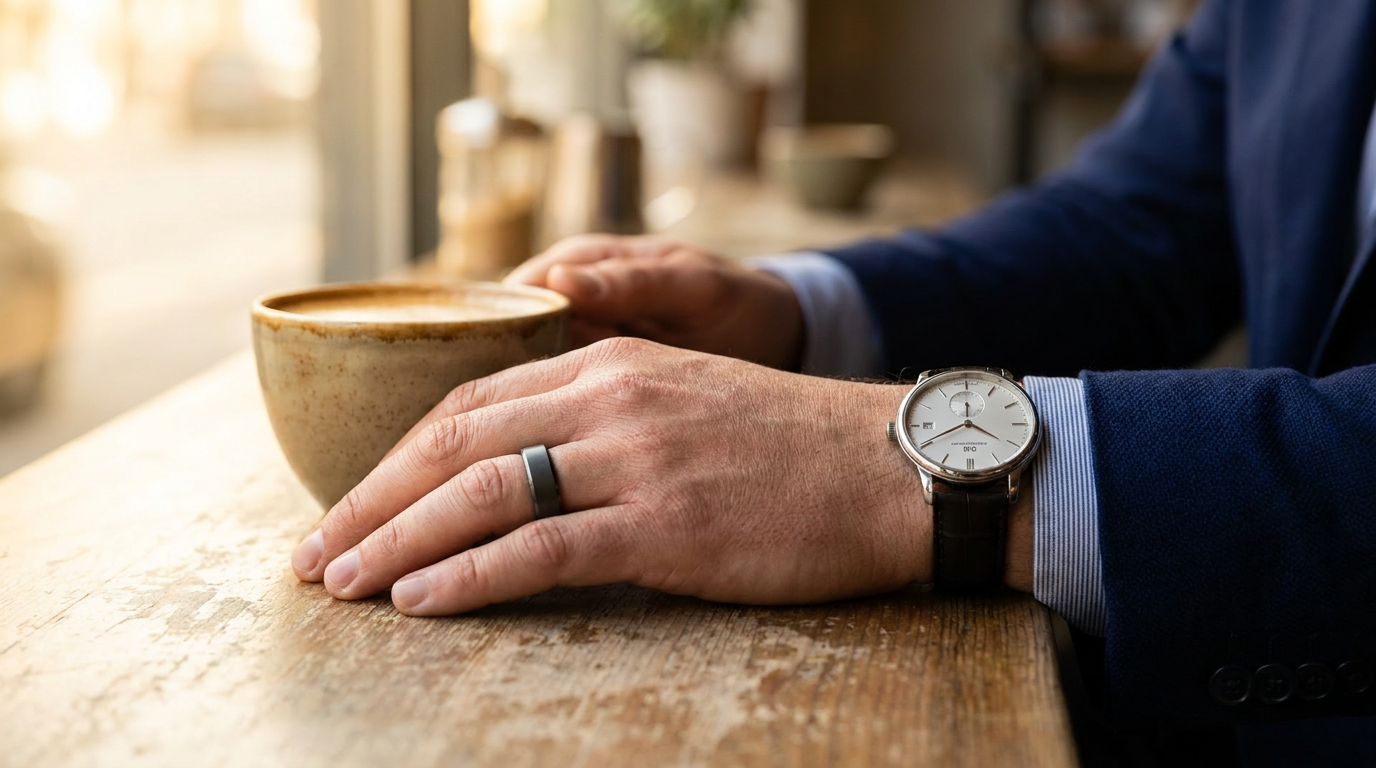
The most prominent beneficiary of this trend is the smart ring, a category that has moved from a niche curiosity to a mainstream staple. Oura, the pioneer in this space, recently unveiled the Oura Ring 5, a device that doubles down on the philosophy of invisible technology. By shrinking the ring's volume by 40% compared to its predecessor, Oura has created a health tracker that genuinely masquerades as traditional jewelry. It is 6 millimeters wide and just 2 millimeters thick, addressing longstanding complaints that earlier smart rings felt too bulky for comfortable daily wear.[2][3][7]

The appeal of the Oura Ring 5 extends far beyond its aesthetics. It represents a fundamental shift in how people interact with their health data. The ring continuously monitors heart rate, blood oxygen, temperature trends, and sleep stages using precision-engineered optical sensors. However, because it lacks a screen, it cannot interrupt the user. The data is quietly collected and synthesized in the background, available only when the wearer actively chooses to open the companion app on their phone. This opt-in approach to health tracking is proving highly attractive to first-time buyers and women, who appreciate the subtle design and the focus on holistic wellness over constant notifications.[2][3][7]
The appeal of the Oura Ring 5 extends far beyond its aesthetics.
The screen-free movement is not limited to premium jewelry. Google has also entered the fray with the Fitbit Air, a minimalist, display-less fitness band that strips away everything but the essential sensors. Priced aggressively at $99, the Fitbit Air is essentially a lightweight sensor pod that clips onto a band, gathering data around the clock without ever buzzing or glowing. It is a deliberate design choice aimed squarely at users who want the benefits of a fitness tracker but refuse to wear another screen on their body.[1][8]
Removing the screen also solves one of the most persistent pain points of the smartwatch era: battery anxiety. The high-resolution, always-on displays of modern smartwatches require immense power, tethering users to a daily charging routine. In contrast, screenless devices offer liberating longevity. The Fitbit Air boasts a seven-day battery life, while the Oura Ring 5 can last between six and nine days on a single charge. This extended battery life is crucial for accurate sleep tracking, as users are not forced to take the device off every night to charge it.[6][7][8]

Beyond screenless trackers, there is a parallel resurgence in the popularity of traditional "dumbwatches." Horology enthusiasts and digital minimalists alike are rediscovering the charm of mechanical automatics, solar-powered field watches, and classic Casio digital pieces. These watches do exactly one thing—tell the time—and they do it with a permanence that smartwatches cannot match. A traditional watch is a piece of craftsmanship that can last for decades, whereas a smartwatch is essentially disposable technology, destined to become obsolete as soon as its internal battery degrades or its software stops receiving updates.[1][5][6]
For many, returning to a traditional watch is a deliberate act of reclaiming their attention. It allows them to leave their smartphones in another room or at home entirely, breaking the compulsive cycle of checking a screen every time they need to know the hour. Some users are finding a middle ground with hybrid smartwatches from brands like Garmin and Withings, which feature physical watch hands over a subtle, e-ink display that only shows essential information when summoned.[1][5][6]
The realization that consistent lifestyles yield consistent data is also driving the exodus from heavy tracking. Many users find that after a year of meticulously monitoring their sleep, strain, and recovery, the patterns become obvious. Once a person internalizes how alcohol affects their resting heart rate or how a late meal ruins their deep sleep, they no longer need a wrist-bound computer to validate those feelings. The data loses its novelty, and the device's constant presence begins to feel redundant.[1][5]

This does not mean the smartwatch is dead, nor that it lacks utility. For turn-by-turn navigation in a new city, contactless payments at the grocery store, and vital emergency communication features like fall detection, wrist-computers remain incredibly powerful and sometimes life-saving tools. However, the era of the smartwatch as the default, one-size-fits-all accessory for every consumer is ending. The market is maturing into a more nuanced ecosystem where individuals can choose the exact level of connectivity that suits their mental health and lifestyle.[1][6]
Ultimately, the rise of screen-free wearables and the return of the dumbwatch signal a broader cultural shift toward digital wellness. Technology is no longer being judged solely by how many features it can cram into a chassis, but by how respectfully it integrates into the user's life. In 2026, the ultimate luxury is not being constantly connected; it is the ability to step away from the noise, secure in the knowledge that your health is being quietly looked after, while your attention remains entirely your own.[1][2][3][5]
How we got here
Mid-2010s
The modern smartwatch era begins, promising to free users from constantly checking their phones.
2015
Oura launches its first smart ring, introducing the concept of screen-free, finger-based health tracking.
2024-2025
Sales of screenless fitness trackers surge by 88% as 'smartwatch fatigue' enters the mainstream.
May-June 2026
Major brands pivot to invisible tech, with the launch of the ultra-thin Oura Ring 5 and Google's screenless Fitbit Air.
Viewpoints in depth
Digital Minimalists
Advocates for reclaiming attention by removing digital distractions from the wrist.
For digital minimalists, the smartwatch represents an invasive escalation of the attention economy. They argue that moving notifications from the pocket to the wrist makes it impossible to fully disconnect from work, social media, and the broader internet. By returning to traditional analog watches or simple digital timepieces like Casios, this camp seeks to restore boundaries. They value the permanence and single-purpose utility of a 'dumbwatch,' viewing the inability to receive a text message on their wrist as a feature rather than a bug.
Health Optimizers
Users who value deep biometric data but prefer the technology to remain invisible.
Health optimizers are heavily invested in tracking metrics like Heart Rate Variability (HRV), sleep architecture, and blood oxygen levels to improve their physical performance and longevity. However, they increasingly reject the glowing screens of traditional smartwatches. This camp argues that the best wearable is one you forget you are wearing. They champion devices like smart rings and screenless bands because these tools provide clinical-grade data without the psychological burden of gamified step-goals or mid-workout notifications, allowing for a more mindful approach to fitness.
Traditional Horologists
Watch enthusiasts who prioritize craftsmanship and longevity over digital features.
Traditional horologists view smartwatches not as watches, but as disposable consumer electronics. They point out that a smartwatch begins to degrade the moment it is purchased, destined for a landfill within a few years as its battery dies and its software becomes obsolete. In contrast, they argue that a well-made mechanical or quartz watch is a piece of enduring craftsmanship that can be repaired, inherited, and worn for decades. For this camp, the return to analog is a rejection of planned obsolescence.
Wearable Manufacturers
Tech companies adapting their product lines to capture the 'off-time' demographic.
Faced with a maturing smartwatch market and vocal consumer fatigue, wearable manufacturers are aggressively pivoting. Companies like Polar, Oura, and Google are designing products specifically for users who want to track their health without engaging with a screen. Industry leaders argue that the future of wearables lies in ambient computing—sensors that blend seamlessly into jewelry or clothing, collecting data silently and only surfacing insights when the user actively requests them. This strategy allows brands to reach consumers who previously rejected wearables entirely.
What we don't know
- Whether the screen-free trend will remain a niche for health enthusiasts or eventually capture a majority share of the broader wearables market.
- How smartwatch giants like Apple and Samsung will adapt their flagship devices if notification fatigue continues to grow.
- If the reduction in sensor size for devices like the Oura Ring 5 will impact long-term durability compared to bulkier predecessors.
Key terms
- Smartwatch Fatigue
- The psychological exhaustion caused by constant notifications, alerts, and screen interactions on a wrist-worn digital device.
- Screen-Free Wearable
- A fitness or health tracker that collects biometric data passively but lacks a display, requiring a companion smartphone app to view the information.
- Heart Rate Variability (HRV)
- The variation in time between consecutive heartbeats, used by wearables as a key indicator of physical recovery and stress levels.
- Horology
- The study and measurement of time, often used to describe the appreciation, craftsmanship, and collecting of traditional mechanical watches.
- Optical Sensor
- Technology used in wearables that shines light into the skin to measure blood flow, heart rate, and oxygen levels.
Frequently asked
Why are people experiencing smartwatch fatigue?
Users report that constant wrist vibrations and health alerts create a sense of notification overload, turning a device meant for convenience into a source of low-grade anxiety and distraction.
What is a screen-free wearable?
It is a health tracker, such as a smart ring or a display-less band, that continuously monitors metrics like heart rate and sleep in the background, requiring users to open a phone app to view their data.
Do screenless trackers have better battery life?
Yes. Because they do not have to power a high-resolution display, devices like the Fitbit Air and Oura Ring 5 can last between a week and nine days on a single charge.
Are traditional watches becoming popular again?
Yes. Many consumers are returning to analog and digital 'dumbwatches' because they offer timeless aesthetics, zero digital distractions, and batteries that last for years rather than days.
Sources
Source coverage
8 outlets
4 viewpoints surfaced








[1]EngadgetDigital Minimalists
Why people might ditch their smartwatches for something simpler
Read on Engadget →[2]BloombergHealth Optimizers
The Oura Ring 5 Makes a Strong Case to First-Time Buyers
Read on Bloomberg →[3]CNETHealth Optimizers
Oura Ring 5 Review: Invisible technology hidden inside jewelry
Read on CNET →[4]ForbesWearable Manufacturers
Polar's Next Wearable Rejects The Screen
Read on Forbes →[5]How-To GeekDigital Minimalists
I thought smartwatches were convenient, but they're not
Read on How-To Geek →[6]MakeUseOfTraditional Horologists
Why I Ditched My Apple Watch for a Simpler Device
Read on MakeUseOf →[7]OuraWearable Manufacturers
Oura Ring 5: Miniaturized, Without Compromise
Read on Oura →[8]9to5GoogleHealth Optimizers
Google's screen-less Fitbit band details
Read on 9to5Google →

Every angle. Every day.
Get technology stories with full source coverage and perspective breakdowns delivered to your inbox.