
How Plug-and-Play Balcony Solar is Democratizing Renewable Energy
Compact, tool-free solar kits that plug directly into standard wall outlets are bypassing traditional rooftop requirements and allowing renters to generate their own electricity.
By Factlen Editorial Team
- DIY Solar Advocates
- Champion plug-and-play systems as a vital tool for democratizing energy access for renters.
- Grid Safety Regulators
- Focus on ensuring that direct-plug systems do not pose fire risks or endanger utility workers during blackouts.
- Traditional Solar Industry
- View balcony solar as a helpful entry point, but emphasize that true energy independence requires full rooftop arrays.
What's not represented
- · Landlords and Property Managers
- · Homeowner Associations (HOAs)
Why this matters
For decades, generating your own renewable energy required owning a home and paying thousands for a professional rooftop installation. Plug-and-play solar removes those barriers, allowing renters and apartment dwellers to lower their utility bills and participate in the green transition using nothing more than a sunny balcony and a standard wall socket.
Key points
- Balcony solar systems are compact, DIY kits that plug directly into standard wall outlets.
- They bypass the need for roof access, professional installation, and complex utility permits.
- Germany leads the global market with over one million registered plug-in systems.
- A typical 400-800W system offsets the power used by 'always-on' appliances like refrigerators.
- New safety standards and state laws are clearing the way for widespread adoption in the U.S.
- The systems feature 'anti-islanding' technology to safely shut off during grid blackouts.
For decades, the financial and logistical benefits of solar energy have been locked behind a massive barrier to entry: homeownership. If you rented an apartment, lived in a condo, or simply lacked a structurally suitable roof, you were effectively shut out of the renewable energy transition. The traditional model required tens of thousands of dollars, complex municipal permitting, and a licensed electrician to hardwire the system into a home's main electrical panel.[3]
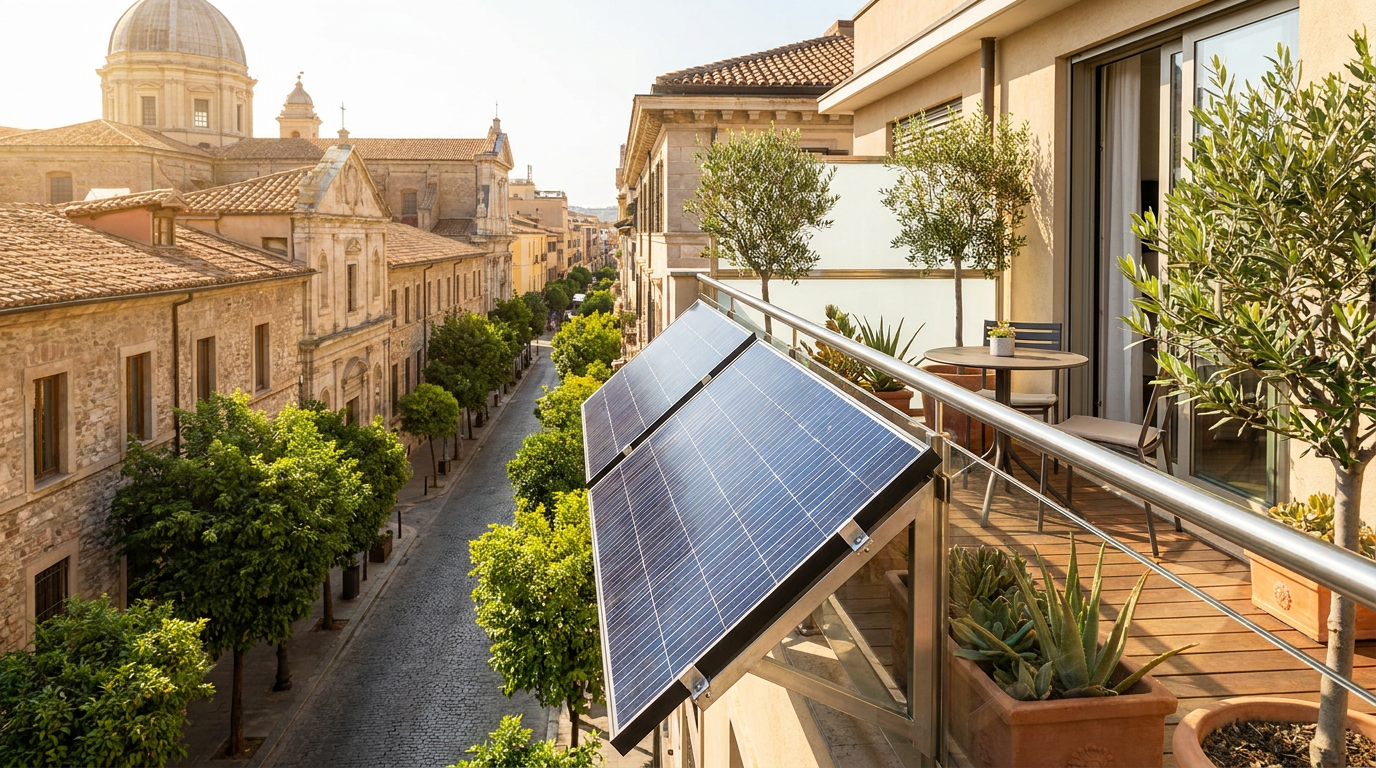
That paradigm is rapidly shifting thanks to the explosion of "balcony solar"—compact, plug-and-play photovoltaic kits designed for tool-free self-installation. Across Europe, and increasingly in the United States, these do-it-yourself systems are democratizing access to green energy, allowing anyone with a sunny railing or patio to become a micro-generator of electricity.[2][3]
The epicenter of this movement is Germany, where over one million balcony systems are already registered and operating. The concept, known locally as "Balkonkraftwerk" (balcony power plant), has become so ubiquitous that it is fundamentally reshaping the country's urban energy grid. Driven by streamlined regulations and a desire for energy independence following the 2022 European energy crisis, German renters have embraced the technology en masse.[1][2][4]
The core appeal of balcony solar lies in the sheer simplicity of its mechanism. Unlike traditional rooftop arrays that require permanent structural mounting and dangerous high-voltage wiring, a plug-and-play system operates much more like a standard household appliance. It is designed specifically for consumers with no electrical background.[4][6]
A standard kit consists of one to four lightweight solar panels, mounting brackets, and a crucial piece of hardware known as a microinverter. While solar panels generate direct current (DC) electricity from sunlight, household appliances run on alternating current (AC). The microinverter's job is to instantly convert that DC power into usable AC power before it ever enters the home.[3][7]

The installation process is remarkably straightforward. The user mounts the panels to a balcony railing, patio fence, or garden stand using secure, drill-free brackets. They then connect the cables from the panels to the microinverter, and simply plug the microinverter's output cord directly into a standard 120-volt (or 240-volt in Europe) outdoor wall socket.[3][7]
Once plugged in, the microinverter synchronizes with the home's grid frequency. The generated electricity flows backward through the outlet and directly into the home's circuitry. Because electricity follows the path of least resistance, the home's appliances will naturally consume this free solar power first, only drawing additional power from the utility grid if the solar output is insufficient.[3][5]
It is important to understand that balcony solar acts as a "load reducer" rather than a full-scale generator. While a massive rooftop system might produce 5,000 to 9,000 watts to power an entire house, a balcony kit typically ranges from 400 to 800 watts. This is just enough to offset the baseline electricity consumed by "always-on" appliances like refrigerators, Wi-Fi routers, and standby electronics.[3][5][6]
It is important to understand that balcony solar acts as a "load reducer" rather than a full-scale generator.
Financially, the math is highly compelling for urban dwellers. A basic 400-watt to 800-watt kit costs between $500 and $1,500, with zero installation fees. Depending on local electricity rates and sun exposure, these systems can shave 10% to 30% off a typical apartment's monthly utility bill. In markets with high energy costs, the hardware often pays for itself within three to six years.[1][3]
The trend is now spilling well beyond Germany's borders. Spain, Italy, France, and Belgium are seeing rapid adoption as manufacturers flood the market with turnkey kits. In Spain, where the technology is just beginning to heat up, suppliers note that the flexibility and lack of installation costs are driving unprecedented interest among renters.[1][2]
However, the United States has historically lagged far behind Europe in adopting this technology. The delay stems from a complex patchwork of strict municipal electrical codes and utility interconnection rules that effectively banned direct plug-in generation, requiring homeowners to file extensive paperwork just to offset a fraction of their power.[2][5]

That regulatory wall is finally cracking in 2026. Over 30 U.S. states have introduced legislation to legalize plug-in solar. Utah and Virginia have led the charge by passing laws that explicitly exempt small systems—typically under 1,200 watts—from complex utility approvals, clearing the way for renters to plug in without fear of utility penalties.[3][5]
The true turning point for the U.S. market arrived in January 2026 with the introduction of UL 3700, a rigorous new safety standard specifically designed for plug-in photovoltaic equipment. Developed by UL Solutions, this certification provides the technical foundation that cautious U.S. regulators have been waiting for.[5][8]
UL 3700 addresses the core safety concern of utility companies: ensuring that the microinverter features fail-safe "anti-islanding" protection. This mechanism guarantees that if the main power grid goes down during a storm, the solar system instantly shuts off. This prevents the panels from feeding live electricity back into the grid and endangering utility crews working to repair downed lines.[4][8]
Despite the global momentum, regulatory uncertainties remain in several major markets. In the United Kingdom, for example, direct plug-in systems are still largely prohibited under current microgeneration rules. While residents can purchase the panels, they are legally required to hire a certified electrician to hardwire the connection via a fused spur, negating the DIY appeal.[2][7]

Furthermore, the physical reality of balcony solar comes with strict limitations. The system is highly dependent on orientation and shading. A north-facing balcony, or one heavily shaded by neighboring high-rises or trees, will yield negligible power, extending the financial payback period indefinitely and frustrating users who expected immediate savings.[4]
There are also aesthetic and structural hurdles to navigate. Some homeowner associations (HOAs) and landlords continue to push back against visible solar panels on building exteriors. They frequently cite architectural guidelines or express liability concerns over improperly secured hardware falling from high floors during severe windstorms.[2]
To address these concerns, the next generation of balcony solar hardware is evolving rapidly. Manufacturers are introducing drill-free, wind-tunnel-tested mounting brackets that satisfy strict building codes. Additionally, many new kits now integrate small, modular lithium-iron-phosphate (LiFePO4) batteries, allowing users to store excess daytime energy for use during peak evening hours when electricity rates are highest.[1][5]
Ultimately, while balcony solar will not single-handedly solve the climate crisis or take entire cities off the grid, it represents a profound psychological shift. It transforms passive energy consumers into active participants, proving that the renewable transition is no longer an exclusive club for those who own a roof.[4]
How we got here
2019
Germany streamlines utility connection rules, sparking the initial boom in European balcony solar adoption.
2022
The European energy crisis drives a massive spike in electricity rates, accelerating the demand for DIY solar kits across the continent.
March 2025
Utah becomes the first U.S. state to pass a dedicated law explicitly legalizing plug-in solar systems under 1,200 watts.
January 2026
UL Solutions launches UL 3700, the first dedicated American safety standard for plug-in photovoltaic equipment.
Viewpoints in depth
Urban Renters & DIY Advocates
View balcony solar as a vital tool for democratizing energy and lowering living costs.
For renters and apartment dwellers, plug-and-play solar represents the first real opportunity to participate in the renewable energy transition. Advocates argue that traditional solar policies have unfairly subsidized wealthy homeowners while leaving renters exposed to volatile utility rates. By removing the need for professional installation and complex permitting, balcony solar empowers individuals to take immediate, tangible action to reduce their carbon footprint and lower their monthly bills, regardless of whether they own the building.
Utility Regulators & Safety Officials
Prioritize grid stability and fire safety over rapid adoption.
Utility companies and electrical safety boards approach plug-in solar with caution. Their primary concern is the risk of unregulated backfeeding—where a DIY system pumps live electricity into the grid during a blackout, potentially electrocuting line workers. Regulators argue that without strict enforcement of standards like UL 3700 and mandatory anti-islanding technology, the mass adoption of uncertified, direct-plug devices could overload local circuits, cause electrical fires, and destabilize neighborhood power grids.
Traditional Solar Installers
See balcony solar as a niche product with severe limitations compared to whole-home systems.
Professionals in the established solar industry often view balcony kits as a stepping stone rather than a comprehensive energy solution. They point out that a 600-watt balcony setup will barely dent the energy demands of a modern household running air conditioning or charging an electric vehicle. Installers emphasize that while plug-and-play is great for offsetting a refrigerator's power draw, true energy independence still requires the scale, battery integration, and optimized roof placement that only a professionally hardwired system can provide.
What we don't know
- How quickly U.S. utility companies will update their local interconnection rules to align with new state laws legalizing plug-in solar.
- Whether homeowner associations (HOAs) will successfully block tenants from mounting panels on exterior railings due to aesthetic guidelines.
- How the integration of cheap, modular battery storage will change the payback period for small-scale balcony systems in the coming years.
Key terms
- Microinverter
- A small device attached to a solar panel that converts the direct current (DC) electricity generated by the sun into the alternating current (AC) electricity used by household appliances.
- Anti-islanding
- A critical safety feature that forces a solar inverter to shut down immediately if the main power grid fails, preventing the system from feeding live electricity into downed power lines.
- Plug-in Photovoltaics (PIPV)
- The technical term for solar systems designed to connect to a home's electrical grid simply by plugging into a standard wall socket.
- Alternating Current (AC)
- The standard type of electricity that flows from wall outlets and powers typical household appliances.
Frequently asked
Do I need an electrician to install balcony solar?
In most regions where it is legal, no. The systems are designed for tool-free DIY installation and plug directly into a standard wall outlet.
Can a balcony solar kit power my whole apartment?
No. A typical 400-800W kit acts as a load reducer, generating enough power to offset 'always-on' appliances like your refrigerator and Wi-Fi router, but not high-draw items like air conditioners.
What happens during a power outage?
For safety reasons, grid-tied microinverters automatically shut down during a blackout to prevent backfeeding electricity into the grid. You will not have power unless your kit includes a dedicated off-grid battery.
Can I take the system with me if I move?
Yes. Because the panels are mounted with removable brackets and plug into a standard socket, they are fully portable and ideal for renters.
Sources
Source coverage
8 outlets
3 viewpoints surfaced








[1]The GuardianTraditional Solar Industry
Spain's balcony scene heats up as country embraces DIY plug-in solar panels
Read on The Guardian →[2]ConsumerAffairsGrid Safety Regulators
Will 'balcony solar' catch on in the US?
Read on ConsumerAffairs →[3]EnergySageTraditional Solar Industry
Plug-in & balcony solar panels: Are they worth it?
Read on EnergySage →[4]HackadayDIY Solar Advocates
Balcony Solar Power: The DIY Revolution
Read on Hackaday →[5]Now.SolarDIY Solar Advocates
Balcony solar steps into the American mainstream
Read on Now.Solar →[6]Solar United NeighborsDIY Solar Advocates
Plug-in solar: A simple, reliable way to save money
Read on Solar United Neighbors →[7]Switch Together UKGrid Safety Regulators
Balcony, Mini and Plug-In PV Explained
Read on Switch Together UK →[8]UL SolutionsGrid Safety Regulators
UL 3700: Outline of Investigation for Interactive Plug-In Photovoltaic Equipment
Read on UL Solutions →
Every angle. Every day.
Get home stories with full source coverage and perspective breakdowns delivered to your inbox.