
The Global Boom in Adaptive Reuse: How Empty Offices Are Becoming Green Housing
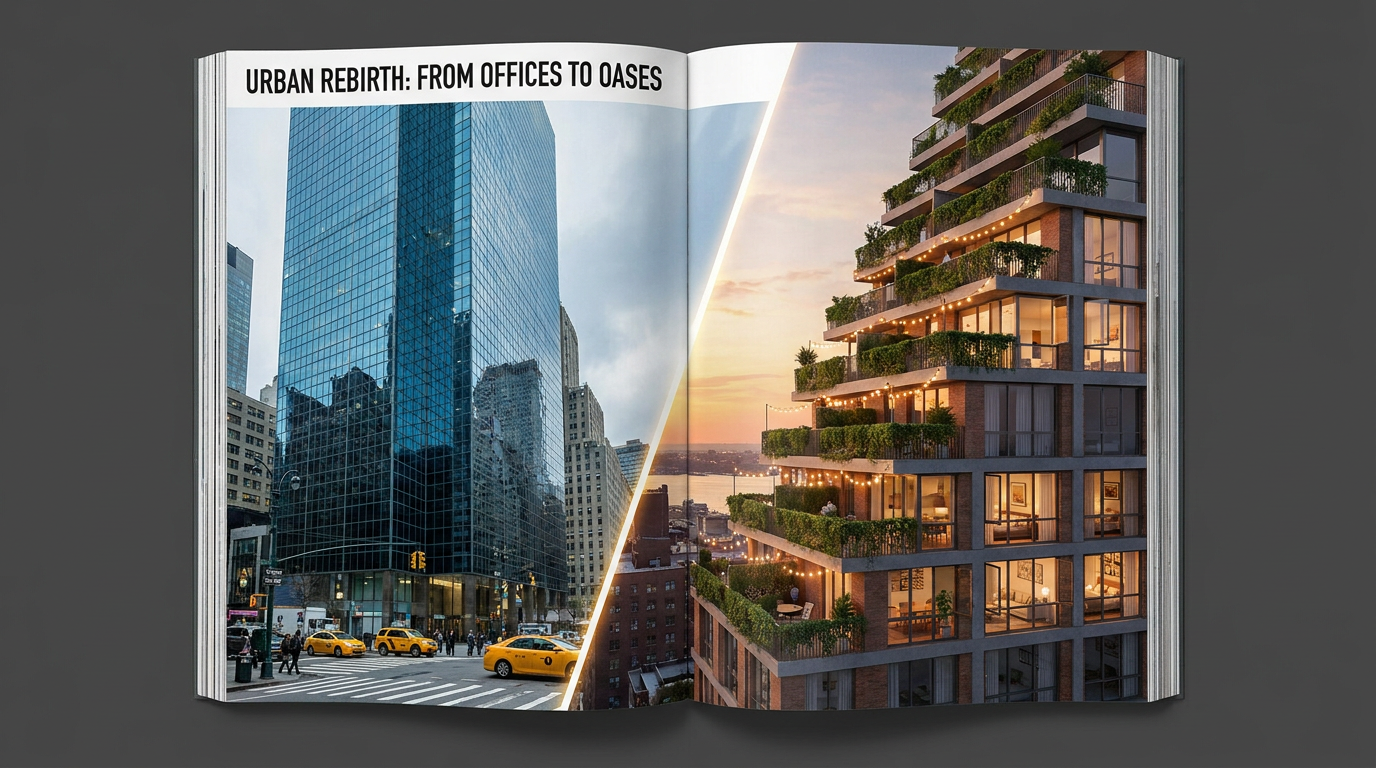
A record 90,300 apartment units are currently in the office-to-residential conversion pipeline, as cities and developers race to transform vacant commercial towers into vibrant neighborhoods.
By Factlen Editorial Team
- Commercial Developers
- Focused on unlocking asset value and navigating the financial complexities of retrofits.
- Urban Planners & Policymakers
- Focused on revitalizing hollowing downtowns and generating new tax revenue.
- Architects & Engineers
- Focused on the physical feasibility and sustainable design of building transformations.
What's not represented
- · Existing Commercial Tenants
- · Affordable Housing Advocates
Why this matters
As remote work leaves millions of square feet of office space vacant, converting these towers into apartments is simultaneously addressing the national housing shortage and saving downtowns from economic decline. For urban residents, this trend promises more vibrant, 24/7 neighborhoods, while offering a blueprint for sustainable, low-carbon city living.
Key points
- The U.S. pipeline for office-to-residential conversions hit a record 90,300 units in 2026.
- Office conversions now make up 47% of all planned adaptive reuse projects nationwide.
- Roughly 24% of the national office inventory is structurally suitable for residential adaptation.
- A looming $213 billion in maturing commercial debt is forcing owners to reposition empty assets.
- Conversions preserve embodied carbon, making them a highly sustainable alternative to new construction.
- Cities are offering tax abatements to encourage the creation of 24/7 mixed-use neighborhoods.
The American downtown is undergoing its most profound physical transformation in a century. Driven by persistent shifts in remote work and a chronic national housing shortage, the movement to convert empty office towers into residential apartments has officially evolved from a niche architectural experiment into a market-defining boom. What began as a desperate measure to salvage distressed commercial assets has matured into a sophisticated urban renewal strategy, fundamentally altering how cities plan for the future.[1][4]
According to a comprehensive March 2026 report by RentCafe, the pipeline for office-to-residential conversions has shattered previous records, reaching 90,300 planned apartment units nationwide. This represents a 28% jump from last year and a staggering fourfold increase since 2022. The sheer volume of these projects indicates that developers have cracked the code on financing and executing these complex retrofits at scale.[4][5]
"The long-promised dream of adaptive conversion for some of the country's financially unviable office properties continues to gain momentum," notes the Scotsman Guide. Today, office conversions account for 47% of all adaptive reuse projects in the United States, far outpacing hotel and industrial repurposing. This shift highlights a broader realization that the mid-century model of the single-use central business district is no longer aligned with modern economic realities.[1][5]

The geography of this boom is heavily concentrated in major metropolitan hubs that have struggled with high commercial vacancy rates since the pandemic. New York City leads the nation with over 16,300 units in the pipeline, followed closely by Washington, D.C., Chicago, and Los Angeles. However, the trend is rapidly expanding into Sunbelt cities like Dallas and Atlanta, proving that the conversion model has broad geographic viability beyond the traditional coastal megacities.[4]
But turning a 1980s commercial high-rise into a modern residential community is not as simple as erecting drywall and installing kitchens. The physical anatomy of an office building dictates its destiny. Deep, sprawling floorplates—common in modern commercial architecture designed for cubicle farms—are notoriously difficult to convert because residential building codes strictly require every bedroom to have a window for natural light and egress.[6][7]
As a result, older, narrower buildings constructed before the 1980s are often the most viable candidates for these transformations. The architectural firm Gensler, which has analyzed over 1,300 office buildings for conversion potential, estimates that roughly 24% of the national office inventory—amounting to about 1.9 billion square feet—is structurally suitable for residential adaptation. Identifying these "Goldilocks" buildings is the first critical step in any successful adaptive reuse project.[1][6]
For the buildings that do qualify, the engineering challenges remain immense and capital-intensive. Developers must core through thick concrete floors to install hundreds of new plumbing lines, upgrade electrical grids to handle individual residential metering, and replace centralized commercial HVAC systems with localized climate control. In some of the most ambitious projects, developers are carving massive "lightwells" straight through the center of deep buildings to bring natural light and fresh air into interior units.[4][6]
Despite these steep construction costs, the financial calculus for developers is finally aligning in 2026. The primary catalyst is a looming wall of commercial debt. Roughly $213 billion in U.S. office loans is scheduled to mature by the end of the year. With physical occupancy in many older buildings hovering between 50% and 55%, owners are facing a stark choice: default on their loans, or radically reposition the asset to generate new revenue streams.[1][4]

Despite these steep construction costs, the financial calculus for developers is finally aligning in 2026.
"With transactions subdued and development limited, the industry is turning to conversions, retrofits and repositioning strategies to drive income and unlock value," reports PERE News. Downtown luxury residential rents can now significantly outperform office income on a per-square-foot basis, making the massive upfront capital expenditure justifiable over the long term. Successful conversion projects are now being underwritten with the same rigor as ground-up development deals.[2]
Furthermore, the macroeconomic environment in 2026 is providing a much-needed tailwind for these capital-intensive projects. Following years of elevated borrowing costs, interest rates have stabilized, unlocking fresh capital for complex redevelopment initiatives. Kevin Thorpe, chief economist at Cushman & Wakefield, notes that "confidence in the CRE sector is building" as capital flows resume and leasing fundamentals stabilize, allowing investors to take calculated risks on adaptive reuse.[8]
Beyond the balance sheets, these conversions are actively reshaping the social fabric of cities. The Urban Land Institute argues that single-use office districts are no longer viable, and that injecting residential life into downtowns is essential for long-term urban survival. By transforming 9-to-5 ghost towns into vibrant 24/7 neighborhoods, cities are restoring critical foot traffic for local retailers, supporting public transit, and generating new, stable tax revenue.[7]
There is also a significant equity component to the conversion wave. A March 2026 study by the Brookings Institution simulated the demographic impacts of office-to-residential conversions in six major cities. The researchers found that, when paired with the right municipal policies, these projects can affirmatively further fair housing by introducing mixed-income populations into historically exclusive commercial districts that previously lacked residential options.[3]
However, the Brookings report cautions that adaptive reuse is not a silver bullet for the broader housing crisis. "In most market contexts, O2R conversion in one submarket is a niche production strategy that does not match the scale of the housing crisis," the authors note. While it is a vital tool for urban renewal and neighborhood stabilization, it must be paired with aggressive new-construction strategies to fully address the national housing shortfall.[3]

The success of these projects also hinges heavily on municipal cooperation and regulatory flexibility. Because commercial zones rarely permit residential use by right, developers often face a labyrinth of zoning variances and permitting delays. Cities that are successfully accelerating conversions—such as Washington, D.C., and Chicago—have streamlined their approval processes and offered targeted tax abatements to offset the high costs of infrastructure retrofits.[1][7]
Environmental sustainability is another major driver propelling the adaptive reuse trend. Converting an existing building preserves its "embodied carbon"—the massive amount of greenhouse gas emissions originally generated to manufacture and install its steel and concrete. By avoiding demolition and ground-up construction, developers are drastically reducing the carbon footprint of new housing, making these projects highly attractive to ESG-focused investors.[2]
To fund these sustainable conversions, developers are increasingly tapping into specialized financial instruments. Lower financing costs for energy-efficient assets and green bonds are emerging as crucial tools in the capital stack. As climate resilience becomes a mandate rather than an option, the ability to market a building as a low-carbon, adaptive reuse project provides a significant competitive advantage in attracting both institutional capital and eco-conscious tenants.[2]

As the pipeline of 90,300 units moves from blueprints to reality, property management firms are also having to adapt their operational models. Operating a residential high-rise requires entirely different software, staffing, and community management strategies than running a corporate headquarters. The transition from managing commercial leases to fostering a residential community is a complex operational pivot that requires significant retraining and technological upgrades.[4]
Ultimately, the transformation of the American downtown in 2026 is a profound testament to the resilience of cities. Faced with the obsolescence of millions of square feet of workspace, urban centers are not hollowing out; they are actively reinventing themselves. By turning the monuments of the 20th-century corporate economy into the vibrant, mixed-use neighborhoods of the 21st century, the real estate industry is helping to forge a more dynamic, livable, and sustainable urban future.[1][2][7]
How we got here
March 2020
The global shift to remote work empties central business districts, triggering a crisis in commercial real estate.
Late 2022
Early pilot conversions begin in cities like New York and Washington D.C. as office vacancies become permanent.
2024 - 2025
Municipalities begin passing zoning reforms and tax abatements to incentivize adaptive reuse.
Early 2026
The conversion pipeline hits a record 90,300 units, driven by maturing commercial debt and stabilized interest rates.
Viewpoints in depth
Urban Planners & Policymakers
Focused on revitalizing hollowing downtowns and generating new tax revenue.
City officials and urban planners view adaptive reuse as a lifeline for central business districts that have struggled since the shift to remote work. By converting single-use corporate zones into 24/7 mixed-use neighborhoods, municipalities hope to restore foot traffic for local retail, stabilize property tax bases, and introduce mixed-income housing into historically exclusive areas.
Commercial Developers
Focused on unlocking asset value and navigating the financial complexities of retrofits.
For developers and property owners, conversions are primarily a financial calculus driven by necessity. Facing a massive wave of maturing debt and persistently low office occupancy, owners are utilizing stabilized interest rates and green financing to reposition distressed assets. Their primary hurdles are securing zoning variances and managing the steep capital expenditures required for infrastructure overhauls.
Architects & Engineers
Focused on the physical feasibility and sustainable design of building transformations.
The design community emphasizes that not every office tower can become a home. Architects are pioneering creative solutions—like carving massive central lightwells and designing modular plumbing cores—to overcome the constraints of deep commercial floorplates. They also champion the environmental benefits of conversions, noting that reusing a building's structural frame saves thousands of tons of embodied carbon compared to new construction.
What we don't know
- Whether the influx of luxury residential units in downtown cores will eventually outpace demand, leading to a new type of vacancy.
- How effectively cities will mandate affordable housing minimums within these high-cost conversion projects.
- The long-term performance of localized HVAC and plumbing retrofits squeezed into legacy commercial infrastructure.
Key terms
- Adaptive Reuse
- The process of repurposing an existing building for a use other than what it was originally designed for, such as turning an office into apartments.
- Floorplate
- The total leasable square footage of a single floor in a commercial building, which dictates how easily apartments can be laid out with window access.
- Lightwell
- An unroofed external space carved into the volume of a large, deep building to allow natural light and air to reach interior residential units.
- Embodied Carbon
- The total greenhouse gas emissions generated by the manufacturing, transportation, and installation of building materials, which is preserved when a structure is reused rather than demolished.
- Class A Space
- The highest quality, most modern office spaces on the market, which are currently retaining corporate tenants while older buildings empty out.
Frequently asked
What makes an office building suitable for residential conversion?
Buildings with narrower floorplates, high ceilings, and pre-1980s architecture are generally the best candidates, as they allow for easier access to natural light and simpler plumbing retrofits.
Will office conversions solve the national housing shortage?
While they provide a crucial influx of units in dense urban cores, experts view conversions as a niche strategy that must be combined with broader new-construction efforts to fully address the housing crisis.
Why is there a sudden surge in conversions in 2026?
A combination of stabilized interest rates, increased municipal tax incentives, and a looming $213 billion wall of maturing commercial office debt is forcing owners to reposition their empty assets.
Are conversions cheaper than building from scratch?
Not necessarily. While they save on the structural frame and reduce carbon emissions, the complex engineering required to retrofit plumbing, electrical, and HVAC systems can make conversions nearly as expensive as ground-up development.
Sources
Source coverage
8 outlets
3 viewpoints surfaced








[1]Scotsman GuideArchitects & Engineers
Office-to-residential conversions gain traction
Read on Scotsman Guide →[2]PERE NewsCommercial Developers
Adaptive reuse moves to the forefront of value creation
Read on PERE News →[3]Brookings InstitutionUrban Planners & Policymakers
Simulating the impacts of office-to-residential conversion on neighborhood racial demographics
Read on Brookings Institution →[4]KardinCommercial Developers
The pipeline just broke another record: Office conversions surge 28%
Read on Kardin →[5]RentCafeArchitects & Engineers
Adaptive Reuse Report: Office-to-Apartment Conversions Hit Record High
Read on RentCafe →[6]GenslerArchitects & Engineers
Office-to-Residential Conversions: Unlocking Urban Resilience
Read on Gensler →[7]Urban Land InstituteUrban Planners & Policymakers
The Future of American Downtowns
Read on Urban Land Institute →[8]Cushman & WakefieldCommercial Developers
U.S. Real Estate Market Outlook 2026
Read on Cushman & Wakefield →
Every angle. Every day.
Get real estate stories with full source coverage and perspective breakdowns delivered to your inbox.