
The Science of Sleep Trackers: What Oura, Whoop, and Apple Watch Actually Measure
Consumer sleep wearables have made massive leaps in accuracy, but clinical data shows they still excel at different things. Here is what the latest polysomnography validation studies reveal about the top devices.
By Factlen Editorial Team
- Quantified Self Advocates
- Data-driven consumers value the continuous, longitudinal insights that wearables provide over months and years.
- Performance Athletes
- Fitness-focused users prioritize actionable recovery coaching and strain management over pure sleep staging accuracy.
- Clinical Sleep Specialists
- Medical professionals emphasize that wearables are screening tools, not diagnostic replacements for laboratory sleep studies.
What's not represented
- · Budget-conscious consumers priced out of subscription-based wearables
- · Individuals with diagnosed sleep disorders whose data breaks standard algorithms
Why this matters
Understanding the clinical accuracy of these devices prevents you from stressing over a single bad 'sleep score' and helps you choose the right tool for your specific health goals, saving you hundreds of dollars.
Key points
- Consumer wearables excel at basic sleep/wake detection, achieving 85–95% accuracy compared to clinical sleep studies.
- Four-stage sleep classification remains challenging, with devices often underestimating deep sleep and brief awakenings.
- The Oura Ring currently leads independent clinical validation for sleep staging due to the stronger pulse signal found in the finger.
- Apple Watch provides the most versatile daytime ecosystem, while Whoop excels at translating sleep data into athletic recovery coaching.
- No consumer device replaces polysomnography for diagnosing medical sleep disorders like apnea or insomnia.
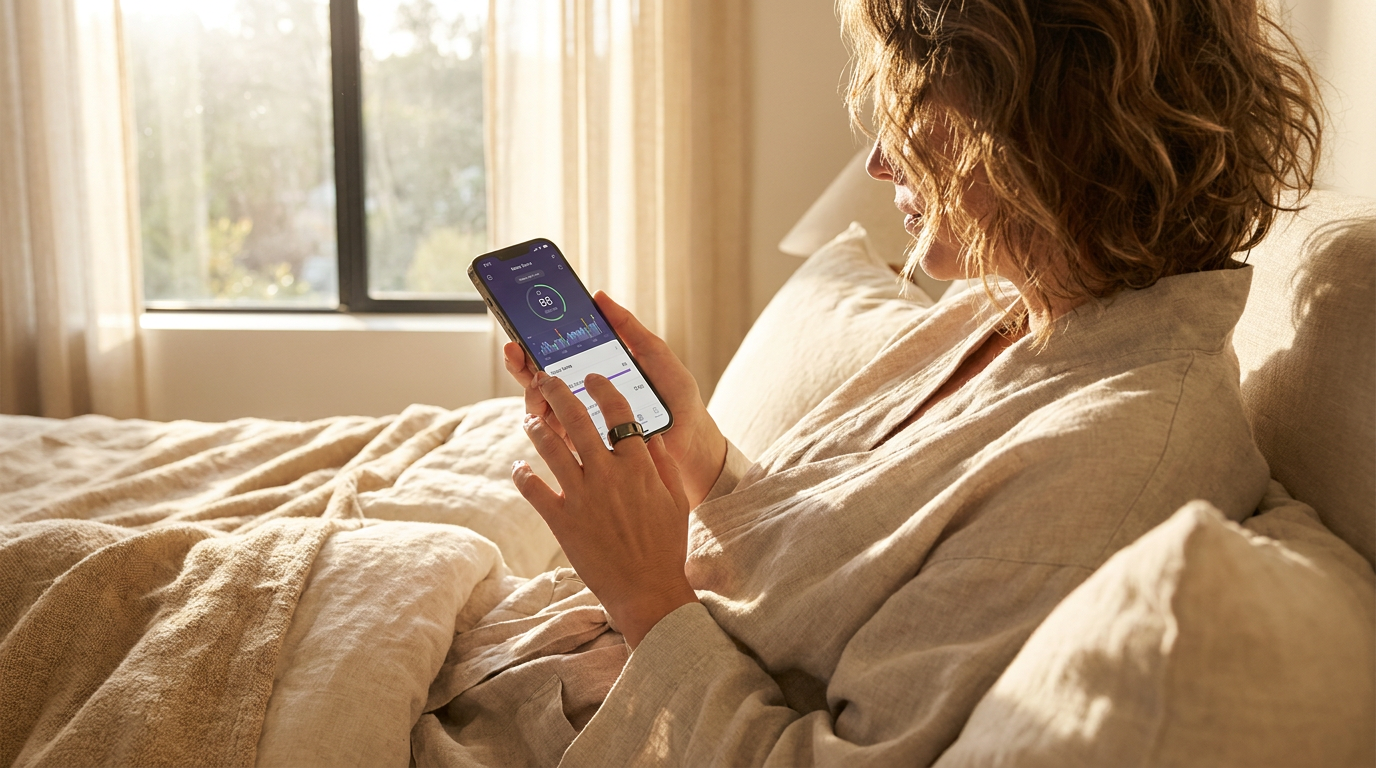
The morning routine has fundamentally changed for millions of people. Before their feet even touch the floor, they reach for their phone to check a number that dictates how they should feel. A sleep score of 88 promises boundless energy, while a 54 signals a day of cognitive fog. Consumer sleep trackers—led by the Oura Ring, Whoop, and Apple Watch—have transformed sleep from a passive biological necessity into a measurable, gamified performance metric. But as these devices increasingly influence our daily decisions, a critical question remains: how much of this data is actually grounded in clinical reality?[7]
To understand what consumer wearables get right, it is essential to understand how they work. The clinical gold standard for measuring sleep is polysomnography (PSG), a laboratory test that uses electroencephalography (EEG) to monitor actual brainwave activity. Brainwaves are the only definitive way to distinguish between light sleep, deep sleep, and rapid eye movement (REM) sleep. Consumer devices do not measure brainwaves. Instead, they rely on a combination of photoplethysmography (PPG)—optical sensors that track blood volume changes to determine heart rate—and accelerometers that measure physical movement.[4][5]
By combining heart rate variability, respiratory rate, and motion, these algorithms make highly educated guesses about what the brain is doing. The evidence shows that for basic binary questions, these guesses are remarkably accurate. When it comes to simple sleep-wake detection—knowing whether you are asleep or awake—modern consumer wearables achieve between 85 and 95 percent sensitivity compared to clinical PSG.[4]

In recent independent testing, the Apple Watch Series 11 demonstrated exceptional precision in this specific area. During a clinical sleep study comparison conducted alongside Stanford Health Care's Sleep Medicine Center, the Apple Watch clocked the user's exact sleep duration down to the minute, matching the laboratory results perfectly. For users who simply want to know how many hours they spent unconscious, almost any premium device on the market today will provide a reliable baseline.[3][7]
The accuracy gap widens significantly, however, when devices attempt four-stage sleep classification. Differentiating between light sleep, deep sleep, REM, and brief awakenings without EEG data pushes optical sensors to their technical limits. Clinical validation studies consistently show that consumer trackers struggle to perfectly map these stages, generally achieving moderate agreement with PSG—often hovering between 60 and 79 percent accuracy.[4][5]
A common algorithmic quirk across the industry is a tendency to underestimate deep sleep and misclassify brief nighttime awakenings. Studies indicate that wearables frequently underestimate 'Wake After Sleep Onset' (WASO) by anywhere from 12 to 48 minutes per night. Because the devices rely heavily on stillness to infer sleep, lying completely motionless while awake can easily trick the algorithm into logging light sleep.[4][6]
Despite these inherent limitations, clear leaders have emerged in the pursuit of staging accuracy. In recent peer-reviewed validation studies, the Oura Ring Generation 4 consistently outperformed wrist-based competitors in four-stage sleep classification. In a 2024 study conducted at Brigham and Women's Hospital, the Oura Ring achieved a 79.5 percent sensitivity for deep sleep detection, the highest among the consumer devices tested.[5]
Despite these inherent limitations, clear leaders have emerged in the pursuit of staging accuracy.
The Oura Ring's advantage is largely anatomical rather than purely algorithmic. Arteries in the finger sit much closer to the skin's surface than the blood vessels in the wrist. This proximity provides the ring's optical sensors with a significantly cleaner blood-volume-pulse signal. Furthermore, the finger experiences far less incidental motion artifact during the night than a heavy smartwatch strapped to the wrist, resulting in fewer data gaps.[6]

In a 2025 independent validation study analyzing 536 nights of sleep data, the Oura Ring matched the medical gold standard for overnight heart rate variability with a Concordance Correlation Coefficient (CCC) of 0.99—essentially a 99 percent match with an electrocardiogram (ECG). For users prioritizing the absolute highest fidelity of passive overnight data, the ring form factor currently holds the scientific edge.[1][6]
Yet, raw accuracy is only one half of the wearable equation; the other is actionability. This is where Whoop 5.0 differentiates itself. While Whoop's four-stage sleep classification trails slightly behind Oura in some independent clinical trials, its platform is purpose-built for behavioral change. Whoop does not just present a sleep score; it integrates overnight metrics into a comprehensive 'Strain and Recovery' loop.[1][5][6]
For performance athletes, knowing the exact minute REM sleep began is often less useful than knowing how hard they can push their cardiovascular system the following day. Whoop excels at this translation, using overnight heart rate variability and respiratory rate to prescribe specific exertion targets. The device's tighter wrist fit and advanced motion compensation also make it vastly superior for tracking active heart rate during intense daytime workouts, an area where smart rings physically struggle.[1][3][6]

The Apple Watch occupies a unique middle ground. While it may not offer the hyper-detailed recovery coaching of Whoop or the specialized staging accuracy of Oura, it remains the most versatile health ecosystem available. Apple does not gatekeep its core sleep data behind a monthly subscription fee—a significant financial advantage over both Oura and Whoop, which require ongoing memberships that can exceed $200 annually.[1][3][5]
Furthermore, Apple has leveraged its massive user base to secure FDA clearance for specific screening tools, such as sleep apnea detection. By tracking microscopic wrist movements associated with breathing disturbances over a 30-day period, the Apple Watch can flag potential respiratory issues that a user might never notice on their own.[3]
This distinction between screening and diagnosing is crucial. Sleep specialists emphasize that no consumer wearable—regardless of its price tag or sensor array—is a medical diagnostic device. A smartwatch cannot diagnose clinical insomnia, restless leg syndrome, or sleep apnea. They are pattern recognition tools designed to highlight anomalies, not replace a physician's evaluation.[4][7]

The true power of these devices lies in longitudinal tracking rather than nightly perfection. If a tracker consistently underestimates deep sleep by 20 minutes, the absolute number is less important than the trend. When a user drinks alcohol before bed and watches their wearable report a 30 percent drop in heart rate variability and a spike in resting heart rate, the behavioral feedback loop is immediate and effective.[6][7]
Ultimately, the 'best' sleep tracker depends entirely on the problem the user is trying to solve. For the quantified-self enthusiast seeking the cleanest overnight biometric data, the Oura Ring is the clinical frontrunner. For the athlete looking to balance training load with recovery, Whoop provides the most actionable coaching. And for the general consumer who wants reliable sleep-wake detection seamlessly integrated into their daily life, the Apple Watch remains the most practical choice.[1][5][7]
As sensor technology continues to miniaturize and machine learning algorithms train on ever-larger datasets, the gap between consumer wearables and clinical polysomnography will continue to narrow. Until then, users are best served by treating their morning sleep scores not as an absolute medical truth, but as a highly educated compass pointing them toward better health habits.[4][7]
How we got here
2015
The first generation of basic accelerometer-based sleep trackers hits the mainstream market.
2018
Oura launches its Generation 2 ring, introducing advanced PPG sensors to the ring form factor.
2020
Apple officially introduces native sleep tracking to the Apple Watch with the release of watchOS 7.
2024
The FDA clears the Apple Watch Series 9 and 10 for sleep apnea detection capabilities.
2025
Independent clinical studies confirm the Oura Ring 4 matches ECG accuracy for overnight heart rate variability.
Viewpoints in depth
Clinical Sleep Specialists
Medical professionals emphasize that wearables are screening tools, not diagnostic replacements for laboratory sleep studies.
For sleep medicine physicians, the gold standard remains polysomnography (PSG), which measures actual brainwave activity via EEG. They caution that because consumer wearables rely on proxy metrics like heart rate and movement, they inherently struggle with precise sleep staging. While specialists acknowledge the value of wearables in highlighting broad behavioral trends—such as the negative impact of alcohol on resting heart rate—they warn against 'orthosomnia,' a condition where users develop severe anxiety over achieving perfect sleep scores based on flawed data.
Quantified Self Advocates
Data-driven consumers value the continuous, longitudinal insights that wearables provide over months and years.
This camp argues that a device does not need to be perfectly aligned with clinical PSG to be highly effective. If a tracker consistently underestimates deep sleep by 20 minutes every night, the absolute number matters less than the baseline trend. By providing a continuous stream of data on heart rate variability, temperature, and resting heart rate, these devices allow users to run personal experiments—testing how meal timing, room temperature, or specific supplements impact their physiological recovery in ways a single night in a sleep lab never could.
Performance Athletes
Fitness-focused users prioritize actionable recovery coaching and strain management over pure sleep staging accuracy.
For athletes, sleep data is only valuable if it dictates how they should train the next day. This perspective favors platforms like Whoop, which may trail slightly in raw sleep staging accuracy but excel at synthesizing overnight biometrics into a clear 'readiness' or 'recovery' score. Athletes rely on this data to prevent overtraining, manage cardiovascular strain, and optimize their performance peaks, viewing the wearable not just as a passive monitor, but as an active digital coach.
What we don't know
- Whether upcoming algorithm updates will significantly improve deep sleep detection without requiring new hardware sensors.
- How the long-term psychological impact of daily 'sleep scores' affects natural sleep confidence in the general population.
- The exact proprietary algorithms each company uses to weight movement versus heart rate when classifying sleep stages.
Key terms
- Polysomnography (PSG)
- The clinical gold standard for sleep testing, which uses EEG sensors to measure actual brainwave activity alongside breathing and heart rate.
- Photoplethysmography (PPG)
- The optical sensor technology used in wearables that shines light into the skin to measure blood flow and heart rate.
- Heart Rate Variability (HRV)
- The variation in time between consecutive heartbeats, used by trackers as a primary indicator of physical recovery and nervous system stress.
- Wake After Sleep Onset (WASO)
- The total amount of time spent awake after initially falling asleep, a metric that consumer wearables often underestimate.
- Concordance Correlation Coefficient (CCC)
- A statistical measure used in clinical studies to evaluate how closely a wearable's data matches the medical gold standard.
Frequently asked
Can a sleep tracker diagnose sleep apnea?
No. While devices like the Apple Watch have FDA-cleared features to detect breathing disturbances, they are screening tools meant to prompt a doctor's visit, not clinical diagnostic devices.
Why does my tracker say I got so little deep sleep?
Consumer wearables frequently underestimate deep sleep because they rely on heart rate and movement rather than brainwaves (EEG), often misclassifying deep sleep as light sleep.
Do I need a subscription to track my sleep?
It depends on the device. Oura and Whoop require ongoing monthly or annual subscriptions for full data access, while Apple Watch and Garmin provide their core sleep metrics without extra fees.
Is a smart ring more accurate than a smartwatch?
For overnight biometrics, yes. Arteries in the finger sit closer to the skin's surface than those in the wrist, providing a cleaner pulse signal with less motion artifact.
Sources
Source coverage
7 outlets
3 viewpoints surfaced







[1]Men's HealthPerformance Athletes
The Best Sleep Trackers to Optimize Your Slumber
Read on Men's Health →[2]Sleep FoundationPerformance Athletes
Best Sleep Trackers of 2026
Read on Sleep Foundation →[3]9to5MacPerformance Athletes
Apple Watch performs favorably in WSJ health tracker showdown
Read on 9to5Mac →[4]The Longevity StoreClinical Sleep Specialists
What Sleep Trackers Actually Measure
Read on The Longevity Store →[5]Motion Sync HealthQuantified Self Advocates
What the Clinical Data Actually Shows
Read on Motion Sync Health →[6]Elemental HealthQuantified Self Advocates
What the 2026 HRV and Sleep Data Shows
Read on Elemental Health →[7]Factlen Editorial TeamQuantified Self Advocates
Synthesis by Factlen editorial team
Read on Factlen Editorial Team →

Every angle. Every day.
Get shopping stories with full source coverage and perspective breakdowns delivered to your inbox.