
As a New El Niño Begins, Scientists Weigh Evidence of Climate Change Supercharging the Phenomenon
With a potentially record-breaking El Niño declared for mid-2026, researchers are analyzing whether rising global temperatures are fundamentally altering the intensity and mechanics of the climate pattern.
By Factlen Editorial Team
- Impact-Focused Consensus
- Emphasize that regardless of internal ocean mechanics, a warmer baseline temperature and atmosphere guarantee that El Niño's real-world impacts will be more severe.
- Amplification Theorists
- Argue that greenhouse gas forcing is fundamentally altering the mechanics of the Pacific Ocean, increasing the variance and violence of ENSO swings.
- Natural Variability Proponents
- Maintain that the observational record is too short to prove climate change is altering ENSO mechanics, attributing recent extremes to natural decadal noise.
What's not represented
- · Indigenous communities in the Pacific whose traditional weather forecasting methods are being disrupted
- · Agricultural commodities traders pricing in the long-term risk of supercharged ENSO cycles
Why this matters
El Niño fundamentally rewires global weather, driving severe droughts in Australia and catastrophic floods in the Americas. Understanding if human-caused warming is permanently amplifying these cycles is critical for governments, agricultural sectors, and insurers preparing for future climate extremes.
Key points
- Meteorological agencies have officially declared the onset of a new El Niño event for mid-2026.
- Scientists are debating whether climate change is altering the internal mechanics of the ENSO cycle.
- There is strong consensus that higher baseline ocean temperatures make El Niño peaks hotter.
- A warmer atmosphere holds more moisture, amplifying the severe flooding associated with El Niño.
- The 2026 event will provide critical new data to test theories on ENSO variance.
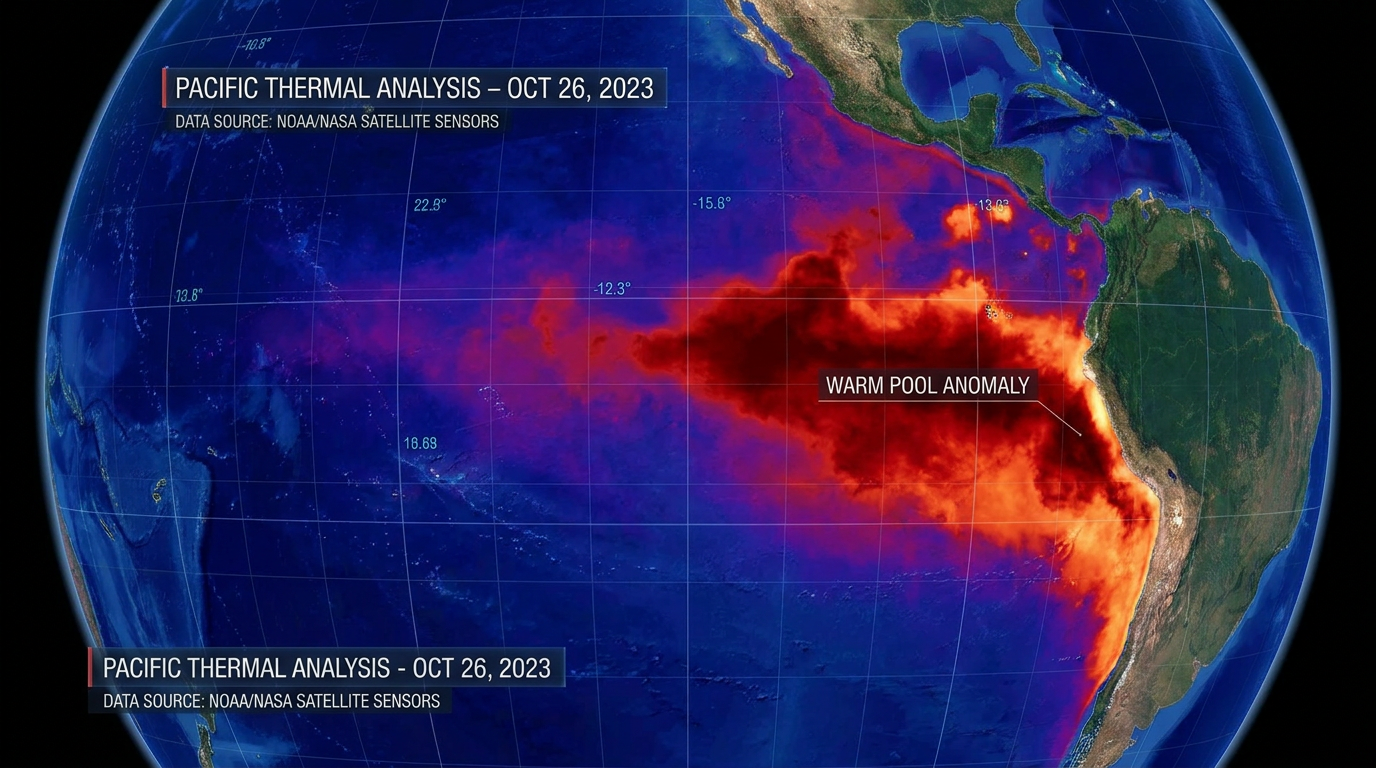
In June 2026, the World Meteorological Organization and the US National Oceanic and Atmospheric Administration officially declared the onset of a new El Niño event. Ocean temperatures in the central and eastern equatorial Pacific have surged past the 0.5-degree Celsius anomaly threshold required to trigger the classification. This rapid warming follows a brief neutral period and has immediately put global meteorological agencies on high alert. Forecasters are already observing atmospheric coupling, where the warming ocean begins to alter wind patterns, locking the climate system into a feedback loop that will dictate global weather for the next nine to twelve months.[2][3][4]
The immediate stakes are immense, as early modeling suggests this event has the potential to rival the record-breaking 'super' El Niños of 1997 and 2015. A severe event fundamentally rewires global precipitation and temperature patterns, typically bringing heavy rainfall to the southern United States and the Horn of Africa, while triggering severe droughts across Australia, Indonesia, and the Amazon basin. Beyond the immediate weather disruptions, the economic toll of a severe El Niño can reach into the trillions of dollars due to agricultural failures, infrastructure damage, and disrupted supply chains.[1][2][4]
However, as this new cycle begins, a profound debate is unfolding within the climate science community: is human-caused climate change fundamentally supercharging the El Niño phenomenon? While El Niño is a naturally occurring cycle that has existed for millennia, researchers are vigorously debating whether the injection of anthropogenic greenhouse gases is altering its underlying mechanics. This is not merely an academic dispute; understanding whether extreme El Niños are the 'new normal' is critical for governments attempting to build resilient infrastructure and secure future food supplies.[1][7]
To understand the debate, one must first look at the baseline mechanics of the El Niño-Southern Oscillation (ENSO). Under normal conditions, strong trade winds blow west across the tropical Pacific, pushing warm surface water toward Asia and allowing cold, nutrient-rich water to upwell off the coast of South America. During an El Niño, these trade winds weaken or even reverse. The pool of warm water sloshes back eastward across the Pacific, capping the cold upwelling and releasing massive amounts of heat and moisture into the atmosphere.[3][7]

The primary claim driving the supercharging hypothesis is that the oceans are already operating at a fundamentally higher baseline temperature. Because the world's oceans have absorbed over 90 percent of the excess heat trapped by greenhouse gases, the starting line for an El Niño is now much warmer than it was in the 20th century. When the natural El Niño cycle adds its own warming spike on top of this elevated baseline, the resulting absolute temperatures reach unprecedented extremes, pushing marine ecosystems and atmospheric circulation patterns into uncharted territory.[5][6]
Evidence for this baseline effect is robust and widely accepted. The Intergovernmental Panel on Climate Change (IPCC) has extensively documented the rising ocean heat content, noting that the upper layers of the Pacific are retaining significantly more thermal energy. When an El Niño triggers the release of this heat, it acts as a massive thermal vent. This is why the years following a strong El Niño—such as 2016 and 2024—invariably shatter global average temperature records. The baseline warming guarantees that even a mechanically average El Niño will produce record-breaking absolute heat.[6][7]
A more contested claim is that climate change is increasing the actual variance or amplitude of the ENSO cycle itself. Some researchers argue that the swings between El Niño (the warm phase) and La Niña (the cool phase) are becoming more violent. In this view, greenhouse gas forcing is altering the temperature gradients across the Pacific Ocean, which in turn affects the strength of the trade winds and the depth of the thermocline—the boundary layer between warm surface water and cold deep water.[1][5]

A more contested claim is that climate change is increasing the actual variance or amplitude of the ENSO cycle itself.
Proponents of this variance theory point to advanced climate modeling and paleoclimate data. Recent studies published in peer-reviewed journals like Nature suggest that the amplitude of ENSO events has increased by roughly 10 percent since the pre-industrial era. By examining coral cores and tree rings, which provide a proxy record of historical ocean temperatures and precipitation, some scientists conclude that the extreme swings observed in the late 20th and early 21st centuries are highly unusual and correlate strongly with the rise in anthropogenic carbon emissions.[5]
However, this claim faces significant skepticism from other prominent climatologists, highlighting the transparent uncertainty inherent in studying decadal climate patterns. The counter-argument rests on the fact that ENSO is a highly chaotic, naturally variable system. The high-quality observational record—relying on satellite data and the TAO/TRITON buoy array in the Pacific—only dates back to the late 1970s. Critics argue that this 50-year window is far too short to definitively separate a permanent, human-caused shift in ENSO mechanics from natural, multi-decadal oscillations.[1][3]
This noise versus signal problem is the crux of the current scientific debate. As the New York Times recently highlighted, researchers are struggling to determine if the recent cluster of strong El Niños is a direct result of climate change or simply a random roll of the meteorological dice. The Pacific Ocean operates on multiple overlapping cycles, including the Pacific Decadal Oscillation, which can naturally amplify or dampen ENSO events. Disentangling the anthropogenic signal from this deafening natural noise remains one of the most complex challenges in modern climate science.[1][7]
Even if the internal ocean mechanics of El Niño are not changing, there is broad consensus on a third crucial claim: climate change is unequivocally supercharging the impacts of the phenomenon through atmospheric feedback loops. The Clausius-Clapeyron relation dictates that for every 1 degree Celsius of warming, the atmosphere can hold approximately 7 percent more moisture. Therefore, when an El Niño alters global weather patterns, the resulting storms have a vastly larger reservoir of water vapor to draw from, turning what would have been heavy rain into catastrophic flooding.[4][6]

Observational data strongly supports this atmospheric amplification. The World Meteorological Organization has tracked a clear increase in the intensity of extreme precipitation events during recent El Niño cycles. Conversely, in regions where El Niño typically brings dry conditions, the higher baseline temperatures exacerbate evaporation rates, turning moderate dry spells into severe, landscape-altering flash droughts. The mechanism of the ocean anomaly may be debated, but the physics of the atmospheric response are clear and currently observable.[4][7]
The resolution of this debate carries profound implications for global policy and economic planning. If climate change is indeed increasing the frequency of super El Niños, the estimated $3 trillion in global economic damages associated with these events will become a recurring, structural drag on the global economy. Agricultural sectors will need to aggressively pivot to drought-resistant crops, while coastal cities and flood-prone regions will require massive investments in resilient infrastructure to handle the amplified precipitation extremes.[2][6][7]

As the 2026 El Niño intensifies, researchers are treating the Pacific Ocean as a real-time laboratory. Oceanographers are closely monitoring the subsurface heat anomalies and the behavior of the equatorial trade winds using an upgraded network of autonomous gliders and satellite sensors. The data collected over the next twelve months will be fed into the next generation of coupled climate models, providing critical new data points to test the competing hypotheses regarding ENSO variance and anthropogenic forcing.[3][5]
Ultimately, the evidence pack currently available to scientists points to a nuanced reality. While the jury is still out on whether human activity is fundamentally rewiring the internal ocean mechanics of the El Niño cycle, the practical outcome for humanity is largely the same. A warmer baseline ocean combined with a thirstier, more energetic atmosphere guarantees that the impacts of the 2026 El Niño—and those that follow—will be felt more severely across the globe. The debate over the mechanics will continue, but the necessity for aggressive adaptation is already supported by overwhelming evidence.[1][6][7]
How we got here
1997-1998
A massive 'Super El Niño' causes widespread global disruption and brings the phenomenon into mainstream public consciousness.
2015-2016
Another record-breaking El Niño combines with baseline global warming to shatter global temperature records.
2020-2023
A rare 'triple-dip' La Niña cools the Pacific, temporarily masking some of the effects of global warming.
Mid-2023
A strong El Niño returns, pushing global temperatures past the 1.5°C warming threshold temporarily.
June 2026
A new, rapidly intensifying El Niño is officially declared by the WMO and NOAA.
Viewpoints in depth
Amplification Theorists
Researchers who argue that climate change is fundamentally altering the mechanics of the Pacific Ocean.
This camp, supported by extensive modeling in journals like Nature, argues that the injection of greenhouse gases is doing more than just raising the baseline temperature; it is changing the physical gradients of the ocean. They point to paleoclimate data showing that the amplitude of ENSO swings has increased by roughly 10 percent since the pre-industrial era. By altering the temperature difference between the eastern and western Pacific, they argue that human activity is directly interfering with the strength of the trade winds and the depth of the thermocline, making the swings between El Niño and La Niña inherently more violent.
Natural Variability Proponents
Climatologists who maintain that the observational record is too short to prove mechanical changes to ENSO.
This perspective emphasizes the immense natural chaos of the Pacific Ocean. Researchers in this camp point out that high-quality, continuous satellite and buoy data only exists from the late 1970s onward. Given that the Pacific operates on multi-decadal cycles (like the Pacific Decadal Oscillation), they argue that a 50-year window is entirely insufficient to separate a permanent anthropogenic shift from a temporary natural cluster of strong events. They caution against attributing every extreme El Niño mechanically to climate change, warning that doing so risks undermining scientific credibility if the cycle naturally dampens in the coming decades.
Impact-Focused Consensus
The broad scientific agreement that regardless of internal mechanics, the real-world impacts of El Niño are worsening.
This viewpoint bridges the gap between the two mechanical theories by focusing on thermodynamics. Even if the ocean currents and trade winds of the 2026 El Niño are mechanically identical to an event from 1850, the environment it operates within is radically different. Because the baseline ocean is warmer, the absolute peak temperatures reached during the event will be unprecedented. Furthermore, because the atmosphere is warmer, it holds significantly more water vapor, meaning the storms triggered by El Niño will drop heavier rain, and the droughts will dry out the land faster. For policymakers and the public, this camp argues, the mechanical debate is secondary to the undeniable reality of amplified impacts.
What we don't know
- Whether the recent cluster of extreme El Niños is a permanent shift or a temporary natural anomaly.
- Exactly how the Pacific Decadal Oscillation will interact with the 2026 El Niño event.
- The precise threshold at which ocean warming might permanently lock the Pacific into a continuous El Niño-like state.
Key terms
- ENSO (El Niño-Southern Oscillation)
- The recurring climate pattern involving changes in the temperature of waters in the central and eastern tropical Pacific Ocean, encompassing both El Niño and La Niña phases.
- Thermocline
- The transition layer in the ocean between the warmer water at the surface and the cooler deep water below.
- Trade Winds
- The permanent east-to-west prevailing winds that flow in the Earth's equatorial region, which weaken or reverse during an El Niño event.
- Sea Surface Temperature (SST) Anomaly
- The difference between the current temperature of the ocean's surface and the long-term historical average for that specific location and time of year.
- Clausius-Clapeyron Relation
- A physical law dictating that the water-holding capacity of the atmosphere increases by about 7 percent for every 1 degree Celsius rise in temperature.
Frequently asked
Does climate change cause El Niño?
No. El Niño is a naturally occurring climate cycle that has existed for millennia. However, climate change is raising the baseline temperature of the ocean, which makes the impacts of El Niño more severe.
How long does an El Niño event typically last?
An El Niño event typically lasts between nine and twelve months, though they can occasionally persist for years. They usually peak during the Northern Hemisphere's winter.
What is the difference between El Niño and La Niña?
El Niño is the warm phase of the ENSO cycle, characterized by unusually warm ocean temperatures in the equatorial Pacific. La Niña is the cool phase, where those same waters become unusually cold.
How does El Niño affect global weather?
It alters the jet stream, typically bringing increased rainfall to the southern US and South America, while causing severe droughts in Australia, Indonesia, and parts of Africa.
Sources
Source coverage
7 outlets
3 viewpoints surfaced







[1]The New York TimesNatural Variability Proponents
Is Climate Change Supercharging El Niño?
Read on The New York Times →[2]ReutersImpact-Focused Consensus
WMO declares onset of El Niño conditions, warns of temperature surges
Read on Reuters →[3]NOAA Climate Prediction CenterNatural Variability Proponents
June 2026 ENSO Diagnostic Discussion
Read on NOAA Climate Prediction Center →[4]World Meteorological OrganizationImpact-Focused Consensus
WMO Update on El Niño/La Niña
Read on World Meteorological Organization →[5]NatureAmplification Theorists
Anthropogenic forcing on ENSO variance over the 21st century
Read on Nature →[6]IPCCAmplification Theorists
AR6 Synthesis Report: Climate Change and ENSO Dynamics
Read on IPCC →[7]Factlen Editorial TeamImpact-Focused Consensus
Synthesis by Factlen editorial team
Read on Factlen Editorial Team →

Every angle. Every day.
Get science stories with full source coverage and perspective breakdowns delivered to your inbox.