
The Science and Art of Aquascaping: How Underwater Gardening Cultivates Ecosystems and Mindfulness
Blending biology, chemistry, and classical design, aquascaping transforms standard aquariums into self-sustaining underwater landscapes. The hobby is gaining global traction for its ability to teach ecological balance while offering profound mental health benefits.
By Factlen Editorial Team
- Nature Aquarium Purists
- Advocates for mimicking natural landscapes and achieving ecological balance through Wabi-sabi principles.
- High-Tech Cultivators
- Focuses on maximizing plant growth and vibrant colors through precise CO2 injection and intense lighting.
- Therapeutic Hobbyists
- Views the tank primarily as a tool for mindfulness, stress reduction, and biophilic connection.
- Biotope Conservationists
- Prioritizes geographical accuracy, recreating exact natural habitats to educate the public on ecological fragility.
What's not represented
- · Commercial aquarium equipment manufacturers
- · Marine biologists studying captive ecosystems
Why this matters
Understanding how to build and maintain a miniature ecosystem offers a hands-on education in biology and chemistry. Beyond the science, the practice provides a proven, screen-free method for reducing modern anxiety through active engagement with nature.
Key points
- Aquascaping shifts the focus of aquariums from fish to the cultivation of a self-sustaining underwater ecosystem.
- The practice relies heavily on the 'Biological Triangle' of light, carbon dioxide, and nutrients to fuel rapid plant growth.
- Beyond aesthetics, maintaining an aquascape offers proven mental health benefits, reducing stress through mindful routines.
- Different layout styles, from minimalist Iwagumi to wild Jungle tanks, require distinct approaches to hardscaping.
- Beneficial bacteria and live plants work together to filter the water naturally, neutralizing toxic ammonia.
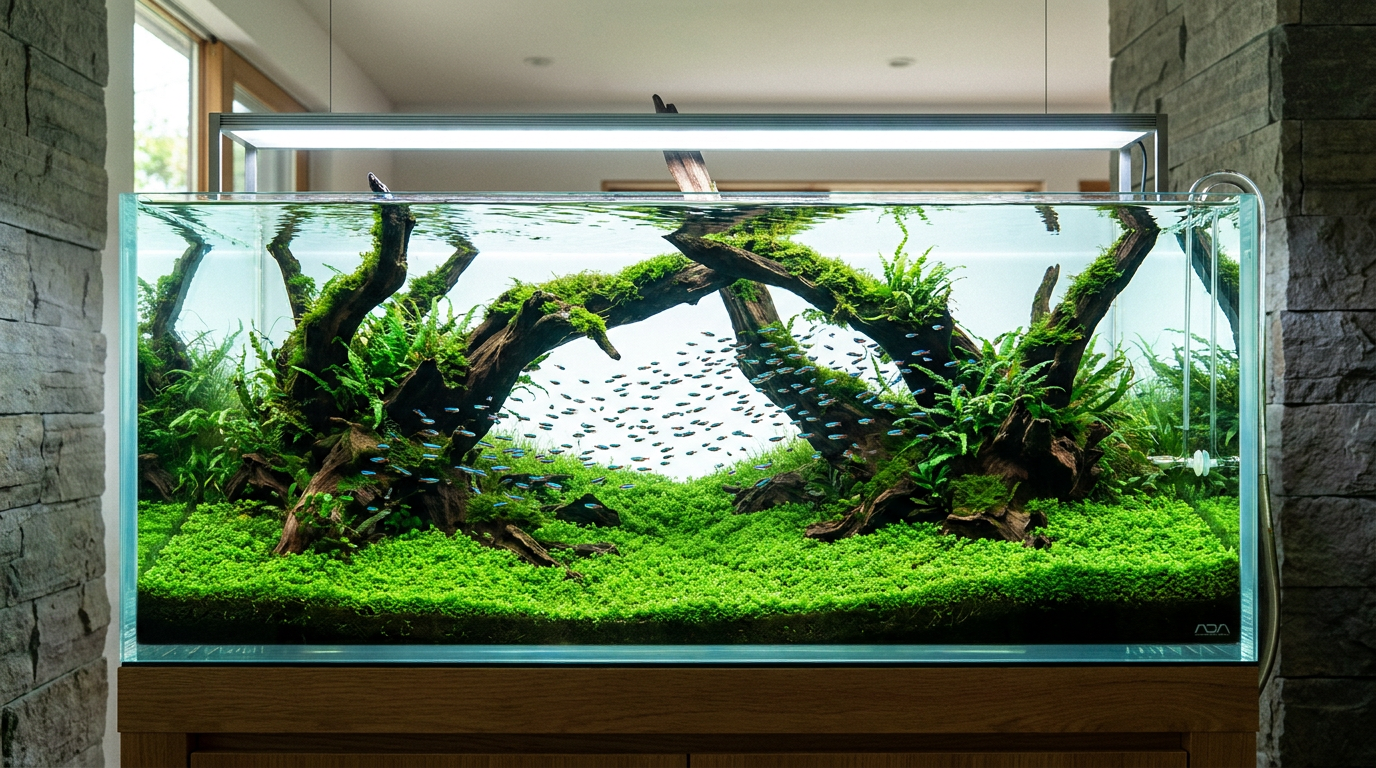
Most people view aquariums as glass boxes meant to display colorful fish. But a growing global movement is flipping that paradigm, shifting the focus from the inhabitants to the environment itself. This is aquascaping—the sophisticated craft of arranging aquatic plants, driftwood, and stones to create harmonious, self-sustaining underwater landscapes. It is a practice where classical art theory intersects with rigorous biology and chemistry.[7]
The modern aquascaping movement traces its roots to the late Japanese photographer and aquarist Takashi Amano. In the 1980s, Amano pioneered the "Nature Aquarium" style, which sought to replicate the pristine mountain streams and lush forests he photographed in the wild. By incorporating Japanese gardening concepts like Wabi-sabi and Zen rock arrangements, Amano transformed fishkeeping from a sterile hobby into a four-dimensional art form.[1][6]
Amano's philosophy treated the tank not as a collection of separate entities, but as a singular, living ecosystem. In his layouts, aquatic flora acts as a living filter. When healthy plants photosynthesize rapidly, they outcompete nuisance algae for nutrients and oxygenate the water, creating an environment where both flora and fauna can thrive in perfect balance.[1][6]

Designing an aquascape begins long before water is added. The foundation is the "hardscape"—the deliberate placement of rocks and driftwood. Aquascapers rely heavily on the Golden Ratio (1:1.618) and the rule of thirds to guide the placement of focal points, avoiding the artificial look of perfect symmetry. By placing a prominent stone or a vibrant plant slightly off-center, the artist creates a dynamic sense of depth that breaks the visual constraint of the glass box.[7]
Different styles dictate the hardscape's rules. The "Iwagumi" style is minimalist, relying strictly on carefully positioned stones and low-growing carpet plants to mimic sweeping terrestrial valleys. In contrast, the "Jungle" style embraces controlled chaos, allowing plants to grow wildly over wood and stone to replicate an untamed Amazonian riverbed. The "Dutch" style eschews hardscape entirely, focusing instead on neat, meticulously pruned rows of contrasting plant species.[3][7]

Beneath the aesthetic design lies a complex chemical engine. The substrate—often a specialized baked clay or aqua soil—provides a nutrient-rich bed for plant roots while actively buffering the water's pH. Maintaining a stable pH, generally between 6.0 and 8.0, is critical. The specific gravity and total dissolved solids in the water dictate how easily plants can absorb the minerals they need to grow.[2][5]
The most critical unseen mechanism in any aquascape is the nitrogen cycle. As fish and decaying plant matter produce ammonia, beneficial bacteria living in the filter and substrate convert this highly toxic compound into nitrite, and then into less harmful nitrate. In a heavily planted aquascape, the plants themselves consume these nitrates as fertilizer, effectively closing the ecological loop and purifying the water.[2][7]

The most critical unseen mechanism in any aquascape is the nitrogen cycle.
To fuel this rapid plant growth, many aquascapers utilize the "Biological Triangle": the precise balance of light, carbon dioxide (CO2), and nutrients. While low-tech tanks rely on the ambient CO2 naturally dissolved in the water, high-tech setups inject pressurized CO2 directly into the water column. This supplementation dramatically accelerates photosynthesis, allowing plants to pearl—releasing visible streams of tiny oxygen bubbles into the water.[2][4]
Filtration in an aquascape serves a different primary purpose than in a traditional fish tank. Rather than relying on chemical filtration to scrub the water, aquascapers prioritize mechanical and biological filtration. A high flow rate—often recommended at ten times the tank's volume per hour—ensures that CO2 and liquid fertilizers are distributed evenly to every leaf, preventing stagnant zones where algae might take hold.[5][7]
In these underwater gardens, livestock plays a supporting role. Rather than stocking large, messy fish, aquascapers employ a "cleanup crew." Species like the Amano shrimp (named after Takashi Amano, who discovered their voracious appetite for algae) and Otocinclus catfish work tirelessly to graze on microscopic algae, keeping the plants and hardscape pristine without damaging the delicate ecosystem.[6][7]
Beyond the science and aesthetics, aquascaping is increasingly recognized for its profound mental health benefits. The practice satisfies the human need for biophilia—our innate desire to connect with nature. Studies suggest that observing a lush, thriving aquatic environment can significantly lower cortisol levels and reduce blood pressure, offering a mindful escape from the overstimulation of modern, screen-heavy lives.[4][7]

The routine maintenance of an aquascape acts as a form of active meditation. The meticulous tasks of trimming overgrown stems, cleaning glass, and performing weekly water changes require a state of flow and present-moment focus. This rhythmic engagement helps quiet racing thoughts, providing a sense of purpose, control, and tangible accomplishment as the underwater garden matures.[4][7]
Educational institutions are also adopting the hobby to teach complex scientific concepts. Building a "Biotope"—an aquascape that strictly replicates a specific geographic habitat, using only the plants, fish, and water parameters found in that exact location—offers students a hands-on lesson in evolutionary specialization and ecological fragility.[3][7]
Yet, the hobby is not without its frustrations. Every aquascape is a delicate balancing act, and the primary antagonist is always algae. If the Biological Triangle falls out of alignment—too much light, insufficient CO2, or an excess of nutrients—algae will rapidly exploit the imbalance. Learning to read the tank and adjust these invisible parameters is the true learning curve of the craft.[5][7]
Ultimately, an aquascape is never truly finished. Unlike a painting or a sculpture, it is a living, four-dimensional piece of art that evolves daily. It requires patience, observation, and a willingness to let nature take the lead. For those who master the balance, the reward is a mesmerizing, self-contained world that brings the tranquility of the wild directly into the living room.[1][7]
How we got here
1970s
Paleobiologist Walter Adey builds early research tanks to monitor coral reef ecosystems, advancing aquarium science.
1982
Takashi Amano founds Aqua Design Amano (ADA), introducing specialized equipment for aquatic plant cultivation.
1992
Amano publishes 'Nature Aquarium World', popularizing the Nature Aquarium style globally.
2015
Takashi Amano completes the world's largest Nature Aquarium, a 160-foot masterpiece at the Lisbon Oceanarium, shortly before his death.
Viewpoints in depth
Nature Aquarium Purists
Advocates for mimicking natural landscapes and achieving ecological balance through Wabi-sabi principles.
Followers of Takashi Amano's original vision argue that an aquascape should be a slice of untouched nature. This camp prioritizes the Wabi-sabi philosophy—finding beauty in imperfection and transience. They emphasize natural wood, asymmetrical stone placement, and allowing plants to grow in a way that feels organic rather than overly manicured. For purists, the ultimate goal is a self-sustaining ecosystem where the biological filtration is so robust that the tank requires minimal artificial intervention.
High-Tech Cultivators
Focuses on maximizing plant growth and vibrant colors through precise CO2 injection and intense lighting.
High-tech enthusiasts approach aquascaping as a rigorous exercise in chemistry and botany. By injecting pressurized CO2 and utilizing high-intensity, full-spectrum LED lighting, they push aquatic plants to grow at accelerated rates. This camp meticulously measures liquid fertilizers, tracking exact parts-per-million of nitrates, phosphates, and potassium. Their reward is the ability to grow notoriously difficult, brightly colored red and purple plant species that would perish in a standard, low-tech environment.
Biotope Conservationists
Prioritizes geographical accuracy, recreating exact natural habitats to educate the public on ecological fragility.
Biotope creators view their tanks as educational exhibits and conservation tools. Rather than mixing plants and fish from different continents for aesthetic appeal, they strictly replicate specific geographic locations—such as a shaded tributary of the Rio Negro or a fast-flowing hill stream in Borneo. By matching the exact water parameters, leaf litter, and endemic species of a region, they aim to study natural behaviors and raise awareness about habitats threatened by pollution and deforestation.
Therapeutic Hobbyists
Views the tank primarily as a tool for mindfulness, stress reduction, and biophilic connection.
For this growing segment, the scientific and competitive aspects of aquascaping are secondary to its mental health benefits. Therapeutic hobbyists focus on the sensory experience: the sound of flowing water, the visual calmness of swaying green plants, and the meditative routine of weekly maintenance. They argue that in an increasingly digital and anxious world, the tactile, screen-free responsibility of nurturing a miniature ecosystem provides a crucial anchor for emotional well-being.
What we don't know
- How long-term exposure to specific artificial LED light spectrums affects the micro-fauna biodiversity within closed aquatic systems.
- The exact psychological mechanisms that make underwater biophilia more effective at reducing cortisol than traditional terrestrial gardening.
Key terms
- Aquascaping
- The craft of arranging aquatic plants, rocks, and driftwood in an aesthetically pleasing, ecologically balanced manner within an aquarium.
- Hardscape
- The foundational non-living elements of an aquascape, such as rocks, stones, and driftwood, which provide structural design.
- Nitrogen Cycle
- The biological process where beneficial bacteria convert toxic fish waste into less harmful compounds, which plants then absorb as fertilizer.
- Iwagumi
- A minimalist Japanese aquascaping style that uses only stones and low-growing carpeting plants to mimic sweeping terrestrial landscapes.
- Biotope
- An aquarium setup designed to strictly replicate a specific natural geographic habitat, including its exact water parameters, flora, and fauna.
- Rhizome
- A thick, modified plant stem used by certain aquatic species to attach to rocks or wood rather than burying roots in the soil.
Frequently asked
What is the difference between aquascaping and a regular aquarium?
Aquascaping focuses primarily on the design and health of the aquatic plants and hardscape, treating the fish as a complementary element rather than the main attraction.
Do I need CO2 injection to start aquascaping?
No. While high-tech setups use pressurized CO2 for rapid, vibrant growth, many beautiful "low-tech" aquascapes thrive using hardy plants that rely on naturally dissolved CO2.
How long does it take for an aquascape to grow in?
Depending on the plant species and lighting, a new aquascape typically takes 2 to 3 months to fully root, spread, and achieve the dense, lush look intended by the designer.
What is the best tank size for a beginner?
Experts often recommend a medium-sized tank, around 15 to 20 gallons. Larger water volumes are more chemically stable, making it easier to manage nutrient spikes and avoid algae blooms.
Sources
Source coverage
7 outlets
4 viewpoints surfaced







[1]Aqua Design AmanoNature Aquarium Purists
Everything Started from Producing Nature Aquariums
Read on Aqua Design Amano →[2]Hanna InstrumentsHigh-Tech Cultivators
The Science of Aquascaping and Water Chemistry
Read on Hanna Instruments →[3]Aquatic DepthsBiotope Conservationists
What Classroom Aquascaping Teaches About Ecology
Read on Aquatic Depths →[4]CO2 ArtTherapeutic Hobbyists
The Mental Health Benefits of Aquascaping
Read on CO2 Art →[5]Shirley AquaticsHigh-Tech Cultivators
Getting Started With Your Aquascape
Read on Shirley Aquatics →[6]WikipediaNature Aquarium Purists
Takashi Amano
Read on Wikipedia →[7]Factlen Editorial TeamTherapeutic Hobbyists
Synthesis by Factlen editorial team
Read on Factlen Editorial Team →
Every angle. Every day.
Get lifestyle stories with full source coverage and perspective breakdowns delivered to your inbox.