
How Hydrofoils and Fast Chargers Are Finally Electrifying the Water
Aerospace-inspired hydrofoils and a rapidly expanding marine fast-charging network are overcoming the physics of water resistance, unlocking high-speed, long-range electric boating.
By Factlen Editorial Team
- Marine Tech Innovators
- Engineers and startups focused on overcoming the physics of water resistance.
- Infrastructure & Adoption Advocates
- Companies building the charging networks required to make electric boating practical.
- Commercial & Transit Operators
- Ferry operators and tourism companies focused on operational efficiency.
What's not represented
- · Traditional gas-powered boat manufacturers
- · Marina operators managing grid upgrades
Why this matters
Marine transport has historically been one of the hardest sectors to decarbonize due to the immense energy required to push hulls through water. The successful commercialization of hydrofoiling and marine fast-charging proves that zero-emission, silent waterways are now a technological reality, not just a concept.
Key points
- Water resistance historically made battery-electric boats too slow or severely range-limited.
- Hydrofoil technology lifts the hull out of the water, reducing energy consumption by up to 80%.
- The Candela C-8 can travel 57 nautical miles at 22 knots on a single charge.
- High-torque electric wake boats like the Arc Sport are tackling the luxury water sports market.
- Aqua superPower is building a global network of 150kW DC marine fast chargers.
- Marine chargers use the CCS standard, which prevents electric shocks if dropped in water.
The water has always been the final boss of vehicle electrification. Because water is roughly 800 times denser than air, traditional boat hulls require massive amounts of continuous energy just to push through the resistance. For years, this stubborn physics problem kept battery-electric boats confined to slow speeds or incredibly short ranges.
Attempting to solve the range issue by simply installing a larger battery created a vicious cycle: the added weight pushed the hull deeper into the water, which increased drag, which in turn demanded even more power. But a wave of aerospace-inspired engineering is finally breaking the stalemate, transforming the marine industry through a combination of computer-controlled hydrofoils, high-density automotive batteries, and a rapidly expanding fast-charging network.
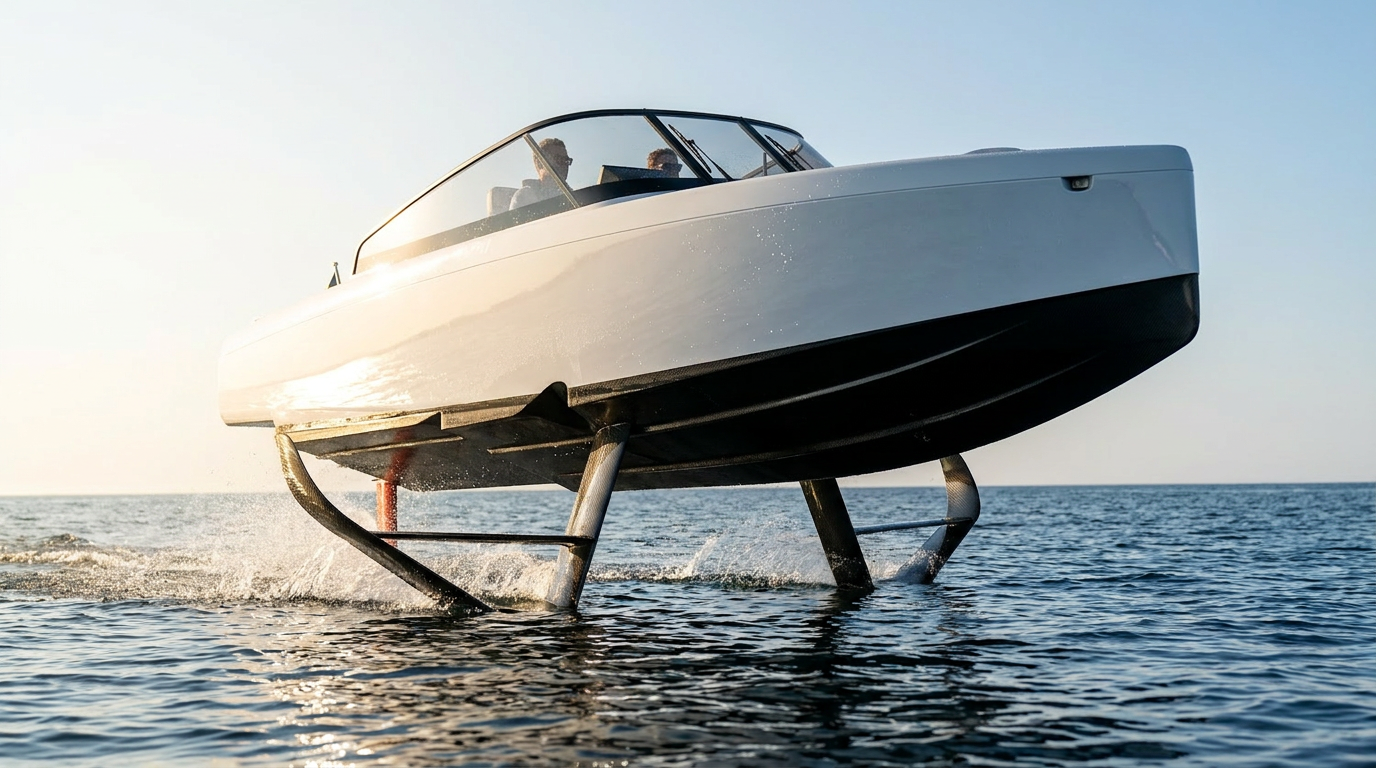
The primary breakthrough lies in flying over the water rather than plowing through it. Hydrofoils—wing-like carbon-fiber structures mounted beneath the hull—generate lift as the boat accelerates. Once a specific speed is reached, the entire hull is hoisted above the surface, slicing through the waves with minimal friction.[1][3]
Swedish manufacturer Candela has pioneered this approach for the consumer market. Their flagship C-8 recreational boat utilizes a proprietary flight-control system that adjusts the submerged foils hundreds of times per second to maintain perfect stability, even in choppy conditions. By eliminating hull friction, this hydrofoiling technique reduces overall energy consumption by up to 80 percent compared to a traditional planing boat.[1][3]

This dramatic leap in efficiency completely rewrites the math of electric boating. Powered by a 69-kilowatt-hour battery sourced from automaker Polestar, the Candela C-8 achieves a range of 57 nautical miles at a cruising speed of 22 knots. It delivers a silent, zero-emission ride that leaves virtually no wake behind it.[3]
The technology is now scaling rapidly into commercial public transport, where the economics of electric propulsion are highly favorable. In 2026, Candela's 30-passenger P-12 ferries are entering service in Stockholm and the Maldives, offering high-speed, zero-emission island hopping that minimizes shoreline erosion.[1]
Similarly, in Australia, New Zealand-based marine innovator Vessev is deploying its VS-9 electric hydrofoil boats on Tasmania's Derwent River. The vessels, which boast a top speed of 30 knots, are being utilized for commuter and premium tourism routes, proving that zero-emission marine transport can operate efficiently at scale.[2]

Similarly, in Australia, New Zealand-based marine innovator Vessev is deploying its VS-9 electric hydrofoil boats on Tasmania's Derwent River.
But hydrofoiling isn't the only way to electrify the water. For water sports enthusiasts, creating a massive wake is the entire point of the vessel, requiring a completely different engineering philosophy. Los Angeles-based Arc Boats, founded by former Boeing and SpaceX engineers, has tackled the luxury wake boat market with brute force and massive battery packs.[4]
Their Arc Sport model packs a staggering 226-kilowatt-hour battery and a 500-horsepower electric motor. The setup delivers more than double the torque of premium gas-powered wake boats, providing instant acceleration to pull wakeboarders out of the water.[4]
Priced around $258,000, the Arc Sport uses computer-controlled ballasts to shape the perfect surfing wave. Crucially, it eliminates the exhaust fumes and deafening engine roar that usually choke the back of a wake boat, allowing passengers to converse at normal volumes while towing a surfer.[4]

Of course, high-capacity batteries require robust infrastructure. Range anxiety on the water is uniquely terrifying, as there is no shoulder to pull over on if a battery dies. To solve this, companies like Aqua superPower are building the marine equivalent of the Tesla Supercharger network, installing high-speed DC fast chargers at marinas across Europe, North America, and the Asia-Pacific.[5][6]
Aqua provides the hardware and installation at zero cost to the marina operators. The company recoups its investment by owning the network and selling the electricity directly to boaters via a cloud-connected mobile app, creating a seamless plug-and-charge experience.[6]
Safety is a primary concern when mixing 350-kilowatt chargers with saltwater environments. To address this, Aqua utilizes the automotive Combined Charging System (CCS) standard, which features a built-in, fail-safe mechanism.[6]
The heavy-duty plug remains completely inert until it makes a verified electronic "handshake" with the boat's battery management system. If a user accidentally drops the connector into the water prior to connection, it carries no live current, eliminating the risk of electric shock.[6]

How we got here
2014
Candela is founded in Sweden with the goal of applying aerospace engineering to marine transport.
2021
Aqua superPower begins deploying its dedicated global marine fast-charging network.
2022
Candela unveils the C-8, featuring a Polestar-built battery and computer-controlled hydrofoils.
2024
Arc Boats launches the Arc Sport, a 500-horsepower electric wake boat targeting the luxury recreational market.
2026
Candela P-12 electric ferries and Vessev VS-9 commuter boats begin entering public commercial service globally.
Viewpoints in depth
Marine Tech Innovators
Engineers and startups focused on overcoming the physics of water resistance.
This camp views traditional boat design as fundamentally flawed for the electric era. By drawing talent from aerospace and automotive sectors (like SpaceX and Polestar), these innovators argue that the only way to achieve viable electric range is to rethink the hull entirely. Whether through computer-stabilized hydrofoils that eliminate drag, or massive, high-torque battery platforms that overpower it, they believe software and advanced materials are the key to decarbonizing the water.
Infrastructure & Adoption Advocates
Companies building the charging networks required to make electric boating practical.
Infrastructure providers emphasize that the best electric boat in the world is useless without a reliable place to charge it. They argue that range anxiety on the water is a massive barrier to consumer adoption. By fully funding the installation of high-speed DC chargers at marinas and utilizing proven, safe automotive charging standards (CCS), they aim to create continuous coastal charging corridors that make electric boating as seamless as driving an EV on the highway.
Commercial & Transit Operators
Ferry operators and tourism companies focused on operational efficiency.
For commercial operators, the shift to electric hydrofoils is driven by pure economics and environmental regulations. Electric vessels drastically reduce daily fuel and maintenance costs compared to diesel engines. Furthermore, because hydrofoils create virtually no wake, these ferries can operate at high speeds in restricted urban waterways and sensitive ecological zones without eroding shorelines or disturbing marine life, opening up new routes for rapid public transit.
What we don't know
- How quickly traditional marinas will upgrade their electrical grid connections to support multiple 150kW+ fast chargers simultaneously.
- Whether the high upfront costs of electric hydrofoil boats will drop fast enough to penetrate the middle-market recreational boating sector.
- How electric boat batteries will hold up to long-term saltwater exposure and marine degradation over a 10-to-15-year lifespan.
Key terms
- Hydrofoil
- A wing-like structure mounted under a boat's hull that lifts the vessel out of the water at speed, drastically reducing drag.
- Combined Charging System (CCS)
- A universal plug standard adopted from the automotive industry that allows for high-voltage DC fast charging, modified for marine safety.
- Wake Boat
- A specialized recreational boat designed to create large, surfable waves behind it for wakeboarding and wakesurfing.
- Planing Hull
- A traditional boat design that uses speed to push the front of the hull up and skim across the water's surface, which requires immense energy.
Frequently asked
How far can an electric hydrofoil boat go?
Models like the Candela C-8 can travel roughly 57 nautical miles at cruising speeds of 22 knots, thanks to drastically reduced water resistance.
Is it safe to charge a boat with high-voltage electricity?
Yes. Marine fast chargers use the CCS standard, which requires an electronic 'handshake' with the boat's battery before the plug goes live, preventing shocks if dropped in the water.
Can electric boats create wakes for surfing?
Yes. While hydrofoil boats are designed to eliminate wakes, specialized electric wake boats use high-torque motors and computer-controlled ballasts to generate massive, surfable waves.
How long does it take to charge an electric boat?
Using a DC fast charger, a modern electric boat can charge from 10 to 80 percent in roughly 35 to 60 minutes, depending on the battery size and charger output.
Sources
Source coverage
7 outlets
3 viewpoints surfaced







[1]ElectriveCommercial & Transit Operators
Candela builds ten electric hydrofoil boats for the Maldives
Read on Electrive →[2]The DrivenCommercial & Transit Operators
Australia's first electric hydrofoil boats to be rolled out on Tasmania's Derwent River
Read on The Driven →[3]Boating MagazineMarine Tech Innovators
Candela C-8 Electric Boat Review
Read on Boating Magazine →[4]ElectrekMarine Tech Innovators
We rode in Arc's new Sport electric wake boat, and it rips
Read on Electrek →[5]PlugboatsInfrastructure & Adoption Advocates
High speed marine charging for commercial e-boats
Read on Plugboats →[6]Yachting MagazineInfrastructure & Adoption Advocates
Aqua superPower's E-Boat Charging Stations
Read on Yachting Magazine →[7]Market Research FutureCommercial & Transit Operators
Electric Hydrofoil Boats Market Future Outlook
Read on Market Research Future →
Every angle. Every day.
Get automotive stories with full source coverage and perspective breakdowns delivered to your inbox.