
Carbon Monoxide Discovery Suggests Uranus Has a True Icy Core
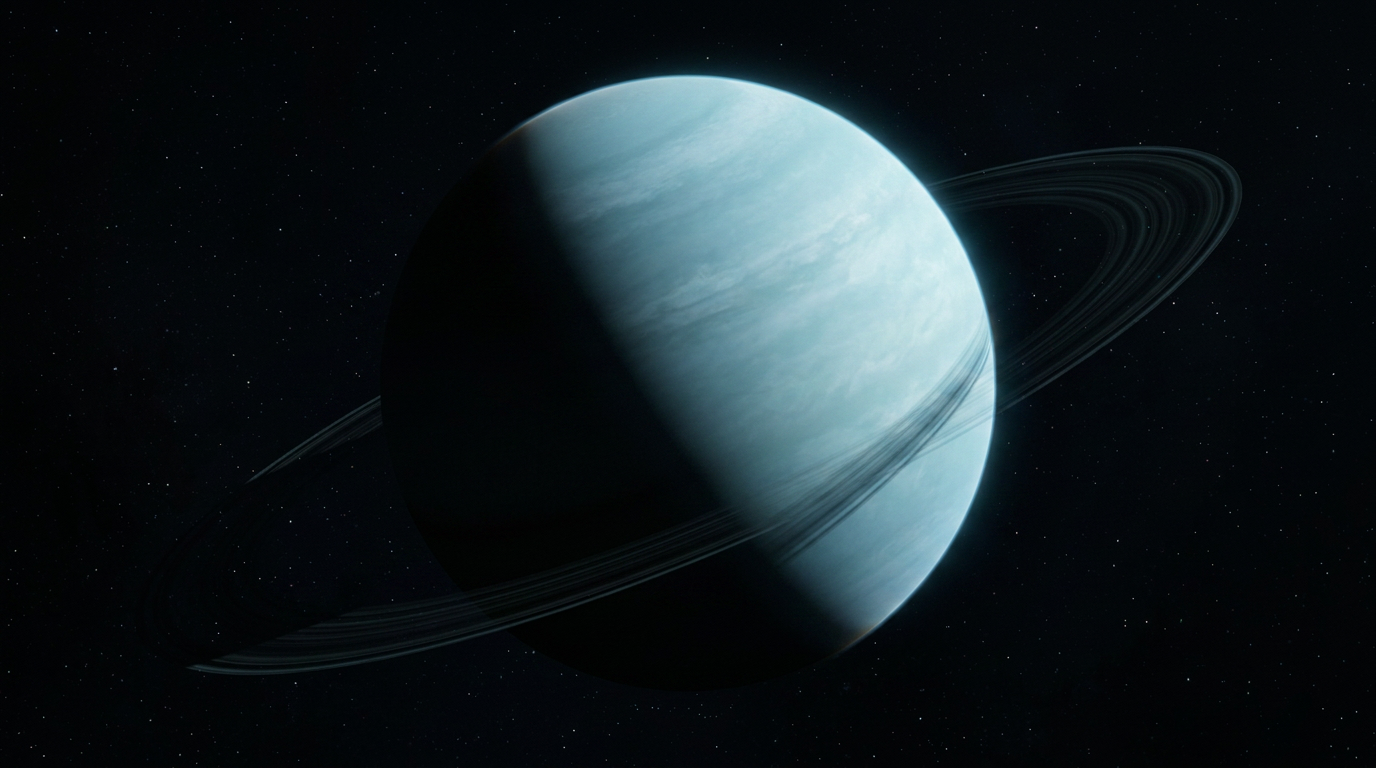
A new analysis of gas deep within Uranus's atmosphere has revealed unexpected levels of carbon monoxide, suggesting the planet's core is dominated by ice rather than rock. The discovery challenges recent alternative theories and aligns Uranus's formation history more closely with its sibling, Neptune.
By Factlen Editorial Team
- Classical Ice Giant Proponents
- Argues that Uranus and Neptune are primarily composed of water, ammonia, and methane ices.
- Rock Giant Theorists
- Suggests that the planets might be composed largely of refractory rock and organics that reacted with hydrogen to form methane.
- Planetary Exploration Advocates
- Emphasizes that remote spectroscopy is inherently limited and that a dedicated atmospheric probe is required.
What's not represented
- · Instrument engineers for future atmospheric probes
- · Protoplanetary disk dynamicists
Why this matters
Resolving the internal composition of Uranus fundamentally changes our understanding of how the Solar System formed. By confirming the presence of deep water ice, scientists can better model the chaotic early days of planetary accretion and apply these lessons to the thousands of similar-sized exoplanets discovered across the galaxy.
Key points
- New observations detect carbon monoxide welling up from the deep atmosphere of Uranus.
- The presence of the gas strongly indicates a massive interior reservoir of oxygen-rich water ice.
- This challenges recent theories that Uranus might be a 'rock giant' composed mainly of organics and silicates.
- The findings suggest Uranus and Neptune share a more similar formation history than previously thought.
- Planetary scientists argue a dedicated atmospheric probe is needed to definitively confirm the planet's internal structure.
A new analysis of gas deep within the atmosphere of Uranus has revealed unexpected levels of carbon monoxide, providing compelling evidence that the planet's core is dominated by ice rather than rock. The discovery, reported this week, addresses a fundamental mystery in planetary science regarding the true composition of the Solar System's outermost worlds.[1]
For decades, astronomers have classified Uranus and Neptune as "ice giants," distinct from the gas giants Jupiter and Saturn. However, the exact ratio of ice to rock in their interiors has remained notoriously difficult to measure, leading to a persistent debate over whether they might actually be "rock giants" masquerading under a thin icy veneer.[2][4]
The primary claim of the new research rests on the detection of carbon monoxide welling up from the deep Uranian troposphere. In planetary chemistry, carbon monoxide acts as a crucial tracer for interior composition. Under the extreme pressures and temperatures of a planetary mantle, the ratio of oxygen to carbon determines how much of the gas can form and escape into the upper atmosphere.[1][2]
The evidence for an icy interior strengthens when comparing Uranus to its sibling, Neptune. Neptune has long been known to possess significant carbon monoxide in its stratosphere—roughly 1,000 times more than Jupiter or Saturn. Scientists have interpreted this as strong evidence of a water-ice-rich interior dredging oxygen upward.[2]

Uranus, by contrast, historically appeared depleted in carbon monoxide. Previous spectroscopic observations failed to detect the gas in the planet's troposphere, yielding only trace amounts in the upper stratosphere. This anomaly led some researchers to hypothesize that Uranus might have a fundamentally different interior structure than Neptune, potentially lacking a massive water-ice reservoir.[2][5]
Recent theoretical models even proposed that Uranus could be a true rock giant. A 2024 study demonstrated that chemical reactions between hydrogen and organic-rich rocky planetesimals could produce large amounts of methane. This methane could theoretically mimic the density and mass of an ice giant without requiring actual water ice.[3]
However, the new detection of deep-atmospheric carbon monoxide challenges the rock-heavy model. The presence of this specific gas strongly implies that Uranus contains a massive reservoir of oxygen-rich ices—specifically water and ammonia—deep within its mantle, rather than just carbon-rich methane.[1][6]
However, the new detection of deep-atmospheric carbon monoxide challenges the rock-heavy model.
It is important to clarify the scientific definition of "ice" in this context. In planetary science, ice does not refer to solid frozen water as it exists on Earth. Instead, it describes volatiles like water, ammonia, and methane that exist in a supercritical, slushy fluid state under immense pressure and temperature.[4][5]
If the carbon monoxide readings are accurate, they rewrite the story of how Uranus formed. The data suggests that Uranus accreted further out in the primordial solar nebula, in a colder region where carbon monoxide and water ice were highly abundant. This aligns its formation history much more closely with Neptune's.[1][2]

The evidence also provides a potential solution to the mystery of Uranus's bizarre magnetic field. Voyager 2 observations in 1986 revealed that the planet's magnetic field is highly asymmetrical and offset from its physical center.[4]
A water-rich interior supports the leading hypothesis for this magnetic anomaly. A convecting layer of superionic water ice—a bizarre phase of water that is both solid and liquid—could generate the shallow dynamo effect required to produce such a skewed magnetic field. A purely rocky interior would struggle to explain this phenomenon.[2][4]
Despite these compelling findings, the evidence carries transparent uncertainty. The exact ratio of ice to rock remains unconstrained, as remote spectroscopy can only pierce so far through the Uranian haze. The deep atmosphere is obscured by thick layers of methane clouds and photochemical smog.[2][5]
Furthermore, the carbon monoxide could theoretically have an external origin. Some researchers have previously suggested that the gas in the upper atmospheres of the ice giants could be delivered by a steady rain of interplanetary micrometeorites or cometary impacts.[2]
However, the depth at which the new gas signatures were detected makes an external source highly unlikely. The upwelling pattern strongly points to an internal origin, dredged up from the supercritical mantle and circulating into the lower atmosphere.[1][6]

To definitively resolve the ice giant versus rock giant debate, planetary scientists emphasize the need for in situ measurements. The planetary science community has strongly advocated for a dedicated Uranus Orbiter and Probe mission in the coming decade.[2][4]
Such a mission would drop a mass spectrometer directly into the cyan clouds, measuring the exact isotopic ratios and noble gas abundances down to pressures of 10 bar or more. This would provide ground truth for the remote spectroscopic data and settle the composition debate permanently.[2][6]
Until a spacecraft makes that descent, the carbon monoxide tracer provides the strongest evidence yet available. It suggests that Uranus is, at its heart, a true sibling to Neptune—a world defined by its deep, hidden ices, and a critical missing puzzle piece in our understanding of how the Solar System formed.[1][6]
How we got here
1781
William Herschel discovers Uranus, the first planet found with the aid of a telescope.
1986
NASA's Voyager 2 spacecraft makes the only close flyby of Uranus, revealing its off-center magnetic field and cold, featureless atmosphere.
2020
Studies highlight the lack of tropospheric carbon monoxide on Uranus, fueling theories that it might be a 'rock giant'.
2024
Researchers publish models showing that chemical reactions could create a methane-rich 'rock giant' that mimics the density of an ice giant.
June 2026
New spectroscopic data reveals carbon monoxide welling up from Uranus's deep atmosphere, strongly supporting the classical ice giant model.
Viewpoints in depth
Classical Ice Giant Proponents
Argues that Uranus and Neptune are primarily composed of water, ammonia, and methane ices.
This camp points to the new carbon monoxide detections as the smoking gun for a water-rich interior. Because carbon monoxide formation in a planetary interior requires abundant oxygen, a massive reservoir of water ice is the most chemically straightforward explanation. They argue that the similarities between Uranus and Neptune's atmospheric chemistry suggest a shared formation history in the outer, ice-rich regions of the protoplanetary disk.
Rock Giant Theorists
Suggests that the planets might be composed largely of refractory rock and organics.
Researchers in this camp highlight the ambiguities in bulk density measurements. They argue that chemical reactions between a thick hydrogen envelope and a core made of organic-rich rock could produce vast oceans of methane. In this view, the planets are 'rock giants' that generated their own icy layers through extreme chemistry, rather than accreting water ice directly from the solar nebula.
Planetary Exploration Advocates
Emphasizes that remote spectroscopy is inherently limited and requires in situ verification.
This perspective focuses on the limitations of current data. Because the deep atmospheres of the ice giants are obscured by thick photochemical haze and methane clouds, remote telescopes can only measure the uppermost layers. They argue that the only way to definitively settle the interior composition debate is to send a dedicated orbiter and atmospheric probe to Uranus to directly sample the isotopic ratios and noble gases.
What we don't know
- The exact ratio of water ice to rock in Uranus's deep interior remains unconstrained by remote observations.
- It is still unclear why Uranus's atmosphere is so much colder and less active than Neptune's.
- The precise mechanism generating Uranus's highly asymmetrical magnetic field is not fully understood.
Key terms
- Ice Giant
- A class of giant planets composed mainly of elements heavier than hydrogen and helium, specifically volatiles like water, ammonia, and methane.
- Supercritical Fluid
- A state of matter that occurs under extreme temperature and pressure, where distinct liquid and gas phases do not exist, behaving like a dense, slushy gas.
- Spectroscopy
- The study of the interaction between matter and electromagnetic radiation, used by astronomers to determine the chemical composition of distant planets by analyzing the light they absorb or emit.
- Planetesimal
- A small, solid body of rock or ice in a developing solar system that can merge with others to form a planet.
- Dynamo Effect
- The process by which a celestial body generates a magnetic field through the convective motion of electrically conducting fluids in its interior.
Frequently asked
What makes a planet an 'ice giant'?
In planetary science, 'ice' refers to volatile elements like water, ammonia, and methane. An ice giant is a planet composed primarily of these elements in a supercritical fluid state, rather than mostly hydrogen and helium like Jupiter.
Why is carbon monoxide important in this discovery?
Carbon monoxide acts as a chemical tracer. Its presence in the deep atmosphere indicates that there is a large amount of oxygen in the planet's interior, which strongly points to a core made of water ice.
How is Uranus different from Neptune?
While similar in size and composition, Uranus has a much colder atmosphere, a more sluggish weather system, and an extreme axial tilt that causes it to orbit on its side. Historically, it also appeared to have much less carbon monoxide than Neptune.
Will we send a spacecraft to Uranus soon?
Planetary scientists have made a Uranus Orbiter and Probe a top priority for the next decade of space exploration, though no mission has officially launched yet.
Sources
Source coverage
6 outlets
3 viewpoints surfaced






[1]New ScientistClassical Ice Giant Proponents
Gas from Uranus reveals it has an icy centre
Read on New Scientist →[2]Philosophical Transactions of the Royal Society APlanetary Exploration Advocates
Neptune and Uranus: ice or rock giants?
Read on Philosophical Transactions of the Royal Society A →[3]arXivRock Giant Theorists
Uranus and Neptune: Ice or Rock Giants?
Read on arXiv →[4]NASA SciencePlanetary Exploration Advocates
Physical Characteristics of Uranus, Neptune, and the Outer Icy Worlds
Read on NASA Science →[5]WikipediaPlanetary Exploration Advocates
Uranus
Read on Wikipedia →[6]Factlen Editorial TeamClassical Ice Giant Proponents
Synthesis by Factlen editorial team
Read on Factlen Editorial Team →
Every angle. Every day.
Get science stories with full source coverage and perspective breakdowns delivered to your inbox.