
Beyond the Ramp: How Architects Are Redesigning Buildings for Neurodiversity
A new wave of architectural standards is shifting the focus of inclusive design from physical accessibility to cognitive and sensory well-being. By rethinking acoustics, lighting, and spatial flow, designers are creating environments that accommodate the 15 to 20 percent of the population who are neurodivergent.
By Factlen Editorial Team
- Architectural Designers
- Focus on integrating sensory solutions seamlessly into the aesthetic and functional flow of a building.
- Neurodivergent Advocates
- Prioritize autonomy, choice, and the reduction of environmental stressors that impede daily life.
- Corporate Employers & Planners
- View neuroinclusive design as a vital tool for talent retention, productivity, and broader workplace wellness.
What's not represented
- · Public school administrators retrofitting older educational facilities on limited budgets.
- · Real estate developers balancing the cost of specialized acoustic materials with commercial profitability.
Why this matters
For decades, building codes have focused almost exclusively on physical mobility. The shift toward neuroinclusive design means that workplaces, schools, and public spaces will increasingly accommodate different sensory needs, reducing burnout and making environments more comfortable for everyone.
Key points
- Neuroinclusive design shifts architectural focus from physical accessibility to cognitive and sensory well-being.
- An estimated 15 to 20 percent of the global population is neurodivergent, facing unique sensory processing needs.
- Traditional open-plan offices and harsh public spaces often trigger sensory overload and cognitive fatigue.
- The UK's PAS 6463 standard provides pioneering guidance on lighting, acoustics, and layout for neurodiversity.
- Effective sensory design relies on offering users flexibility, control, and distinct environmental zones.
- Neuroinclusive spaces benefit all users by reducing general environmental stress, a phenomenon known as the curb-cut effect.
For decades, the architectural definition of accessibility has been largely defined by the parameters of physical mobility. Building codes and international regulations, such as the Americans with Disabilities Act (ADA), mandated the inclusion of wheelchair ramps, widened doorways, and accessible elevators to ensure equitable use of space [5]. While these physical interventions fundamentally transformed the built environment and expanded access for millions, they left a significant portion of the population navigating invisible barriers [8]. Today, a new movement is pushing the boundaries of inclusive design far beyond physical access, focusing instead on the cognitive and sensory well-being of the people who occupy these spaces [5].[5][8]
This architectural shift is driven by a growing societal understanding of neurodiversity—the natural variation in human brain function, learning styles, and cognition [2]. Current estimates suggest that between 15 and 20 percent of the global population is neurodivergent, a broad umbrella that encompasses individuals with autism spectrum disorder, ADHD, dyslexia, and various sensory processing differences [3]. For these individuals, the challenge of navigating a standard public building, educational facility, or corporate office is rarely a matter of physical restriction; rather, it is a matter of profound sensory and cognitive friction that can make everyday environments feel actively hostile [2].[2][3]
The prevailing trends in modern commercial architecture have often inadvertently exacerbated these sensory challenges. Over the past two decades, the widespread adoption of open-plan offices, exposed concrete surfaces, floor-to-ceiling glass walls, and harsh fluorescent lighting created environments that prioritize aesthetic minimalism and spatial density over fundamental human comfort [2]. For a neurodivergent individual, the echoing acoustics of a minimalist lobby or the visual clutter of an undivided workspace can quickly trigger sensory overload, leading to acute anxiety, chronic fatigue, and a severely diminished ability to focus on complex tasks [4].[2][4]
The physiological mechanism behind this discomfort lies in how the human brain filters and processes environmental stimuli. While a neurotypical brain might easily relegate the hum of an HVAC system or the visual movement of colleagues walking past a glass conference room to the background, a neurodivergent brain may process all of these inputs simultaneously and with equal, unyielding intensity [7]. The immense cognitive load required to exist in an overstimulating environment continuously drains mental energy, making it extraordinarily difficult to perform professional tasks, learn new information, or comfortably socialize [8].[7][8]

Recognizing this systemic failure in traditional building design, regulatory bodies and architectural institutions are finally beginning to codify sensory design principles. In late 2022, the British Standards Institution published PAS 6463, formally titled 'Design for the mind – Neurodiversity and the built environment' [6]. This pioneering document represents the first comprehensive national guidance specifically aimed at mitigating sensory overload through intentional building design, providing a rigorous framework that is increasingly being adopted as a benchmark by international urban planners and corporate real estate developers [6].[6]
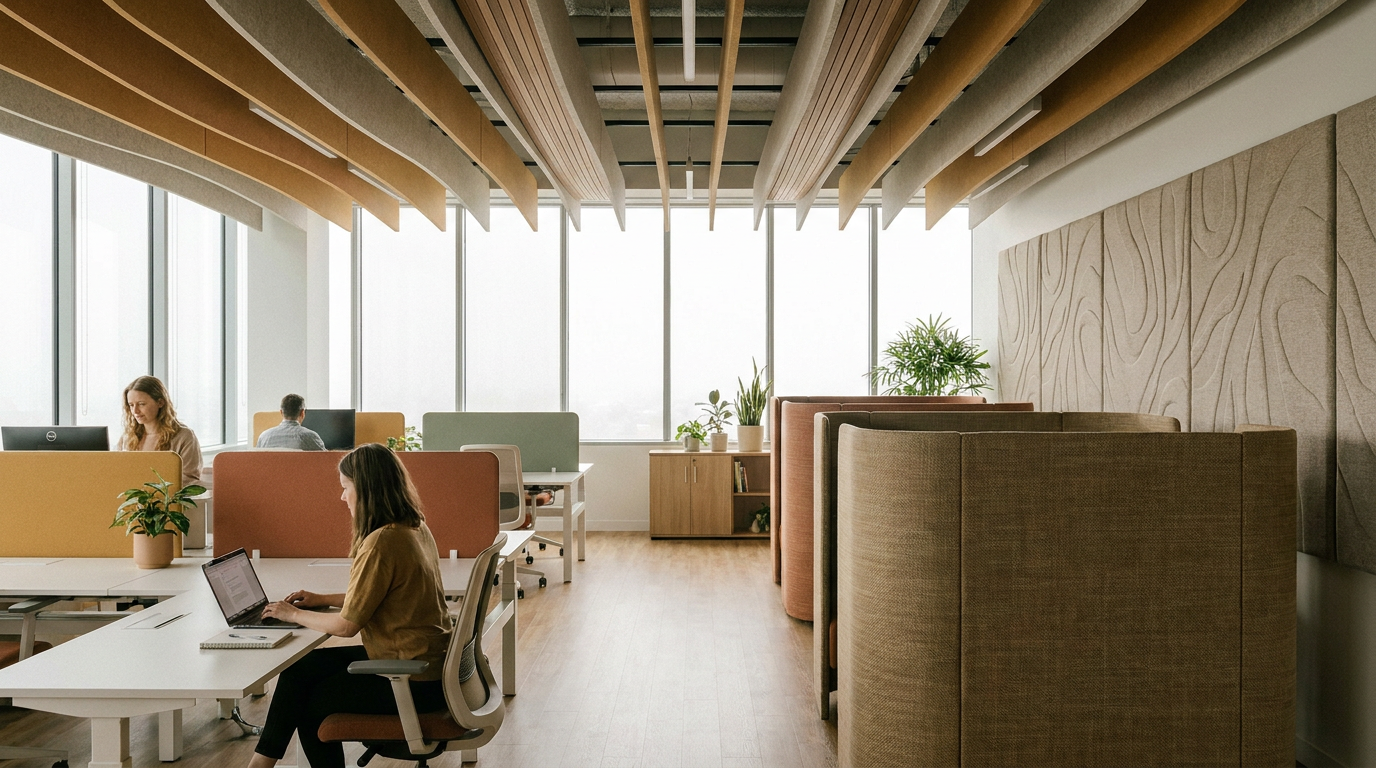
At the core of neuroinclusive design is the careful and deliberate management of interior acoustics. The goal is not necessarily to achieve absolute, deadened silence—which can actually be unnerving and isolating—but rather the control of unpredictable, reverberating noise [4]. To achieve this, architects are moving away from hard, highly reflective surfaces, instead integrating advanced sound-absorbing materials, textured fabric wall panels, and specialized acoustic furniture that dampen ambient sound and prevent localized conversations from carrying disruptively across a large room [7].[4][7]
At the core of neuroinclusive design is the careful and deliberate management of interior acoustics.
Lighting and visual environments serve as equally critical mechanisms for sensory regulation. Harsh, uniform overhead lighting—particularly traditional fluorescent bulbs that emit a subtle but perceptible flicker—can cause significant neurological distress and visual fatigue [1]. Neuroinclusive spaces prioritize abundant access to natural daylight while offering highly adjustable task lighting that allows users to precisely control the illumination of their immediate environment [5]. Furthermore, color palettes are carefully selected, utilizing muted earth tones and avoiding high-contrast, chaotic geometric patterns that can cause visual disorientation [1].[1][5]
Spatial layout and intuitive wayfinding also play a vital role in reducing the cognitive load required to navigate a building. Environments that are confusing, labyrinthine, or visually ambiguous inherently induce anxiety [3]. Designers are now focusing heavily on spatial predictability and legibility, creating clear sightlines and intuitive pathways that guide users effortlessly [1]. Rather than relying solely on text-heavy signage, neuroinclusive wayfinding utilizes distinct architectural features, subtle color zoning, and directional lighting cues to help users orient themselves naturally and confidently within a complex facility [3].[1][3]
To help individuals navigate the jarring shift between different sensory environments, architects are increasingly introducing the concept of 'transition zones' [4]. These are intentional architectural pauses designed into the flow of a building—such as a drawn-out hallway where the flooring material distinctly shifts from hard tile to soft carpet, or where the ceiling height gradually lowers to create a sense of enclosure [4]. These physical and visual cues allow a person to mentally prepare and adjust their sensory expectations as they move from a loud, bustling public lobby into a quiet, focused workspace [4].[4]

In the modern workplace, the implementation of neuroinclusive design definitively marks the end of the one-size-fits-all open floorplan. Progressive employers and space planners are replacing uniform rows of identical desks with a diverse, choice-driven 'menu' of work settings [4]. This dynamic layout includes high-stimulation collaborative zones for energetic team interactions, low-stimulation enclosed retreat pods for deep focus, and specialized areas designed for 'body doubling'—a proven productivity strategy where individuals work quietly alongside others to organically boost motivation and maintain concentration [8].[4][8]

One of the primary and most complex challenges in sensory design is balancing inherently conflicting neurological needs. While some neurodivergent individuals are sensory avoiders who require muted, quiet, and highly controlled spaces to function, others are sensory seekers who actively thrive in environments with higher levels of kinetic energy, ambient noise, and visual stimulation [1]. Because no single static environment can perfectly accommodate both extremes simultaneously, the architectural solution relies heavily on providing maximum flexibility, modularity, and user autonomy within the broader space [3].[1][3]
Ultimately, the growing push for neuroinclusive architecture is demonstrating a powerful and far-reaching 'curb-cut effect' [8]. Just as sidewalk ramps originally built to accommodate wheelchairs ended up benefiting parents pushing strollers, delivery workers with hand trucks, and travelers with rolling luggage, environments designed to reduce sensory stress for neurodivergent individuals tend to universally improve the well-being of everyone [1]. A quiet, well-lit, and easily navigable building fundamentally reduces general environmental fatigue and cognitive drain, regardless of a person's specific neurological profile [8].[1][8]
While comprehensive neuroinclusive guidelines have not yet been universally mandated by global building codes in the same manner as physical accessibility laws, they are rapidly becoming a baseline expectation for top-tier corporate real estate and progressive public infrastructure projects [5]. By shifting the architectural focus from mere physical compliance to holistic human experience, designers are proving that the most innovative and successful buildings are those that seamlessly adapt to the diverse minds of the people inside them [6].[5][6]
How we got here
1990
The Americans with Disabilities Act (ADA) is passed, setting a global precedent for physical accessibility in architecture.
Late 2010s
Growing awareness of neurodiversity prompts initial discussions about cognitive and sensory barriers in the built environment.
Oct 2022
The British Standards Institution publishes PAS 6463, the first national guidance on designing for neurodiversity.
2024-2025
Major architectural firms and corporate planners begin adopting neuroinclusive principles as a baseline for new workplace designs.
Viewpoints in depth
Architectural Designers
Focus on integrating sensory solutions seamlessly into the aesthetic and functional flow of a building.
For architects, the challenge is moving beyond the checklist approach of traditional accessibility codes. They view neuroinclusive design not as a set of clinical add-ons, but as an opportunity to create richer, more adaptable environments. By manipulating volume, sequencing, and materials, designers aim to build spaces that inherently solve for sensory distress without looking institutional.
Neurodivergent Advocates
Prioritize autonomy, choice, and the reduction of environmental stressors that impede daily life.
Advocates emphasize that sensory overload is not merely an annoyance, but a systemic barrier to employment, education, and public participation. They argue that environments should offer users control over their surroundings—such as adjustable lighting and accessible retreat spaces—rather than forcing individuals to mask their discomfort or rely on personal coping mechanisms like noise-canceling headphones.
Corporate Employers & Planners
View neuroinclusive design as a vital tool for talent retention, productivity, and broader workplace wellness.
From a corporate real estate perspective, investing in sensory-friendly design is an economic imperative. Planners recognize that the traditional open-plan office actively harms focus and increases burnout. By offering a 'menu' of workspaces that cater to different cognitive needs, employers aim to unlock the potential of neurodivergent talent while simultaneously improving the well-being of their entire workforce.
What we don't know
- How quickly neuroinclusive guidelines will be formally integrated into mandatory global building codes like the ADA.
- The long-term measurable impact of sensory-optimized workplaces on overall corporate productivity and employee retention.
- How to perfectly balance the conflicting environmental needs of sensory-seeking and sensory-avoiding individuals in shared public spaces.
Key terms
- Neurodiversity
- The natural variation in human brain function and cognition, encompassing conditions like autism, ADHD, and dyslexia.
- Sensory Overload
- A state where the brain is overwhelmed by excessive environmental stimuli, such as loud noises or bright lights, leading to stress and fatigue.
- Wayfinding
- The systems and design elements—like signage, colors, and spatial layout—that help people navigate and orient themselves within a physical space.
- Body Doubling
- A productivity strategy where a person works alongside another individual to improve focus and motivation, often utilized in neuroinclusive workspace planning.
- Curb-Cut Effect
- The phenomenon where designs created to benefit a specific marginalized group end up benefiting the broader population.
Frequently asked
What is neuroinclusive architecture?
It is an approach to building design that considers the sensory and cognitive needs of neurodivergent individuals, focusing on elements like acoustics, lighting, and spatial predictability.
How does it differ from traditional accessibility?
While traditional accessibility (like the ADA) focuses primarily on physical mobility—such as wheelchair ramps and elevator access—neuroinclusive design addresses invisible cognitive and sensory barriers.
Does neuroinclusive design only benefit neurodivergent people?
No. Just as wheelchair ramps help people with strollers, environments designed to reduce sensory stress and cognitive load tend to improve comfort and focus for everyone.
What are transition zones in a building?
Transition zones are architectural spaces that use changes in lighting, flooring, or ceiling height to help users mentally prepare as they move from a loud, busy area to a quiet, focused one.
Sources
Source coverage
8 outlets
3 viewpoints surfaced








[1]ArchDailyArchitectural Designers
Architecture for Neurodiversity: Designing for Control, Choice, and the Senses
Read on ArchDaily →[2]Unlike ArchitectsArchitectural Designers
Neuroinclusive Design
Read on Unlike Architects →[3]Neurodiversity in PlanningNeurodivergent Advocates
Neurodiversity in Planning and Design
Read on Neurodiversity in Planning →[4]DLR GroupCorporate Employers & Planners
How Neuroinclusive Design is Reshaping the Workplace
Read on DLR Group →[5]Vision ConstructorsCorporate Employers & Planners
Inclusive Design Beyond ADA: Embracing Neurodiversity and Sensory Considerations in Architecture
Read on Vision Constructors →[6]Architectural TechnologyNeurodivergent Advocates
PAS 6463: Design for the mind – Neurodiversity and the built environment
Read on Architectural Technology →[7]M Moser AssociatesArchitectural Designers
Sensory design and the architecture of experience
Read on M Moser Associates →[8]Factlen Editorial TeamCorporate Employers & Planners
Synthesis by Factlen editorial team
Read on Factlen Editorial Team →

Every angle. Every day.
Get culture stories with full source coverage and perspective breakdowns delivered to your inbox.