
Sony Unveils Shape-Shifting Controller Tech as Industry Pushes for Universal Accessibility Standards
A newly uncovered Sony patent reveals controller buttons that physically adapt their stiffness for disabled gamers, arriving alongside a broader industry push for standardized accessibility tags across all major console storefronts.
By Factlen Editorial Team
- Accessibility Advocates
- Prioritizes universal standards, storefront transparency, and software features that ensure no player is left behind.
- Hardware Innovators
- Focuses on the engineering breakthroughs of tactile feedback and dynamic materials to create immersive and accessible experiences.
- Academic Researchers
- Examines the sociological and psychological benefits of shared control and reduced barriers in digital spaces.
What's not represented
- · Disabled gamers who prefer standard controllers and worry about being forced into niche hardware ecosystems.
- · Independent game developers struggling with the financial cost of implementing complex accessibility features.
Why this matters
For millions of disabled players, rigid hardware and opaque software have long turned gaming into an exercise in frustration. The shift toward adaptive hardware and universal storefront standards means more people can participate in the world's largest entertainment medium without physical or financial barriers.
Key points
- A newly uncovered Sony patent details controller buttons that can physically harden or soften using magnetic elastomers.
- The technology is designed to accommodate non-standard contact points, such as a player using their palm or elbow to press a button.
- The hardware news coincides with the 4th annual Access-Ability Summer Showcase, highlighting inclusive game design.
- Advocates are currently pushing for PlayStation and Nintendo to adopt standardized accessibility tags on their digital storefronts, a feature already utilized by Xbox.
The video game controller has remained fundamentally unchanged for decades: a rigid plastic shell with static buttons. But a newly uncovered patent from Sony Interactive Entertainment suggests the next generation of gamepads could physically transform in the player's hands. Published in late May 2026 and widely circulated in mid-June, the filing details a controller equipped with buttons that dynamically harden or soften based on gameplay scenarios.[1][2]
The technology relies on either fluid-filled membranes or a "magnetoviscoelastic elastomer"—a rubber-like compound that stiffens when exposed to a magnetic field. While the patent describes immersive gaming applications, such as a "finger grab" effect that simulates being caught by an enemy, the most profound implications are for accessibility.[1][2]
Sony’s filing explicitly notes that these adaptive buttons are designed to accommodate non-standard contact points. For disabled gamers who may press buttons using their palms, elbows, or the sides of their hands, a rigid plastic button can be difficult to engage or cause physical fatigue. A button that softens to allow a limb to sink in, then hardens to register a firm press, could dramatically lower the physical barrier to entry.[1][2]

This hardware revelation arrives during a watershed month for inclusive gaming. June 2026 saw the return of the Access-Ability Summer Showcase, a dedicated presentation running alongside the industry's massive Summer Game Fest. Now in its fourth year, the showcase highlights upcoming titles specifically designed with disabled players in mind, requiring developers to detail their accessibility settings upfront.[3][4]
The showcase underscores a broader industry shift: accessibility is transitioning from a niche post-launch patch to a foundational design pillar. Major studios are increasingly recognizing that inclusive design benefits the entire player base, standardizing features like remappable controls, high-contrast modes, and granular subtitle customization.[6]
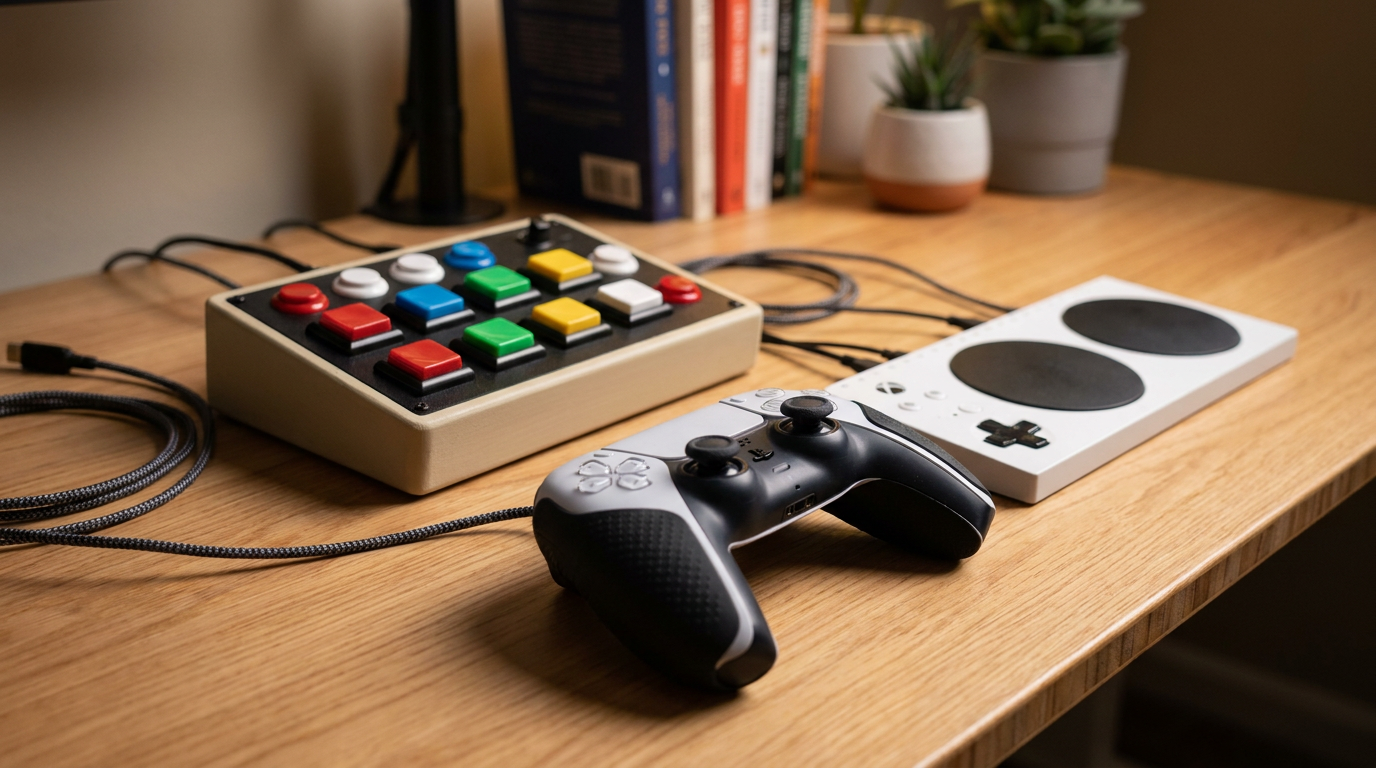
Microsoft has long been viewed as the pioneer in this space, having launched the modular Xbox Adaptive Controller in 2018. In 2026, the company's ecosystem approach continues to pay dividends. The Xbox Accessories app allows for deep software-level customization across consoles and PCs, ensuring that a single physical device can be tuned for vastly different mobility needs.[5][6]
One of the most celebrated software innovations is "Copilot" or "Controller Assist" mode, which allows two separate controllers to register as a single input device. This enables a disabled player to handle the inputs they can comfortably manage, while a friend or family member takes over more complex actions on a second pad.[3][5]

One of the most celebrated software innovations is "Copilot" or "Controller Assist" mode, which allows two separate controllers to register as a single input device.
Academic research is validating the sociological benefits of these shared-control systems. A 2026 study from the University of Milan examined human cooperation technologies in video games, finding that systems like Xbox Copilot and the PlayStation Access Controller's pairing feature significantly reduce barriers to entry. The researchers noted that these tools foster social interaction and allow players to experience complex, fast-paced games that might otherwise be inaccessible.[7]
However, advocates stress that hardware and software features are only part of the equation. Discoverability remains a significant hurdle. While Xbox has successfully implemented standardized accessibility tags on its digital storefront—allowing users to filter games by features like "custom volume controls" or "single stick gameplay"—advocates are pushing for PlayStation and Nintendo to adopt identical universal standards.[3]
Knowing what accessibility settings a game contains before purchasing is crucial. If a player requires specific visual or motor accommodations, a lack of storefront transparency can turn a premium game purchase into a gamble. The push for universal tags aims to eliminate this friction, ensuring that accessibility data is treated with the same importance as age ratings or storage requirements.[3]

Furthermore, the definition of "accessibility" is expanding to include infrastructure. Industry analysts point out that latency and hardware requirements are inherently accessibility issues. A player in a rural area with limited broadband infrastructure is fundamentally excluded from cloud gaming or competitive online titles, regardless of their physical abilities.[6]
As cloud compression technology improves, services are attempting to bridge this gap, but disparities remain. The resurgence of highly optimized, free-to-play browser games in 2026 is partly driven by this need for low-barrier entry, allowing players globally to bypass massive downloads and expensive hardware.[6]
Ultimately, whether Sony's shape-shifting controller makes it to market remains to be seen. The company filed over 2,200 patents in 2025 alone, and many experimental designs never leave the laboratory. Battery drain from magnetic actuation presents a significant engineering challenge that must be solved before mass production.[2]

Yet, the patent's existence signals that the industry's biggest players are actively investing research and development into tactile, hardware-level inclusion. Combined with the momentum of events like the Access-Ability Showcase and the widespread adoption of shared-control software, the gaming landscape of 2026 is demonstrably more welcoming than it was a decade ago.[2][3][4]
How we got here
2018
Microsoft launches the Xbox Adaptive Controller, pioneering modular hardware accessibility.
2023
Sony releases the PlayStation Access Controller, offering a highly customizable alternative to the standard DualSense.
June 2026
The 4th annual Access-Ability Summer Showcase airs, highlighting the industry's progress in software inclusion.
June 2026
Sony's patent for shape-shifting adaptive buttons is uncovered, signaling the next potential leap in hardware design.
Viewpoints in depth
Hardware Innovators
Focuses on the engineering breakthroughs of tactile feedback and dynamic materials.
For hardware engineers, the challenge of accessibility is a materials science problem. Traditional controllers rely on simple mechanical switches and springs, which offer a binary experience: the button is either pressed or it isn't. By introducing magnetoviscoelastic elastomers or fluid-filled membranes, engineers can create a peripheral that physically responds to the user's unique physiology. However, these innovators acknowledge significant hurdles, particularly regarding power consumption. Generating the magnetic fields required to constantly alter button stiffness could drastically reduce battery life compared to traditional haptic motors.
Accessibility Advocates
Prioritizes universal standards and storefront transparency over experimental hardware.
While advocates welcome hardware innovation, they argue that the most pressing issues in 2026 are software-based and systemic. A shape-shifting controller is useless if a player purchases a $70 game only to discover it lacks remappable controls or readable subtitles. This camp is heavily focused on standardizing the digital shopping experience. They point to Xbox's successful implementation of accessibility tags as the gold standard, arguing that PlayStation and Nintendo must adopt identical, universal metadata so disabled players can make informed purchasing decisions without relying on third-party research.
Academic Researchers
Examines the sociological benefits of shared control and reduced barriers in digital spaces.
Researchers studying human-computer interaction view accessibility features not just as mechanical aids, but as vital tools for social inclusion. Studies, such as those conducted by the University of Milan, highlight that features like Copilot mode do more than just make a game playable—they transform solitary experiences into cooperative ones. By allowing a friend or family member to seamlessly assist with complex inputs, these technologies foster interdependence and shared achievement, proving that accessibility features can fundamentally enhance the social fabric of gaming.
What we don't know
- Whether Sony's shape-shifting button technology will ever make it out of the prototyping phase and into a consumer product.
- How much a controller utilizing magnetoviscoelastic elastomers would cost, given the advanced materials required.
- When or if PlayStation and Nintendo will adopt the universal accessibility storefront tags currently championed by advocates.
Key terms
- Magnetoviscoelastic Elastomer
- A compound material that alters its rigidity in response to magnetic fields, proposed for use in adaptive controller buttons.
- Copilot Mode
- A system-level feature that allows inputs from two different controllers to be read by the console as coming from a single player.
- Haptic Feedback
- Advanced vibration technology used in modern controllers to simulate the physical sensation of in-game actions, such as drawing a bowstring or driving over gravel.
- Accessibility Tags
- Standardized labels on digital storefronts that inform buyers about specific inclusive features a game supports, such as colorblind modes or remappable controls.
Frequently asked
What is a magnetoviscoelastic elastomer?
It is a smart, rubber-like material that changes its physical stiffness and shape when exposed to a magnetic field, allowing buttons to harden or soften dynamically.
How does Copilot mode work?
Copilot mode is a software feature that links two separate controllers so they function as a single input device, allowing two people to share control of one character.
What is the Access-Ability Summer Showcase?
It is an annual presentation held during Summer Game Fest that highlights upcoming video games specifically designed with robust accessibility features.
Will Sony's shape-shifting controller be released soon?
There is no official release date. The technology is currently in the patent phase, and many patented designs never reach mass production due to engineering challenges like battery drain.
Sources
Source coverage
7 outlets
3 viewpoints surfaced






[1]BeebomHardware Innovators
Sony Patents Adaptive Controller Buttons That Physically Transform As You Game
Read on Beebom →[2]GagadgetHardware Innovators
Sony's New Patent Reveals Futuristic Controller Buttons That Harden or Soften During Gameplay
Read on Gagadget →[3]Access-AbilityAccessibility Advocates
2026 Gaming Accessibility Predictions / Questions
Read on Access-Ability →[4]IGNAccessibility Advocates
Summer Game Fest 2026: Schedule, Dates, and Times
Read on IGN →[5]Windows ForumAcademic Researchers
The Evolution of the Xbox Controller and Accessibility
Read on Windows Forum →[6]COGconnectedAccessibility Advocates
The Design of Online Gaming Accessibility
Read on COGconnected →[7]University of MilanAcademic Researchers
Human Cooperation Technologies and Video Game Accessibility
Read on University of Milan →
Every angle. Every day.
Get entertainment stories with full source coverage and perspective breakdowns delivered to your inbox.