
How 'Cozy Gaming' Evolved From a Pandemic Fad to a Billion-Dollar Mental Health Tool
Once dismissed as a niche hobby, low-stakes 'cozy' video games have become a scientifically backed method for stress reduction, driving a rapidly expanding sector of the gaming industry.
By Factlen Editorial Team
- Cozy Gamers & Streamers
- Value the genre for its community, aesthetic comfort, and ability to provide a safe escape from real-world burnout.
- Clinical Researchers
- Focus on the measurable physiological benefits of low-stakes gaming, such as cortisol reduction and flow-state induction.
- Industry Analysts
- View the trend as a massive economic opportunity, while warning against market oversaturation and the friction of traditional monetization.
What's not represented
- · Traditional competitive gamers who feel alienated by the shift in industry focus
- · Parents navigating screen-time limits for children playing non-educational cozy titles
Why this matters
As burnout rates climb globally, millions are finding accessible, low-cost mental health support in an unexpected place: video games. Understanding the mechanics of 'cozy gaming' offers a blueprint for how digital environments can be designed to heal rather than overstimulate.
Key points
- The global market for cozy games is projected to reach $1.47 billion by 2032.
- Studies show low-stakes gaming can lower heart rates and reduce cortisol levels.
- Therapists are increasingly using cozy games to teach emotional regulation and life skills.
- The genre's audience is 63% female and actively seeks alternatives to competitive gaming.
- Watching others play relaxing games on platforms like Twitch provides vicarious stress relief.
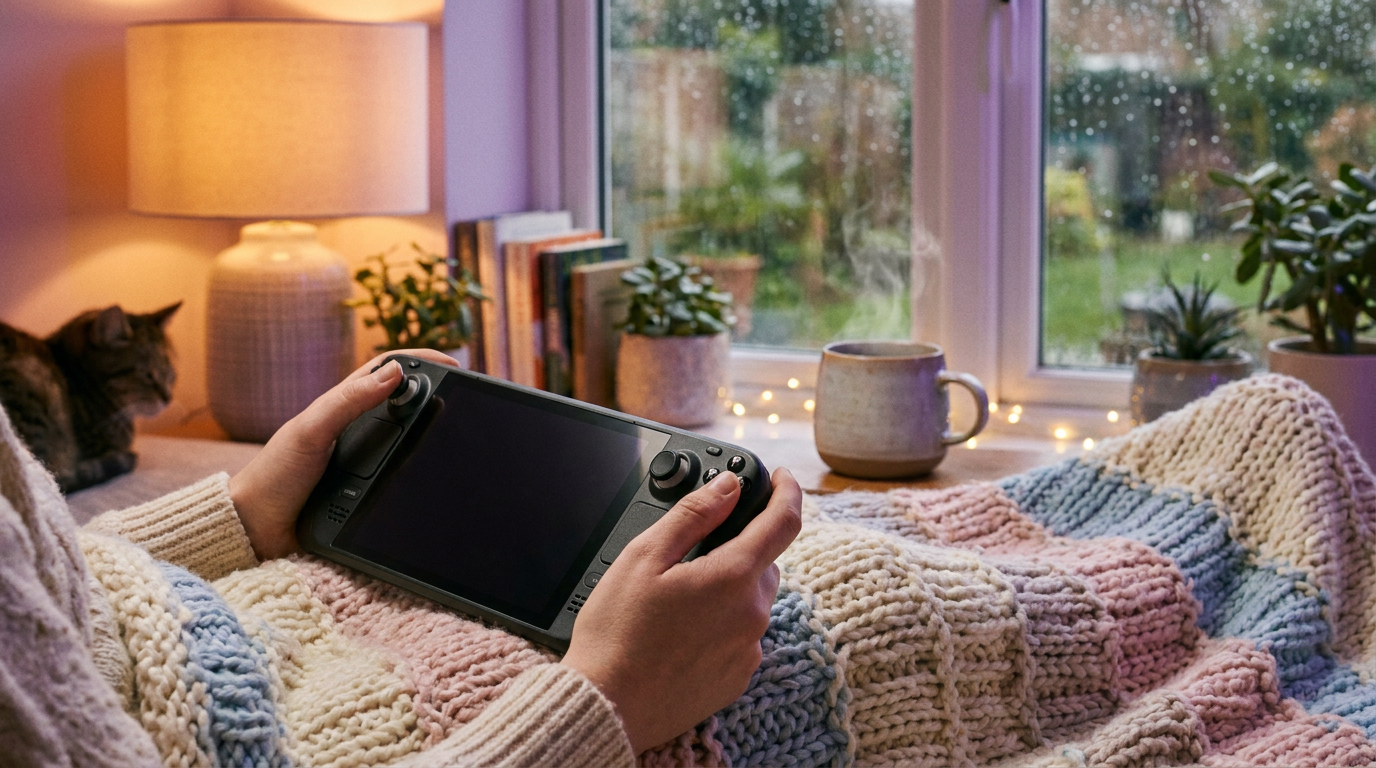
For decades, the video game industry's most lucrative titles relied on a simple physiological formula: spike the player's adrenaline. Blockbuster franchises simulated warfare, high-speed chases, and survival horror, rewarding fast reflexes and punishing failure. But by 2026, a quiet revolution has completely reshaped the digital landscape. Millions of players are logging on not to save the world, but to water virtual turnips, unpack digital moving boxes, and arrange furniture in pastel-colored rooms.[3][7]
This is the era of the "cozy game." What began as a pandemic-era coping mechanism—most notably driven by the explosive success of Nintendo's Animal Crossing: New Horizons in 2020—has matured into a permanent, billion-dollar sector of the entertainment industry. The global market for online cozy games, valued at $973 million in 2024, is now projected to reach $1.47 billion by 2032, growing at a steady 6.5% annual rate.[2][4]
The defining characteristic of a cozy game is its lack of friction. There are no harsh penalties, no ticking clocks, and no "Game Over" screens. Instead, these titles focus on creativity, gentle exploration, and low-stakes social connection. On platforms like Steam, the number of games released with the "cozy" tag has grown exponentially, doubling year over year as independent developers and major studios alike rush to meet consumer demand.[2][3]

But the true story of cozy gaming in 2026 isn't just about market economics; it is about clinical psychology. Researchers and mental health professionals are increasingly recognizing these games not as mere distractions, but as legitimate tools for emotional regulation. The appeal lies in how these digital environments interact with the human nervous system.[1][5][7]
Scientific research provides a clear picture of the mechanism at work. Multiple peer-reviewed studies have demonstrated that casual, nature-themed games significantly decrease physiological arousal. Playing these low-intensity titles can lower a player's heart rate, reduce blood pressure, and drop levels of cortisol—the body's primary stress hormone. In some clinical observations, the physiological calming effect of a cozy game mirrors that of a formal mindfulness meditation session.[5][6]
The psychological benefit is rooted in "flow state" theory. In cozy games, players engage in simple, repetitive activities—like sorting items, mapping out a garden, or cleaning a virtual town. These tasks require just enough cognitive engagement to pull the player's attention away from real-world anxieties, but not so much that they induce frustration. This channels the mind into the present moment, acting as a form of light, active meditation.[1][6]

In cozy games, players engage in simple, repetitive activities—like sorting items, mapping out a garden, or cleaning a virtual town.
A landmark 2024 study conducted in Japan, analyzing data from the pandemic years, found that game console ownership and increased gameplay were directly associated with reduced psychological distress. The predictable routines and soft aesthetics of cozy games provide a buffer against the unpredictability of daily life. Because the player has total control over their digital environment, they experience a restorative sense of agency that is often missing in high-stress workplaces.[5]
This therapeutic potential has not gone unnoticed by the medical community. In 2026, a growing number of therapists are actively incorporating cozy games into their practices. A counselor might use a client's virtual farm as a low-stakes metaphor to discuss real-life goals, setbacks, and time management. The games allow clients to practice decision-making and emotional regulation in a safe environment, skills that therapists report frequently transfer over to the client's daily routines.[5][7]
The demographics of the cozy gaming boom challenge long-held industry stereotypes. According to recent market analytics, 63% of the player base for these titles is female. Furthermore, the audience is steadily aging up. As millennials and older Gen Z players navigate the pressures of careers, mortgages, and parenthood, their tolerance for high-stress, competitive gaming has plummeted. They are actively seeking out mature, emotionally resonant narratives that fit into limited pockets of free time.[4]

The trend has also spawned a massive spectator culture. On streaming platforms like Twitch, the "chill" tag has become one of the most popular directories, attached to millions of broadcasts. Viewers tune in not for high-level esports gameplay, but to hang out in a relaxed, empathetic environment. Researchers at UC Irvine note that watching someone else play a cozy game can trigger mirror neurons, allowing the viewer to experience vicarious relaxation and socialization without the energy expenditure of playing.[1]
However, the genre's rapid commercialization has introduced growing pains. As major publishers attempt to capitalize on the trend, the market has faced a wave of "fast fashionization"—a flood of poorly optimized, derivative farming simulators rushed to digital storefronts. This oversaturation threatens to dilute the very quality that makes the genre special: the careful, handcrafted charm of independent development.[2][7]
Monetization presents another hurdle. The traditional video game industry relies heavily on microtransactions, competitive battle passes, and artificial scarcity to drive revenue. These mechanics are fundamentally incompatible with the non-competitive, stress-free ethos of cozy gaming. When studios attempt to force aggressive monetization into a cozy title, they frequently face severe backlash from a community that is highly protective of its digital sanctuaries.[4][7]

To survive the saturation, the genre is currently evolving beyond the standard farming simulator. Developers are experimenting with new mechanics that evoke coziness without relying on agricultural tropes. Recent hits include games centered around photography, running a rural post office, or simply unpacking boxes in a new apartment. The definition of "cozy" is expanding to encompass any interactive experience that prioritizes emotional safety.[2][3]
Ultimately, the rise of cozy gaming reflects a broader cultural shift in how we view digital consumption. For years, screen time was broadly categorized as an inherently stressful, isolating activity. The wholesome games movement proves that technology can be leveraged to do the exact opposite. In a world optimized for relentless speed and productivity, the simple act of slowing down in a digital space has become a radical, and highly effective, form of self-care.[1][7]
How we got here
Early 2020
Animal Crossing: New Horizons launches during global lockdowns, mainstreaming the concept of digital sanctuaries.
2021–2022
The 'Wholesome Games' community explodes on social media, giving independent developers a massive platform.
2024
The online cozy game market reaches a valuation of $973 million as major studios attempt to replicate indie successes.
2025
Twitch's 'chill' tag becomes one of the platform's most-watched categories, highlighting the demand for vicarious relaxation.
2026
Clinical adoption rises as therapists formally integrate cozy gaming mechanics into mental health treatment plans.
Viewpoints in depth
Clinical Researchers
Mental health professionals view cozy gaming as a highly accessible tool for nervous system regulation.
For clinical psychologists and researchers, the value of cozy games lies in their measurable physiological impact. Studies demonstrate that the repetitive, low-stakes tasks found in these games—like watering digital crops or organizing a room—act as a 'distraction-type' coping strategy. This light cognitive load pulls the brain out of anxious rumination and induces a flow state, effectively lowering cortisol levels and heart rates. Many in the medical community now view these games as a valid, low-cost supplement to traditional mindfulness practices, particularly for neurodivergent individuals or those who find silent meditation overly distressing.
Game Developers & Publishers
The gaming industry sees a massive economic opportunity, but struggles with the unique constraints of the genre.
For the business side of the gaming industry, the cozy genre represents a highly lucrative, rapidly expanding market that taps into an older, predominantly female demographic with disposable income. However, developers face a unique challenge: the core audience actively rejects the monetization strategies that usually drive industry profits. Aggressive microtransactions, competitive leaderboards, and artificial time-gates induce the exact stress players are trying to escape. Consequently, studios are forced to innovate new, non-predatory revenue models while fighting off market oversaturation caused by a flood of low-quality, copycat farming simulators.
Cozy Gamers & Streamers
Players value the genre as a digital sanctuary that prioritizes community, creativity, and emotional safety.
For the players themselves, cozy gaming is a lifestyle and a community as much as it is a hobby. In a culture that constantly demands productivity and speed, players view these games as a guilt-free pause button. The appeal extends beyond the games themselves into the broader ecosystem of Twitch streams, TikToks, and Discord servers, where the focus is on sharing aesthetic setups and supporting independent creators. For this camp, the lack of violence and competition isn't just a preference; it is a necessary boundary that protects their mental energy after a demanding workday.
What we don't know
- Whether the market can sustain its current growth rate without alienating players through oversaturation and corporate monetization.
- The long-term psychological effects of substituting real-world social interaction with parasocial, cozy digital environments.
- How the definition of 'cozy' will evolve as virtual reality (VR) and augmented reality (AR) technologies become more mainstream.
Key terms
- Cozy Game
- A subgenre of video games focused on relaxation, creativity, and non-competitive gameplay, often featuring farming, decorating, or narrative exploration.
- Flow State
- A psychological state of deep, effortless concentration and immersion in an activity, which can reduce anxiety and promote mental clarity.
- Cortisol
- The body's primary stress hormone, which can be measurably reduced by engaging in calming, low-stakes digital activities.
- Mirror Neurons
- Brain cells that react both when a person performs an action and when they observe someone else performing it, explaining why watching relaxing game streams can feel therapeutic.
Frequently asked
What exactly is a 'cozy game'?
A cozy game is a video game designed for relaxation rather than competition. They typically feature low-stakes gameplay, no harsh penalties or time limits, soft aesthetics, and mechanics focused on creativity, farming, or gentle exploration.
Can video games actually reduce stress?
Yes. Peer-reviewed studies show that playing casual, low-intensity games can lower heart rate, reduce the stress hormone cortisol, and induce a light meditative 'flow state' that helps regulate emotions.
Who is playing these games?
The demographic is broad but skews older and more female than traditional gaming markets. Market research indicates that approximately 63% of the cozy game player base is female, with many players seeking relief from daily burnout.
Why are therapists using video games?
Some therapists use cozy games as a low-pressure tool to help clients discuss real-life goals. The games allow patients to practice decision-making, time management, and emotional regulation in a safe, controllable digital environment.
Sources
Source coverage
7 outlets
3 viewpoints surfaced







[1]MashableClinical Researchers
The psychology behind mindfulness and cozy gaming
Read on Mashable →[2]The GuardianCozy Gamers & Streamers
The explosion of the cozy gaming genre
Read on The Guardian →[3]PC GamerCozy Gamers & Streamers
How 'cozy' became the biggest gaming trend of the decade
Read on PC Gamer →[4]Intel Market ResearchIndustry Analysts
Online Cozy Game Market Growth Analysis 2025-2032
Read on Intel Market Research →[5]Genuine TherapyClinical Researchers
The Science-Backed Benefits of Cozy Gaming
Read on Genuine Therapy →[6]The Potion GameClinical Researchers
How Cozy Games Reduce Stress: The Scientific Basis
Read on The Potion Game →[7]Factlen Editorial TeamIndustry Analysts
Synthesis by Factlen editorial team
Read on Factlen Editorial Team →

Every angle. Every day.
Get entertainment stories with full source coverage and perspective breakdowns delivered to your inbox.