
Carbon Monoxide Detection Confirms Uranus is a True Ice Giant
A breakthrough detection of carbon monoxide deep in Uranus's atmosphere confirms the planet's core is rich in water ice rather than rock. The finding settles a long-running debate and provides crucial evidence for how the outer solar system formed.
By Factlen Editorial Team
- Planetary Astronomers
- Focuses on the observational data and chemical markers that define planetary interiors.
- Formation Theorists
- Focuses on how planetary compositions reflect the conditions of the early solar system.
- Future Mission Advocates
- Emphasizes the limitations of telescopes and the need for direct atmospheric entry probes.
What's not represented
- · Exoplanet Researchers
Why this matters
Understanding the true composition of Uranus helps astrophysicists refine the models of how our solar system formed and evolved. Because ice giants are the most common type of planet found in the galaxy, unlocking Uranus's secrets provides a blueprint for understanding water-rich worlds orbiting distant stars.
Key points
- Astronomers detected carbon monoxide deep in Uranus's atmosphere using the ALMA telescope array.
- The presence of this gas indicates that Uranus's interior is highly enriched with water ice, not rock.
- The finding settles a long-running debate over whether Uranus is a true 'ice giant' or a 'rock giant'.
- Confirming the ice giant model supports theories that Uranus formed far out in the solar system near the carbon monoxide ice line.
For decades, planetary scientists have debated a fundamental question about the architecture of the outer solar system: Are Uranus and Neptune truly "ice giants," or are they actually "rock giants" hiding beneath thick, hazy atmospheres? Because these distant worlds are shrouded in choking blankets of hydrogen and helium gas, peering into their deep interiors has been nearly impossible. Researchers have had to rely on indirect measurements, gravitational models, and external magnetic field readings, leading to a long-running controversy over what exactly constitutes the core of the seventh planet from the Sun.[2]
Now, a breakthrough in radio astronomy has tipped the scales. By detecting carbon monoxide deep within Uranus's atmosphere, researchers have uncovered a critical chemical marker that reveals the planet's internal structure. The findings confirm that Uranus's core is indeed stuffed with ice rather than rock, settling the debate and solidifying its status as a true ice giant. This discovery not only resolves a planetary identity crisis but also provides crucial evidence for how water-rich worlds form across the galaxy.[1][6]
The discovery relied on mapping the planet's submillimeter emissions between 2022 and 2024. By peering through the upper cloud decks with unprecedented sensitivity, the team successfully measured the abundance of carbon monoxide in the planet's lower atmosphere, known as the troposphere. This region is notoriously difficult to probe because of the thick layers of methane and ammonia haze that obscure deeper thermal emissions. Capturing a clear signal required pushing the world's most advanced radio telescope arrays to their absolute limits.[1]
In the high-pressure chemistry of giant planets, carbon monoxide acts as a definitive diagnostic tool for what lies beneath. If a planet's interior is dominated by rock—specifically silicates—its oxygen is locked away in solid form, leaving the atmosphere heavily depleted of carbon monoxide. Conversely, if the interior is dominated by water ice, the abundant oxygen reacts under extreme heat and pressure to form detectable levels of carbon monoxide gas that eventually well up into the troposphere. This chemical relationship makes carbon monoxide one of the few reliable proxies for understanding the bulk composition of a gas-shrouded world without having to drill through thousands of kilometers of atmosphere.[2]

The recent data revealed an upper tropospheric carbon monoxide abundance of approximately 5.8 parts per billion. When researchers ran this figure through complex thermochemical models, the results were definitive: the only way Uranus could support this level of carbon monoxide is if its mantle is highly enriched with water ice. A rock-dominated interior simply could not produce the observed chemical signature. The models demonstrate that the deep oxygen abundance is far too high to be accounted for by silicates alone.[1]
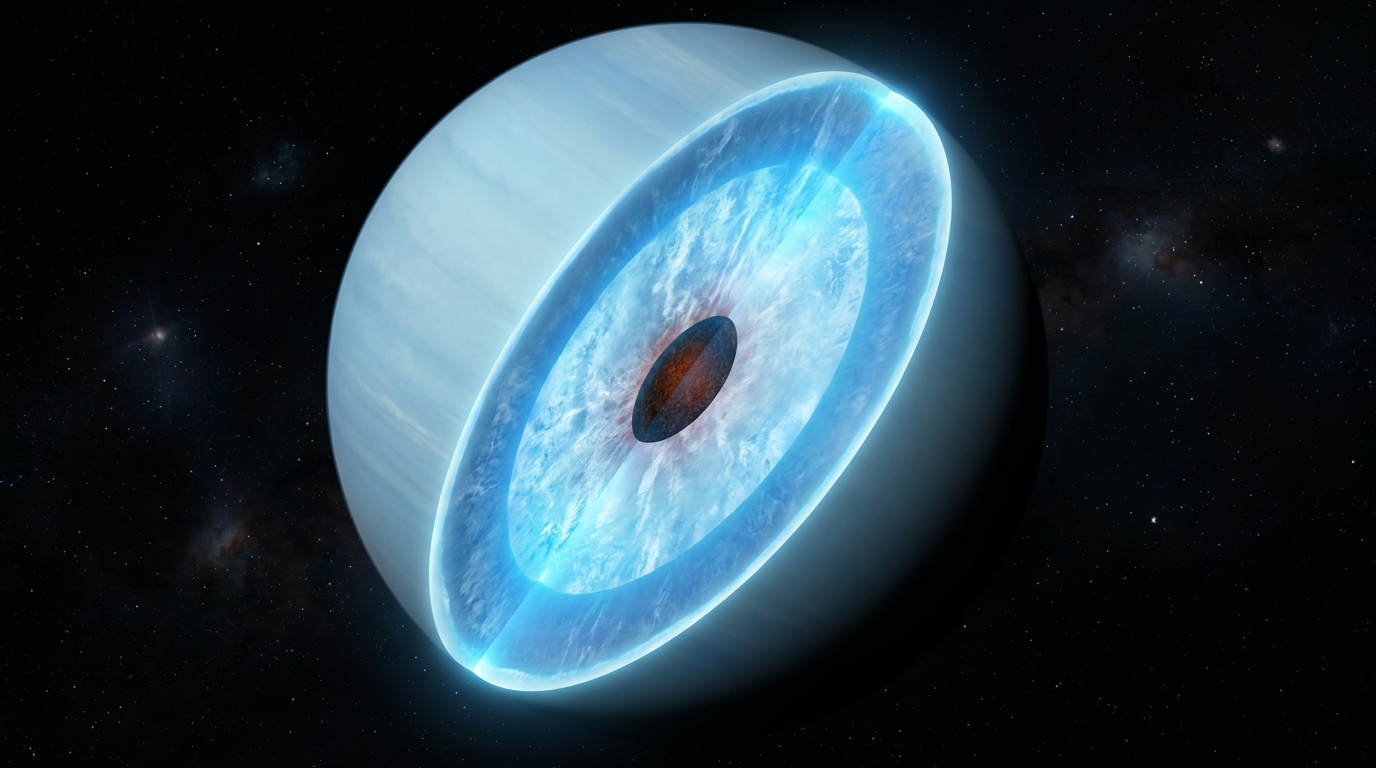
However, the "ice" inside Uranus is not like the solid cubes found in a standard freezer. Under the extreme temperatures and crushing pressures of the planet's mantle, water, ammonia, and methane exist in a supercritical state known as a "superionic fluid." This bizarre phase of matter behaves simultaneously like a liquid and a solid, with oxygen atoms locking into a crystalline lattice while hydrogen ions flow freely through it. Its highly electrically conductive nature is believed to generate the planet's unusual, off-center magnetic field.[3]
Interestingly, the observations also detected carbon monoxide floating much higher up, in Uranus's stratosphere. But atmospheric circulation models indicate this upper-layer gas did not dredge up from the deep interior. Instead, scientists believe it was delivered by a rogue comet that smashed into the planet hundreds of years ago, leaving a lingering chemical scar in the upper atmosphere. This dual-source reality highlights the complex, dynamic nature of the Uranian atmosphere, where internal chemistry and external bombardments both leave lasting marks.[1]
Interestingly, the observations also detected carbon monoxide floating much higher up, in Uranus's stratosphere.
Confirming Uranus as a true ice giant has profound implications for our understanding of how the solar system formed. If Uranus had turned out to be a rock giant, it would have implied that it formed through a completely different mechanism than its neighbor, Neptune. This would have forced astrophysicists to rewrite the models of planetary migration that explain the current architecture of the outer solar system, as it is highly unlikely two vastly different planets would end up in adjacent, similar orbits.[1][2]
Current formation theories suggest that both Uranus and Neptune coalesced far out in the primordial protoplanetary disk, near the "carbon monoxide ice line." In this frigid region of the early solar system, temperatures were low enough for carbon monoxide gas to freeze into solid building blocks, which the growing planets then accreted as they swept through their orbital paths. Forming at this specific distance from the young Sun allowed them to gather the massive amounts of volatile ices that define their interiors today.[4]
This formation pathway explains several of the ice giants' quirks, including their high carbon enrichment and their severe depletion of nitrogen compared to Jupiter and Saturn. Accreting large quantities of carbon monoxide ice alongside water ice perfectly matches the isotopic signatures measured in their atmospheres today, tying their origin directly to the coldest reaches of the early solar nebula. It provides a cohesive narrative that links their current chemical makeup to the specific conditions present billions of years ago.[4]

While Uranus and Neptune share a similar origin story, they evolved into distinct worlds. Uranus is the lighter of the two, weighing in at 14.54 Earth masses compared to Neptune's 17. It also famously rotates on its side—an extreme axial tilt of 97.8 degrees that was likely caused by a catastrophic collision with an Earth-sized protoplanet early in its history. This severe tilt gives Uranus the most extreme seasons in the solar system, with each pole facing decades of continuous sunlight followed by decades of total darkness.[3]
Recent observations by the James Webb Space Telescope have further highlighted Uranus's unique dynamics. Webb's infrared instruments have mapped the planet's upper atmosphere in three dimensions, revealing how its lopsided magnetic field influences auroral formations and temperature distributions. These observations confirm that Uranus's upper atmosphere is still actively cooling, a trend first noticed in the 1990s. Together with the ALMA data, these findings are painting the most detailed portrait yet of how energy and chemistry flow through the ice giant.[5]
Despite these remote sensing breakthroughs, significant uncertainties remain. Ground-based and space-based telescopes can only probe the uppermost layers of the atmosphere. The exact ratio of rock to ice, the precise depth of the transition zones, and the mechanics of the planet's internal dynamo are still hidden beneath thousands of kilometers of crushing gas. Remote observations provide vital clues, but they cannot replace the hard data that comes from physically sampling a planet's environment. Scientists are still forced to rely on extrapolated models to guess exactly where the gaseous atmosphere ends and the superionic ice mantle begins.[2]

To definitively map the interior, the planetary science community argues that an in-situ mission is required. A dedicated Uranus Orbiter and Probe—which would drop a mass spectrometer directly into the atmosphere to sample the chemistry firsthand—has been identified as a top priority for future space exploration. Such a mission would measure the exact abundances of noble gases and isotopic ratios, providing the ground-truth data needed to confirm the remote observations and finalize our understanding of ice giant formation.[2]
Until a dedicated probe launches, our only direct measurements come from the Voyager 2 spacecraft, which performed a brief flyby in 1986. Today's discoveries rely entirely on the ingenuity of astronomers pushing the limits of modern observatories, slowly peeling back the layers of the solar system's most mysterious planets. By detecting the faint chemical whispers of carbon monoxide from billions of miles away, scientists have proven that even after decades of observation, Uranus still has profound secrets to reveal.[3][6]
How we got here
1986
NASA's Voyager 2 spacecraft performs the first and only close flyby of Uranus, gathering foundational data on its atmosphere and magnetic field.
2014
Dynamical models propose that Uranus and Neptune formed at the carbon monoxide ice line, explaining their unique chemical signatures.
2022–2024
Astronomers use the ALMA telescope array in Chile to map Uranus's submillimeter emissions, searching for deep atmospheric trace gases.
June 2026
Researchers announce the detection of carbon monoxide in Uranus's troposphere, confirming the planet's interior is dominated by water ice.
Viewpoints in depth
Planetary Astronomers
Focuses on the observational data and chemical markers that define planetary interiors.
For observational astronomers, the detection of deep-atmospheric carbon monoxide is a triumph of remote sensing. Because the crushing pressures of giant planets prevent direct sampling, researchers must rely on trace gases that act as chemical proxies. The ALMA data provides the strongest empirical evidence yet that Uranus's mantle is oxygen-rich, confirming the ice giant model and demonstrating the power of next-generation submillimeter arrays.
Formation Theorists
Focuses on how planetary compositions reflect the conditions of the early solar system.
Theorists studying the origins of the solar system view the confirmation of Uranus's icy interior as a crucial validation of migration models. If Uranus accreted its mass near the carbon monoxide ice line, it explains the planet's severe nitrogen depletion and carbon enrichment. This supports the hypothesis that the ice giants formed in a specific, frigid zone of the protoplanetary disk before migrating to their current orbits.
Future Mission Advocates
Emphasizes the limitations of telescopes and the need for direct atmospheric entry probes.
While remote observations have settled the broad strokes of the ice-versus-rock debate, mission advocates argue that telescopes can only see so deep. They emphasize that the exact rock-to-ice ratio, the depth of the superionic mantle, and the mechanics of Uranus's bizarre magnetic field remain entirely theoretical. For this camp, the ALMA findings are a compelling preview that justifies funding a dedicated Uranus Orbiter and Probe to drop instruments directly into the atmosphere.
What we don't know
- The exact ratio of rock to ice deep within Uranus's interior remains unmeasured.
- The precise depth at which the gaseous atmosphere transitions into the superionic ice mantle is still theoretical.
- It is unclear exactly how Uranus's highly conductive superionic fluid generates its severely lopsided magnetic field.
Key terms
- Ice Giant
- A giant planet composed largely of elements heavier than hydrogen and helium, such as oxygen, carbon, nitrogen, and sulfur, which planetary scientists refer to as 'ices.'
- Superionic Fluid
- A phase of matter under extreme pressure and temperature where water behaves as both a liquid and a solid, with highly mobile hydrogen ions.
- Carbon Monoxide Ice Line
- The specific distance from a young star where temperatures drop low enough for carbon monoxide gas to freeze into solid grains.
- Troposphere
- The lowest layer of a planet's atmosphere, where weather occurs and convection drives atmospheric circulation.
Frequently asked
Why is Uranus called an ice giant if it's made of gas?
While Uranus has a thick gaseous atmosphere of hydrogen and helium, the bulk of its mass consists of heavier elements like water, ammonia, and methane. In planetary science, these volatile compounds are traditionally called 'ices,' even when they exist as superionic fluids.
How did carbon monoxide get into Uranus's upper atmosphere?
Scientists believe the carbon monoxide found high in the stratosphere was delivered by a comet that collided with Uranus centuries ago, rather than welling up from the planet's interior.
Will NASA send another mission to Uranus?
The planetary science community has strongly recommended a dedicated Uranus Orbiter and Probe as a top priority for the coming decades, though a mission has not yet launched.
Sources
Source coverage
6 outlets
3 viewpoints surfaced






[1]New ScientistPlanetary Astronomers
Gas from Uranus reveals it has an icy centre
Read on New Scientist →[2]Philosophical Transactions of the Royal Society AFormation Theorists
Neptune and Uranus: ice or rock giant?
Read on Philosophical Transactions of the Royal Society A →[3]Sky at Night MagazineFuture Mission Advocates
Uranus facts: 10 things you didn't know about the ice giant
Read on Sky at Night Magazine →[4]ScienceDailyFormation Theorists
The measured compositions of Uranus and Neptune from their formation on the CO ice line
Read on ScienceDaily →[5]ESA WebbPlanetary Astronomers
Webb maps Uranus's upper atmosphere
Read on ESA Webb →[6]Factlen Editorial TeamFuture Mission Advocates
Synthesis by Factlen editorial team
Read on Factlen Editorial Team →


Every angle. Every day.
Get science stories with full source coverage and perspective breakdowns delivered to your inbox.