
US-Iran Peace Talks in Switzerland Postponed After Deadly Flare-Up in Lebanon
A sudden escalation of violence between Israel and Hezbollah forced the abrupt cancellation of technical negotiations in Geneva, threatening the fragile 60-day peace framework between Washington and Tehran.
By Factlen Editorial Team
- US Administration
- Prioritizes the broader US-Iran peace deal and global economic stability, viewing the Lebanon conflict as a dangerous spoiler.
- Israeli Government
- Treats the fight against Hezbollah as an independent national security imperative, rejecting constraints from a US-Iran agreement it did not sign.
- Iranian Leadership
- Demands that the US rein in Israel's military campaign in Lebanon before committing to further nuclear negotiations.
- Global Energy Markets
- Hyper-focused on the free flow of oil through the Strait of Hormuz and the prevention of further supply shocks.
What's not represented
- · Lebanese civilians displaced by the fighting
- · European diplomats facilitating the Swiss summit
Why this matters
The sudden suspension of the U.S.-Iran peace talks demonstrates how easily a localized flare-up in Lebanon can derail global diplomacy. If the 60-day negotiation window collapses, the world faces the immediate threat of renewed conflict in the Middle East, soaring energy prices, and severe disruptions to international shipping.
Key points
- U.S. and Iranian officials abruptly postponed technical peace talks scheduled for Friday in Switzerland.
- The cancellation followed a deadly flare-up in Lebanon, where a Hezbollah ambush killed four Israeli soldiers.
- Israel retaliated with massive airstrikes across southern Lebanon, resulting in at least 47 deaths.
- Following intense mediation by the U.S. and Qatar, Israel and Hezbollah agreed to renew their ceasefire by Friday afternoon.
- Global oil prices fluctuated wildly, spiking on the cancellation news before retreating as the truce took hold.
- The broader U.S.-Iran Memorandum of Understanding, which includes a 60-day negotiation window, remains highly precarious.
The highly anticipated diplomatic summit between the United States and Iran, scheduled to take place in the Swiss Alps, was abruptly cancelled on Friday morning. U.S. Vice President JD Vance, the lead negotiator for the Trump administration, grounded his flight at Joint Base Andrews just hours before departure, citing unresolved logistical issues. The sudden postponement sent shockwaves through the international community, raising immediate questions about the durability of the fragile peace framework established earlier in the week.[1][6]
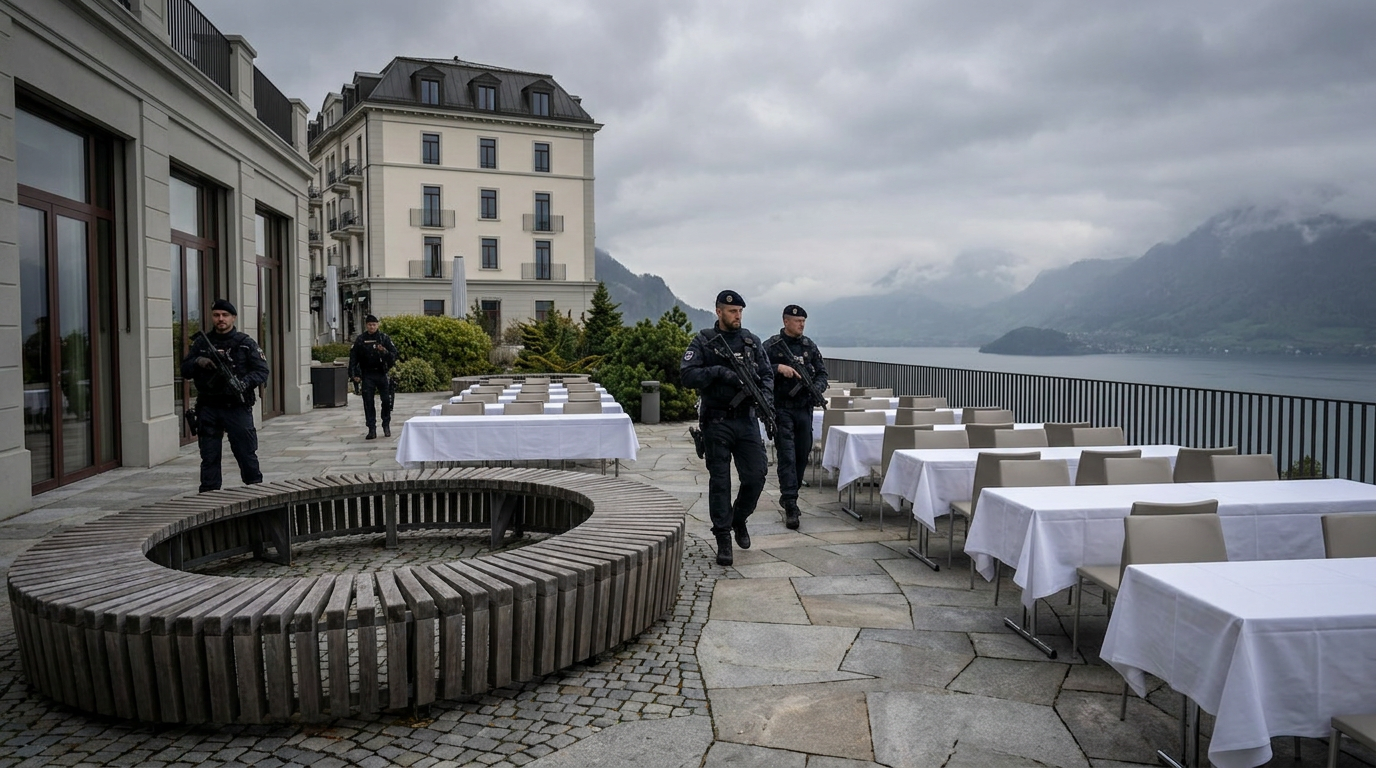
The stakes for the Bürgenstock summit were monumental. The talks were designed as the first round of technical negotiations following the signing of a landmark Memorandum of Understanding (MoU) between Washington and Tehran. That interim agreement formally ended months of direct military conflict, reopened the critical Strait of Hormuz to global shipping, and initiated a 60-day window to negotiate a permanent settlement regarding Iran's nuclear program.[1][8]
The trigger for the diplomatic collapse did not originate in Washington or Tehran, but in the volatile borderlands of southern Lebanon. On Thursday, the Iran-backed militant group Hezbollah launched a deadly ambush on an Israeli tank in the village of Kfar Tebnit. The attack killed four Israeli soldiers, including a battalion commander, marking the deadliest incident for the Israel Defense Forces since a tentative local truce had been established.[2][3]
Israel responded with overwhelming force. The Israeli military launched a wave of roughly 150 airstrikes across southern and eastern Lebanon, targeting what it described as Hezbollah command centers and launch positions. The bombardment resulted in massive casualties; the Lebanese Health Ministry reported that at least 47 people were killed and nearly 100 others wounded in the retaliatory campaign.[2][3]

This fierce escalation in Lebanon directly threatened the broader U.S.-Iran peace framework. The first clause of the newly signed MoU explicitly mandates the immediate and permanent termination of military operations on all fronts, including in Lebanon. By continuing to exchange fire, both Israel and Hezbollah were effectively violating the core premise of the agreement that was supposed to serve as the foundation for the Swiss talks.[1][8]
In response to the Israeli airstrikes, Tehran adopted a hardline stance. Iranian officials informed mediators that they would not send their delegation to Geneva, demanding concrete guarantees that the United States would rein in Israel's military campaign. Iran's Foreign Ministry publicly stated that further negotiations were impossible without the implementation of a comprehensive, region-wide ceasefire.[3][6]
The diplomatic breakdown triggered a frantic scramble behind the scenes. Recognizing that the entire peace process was on the verge of collapse, officials from the United States, Qatar, and Iran engaged in urgent back-channel mediation. Their primary objective was to halt the violence in Lebanon before it could permanently derail the 60-day negotiation window established by the MoU.[2][5]
The diplomatic breakdown triggered a frantic scramble behind the scenes.
The pressure campaign yielded a breakthrough by Friday afternoon. Following intense negotiations, Israel and Hezbollah agreed to renew their fragile ceasefire, with the halt in hostilities officially taking effect at 4:00 p.m. local time. U.S. officials confirmed the truce, noting that the immediate crisis had been contained, though the underlying tensions remained entirely unresolved.[2][5][8]

President Donald Trump reportedly played a direct role in securing the renewed ceasefire. In a Friday interview, the President confirmed that he had personally spoken with Israeli leadership, urging them to halt their offensive operations to protect the broader diplomatic effort with Iran. The intervention highlighted the administration's determination to prioritize the U.S.-Iran deal over localized tactical engagements.[3][8]
The crisis exposed a deepening and public rift between the United States and Israel. During a press briefing, Vice President Vance delivered an unusually blunt rebuke to members of the Israeli cabinet who had criticized the Iran deal. Vance warned Israeli leaders to wake up and smell the reality, reminding them that the U.S. is their only remaining powerful ally on the global stage and cautioning against actions that undermine American diplomatic objectives.[6]
From Jerusalem's perspective, the situation looks fundamentally different. Israel was not a party to the U.S.-Iran MoU and has consistently maintained that its military operations against Hezbollah are a separate, non-negotiable national security imperative. Israeli Prime Minister Benjamin Netanyahu has vowed to maintain a six-mile security buffer in southern Lebanon to protect northern Israeli communities, regardless of the diplomatic timelines established in Washington and Tehran.[2][8]
The geopolitical whiplash had an immediate and volatile impact on global energy markets. Traders, who had spent the week celebrating the reopening of the Strait of Hormuz, were suddenly forced to price in the risk of a renewed regional war. The uncertainty sent shockwaves through trading desks from London to New York.[4][7]

Brent crude, the international oil benchmark, initially spiked above $80 per barrel on Friday morning as news of the cancelled Swiss talks broke. However, as reports of the renewed Lebanon ceasefire filtered through the markets later in the day, prices retreated, ultimately erasing their earlier gains. The wild fluctuations underscored how tightly the global economy remains tethered to the diplomatic maneuvering in the Middle East.[4][7]
Despite the diplomatic crisis, the physical mechanisms of the U.S.-Iran deal have begun to function. The U.S. military confirmed that it had lifted its naval blockade of Iranian ports, and Vice President Vance noted that tankers carrying more than 12 million barrels of oil had successfully transited the Strait of Hormuz overnight without incident. The resumption of energy flows provided a crucial counterweight to the political instability.[1][4]

Yet, the path forward remains highly precarious. The MoU only provides a 60-day window to resolve deeply entrenched issues, including the unfreezing of Iranian assets and the implementation of strict curbs on Tehran's nuclear ambitions. With the technical talks in Switzerland postponed indefinitely, the clock is ticking on an agreement that has already proven highly vulnerable to external shocks.[1][3]
For now, the Middle East remains in a state of suspended animation. The immediate threat of a wider war has been averted by the renewed ceasefire in Lebanon, but the fundamental contradictions between Israel's security imperatives and the U.S.-Iran peace framework remain unresolved. Until negotiators can finally sit down at the table, the durability of the entire diplomatic enterprise will continue to hang in the balance.[1][5]
How we got here
Early June 2026
The United States and Iran sign a Memorandum of Understanding to end direct hostilities and reopen the Strait of Hormuz.
June 18, 2026
Hezbollah ambushes an Israeli tank in southern Lebanon, killing four soldiers; Israel retaliates with massive airstrikes.
June 19, 2026 (Morning)
The U.S. and Iran abruptly postpone technical peace talks scheduled to take place in Switzerland.
June 19, 2026 (Afternoon)
Following intense mediation by the U.S. and Qatar, Israel and Hezbollah agree to renew their fragile ceasefire.
Viewpoints in depth
The U.S. Administration's view
Prioritizing the broader peace framework over localized tactical engagements.
For Washington, the overarching strategic goal is to finalize the historic Memorandum of Understanding with Iran, which promises to stabilize global energy markets and curb Tehran's nuclear program. U.S. officials view the ongoing conflict in Lebanon as a dangerous spoiler that threatens to derail this massive diplomatic achievement. This perspective was underscored by Vice President JD Vance's blunt public warnings to Israeli leadership, indicating that the administration is willing to exert immense pressure on its closest regional ally to ensure the 60-day negotiation window remains open.
The Israeli Government's view
Treating the northern front as an independent national security imperative.
Jerusalem fundamentally rejects the premise that its military operations should be constrained by a U.S.-Iran agreement it did not sign. From the perspective of the Israeli defense establishment, Hezbollah remains an existential threat on its northern border, and the recent ambush that killed a battalion commander demands an overwhelming military response. Prime Minister Benjamin Netanyahu's government insists on maintaining a physical security buffer in southern Lebanon to protect its citizens, viewing the U.S. pressure to halt operations as an infringement on its sovereign right to self-defense.
The Iranian Leadership's view
Leveraging regional proxies to force American concessions on Israel.
Tehran is utilizing its influence over Hezbollah and its control of the Strait of Hormuz as diplomatic leverage. By refusing to send a delegation to Switzerland until the fighting in Lebanon ceased, Iranian negotiators effectively forced the United States to act as a restraining force on Israel. Iranian officials argue that the MoU explicitly calls for an end to hostilities on all fronts, and they are demanding tangible proof that Washington can deliver on this comprehensive ceasefire before committing to complex, long-term negotiations regarding their nuclear capabilities.
Global Energy Markets' view
Hyper-focused on the physical flow of oil through the Strait of Hormuz.
For energy traders and macroeconomic analysts, the political nuances of the Lebanon conflict are secondary to the physical security of the Strait of Hormuz. The market's primary concern is preventing a return to the supply shocks that characterized the height of the U.S.-Iran war. This perspective was evident in the wild fluctuations of Brent crude on Friday; prices spiked on the headline risk of the cancelled talks but rapidly cooled once it became clear that the ceasefire had been renewed and that millions of barrels of oil were successfully transiting the strait.
What we don't know
- When, or if, the postponed technical talks in Switzerland will be rescheduled.
- Whether Israel will agree to permanently withdraw its forces from the six-mile security buffer in southern Lebanon.
- How the Trump administration plans to navigate the deepening public rift with the Israeli government over the peace framework.
Key terms
- Memorandum of Understanding (MoU)
- A formal, written agreement between two or more parties that establishes a framework for future negotiations, though it is often not legally binding.
- Strait of Hormuz
- A narrow, strategically vital waterway between the Persian Gulf and the Gulf of Oman through which roughly a fifth of the world's oil supply passes.
- Buffer Zone
- A neutral or demilitarized area separating hostile forces; Israel is currently occupying a six-mile stretch of southern Lebanon to prevent cross-border attacks.
- Brent Crude
- A major trading classification of sweet light crude oil that serves as a benchmark price for purchases of oil worldwide.
Frequently asked
Why were the US-Iran talks in Switzerland cancelled?
The talks were postponed after a deadly military flare-up between Israel and Hezbollah in Lebanon violated the terms of the newly signed U.S.-Iran ceasefire agreement.
What does the US-Iran Memorandum of Understanding (MoU) actually do?
It establishes a 60-day window to negotiate a permanent peace deal, reopens the Strait of Hormuz to international shipping, and mandates an end to hostilities on all fronts.
Is Israel a part of the US-Iran peace deal?
No. Israel was not a party to the negotiations and has maintained that its military campaign against Hezbollah in Lebanon is a separate national security issue.
How did the oil markets react to the cancelled talks?
Brent crude prices initially spiked above $80 per barrel on fears of renewed conflict, but retreated after Israel and Hezbollah agreed to renew their ceasefire later in the day.
Sources
Source coverage
8 outlets
4 viewpoints surfaced








[1]The GuardianGlobal Energy Markets
US-Iran talks abruptly called off after Israel and Hezbollah trade deadly attacks
Read on The Guardian →[2]The Washington PostUS Administration
After 4 Israeli soldiers' deaths, Israel and Hezbollah agree to renew ceasefire
Read on The Washington Post →[3]The Times of IsraelIsraeli Government
US-Iran talks delayed as Iran demands guarantee Israel will halt Lebanon strikes
Read on The Times of Israel →[4]CNBCGlobal Energy Markets
Oil prices turn negative after U.S. official says Israel, Hezbollah agree to ceasefire
Read on CNBC →[5]CBS NewsUS Administration
Israel and Hezbollah agree to a ceasefire, diplomat briefed on the deal says
Read on CBS News →[6]Saudi GazetteIranian Leadership
US-Iran talks in Switzerland called off as Israel and Hezbollah trade strikes
Read on Saudi Gazette →[7]Investing.comGlobal Energy Markets
U.S. stock futures edge lower after a strong rally on Wall Street driven by hopes that a U.S.-Iran peace deal could hold
Read on Investing.com →[8]TIMEUS Administration
Israel and Hezbollah Agree to Cease-Fire After Strikes Risked Derailing U.S.-Iran Talks
Read on TIME →

Every angle. Every day.
Get news politics stories with full source coverage and perspective breakdowns delivered to your inbox.