
The Rise of the 'Library of Things': How Communities Are Rethinking Ownership
Neighborhoods worldwide are launching "Libraries of Things" to share tools, appliances, and gear, saving residents money while reducing environmental waste and building local trust.
By Factlen Editorial Team
- Circular Economy Advocates
- Focus on reducing consumption, keeping items out of landfills, and challenging the retail model.
- Community Builders
- Emphasize the social benefits of sharing hubs, including combating isolation and fostering neighborhood trust.
- Economic Equity Proponents
- Highlight how shared access removes financial barriers for low-income households to repair homes and access resources.
What's not represented
- · Traditional hardware retailers facing reduced local sales
- · Corporate rental companies competing with free community alternatives
Why this matters
By shifting from individual ownership to community access, Libraries of Things offer a practical way to save thousands of dollars on household items while drastically reducing clutter and environmental waste. This movement provides a blueprint for how neighborhoods can build resilience, trust, and economic equity outside of traditional retail systems.
Key points
- Libraries of Things (LoTs) allow community members to borrow infrequently used items like power tools and camping gear.
- The average power drill is used for only 15 minutes in its lifetime, highlighting the inefficiency of individual ownership.
- There are over 2,000 formal LoTs operating globally, ranging from volunteer setups to multi-location enterprises.
- The model saves members money, reduces landfill waste, and lowers the carbon footprint of neighborhoods.
- Unlike corporate gig-economy platforms, LoTs keep wealth and resources circulating within the local community.
- Public libraries are increasingly adopting the model, integrating 'things' into their traditional book catalogs.
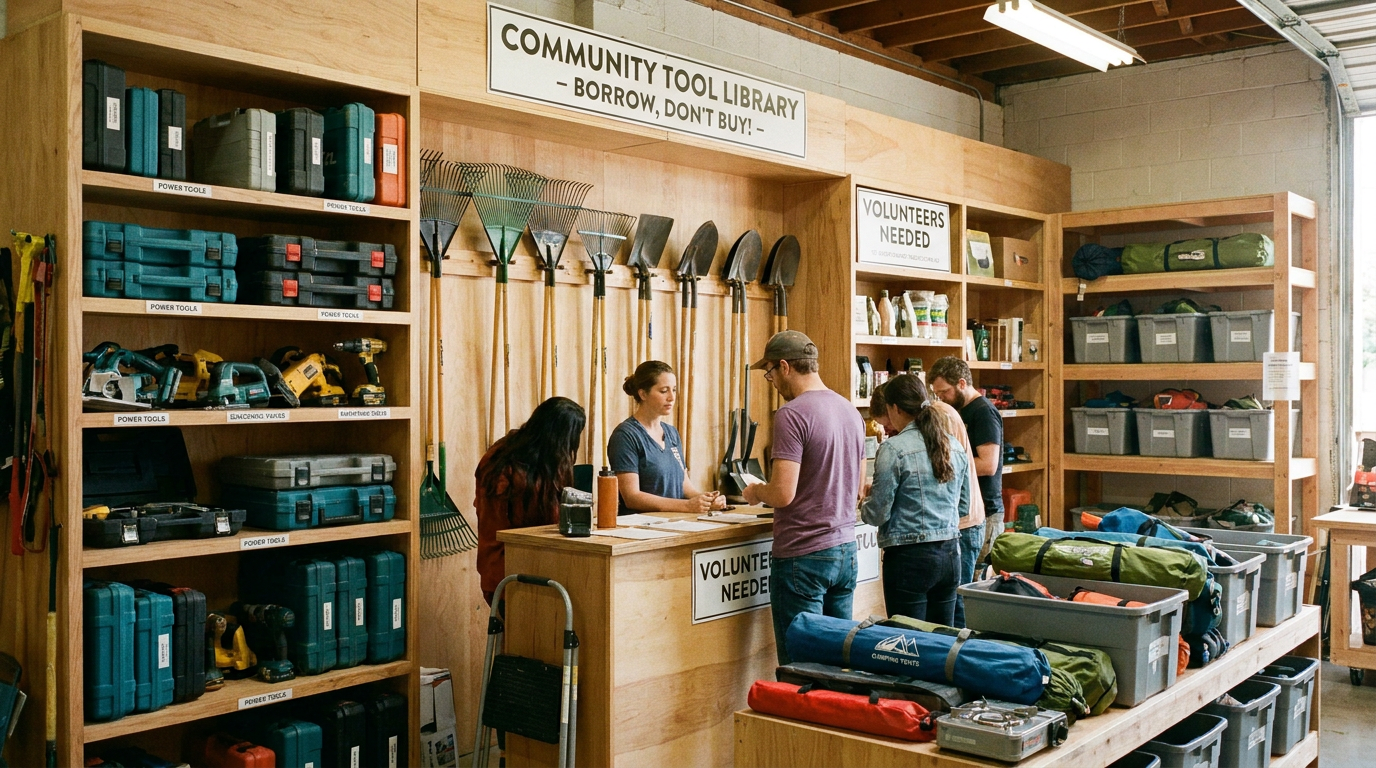
Consider the average power drill. It is a staple of the modern household, sitting on a garage shelf or tucked into a closet, waiting for the rare moment a picture needs hanging or a shelf needs mounting. According to circular economy researchers, the average power drill is used for just 13 to 15 minutes over its entire lifetime. Yet, millions of households purchase their own, dedicating money and space to an item that spends 99.9% of its existence gathering dust. This paradox of modern consumption—where neighborhoods are filled with identical, underutilized tools—has sparked a quiet but rapidly growing grassroots rebellion. Across the globe, communities are rethinking the necessity of individual ownership and embracing a model that prioritizes access over accumulation. The result is the "Library of Things" movement, a civic innovation that applies the traditional public library model to household items, tools, and recreational gear.[3][4]
A Library of Things (LoT) operates on a simple premise: borrow what you need, use it, and return it for the next person. Instead of browsing shelves for novels or biographies, members browse for circular saws, pasta makers, camping tents, and carpet cleaners. The inventory typically consists of items that are highly useful but only needed occasionally, making them financially and spatially cumbersome to own. By centralizing these resources, a single neighborhood LoT can replace the need for hundreds of individual purchases. Members usually pay a sliding-scale annual fee or a small per-item borrowing cost, granting them access to thousands of dollars worth of equipment. This model not only declutters homes but fundamentally shifts how communities interact with the material world, transforming passive consumers into active participants in a shared local economy.[1][5]

What began as a scattering of experimental tool-sharing initiatives has matured into a robust global network. Today, there are an estimated 2,000 formal Libraries of Things operating worldwide, alongside countless informal neighborhood sharing groups. These hubs range from modest, volunteer-run operations housed in shipping containers or community centers to highly organized, multi-location enterprises. In the United Kingdom, the London-based Library of Things has scaled to 19 diverse neighborhoods, employing 20 staff members and generating an annual turnover of £800,000. By licensing their digital platform and partnering with local governments, they have demonstrated that the model can be both financially viable and highly scalable. Meanwhile, in North America, established hubs like the Toronto Tool Library boast inventories of over 7,000 items, serving as vital civic infrastructure for thousands of residents.[1][2][3]
The economic implications of this movement are profound, particularly for low- and middle-income households. By removing the financial barrier to accessing high-quality tools and equipment, LoTs democratize self-sufficiency. A family living in affordable housing can borrow the tools necessary to repair furniture or maintain their living space without incurring high-interest debt or sacrificing their weekly grocery budget. In London alone, the Library of Things estimates that it has saved its members over £6 million, with 84% of users reporting tangible financial relief. Furthermore, this model keeps money circulating within the local community rather than funneling it to multinational big-box retailers. It represents a tangible shift toward economic equity, where a person's ability to improve their home or pursue a hobby is no longer strictly dictated by their disposable income.[2][5]

The economic implications of this movement are profound, particularly for low- and middle-income households.
Beyond household economics, the Library of Things is a cornerstone of the emerging circular economy. Traditional retail relies on a linear model of extraction, production, consumption, and disposal—a cycle that heavily taxes the planet's resources. By maximizing the utility of a single manufactured item, sharing libraries drastically reduce material intensity and carbon emissions. When a neighborhood shares one high-quality pressure washer instead of purchasing fifty cheap ones, the environmental savings multiply. Organizations tracking these metrics note that established LoTs divert tons of potential waste from landfills each year. This collective approach to resource management offers a pragmatic, community-led response to the climate crisis, proving that sustainable living does not have to mean a reduction in quality of life; rather, it can mean smarter, more efficient access to the things we need.[2][3][4]
Advocates are quick to distinguish the Library of Things from the corporate "sharing economy" popularized by tech giants over the last decade. While platforms like Uber and Airbnb commodify personal assets for profit—often extracting wealth from communities and exacerbating local housing crises—tool libraries represent a "real" sharing economy. They are inherently place-based, non-extractive, and focused on mutual aid rather than shareholder returns. These resource-sharing systems sidestep top-down economic structures, treating people as neighbors and collaborators rather than mere consumers or gig workers. By embedding the sharing mechanism within a non-profit or cooperative framework, LoTs ensure that the aggregated wealth and social power generated by the project remain firmly within the community that built it.[5][6]
Perhaps the most transformative, yet difficult to quantify, benefit of a Library of Things is its impact on social cohesion. In an era marked by increasing isolation and digital fragmentation, physical sharing hubs force neighbors to interact. Returning a borrowed item often leads to conversations about home projects, gardening tips, or local events. Many LoTs have evolved beyond simple lending desks into vibrant community hubs, hosting repair cafes, skill-sharing workshops, and youth mentoring programs. Members report feeling a stronger sense of belonging and pride in their neighborhoods. By fostering an environment of reciprocal care and trust, these spaces weave a tighter social fabric, proving that the simple act of sharing a ladder or a sewing machine can be a powerful antidote to urban alienation.[1][4][5]

Despite their success, running a Library of Things is not without significant challenges. The vast majority of these organizations operate on shoestring budgets of less than $10,000 a year, relying heavily on the dedication of unpaid volunteers. Maintaining a fleet of power tools requires specialized knowledge, and ensuring the safety and liability of borrowed equipment is a constant administrative burden. Finding affordable, accessible physical space in increasingly expensive urban real estate markets is another major hurdle. Many grassroots libraries struggle with burnout as the demands of inventory management, community outreach, and fundraising fall on a small core team. To survive long-term, these initiatives must navigate the delicate balance between remaining accessible to low-income residents and generating enough revenue to cover operational costs and equipment repair.[1][3]
Looking ahead, the Library of Things movement is poised to transition from a niche sustainability trend into standard civic infrastructure. Public library systems across the globe are increasingly integrating "things" into their traditional catalogs, recognizing that lending a thermal imaging camera or a guitar aligns perfectly with their historic mission of providing free access to information and resources. Additionally, forward-thinking urban planners and affordable housing developers are beginning to incorporate dedicated sharing spaces directly into new residential builds. As communities continue to grapple with the dual pressures of economic inflation and environmental degradation, the logic of the shared economy becomes undeniable. By choosing access over ownership, neighborhoods are not just decluttering their garages—they are actively building more resilient, connected, and equitable communities.[1][2][6]
How we got here
1943
First tool library opens in Grosse Pointe Farms, Michigan, initially designed to offer training to young people.
2012
The Toronto Tool Library opens its doors, helping to popularize the modern, large-scale community lending model.
2014
The Library of Things project begins testing in London, eventually scaling to 19 neighborhoods and raising over £1.5 million.
2019
The Make-Do library of things launches in Australia, reflecting the movement's rapid global expansion.
2024
Shareable launches the Library of Things Co-Lab, bringing together hundreds of organizers to train and scale community resource-sharing spaces.
2026
Public library systems globally report significant expansions of their non-traditional collections, cementing 'things' as standard civic infrastructure.
Viewpoints in depth
Circular Economy Advocates
Focus on reducing consumption, keeping items out of landfills, and challenging the retail model.
Advocates for a circular economy view the Library of Things as a direct challenge to the linear "take-make-dispose" model of modern retail. They argue that manufacturing millions of complex, resource-intensive items—like power drills or carpet cleaners—only for them to sit idle in private garages is an ecological failure. By maximizing the utilization rate of a single product, sharing libraries drastically reduce the need for raw material extraction, manufacturing energy, and packaging waste. Organizations like the Ellen MacArthur Foundation point to these libraries as practical, scalable examples of decoupling economic activity from the consumption of finite resources. Furthermore, they argue that LoTs incentivize the production of higher-quality, repairable goods. When a community hub purchases a tool, they prioritize durability and repairability over the planned obsolescence that plagues cheap consumer goods, slowly shifting market demand toward sustainable manufacturing.
Community Builders
Emphasize the social benefits of sharing hubs, including combating isolation and fostering neighborhood trust.
For community organizers, the physical inventory of a tool library is secondary to the social infrastructure it creates. They argue that the true value of a Library of Things lies in its ability to combat urban isolation and foster neighborhood trust. In a society where people increasingly interact through digital screens, a physical space dedicated to mutual aid forces serendipitous, face-to-face connections. These advocates highlight how LoTs naturally evolve into broader community hubs. A space that lends tools often begins hosting repair cafes, where older generations pass down fixing skills to younger members, or DIY workshops that empower residents to take ownership of their living spaces. By framing the transaction as a cooperative exchange rather than a retail purchase, community builders believe these libraries weave a tighter, more resilient social fabric capable of withstanding broader societal crises.
Economic Equity Proponents
Highlight how shared access removes financial barriers for low-income households to repair homes and access resources.
Proponents of economic equity focus on how the Library of Things dismantles financial barriers to self-sufficiency. They argue that the traditional retail model unfairly penalizes low-income households, who often cannot afford the upfront cost of specialized tools necessary for home repair, vehicle maintenance, or even starting a small side business. By offering access for free or via a nominal sliding-scale fee, LoTs provide immediate financial relief. These advocates draw a sharp distinction between grassroots sharing libraries and the corporate "sharing economy" (like Uber or Airbnb), which they criticize for extracting wealth from communities. In contrast, a neighborhood-owned tool library keeps capital circulating locally. When a family saves hundreds of dollars by borrowing rather than buying a pressure washer, that retained wealth can be redirected toward essential needs, incrementally leveling the playing field in under-resourced neighborhoods.
What we don't know
- Whether the volunteer-driven model can sustain long-term growth without transitioning to paid staff.
- How traditional hardware retailers will adapt if community borrowing significantly impacts local sales.
- The exact global carbon emissions saved by the movement, as data collection remains fragmented across thousands of independent libraries.
Key terms
- Library of Things (LoT)
- A community-based lending system that allows people to borrow physical resources—like tools, appliances, and recreational gear—instead of purchasing them.
- Circular Economy
- An economic model focused on eliminating waste by sharing, leasing, reusing, repairing, and refurbishing existing materials and products for as long as possible.
- Real Sharing Economy
- Grassroots, peer-to-peer, or community-owned resource sharing networks, distinct from corporate rental platforms that extract profit from user assets.
- Mutual Aid
- A voluntary, reciprocal exchange of resources and services for mutual benefit, emphasizing solidarity and community care over charity.
- Planned Obsolescence
- The practice of designing products to break or become useless quickly, forcing consumers to buy replacements—a trend sharing libraries actively combat by purchasing durable goods.
Frequently asked
How much does it cost to join a Library of Things?
Costs vary by location. Many operate on a sliding scale, offering annual memberships ranging from $20 to $100, while others are entirely free or ask for a small per-item borrowing fee.
What happens if a borrowed tool breaks?
Most libraries understand that tools experience normal wear and tear and will repair the item at no cost to the borrower. However, members may be asked to pay a replacement fee if the item was damaged due to negligence or misuse.
Do public libraries offer these items?
Increasingly, yes. Many traditional public library systems are expanding their catalogs to include "Library of Things" collections, lending out everything from baking pans and board games to thermal imaging cameras.
How do these libraries acquire their inventory?
The vast majority of items are donated by community members decluttering their homes. Some libraries also secure grants to purchase highly requested, durable items that are not frequently donated.
Sources
Source coverage
6 outlets
3 viewpoints surfaced





[1]ShareableCommunity Builders
Library of Things Toolkit 2.0
Read on Shareable →[2]Doughnut Economics Action LabCircular Economy Advocates
Library of Things: A circular platform enabling communities to share
Read on Doughnut Economics Action Lab →[3]Ellen MacArthur FoundationCircular Economy Advocates
Toronto Tool Library: Consolidating tools for community access
Read on Ellen MacArthur Foundation →[4]SBS NewsCommunity Builders
Do households need one of everything? These communities show another way is possible
Read on SBS News →[5]Sierra Service ProjectEconomic Equity Proponents
Tool Libraries and the Sharing Economy
Read on Sierra Service Project →[6]Factlen Editorial TeamEconomic Equity Proponents
Synthesis by Factlen editorial team
Read on Factlen Editorial Team →
Every angle. Every day.
Get community stories with full source coverage and perspective breakdowns delivered to your inbox.