
Is Climate Change Supercharging El Niño? Inside the Scientific Debate Over the Pacific's Warming Engine
As a potentially record-breaking El Niño develops in 2026, scientists are vigorously debating whether human-induced climate change is permanently altering the internal mechanics of the phenomenon.
By Factlen Editorial Team
- Natural Variability Consensus
- Maintain that El Niño's internal mechanics are driven by natural cycles, though its impacts are amplified by a warmer baseline.
- Attribution Scientists
- Argue that human-caused climate change is directly altering the frequency and baseline intensity of El Niño events.
- Climate Adaptation Planners
- Focus on preparing for the compounded extremes of El Niño and global warming, regardless of the exact meteorological mechanism.
What's not represented
- · Indigenous communities in the Amazon and Pacific Islands facing immediate displacement from extreme weather.
- · Agricultural commodities traders pricing in the risk of multi-region crop failures.
- · Local emergency management directors tasked with preparing for unprecedented floods and wildfires.
Why this matters
El Niño fundamentally rewires global weather patterns, driving droughts that spike food prices and storms that threaten infrastructure. Understanding whether climate change is permanently amplifying this cycle is crucial for governments and businesses preparing for the next decade of extreme weather.
Key points
- A potentially historic El Niño is developing in 2026, threatening to shatter global temperature records.
- Scientists agree that climate change is severely amplifying the downstream impacts of El Niño, such as floods and droughts.
- There is vigorous debate over whether greenhouse gases are permanently altering the internal mechanics of the El Niño cycle itself.
- The IPCC maintains that current El Niño behavior remains within the bounds of historical natural variability.
- Forecasters warn that the compounding effects of natural variability and global warming require urgent adaptation of global infrastructure.
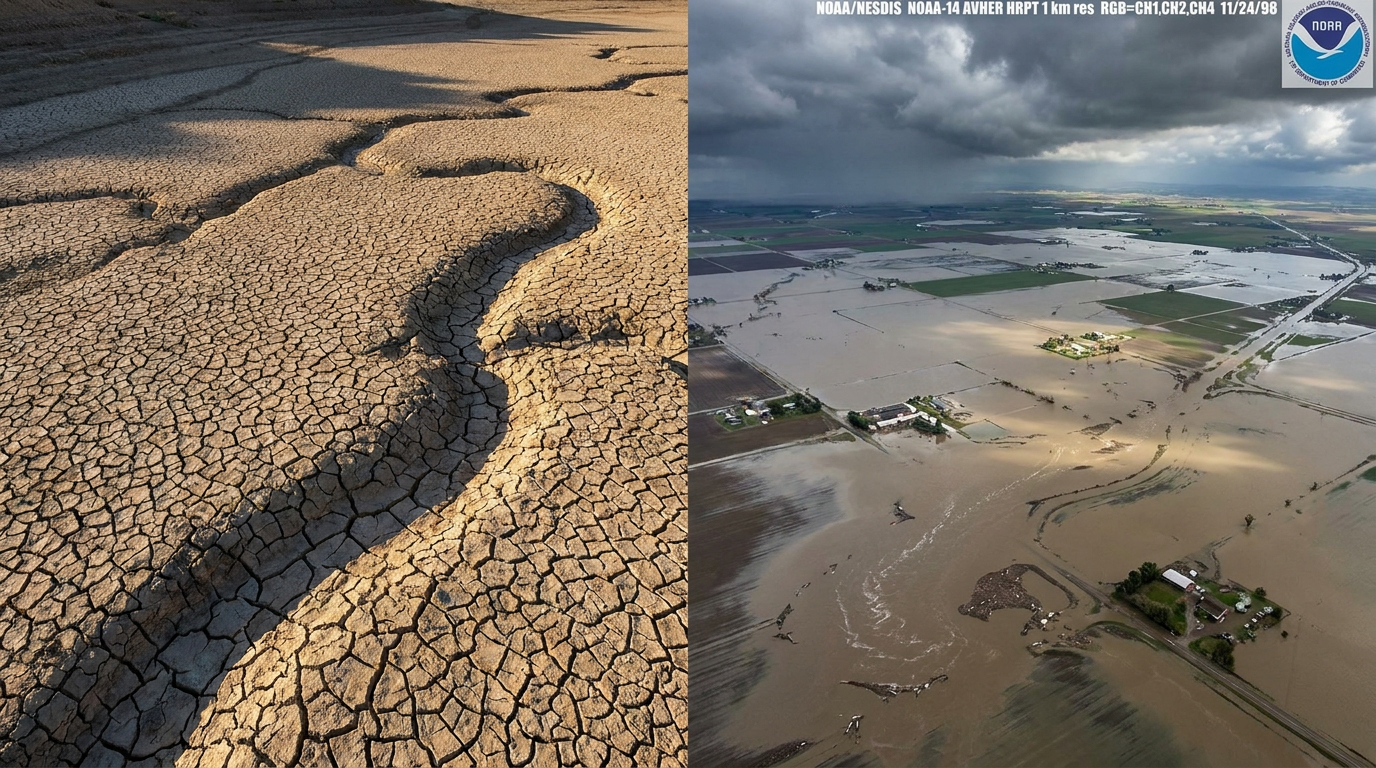
The Pacific Ocean is heating up again, signaling the rapid development of a potentially historic El Niño in 2026. Ocean buoys and satellite data have detected a steady rise in sea surface temperatures across the central and eastern equatorial Pacific, prompting major meteorological agencies to issue early warnings. This naturally occurring climate pattern is notorious for upending global weather, driving droughts in some regions and catastrophic floods in others. But its return has reignited a fierce and highly consequential scientific debate: Is human-induced climate change fundamentally supercharging the El Niño engine itself?[1][2]
The stakes of this meteorological debate are planetary in scale. El Niño years reliably produce massive spikes in global average temperatures, as the Pacific Ocean vents trapped heat into the atmosphere. With the global baseline temperature already significantly elevated by decades of greenhouse gas emissions, forecasters warn that 2026 and 2027 are poised to shatter existing heat records. The compounding effects of this heat threaten to disrupt global agriculture, strain energy grids, and trigger a cascade of extreme weather events that will test the limits of modern infrastructure.[2][3]
To understand the nuances of this debate, one must first unpack the underlying mechanism of the El Niño-Southern Oscillation, commonly referred to as ENSO. Under normal, neutral conditions, powerful trade winds blow consistently from east to west across the equatorial Pacific Ocean. These winds push warm surface water toward Asia and Australia, which in turn allows cold, nutrient-rich water from the deep ocean to upwell off the western coast of South America. This upwelling sustains massive marine ecosystems and regulates regional climates.[4]
During an El Niño event, this delicate atmospheric engine falters. For reasons that meteorologists are still working to fully predict, the east-to-west trade winds inexplicably weaken, and in severe cases, they can even reverse direction. Without the wind to hold it back, the massive pool of warm surface water sloshes eastward back toward the Americas. This warm water caps the cold upwelling, fundamentally altering the atmospheric pressure above the ocean and releasing staggering amounts of oceanic heat and moisture into the global jet stream.[4]

The core scientific consensus is entirely unified on one critical front: the downstream impacts of El Niño are undoubtedly worsening because they are occurring in a fundamentally altered, warmer world. The World Meteorological Organization notes that the atmosphere's capacity to hold water increases by roughly seven percent for every degree Celsius of warming. Consequently, when El Niño alters the jet stream to dump rain on the southern United States or the coast of Peru, that precipitation is falling from a heavily saturated atmosphere, turning typical seasonal storms into catastrophic, infrastructure-destroying floods.[2][3]
The inverse is equally true for regions that typically experience dry conditions during an El Niño. When the phenomenon suppresses rainfall in the Amazon rainforest, eastern Australia, or Southeast Asia, those droughts are exacerbated by higher baseline temperatures. The excess heat bakes the soil, accelerates evaporation, and creates a vast tinderbox for wildfires. In these instances, climate change acts as a massive threat multiplier, taking the natural variability of El Niño and stretching its consequences to dangerous new extremes.[2][4]
But the deeper, far more contentious question highlighted by recent reporting is whether climate change is altering the internal mechanics of El Niño itself. Are the trade winds and ocean currents being permanently rewired by the billions of tons of carbon dioxide pumped into the atmosphere? Some climate models and attribution scientists suggest that the frequency of "extreme" El Niño events has noticeably increased since the 1950s. They point to a potential feedback loop where a warmer ocean surface makes the trade winds inherently more prone to the sudden collapses that trigger the cycle.[1][5]
But the deeper, far more contentious question highlighted by recent reporting is whether climate change is altering the internal mechanics of El Niño itself.
Conversely, the Intergovernmental Panel on Climate Change maintains a notably more cautious stance on the mechanics of the ENSO cycle. In its most recent comprehensive assessments, the IPCC noted that there is "low confidence" that anthropogenic forcing has fundamentally changed the internal mechanism or the specific type of El Niño events. The Pacific Ocean is vast, deep, and inherently chaotic, operating on multi-decadal cycles that are notoriously difficult to model with absolute precision.[3]
Natural variability researchers argue that the historical, high-fidelity record of El Niño—which relies heavily on satellite data and ocean buoys deployed only in the last few decades—is simply too short to definitively separate human influence from the ocean's natural rhythms. While the ocean is undeniably hotter, these scientists argue that the current behavior of the El Niño engine remains within the broad bounds of historical natural variability. To them, the engine isn't necessarily running faster; it is just operating in a much hotter room.[3][4]

This scientific uncertainty is further compounded by the sheer rarity of "very strong" or "super" El Niño events. Meteorologists generally define a strong El Niño as one where sea surface temperature anomalies in the central Pacific exceed 1.5 degrees Celsius above average, with "super" events crossing the 2.0-degree threshold. With only a handful of such extreme events recorded in modern history—most notably in 1997-1998, 2015-2016, and 2023-2024—the statistical sample size is arguably too small to declare a definitive, human-caused trend in the engine's raw power.[1][4]
The media's rapid adoption of terms like "Super El Niño" often obscures the nuanced reality of climate forecasting. While the label effectively communicates the severe risks to the public, it is not a standardized meteorological classification. The National Oceanic and Atmospheric Administration and the WMO prefer to focus on the probabilistic outcomes, noting that even a "moderate" El Niño in today's superheated climate can produce the kind of devastating impacts that were previously only associated with the strongest historical events.[2][4]

The Canadian Centre for Climate Modelling and Analysis has pointed out that the alignment of natural El Niño warming with the relentless upward trend of global greenhouse gas emissions creates an unprecedented scenario. Their models indicate that the combined forcing of these two factors is pushing the Earth's climate system into uncharted territory. The rapid succession of strong El Niño events in the 21st century suggests that the buffer capacity of the world's oceans is being severely tested.[5]
Regardless of whether the ENSO engine itself is permanently supercharged or simply amplifying a hotter baseline, the synthesis of current evidence points to an escalating global crisis. NOAA forecasts currently indicate an 80 to 90 percent probability that the developing El Niño will persist through late 2026 and into 2027. This prolonged exposure to altered weather patterns guarantees widespread agricultural disruption, threatening global food security and supply chain stability.[4][6]
For policymakers, economists, and adaptation planners, the academic debate over the precise mechanics of ENSO is entirely secondary to the immediate reality on the ground. The compounding forces of natural climate variability and human-induced warming require a fundamental, urgent rethinking of global infrastructure. Governments can no longer plan for the weather of the 20th century; they must prepare for a reality where every El Niño carries the potential for unprecedented destruction.[2][6]

Ultimately, the 2026 El Niño will serve as a critical, real-time stress test for the planet. As scientists deploy advanced buoys and satellites to monitor the weakening trade winds and the eastward march of warm water, the world watches to see just how high the temperature will spike. Whether driven by a rewired ocean or simply a hotter baseline, the mandate for humanity remains the same: rapidly reduce the fossil fuel emissions that are turning natural climate cycles into existential threats.[1][6]
How we got here
Late 19th Century
Peruvian fishermen first identify and name the unusually warm ocean waters 'El Niño' because the phenomenon typically peaked around Christmas.
1997–1998
A historically powerful El Niño causes an estimated $35 billion in global damages and widespread extreme weather, bringing the phenomenon into mainstream awareness.
2015–2016
Another massive El Niño event combines with global warming to shatter global temperature records and trigger severe droughts in Africa and the Amazon.
2023–2024
A strong El Niño helps push global average temperatures past the critical 1.5°C warming threshold for the first time in recorded history.
June 2026
The WMO and NOAA confirm the rapid development of a new El Niño, warning of potentially record-breaking intensity by year's end.
Viewpoints in depth
Attribution Scientists
Researchers pointing to a shifting baseline in the Pacific Ocean's behavior.
This camp highlights that the frequency of 'extreme' El Niño events has noticeably increased since the 1950s. They argue that as greenhouse gases trap more heat in the climate system, the Pacific Ocean absorbs the brunt of this energy. This excess heat may be altering the delicate balance of the trade winds, making them more prone to the sudden collapses that trigger El Niño. For these scientists, the historical record is already showing a definitive human fingerprint on the ENSO cycle itself.
Natural Variability Consensus
Meteorologists emphasizing the inherent chaos and long-term cycles of the Pacific.
Representing the cautious mainstream view held by the IPCC, this perspective argues that the Pacific Ocean is too vast and its multi-decadal cycles too complex to definitively link changes in El Niño's engine to human activity. They point out that climate models show current El Niño behavior remains within the bounds of historical natural variability. However, they strongly agree that the impacts of El Niño are worsening, simply because a natural heat-release event is now occurring in an artificially warmed world.
Climate Adaptation Planners
Policymakers and economists focused on the immediate compounding risks.
For those tasked with protecting infrastructure and food supplies, the academic debate over whether El Niño's internal mechanics are changing is largely academic. Their focus is on the undeniable reality that the combination of natural variability and global warming is producing unprecedented extremes. This camp advocates for massive investments in early warning systems, drought-resistant agriculture, and flood defenses, operating on the assumption that every future El Niño will behave like a 'super' event.
What we don't know
- Whether the frequency of 'Super El Niño' events will permanently increase as global baseline temperatures continue to rise.
- Exactly how the current 2026 El Niño will interact with other regional climate drivers, such as the Indian Ocean Dipole.
- The precise threshold at which ocean warming might permanently alter the Pacific trade winds.
Key terms
- ENSO (El Niño-Southern Oscillation)
- The overarching climate cycle in the Pacific Ocean that includes both the warm El Niño phase and the cool La Niña phase.
- Trade Winds
- Persistent east-to-west winds along the equator that typically push warm surface water toward Asia, but weaken or reverse during an El Niño.
- Sea Surface Temperature Anomaly
- The difference between the current temperature of the ocean's surface and its long-term historical average, used to measure El Niño's strength.
- Anthropogenic Forcing
- Changes to the Earth's climate system caused by human activities, primarily the emission of greenhouse gases from burning fossil fuels.
- Upwelling
- The process where cold, nutrient-rich water from the deep ocean rises to the surface, which is typically suppressed during an El Niño event.
Frequently asked
What exactly is El Niño?
El Niño is a natural climate pattern characterized by unusually warm ocean surface temperatures in the central and eastern equatorial Pacific, which disrupts weather patterns globally.
Is climate change causing El Niño?
No. El Niño is a natural phenomenon that has occurred for millennia. However, climate change is raising the baseline temperature of the ocean and atmosphere, making El Niño's impacts significantly more severe.
What is a 'Super El Niño'?
While not an official scientific classification, meteorologists use the term to describe a very strong El Niño event where sea surface temperatures in the central Pacific rise at least 2.0 degrees Celsius above average.
How does El Niño affect global temperatures?
During an El Niño, the Pacific Ocean releases massive amounts of trapped heat into the atmosphere. This temporarily spikes global average temperatures, often leading to record-breaking warm years.
Sources
Source coverage
6 outlets
3 viewpoints surfaced






[1]The New York TimesAttribution Scientists
Is Climate Change Supercharging El Niño?
Read on The New York Times →[2]World Meteorological OrganizationNatural Variability Consensus
WMO Update: Prepare for El Niño
Read on World Meteorological Organization →[3]Intergovernmental Panel on Climate ChangeNatural Variability Consensus
AR6 Climate Change: The Physical Science Basis
Read on Intergovernmental Panel on Climate Change →[4]National Oceanic and Atmospheric AdministrationNatural Variability Consensus
El Niño/Southern Oscillation (ENSO) Diagnostic Discussion
Read on National Oceanic and Atmospheric Administration →[5]Canadian Centre for Climate Modelling and AnalysisAttribution Scientists
ENSO Projections and Climate Models
Read on Canadian Centre for Climate Modelling and Analysis →[6]Factlen Editorial TeamClimate Adaptation Planners
Synthesis by Factlen editorial team
Read on Factlen Editorial Team →

Every angle. Every day.
Get science stories with full source coverage and perspective breakdowns delivered to your inbox.