
The Data Behind the 2026 Office-to-Residential Conversion Boom
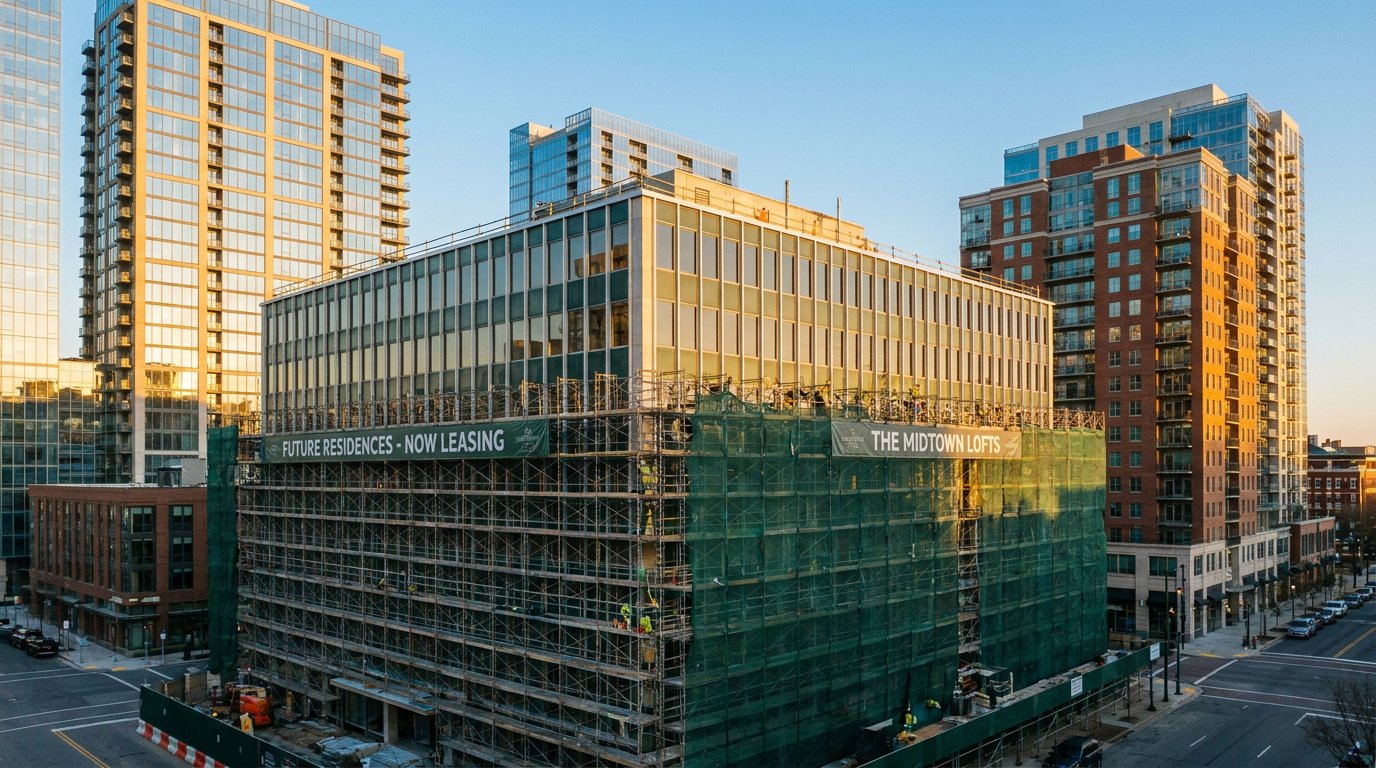
Adaptive reuse of obsolete office buildings has surged, with over 90,000 apartment units currently in the U.S. conversion pipeline. While architectural constraints mean it won't single-handedly solve the housing shortage, the trend is successfully revitalizing post-pandemic downtowns.
By Factlen Editorial Team
- Urban Planners & Developers
- Argue that adaptive reuse is essential for revitalizing downtowns and requires zoning reform and tax incentives to be financially viable.
- Commercial Real Estate Analysts
- View conversions primarily as a mechanism to remove obsolete inventory, stabilize office vacancy rates, and reset property valuations.
- Housing Advocates
- Emphasize that conversions must include affordable housing mandates, warning that luxury apartments do not solve the broader affordability crisis.
- Architectural Skeptics
- Point out the physical limitations of modern office buildings, noting that deep floor plates and plumbing overhauls make most structures unsuitable for conversion.
What's not represented
- · Existing commercial tenants facing displacement from converting buildings
- · Construction labor unions executing the retrofits
Why this matters
Empty downtowns drain municipal tax revenues and hurt local businesses, while a severe housing shortage locks millions out of homeownership. Converting obsolete office spaces into residential apartments addresses both generational challenges simultaneously, stabilizing commercial real estate markets while adding housing supply where infrastructure already exists.
Key points
- The U.S. office-to-residential conversion pipeline has reached 90,300 units in early 2026, nearly quadrupling since 2022.
- For the first time in recent history, the amount of office space being removed from the market exceeds new office construction.
- New York City leads the nation in conversions, heavily incentivized by the newly enacted 467-m property tax exemption.
- Architectural constraints, such as deep floor plates, mean that only a fraction of existing office buildings are physically suitable for residential conversion.
- While not a complete solution to the national housing shortage, adaptive reuse is successfully revitalizing post-pandemic downtowns.
The post-pandemic shift to hybrid work left American downtowns grappling with a historic glut of empty office space. Simultaneously, a severe national housing shortage has driven up rents and locked millions out of homeownership. The proposed solution—converting obsolete office towers into residential apartments—has transitioned from a theoretical talking point into a measurable market reality, backed by a surge of institutional capital.[8]
The scale of adaptive reuse is accelerating at an unprecedented rate. According to early 2026 data from RentCafe, the number of office spaces scheduled to become apartments has reached 90,300 units nationwide. This represents a 28 percent year-over-year increase and is nearly four times higher than the pipeline recorded in 2022.[1][6]
Office-to-residential projects now account for 47 percent of all future adaptive reuse developments in the United States, far outpacing hotel and industrial conversions. Yardi Matrix, a commercial real estate data provider, notes that the scale of these projects is expanding much faster than industry analysts initially projected, driven by plunging commercial property valuations that make acquisitions viable.[1][4][6]

These conversions are fundamentally altering the commercial real estate landscape. A landmark 2025 report by CBRE revealed a historic inflection point: for the first time since at least 2018, the amount of office space being removed from the U.S. market via conversion or demolition exceeded the amount of new office construction.[2]
By the end of 2025, an estimated 23.3 million square feet of office space was slated for removal, compared to just 12.7 million square feet of new deliveries. This contraction is viewed by analysts as a necessary market correction. By removing obsolete, underperforming inventory, the commercial real estate sector can stabilize vacancy rates and support a nascent recovery for premium, highly amenitized office buildings.[2][7]

Despite the enthusiasm, the economics of buying an office building and retrofitting it for residential use remain notoriously difficult. Policy interventions and tax incentives have emerged as the primary catalysts separating viable projects from abandoned proposals.[8]
Despite the enthusiasm, the economics of buying an office building and retrofitting it for residential use remain notoriously difficult.
In New York City, which leads the nation with over 16,300 units in the conversion pipeline, the state legislature enacted the "467-m" property tax exemption in 2024. This program offers significant tax relief for developers who convert office buildings into rentals, provided that 25 percent of the apartments are income-restricted.[3][5]
The impact of this legislation is clearly visible in the data. Cushman & Wakefield tracked that office-to-residential conversion starts in New York City more than doubled from 1.6 million square feet in 2023 to 3.3 million in 2024, and hit 4.1 million square feet by August 2025 alone.[3]
Other major metros are following suit to clear regulatory hurdles. Los Angeles recently updated its Adaptive Reuse Ordinance to apply city-wide, streamlining administrative approvals for commercial buildings over 15 years old. Washington, D.C., introduced a "Housing in Downtown" program offering 20-year tax abatements for similar commercial-to-residential pivots.[4][7]
However, transparent uncertainty remains regarding the ultimate ceiling of this trend. Architectural constraints prevent adaptive reuse from acting as a silver bullet for the housing crisis. CBRE estimates that the 71 million square feet of conversions planned or underway represent only about 1.7 percent of total U.S. office inventory.[2]
The primary barrier is physical geometry. Modern office buildings often feature "deep floor plates"—massive square footage where the interior core is too far from the windows to provide natural light. Because residential building codes strictly require bedrooms to have exterior windows, highly efficient office layouts often result in unviable, windowless apartment interiors.[8]

Furthermore, upgrading plumbing, electrical, and HVAC systems from centralized commercial setups to individualized residential units requires massive capital expenditure. High construction costs and elevated interest rates mean that only buildings acquired at a steep discount—often 40 to 60 percent below their pre-pandemic peaks—are financially feasible for conversion.[2][6]
The evidence strongly supports that office-to-residential conversions are a durable, accelerating trend rather than a fleeting pandemic-era fad. However, the data also indicates that these projects are a targeted tool for urban regeneration, not a panacea for the national housing deficit.[1][3][8]
For cities willing to reform zoning laws and offer targeted tax abatements, adaptive reuse offers a proven mechanism to breathe life back into 9-to-5 business districts. By replacing empty cubicles with full-time residents, municipalities are successfully transforming single-use commercial zones into vibrant, 24-hour neighborhoods.[5][7]
How we got here
Pre-2020
Office construction outpaces conversions and demolitions by a wide margin across major U.S. markets.
2022
The U.S. office-to-residential conversion pipeline sits at roughly 23,100 units.
2024
New York enacts the 467-m tax exemption, sparking a surge in local conversion starts.
2025
For the first time, the amount of office space removed from the market exceeds new office construction.
Early 2026
The national conversion pipeline reaches 90,300 units, a nearly fourfold increase since 2022.
Viewpoints in depth
Urban Planners & Developers
Argue that adaptive reuse is essential for revitalizing downtowns and requires zoning reform.
This camp views the office vacancy crisis as a generational opportunity to correct the urban planning mistakes of the 20th century, which segregated commercial and residential zones. By offering tax abatements and streamlining permitting, they argue cities can transform sterile 9-to-5 business districts into vibrant, 24-hour neighborhoods that generate diverse tax revenues.
Commercial Real Estate Analysts
View conversions primarily as a mechanism to remove obsolete inventory and stabilize the market.
From a financial perspective, analysts focus on the supply-side benefits to the office market itself. By removing aging, underperforming buildings from the total inventory, the remaining premium office spaces can command higher rents and lower vacancy rates. They see conversions as a necessary market correction rather than a housing crusade.
Housing Advocates
Emphasize that conversions must include affordable housing mandates to be truly beneficial.
Advocates point out that the massive capital required to retrofit office buildings almost always dictates that the resulting apartments are priced at luxury rates. They argue that without strict government mandates—such as New York's requirement that 25 percent of units be income-restricted in exchange for tax breaks—adaptive reuse does little to help low- and middle-income renters.
What we don't know
- It remains unclear how elevated interest rates and construction costs will impact the completion timeline for the 90,000 units currently in the pipeline.
- The long-term impact of these conversions on overall municipal tax revenues is still being modeled by city governments.
- It is unknown if secondary and tertiary markets will adopt the aggressive tax incentives currently driving conversions in tier-one cities like New York and Los Angeles.
Key terms
- Adaptive reuse
- The process of repurposing an existing building for a use other than what it was originally designed for.
- Deep floor plate
- A building design with a large distance between the exterior windows and the interior core, common in modern offices but problematic for residential layouts.
- Net absorption
- The total amount of commercial space newly occupied in a given period minus the amount newly vacated.
- 467-m exemption
- A New York property tax incentive designed to encourage office-to-residential conversions that include affordable housing.
Frequently asked
Will office conversions solve the housing shortage?
No. While conversions are adding tens of thousands of units, they represent less than 2 percent of total U.S. office inventory and cannot single-handedly close the multi-million unit national housing deficit.
Why can't all empty offices become apartments?
Many modern office buildings have 'deep floor plates,' meaning the interior is too far from the windows. Residential building codes require bedrooms to have exterior windows, making these layouts unviable.
Are these new apartments affordable?
It depends on local policy. Because conversion costs are extremely high, most projects result in luxury apartments unless municipalities offer tax exemptions in exchange for income-restricted units.
Sources
Source coverage
8 outlets
4 viewpoints surfaced





[1]RentCafeHousing Advocates
Adaptive Reuse Report: Office-to-Residential Conversions Surge in 2026
Read on RentCafe →[2]CBRECommercial Real Estate Analysts
Office Conversions and Demolitions Will Exceed New Construction in 2025
Read on CBRE →[3]Cushman & WakefieldCommercial Real Estate Analysts
New York City Office-to-Residential Conversions Reach Historic Highs
Read on Cushman & Wakefield →[4]Yardi MatrixCommercial Real Estate Analysts
Commercial Real Estate Conversion Pipeline Accelerates
Read on Yardi Matrix →[5]NYC.govUrban Planners & Developers
Office-to-Residential Conversion Projects and the 467-m Exemption
Read on NYC.gov →[6]Multifamily ExecutiveHousing Advocates
Office-to-Apartment Conversion Pipeline Continues to Grow
Read on Multifamily Executive →[7]Scotsman GuideUrban Planners & Developers
Adaptive conversion continues to gain momentum
Read on Scotsman Guide →[8]Factlen Editorial TeamArchitectural Skeptics
Synthesis by Factlen editorial team
Read on Factlen Editorial Team →

Every angle. Every day.
Get real estate stories with full source coverage and perspective breakdowns delivered to your inbox.