
Deep Carbon Monoxide Detection Confirms Uranus is a True Ice Giant
Astronomers have detected carbon monoxide deep in the atmosphere of Uranus for the first time, providing conclusive evidence that the planet's core is packed with volatile ices rather than rock.
By Factlen Editorial Team
- Planetary Chemists
- Focuses on the chemical composition, ice lines, and the supercritical state of volatiles deep within the planet.
- Formation Theorists
- Focuses on the accretion history of the solar system and the similarities between Uranus and Neptune.
- Observational Astronomers
- Focuses on the ALMA telescope data, the difficulty of peering through the gas, and the need for a dedicated probe.
What's not represented
- · Space Agency Mission Planners
- · Exoplanet Researchers
Why this matters
Confirming the internal structure of Uranus solves a decades-old mystery about how our solar system formed. Understanding the chemical building blocks of our local ice giants also helps astronomers decode the composition of similar exoplanets discovered across the galaxy.
Key points
- Astronomers detected carbon monoxide in the lower atmosphere of Uranus for the first time.
- The presence of the gas indicates the planet's core is primarily made of ice, not rock.
- The discovery aligns the formation history of Uranus with its neighboring ice giant, Neptune.
- Both planets likely formed at the carbon monoxide 'ice line' in the early solar system.
- The 'ice' inside Uranus is actually a hot, dense supercritical fluid due to extreme pressure.
The long-standing debate over the true nature of Uranus—whether it is a true "ice giant" or a disguised "rock giant"—may finally be resolved. A breakthrough detection of carbon monoxide deep within the planet's atmosphere provides compelling evidence that its interior is packed with frozen water and volatile ices, rather than a massive rocky core.[1][2]
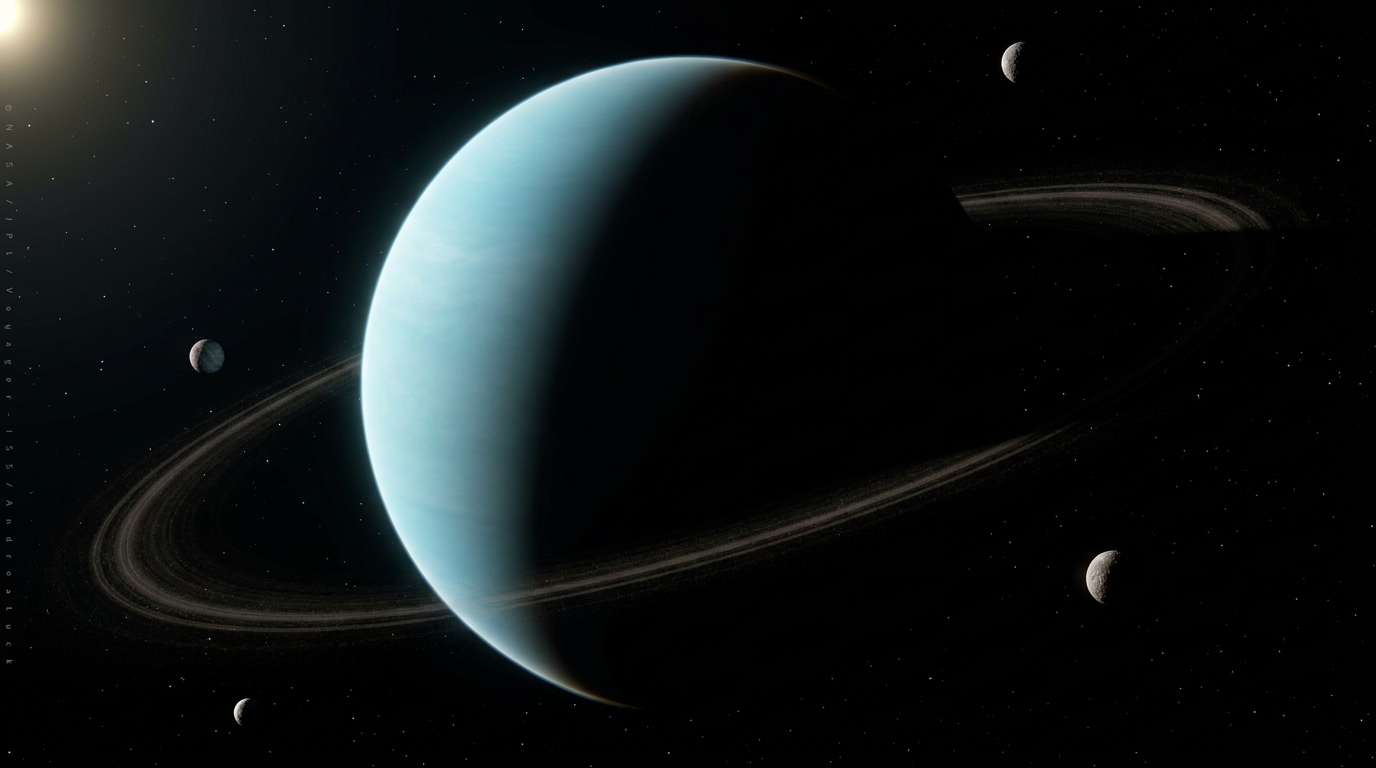
The discovery, published in June 2026, relies on high-resolution observations from the Atacama Large Millimeter/submillimeter Array (ALMA) in Chile. A research team led by Thibault Cavalié at the University of Bordeaux utilized the telescope between 2022 and 2024 to peer beneath Uranus's thick, cyan-colored clouds, successfully identifying carbon monoxide in the lower atmosphere for the first time.[1][2]
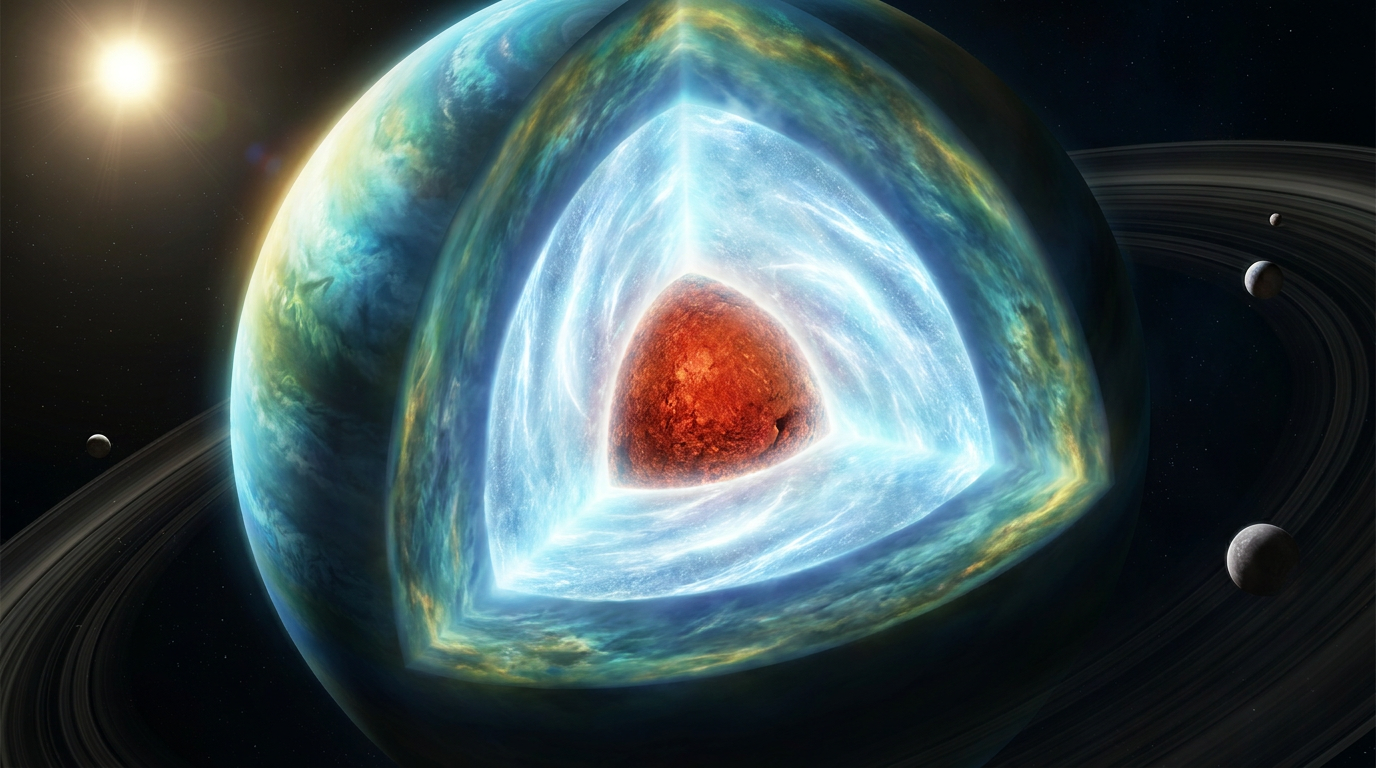
In planetary chemistry, the composition of a gas giant's outer envelope serves as a window into its inaccessible core. The primary claim driving this new consensus is that the presence of carbon monoxide in the troposphere strongly correlates with a high concentration of oxygen-rich ices—specifically water—deep within the planet.[3][8]
To test this relationship, the researchers ran the ALMA data through extensive computer simulations of the planet's internal structure. The models demonstrated that the observed abundance of carbon monoxide could only be sustained if the planet's core is overwhelmingly composed of ice rather than rock. Thibault Cavalié stated that the team found Uranus to be firmly on the ice-giant side, declaring that the structural controversy is effectively over.[1][2]

For years, the apparent absence of deep carbon monoxide on Uranus presented a major cosmological puzzle. Neptune is rich in the gas, leading some theorists to propose that Uranus was a rocky anomaly that formed under entirely different conditions than its closest neighbor.[2][4]
The new detection brings the two outermost planets back into chemical alignment. By confirming that Uranus possesses a similar volatile inventory to Neptune, the data supports the prevailing model that both planets accreted in the same frigid, distant region of the early solar system.[1][5]
Planetary chemists theorize that the ice giants formed in a specific zone of the primordial solar nebula, located between the carbon monoxide and molecular nitrogen ice lines. At distances exceeding 28 astronomical units from the young Sun, temperatures plummeted to roughly 25 Kelvin, or minus 248 degrees Celsius.[4][5]
At distances exceeding 28 astronomical units from the young Sun, temperatures plummeted to roughly 25 Kelvin, or minus 248 degrees Celsius.
In this deep freeze, carbon monoxide transitioned from a gas to a solid, creating dense peaks of concentrated ice. As Uranus and Neptune swept through this region, they accreted massive quantities of these carbon-rich solids, which explains why their modern atmospheres are highly enriched in carbon but depleted in nitrogen.[3][5]

The ALMA observations also detected carbon monoxide floating high in Uranus's stratosphere, but isotopic analysis suggests this gas did not well up from the icy core. Instead, the chemical signature points to an external delivery mechanism, adding a layer of complexity to the planet's atmospheric profile.[2][6]
The research team hypothesizes that this high-altitude carbon monoxide was deposited by a rogue comet that collided with Uranus hundreds of years ago. This dual-source reality—an internal reservoir driving the lower atmosphere and a cometary impact seeding the upper atmosphere—highlights the intricate, layered chemistry of the planet.[2][8]
While the ALMA data provides the most robust evidence to date, the researchers maintain transparent uncertainty regarding the limits of their atmospheric modeling. The link between atmospheric carbon monoxide and an icy core relies heavily on theoretical equations of state for materials under extreme pressure, which cannot be perfectly replicated in a laboratory.[2][3]
Cavalié cautioned that the team must be careful with absolute declarations, noting that their conclusions depend on the accuracy of these internal models. If the classical three-layer structure model of gas giants is flawed, the chemical ratios could theoretically be explained by a fully mixed interior with different heavy-element distributions, though the icy-core model remains the strongest fit for the data.[3][8]
A common public misconception is that the "ice" inside Uranus resembles the solid glaciers found on Earth. In reality, the extreme temperatures and crushing pressures deep within the planet force water, ammonia, and methane into a supercritical fluid state.[6][7]

This supercritical phase is a dense, hot, and highly conductive soup that behaves simultaneously like a liquid and a gas. Astronomers and chemists refer to these volatile compounds as "ices" strictly because they existed in a frozen, solid state when the planet first accreted from the protoplanetary disk billions of years ago.[6][7]
The confirmation of Uranus's icy nature has cascading implications for our understanding of planetary magnetic fields. The planet possesses a highly unusual, off-center magnetic field tilted at 59 degrees from its axis of rotation. A massive internal reservoir of supercritical water—which is electrically conductive—provides the necessary dynamo to generate this erratic magnetosphere.[3][6]
Ultimately, while ground-based observatories like ALMA have revolutionized our understanding of the outer solar system, remote spectroscopy has its limits. Fully mapping the chemical gradients and isotopic ratios of Uranus will require a dedicated flagship spacecraft mission to drop an atmospheric probe directly into its cyan clouds. Until then, the faint spectral lines of carbon monoxide remain our best guide to the icy depths of the seventh planet.[2][8]
How we got here
1986
NASA's Voyager 2 probe flies by Uranus, providing the first and only close-up data of the planet's atmosphere and magnetic field.
2014
Planetary chemists publish models suggesting Uranus and Neptune formed at the carbon monoxide ice line, though observational proof for Uranus is lacking.
2022–2024
Astronomers use the ALMA telescope in Chile to scan Uranus's lower atmosphere for chemical signatures.
June 2026
Researchers announce the detection of deep atmospheric carbon monoxide, confirming Uranus's icy interior.
Viewpoints in depth
Planetary Chemists
Focuses on the chemical composition and the supercritical state of volatiles deep within the planet.
For planetary chemists, the detection of carbon monoxide is a crucial tracer for the planet's bulk composition. Because the extreme pressures inside Uranus crush water, ammonia, and methane into a hot, dense supercritical fluid, scientists cannot observe the 'ice' directly. Instead, they rely on chemical equilibrium models which dictate that a massive internal water reservoir will naturally release carbon monoxide into the lower atmosphere. This perspective emphasizes that the term 'ice giant' refers to the planet's chemical building blocks—materials that freeze at relatively high temperatures in space—rather than its current physical state.
Formation Theorists
Focuses on the accretion history of the solar system and the similarities between Uranus and Neptune.
Formation theorists view the carbon monoxide discovery as the missing puzzle piece that aligns Uranus with its twin, Neptune. If Uranus lacked carbon monoxide, it would imply the planet formed closer to the Sun and was later thrown outward, or that it accreted from entirely different materials. By confirming the presence of CO, theorists can confidently place the birthplace of both ice giants in the deep freeze of the outer solar nebula, specifically between the carbon monoxide and nitrogen ice lines, where carbon-rich solids were abundant.
Observational Astronomers
Focuses on the ALMA telescope data and the difficulty of peering through the gas.
Observational astronomers highlight the sheer technical difficulty of this discovery. Uranus is shrouded in a thick, hazy atmosphere of hydrogen, helium, and methane that obscures its lower layers from visible-light telescopes. It required the Atacama Large Millimeter/submillimeter Array (ALMA)—a network of radio antennas in the Chilean desert—to detect the faint millimeter-wavelength emissions of carbon monoxide molecules. From this viewpoint, the breakthrough underscores the limits of remote sensing and strengthens the argument for sending a dedicated atmospheric probe to Uranus in the coming decades.
What we don't know
- Whether the classical three-layer structure model of gas giants accurately represents the interior of Uranus.
- The exact isotopic ratios of the carbon monoxide, which would definitively confirm its origin.
- How the deep internal chemistry interacts with the planet's highly unusual, off-center magnetic field.
Key terms
- Ice Giant
- A class of planets composed mainly of elements heavier than hydrogen and helium, such as oxygen, carbon, nitrogen, and sulfur, which were frozen during the planet's formation.
- Supercritical Fluid
- A state of matter that occurs at extreme temperatures and pressures, where a substance exhibits properties of both a liquid and a gas.
- Ice Line
- The specific distance from a young star where temperatures are cold enough for a particular volatile compound (like water or carbon monoxide) to freeze into solid grains.
- Protoplanetary Disk
- A rotating disk of dense gas and dust surrounding a newly formed star, from which planets eventually accrete.
- Troposphere
- The lowest, densest layer of a planet's atmosphere, where most weather occurs and where internal gases can be detected.
Frequently asked
Why is Uranus called an ice giant if it isn't frozen?
Astronomers call Uranus an 'ice giant' because it is primarily made of water, ammonia, and methane—substances that were frozen solid when the planet first formed. Inside the planet today, extreme heat and pressure turn these materials into a dense, supercritical fluid.
How did scientists find carbon monoxide on Uranus?
Researchers used the Atacama Large Millimeter/submillimeter Array (ALMA) in Chile to detect the faint radio-frequency emissions of carbon monoxide molecules hidden deep beneath the planet's upper cloud layers.
Why does carbon monoxide prove the planet has an icy core?
Chemical models show that a massive internal reservoir of oxygen-rich ices (like water) will naturally release carbon monoxide into the lower atmosphere. A purely rocky core would not produce the abundance of carbon monoxide observed.
What is the difference between Uranus and Neptune?
While both are ice giants, Neptune has long been known to have carbon monoxide, leading to debates about whether the two planets formed differently. The new discovery confirms that Uranus also has carbon monoxide, suggesting they share a similar formation history.
Sources
Source coverage
8 outlets
3 viewpoints surfaced








[1]New ScientistObservational Astronomers
Gas from Uranus reveals it has an icy centre
Read on New Scientist →[2]Daily StarObservational Astronomers
Scientists studying Uranus have found carbon monoxide, suggesting the mysterious planet is packed with a massive icy secret rather than a rocky core
Read on Daily Star →[3]Royal Society PublishingPlanetary Chemists
C, N and S abundance ratios in the Sun, Uranus and Neptune
Read on Royal Society Publishing →[4]AstrobitesPlanetary Chemists
The Measured Compositions of Uranus and Neptune from Their Formation on the CO Iceline
Read on Astrobites →[5]ScienceDailyPlanetary Chemists
Uranus and Neptune apparently formed on the Carbon Monoxide (CO) ice line
Read on ScienceDaily →[6]WikipediaFormation Theorists
Uranus
Read on Wikipedia →[7]Sky at Night MagazineFormation Theorists
Uranus: facts about the ice giant planet
Read on Sky at Night Magazine →[8]Factlen Editorial TeamFormation Theorists
Synthesis by Factlen editorial team
Read on Factlen Editorial Team →

More in science
See all 5 stories →Evolutionary Biology
The Tropical Butterfly That Defies Aging: How a Pollen Diet Unlocked Extreme Longevity
6 sources

Ice Giants
Carbon Monoxide Discovery Reveals Uranus's True Icy Core
7 sources
Cellular Therapy
Stem Cells Banish Severe Autoimmune Disease for 15 Years: The Evidence for Immune 'Reboot' Therapies
6 sources

Every angle. Every day.
Get science stories with full source coverage and perspective breakdowns delivered to your inbox.