
Why the Next Skyscraper You Enter Might Be Made of Wood
Engineered mass timber is transforming the construction industry, offering a lower-carbon alternative to steel and concrete that can safely reach up to 18 stories. But while advocates praise its speed and climate benefits, environmental researchers warn that its true ecological impact depends heavily on how the forests are managed.
By Factlen Editorial Team
- Mass Timber Advocates
- Architects, developers, and timber manufacturers who view CLT as a faster, greener, and more aesthetically pleasing alternative to traditional building materials.
- Fire & Structural Engineers
- Technical experts focused on building safety, load-bearing capacities, and the specific fire-resistance mechanics of engineered wood.
- Ecological Skeptics
- Environmental researchers who warn that the carbon benefits of timber are overstated if production waste and forest overharvesting are not strictly controlled.
- Neutral Analysts
- Independent observers and editorial teams synthesizing the structural, economic, and environmental data without a vested interest in the material's adoption.
What's not represented
- · Traditional concrete and steel manufacturers facing market disruption
- · Local communities living near heavily logged industrial forests
Why this matters
The built environment is responsible for nearly 40% of global carbon emissions, largely driven by the production of concrete and steel. If mass timber can safely replace these materials at scale, it could transform cities from massive carbon emitters into long-term carbon sinks.
Key points
- Mass timber uses engineered wood panels, like Cross-Laminated Timber (CLT), to replace concrete and steel in large buildings.
- The material acts as a carbon sink, storing CO2 and potentially reducing a building's embodied carbon by up to 75%.
- Thick timber panels are inherently fire-resistant, forming a protective char layer that maintains structural integrity during a blaze.
- Recent building code updates now permit mass timber structures to safely reach up to 18 stories.
- Environmental researchers warn that the climate benefits rely entirely on sustainable forestry to prevent a short-term carbon debt.
The skyline of the 21st century is undergoing a quiet, organic revolution. For over a century, the recipe for a high-rise was strictly limited to carbon-intensive concrete and steel. Today, a growing number of architects and developers are turning to a material that is grown rather than mined: wood. This shift represents one of the most significant changes in construction methodology in modern history, promising to reshape not just how our cities look, but how they interact with the global climate.[9]
But this is not the light-frame lumber used to build standard suburban homes. The driving force behind this architectural shift is 'mass timber,' a broad category of engineered wood products specifically designed to match or exceed the structural capabilities of traditional industrial materials. By taking smaller pieces of wood and binding them together under immense pressure, manufacturers can create massive, load-bearing components that possess extraordinary strength and stability. These engineered products allow architects to design expansive open floor plans and soaring vertical structures that were previously only possible with heavy steel beams.[1]
The most prominent of these engineered products is Cross-Laminated Timber, commonly known as CLT. Manufactured by gluing layers of kiln-dried lumber—typically three, five, or seven plies thick—at 90-degree angles to one another, CLT panels offer immense structural rigidity in both directions. This cross-lamination process neutralizes the natural tendency of wood to warp or shrink, resulting in a dimensionally stable panel that can bear tremendous weight. These massive panels are frequently utilized for floors, roofs, and load-bearing walls, serving as the primary structural skeleton of the building.[1]
Because mass timber components are prefabricated in a factory to exact digital specifications, they arrive on the construction site ready to be slotted into place. Openings for doors, windows, and even plumbing and electrical conduits are pre-cut with millimeter precision before the wood ever leaves the manufacturing facility. This allows the building to be assembled much like a giant piece of flat-pack furniture, drastically reducing the noise, dust, and chaos typically associated with a major urban construction site.[1]

This high degree of prefabrication drastically accelerates the building process. Projects utilizing mass timber can see overall construction times reduced by 15 to 20 percent compared to conventional concrete and steel builds. Because the panels are simply lifted into place and secured, the process requires a smaller on-site labor force and less heavy machinery. In an era where affordable housing shortages and high labor costs are squeezing developers, the ability to erect a mid-rise building months ahead of schedule presents a massive economic advantage.[5]
Beyond the speed of assembly, mass timber is significantly lighter than its industrial counterparts. A timber building can weigh up to one-fifth of a comparable concrete structure. This drastic reduction in dead load means the building requires a much smaller, less resource-intensive foundation. By pouring less concrete into the ground, developers save both money and carbon emissions before the building even begins to rise. Additionally, the lighter weight makes mass timber an ideal solution for urban infill projects or building on sites with poor soil conditions.[5]
The primary catalyst for the mass timber boom, however, is its environmental promise. The built environment is responsible for nearly 40 percent of annual global carbon emissions, with the manufacturing of concrete and steel accounting for a massive portion of that footprint. These traditional materials require extreme heat and chemical processes to produce, releasing vast quantities of greenhouse gases. Timber, by contrast, acts as a natural carbon sink, offering a pathway to actively remove carbon from the atmosphere.[4][9]
As trees grow, they absorb carbon dioxide from the air through photosynthesis, locking the carbon within their wood fibers. When that tree is harvested and turned into a mass timber panel, that carbon remains sequestered for the entire lifespan of the building. Environmental life-cycle assessments indicate that one cubic meter of mass timber can store approximately 0.9 tonnes of carbon dioxide. By transforming our cities into engineered forests, the construction industry could theoretically lock away millions of tonnes of carbon for decades or even centuries.[4]
When factoring in both the actively sequestered carbon and the avoided emissions from not manufacturing steel or concrete, the climate math becomes highly compelling. Studies suggest that utilizing mass timber can reduce a building's embodied carbon footprint—the total emissions associated with its materials and construction—by up to 75 percent. For governments and corporations racing to meet strict net-zero climate targets, mass timber has emerged as one of the most practical and immediate ways to decarbonize large-scale infrastructure.[4]

When factoring in both the actively sequestered carbon and the avoided emissions from not manufacturing steel or concrete, the climate math becomes highly compelling.
Despite these impressive environmental and economic benefits, the most common question raised by the public and skeptical developers is entirely intuitive: Isn't a wooden skyscraper a massive fire hazard? The idea of living or working in a high-rise made of combustible material naturally triggers alarm, especially given the historical legacy of devastating urban fires in cities built with traditional light-frame wood. Overcoming this psychological barrier has been one of the timber industry's biggest hurdles, requiring extensive physical testing and a massive educational campaign aimed at code officials and the general public.[9]
Fire and structural engineers point out that mass timber behaves fundamentally differently from light-frame wood in a fire scenario. While a standard two-by-four will ignite easily and burn rapidly, a massive timber column is inherently fire-resistant due to a chemical and physical phenomenon known as charring. When exposed to intense heat, the outer layer of a thick mass timber panel burns and creates a dense layer of black char. Because mass timber contains no hidden void spaces for fire to travel through, the flames are forced to burn the solid block of wood from the outside in, which is a slow and highly predictable process.[6]
This char layer acts as a powerful natural insulator. It starves the fire of oxygen and protects the unburned structural core of the wood from the extreme heat. Because the core remains cool and intact, the building is able to maintain its load-bearing capacity for hours, allowing occupants ample time to evacuate and giving firefighters a safe window to extinguish the blaze. In rigorous fire testing, mass timber assemblies have repeatedly demonstrated the ability to withstand intense flames without suffering sudden structural failure.[6]

In many high-heat scenarios, mass timber actually outperforms unprotected structural steel. While steel is non-combustible, it is highly conductive and begins to lose its structural integrity at high temperatures. When exposed to the heat of a severe building fire, unprotected steel beams can soften, warp, and buckle suddenly, leading to catastrophic collapse without warning. Mass timber, protected by its char layer, fails slowly and predictably, often emitting loud cracking noises that serve as a warning sign long before a collapse occurs.[6]
Recognizing this proven engineering reality, regulatory bodies have steadily updated building codes to accommodate taller wood structures. The International Code Council recently introduced sweeping changes to the International Building Code (IBC), creating new Type IV-A, IV-B, and IV-C construction classifications. Under these updated provisions, mass timber buildings are now permitted to reach up to 18 stories in height, provided they adhere to strict fire protection measures, such as encapsulating certain timber elements in fire-resistant gypsum wallboard. These code changes have effectively opened the floodgates for mass timber high-rises across North America and Europe.[2]
Yet, despite the regulatory green lights and the enthusiastic backing of the architecture community, the environmental math of mass timber is not universally accepted as a silver bullet. Environmental researchers and ecological advocates caution that the climate benefits are highly dependent on the entire lifecycle of the wood, from the forest floor to the factory. If the carbon accounting ignores the realities of industrial logging, the perceived climate savings can quickly evaporate. Critics argue that the industry often presents a best-case scenario that doesn't reflect the messy reality of global timber supply chains.[3]
The World Resources Institute notes that a significant portion of a harvested tree never actually makes it into a finished building. When a tree is felled, massive amounts of biomass—including the root system, small branches, and bark—are left behind in the forest to decompose or are burned as waste. This process releases stored carbon back into the atmosphere immediately. When factoring in the energy required to mill the logs, transport the heavy panels, and process the sawdust, the short-term emissions of mass timber production can be substantial.[3]

This dynamic creates what ecologists refer to as a 'carbon debt.' While the regrowing forest will eventually absorb the carbon lost during the harvest, that process can take decades. In the short term—the exact window in which the world urgently needs to reduce emissions to prevent catastrophic climate tipping points—a massive surge in logging to feed the mass timber industry could actually increase the amount of carbon in the atmosphere relative to using highly optimized concrete and steel.[3][8]
Furthermore, if the surging demand for mass timber leads to the overharvesting of natural, old-growth forests, it could severely degrade biodiversity and permanently reduce the planet's overall carbon-sink capacity. To ensure mass timber remains a genuine climate solution rather than an ecological liability, advocates stress that the wood must be sourced exclusively from certified, sustainably managed forests. In these tightly regulated ecosystems, harvesting is strictly balanced by replanting, ensuring that the forest's overall biomass and carbon storage remain stable over time.[8]
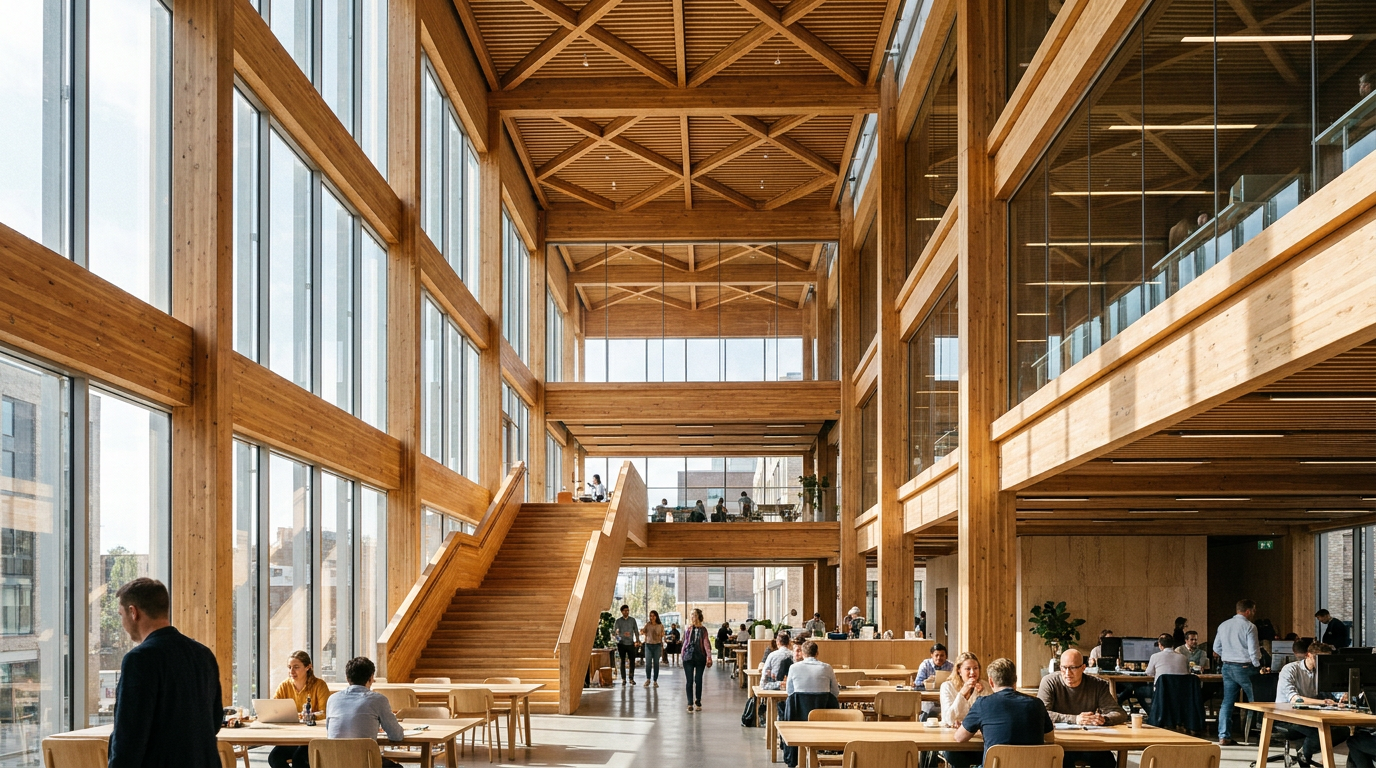
Beyond the environmental and structural debates, mass timber is also winning over occupants through its aesthetic and psychological benefits. Architects point to the principles of biophilic design, which suggest that humans have an innate biological connection to nature. Buildings that leave their mass timber structures exposed—showcasing the warm tones and natural grain of the wood—have been shown to lower stress levels, improve indoor air quality, and increase overall well-being for the people living and working inside them. In a concrete-dominated urban landscape, the presence of natural wood offers a rare sense of warmth and tranquility.[7][9]
Ultimately, mass timber represents a profound shift in how we conceive of our built environment. It offers a tangible path to construct the housing and infrastructure the world desperately needs while actively drawing down atmospheric carbon. While it requires rigorous oversight to ensure sustainable forestry practices and prevent ecological degradation, the potential upside is enormous. If the global supply chain can be managed responsibly, the cities of tomorrow may look less like sterile concrete jungles and more like towering, engineered forests, fundamentally realigning human development with the natural world.[9]
How we got here
1990s
Cross-laminated timber (CLT) is first developed and utilized in Austria and Germany.
2010s
Mass timber begins gaining traction in North America as a sustainable alternative for mid-rise commercial buildings.
2021
The International Building Code (IBC) introduces new Type IV classifications, officially recognizing tall mass timber structures.
2024
Further IBC updates refine fire safety and structural requirements, accelerating the adoption of timber high-rises globally.
Viewpoints in depth
Mass Timber Advocates
Proponents argue that CLT is the only viable way to decarbonize the construction industry at scale.
Architects and developers emphasize that mass timber is not just an environmental play, but an economic one. The prefabrication of panels allows for rapid on-site assembly, drastically reducing labor costs and construction timelines. Furthermore, the aesthetic appeal of exposed wood—often linked to biophilic design principles—creates healthier, more desirable indoor environments for occupants.
Fire & Structural Engineers
Code officials and engineers focus on the predictable, safe failure modes of massive wood components.
While the public often associates wood with kindling, structural engineers point to the physics of charring. Because mass timber panels are so thick, a fire only burns the outer layer, creating an insulating char that starves the fire of oxygen and protects the structural core. This predictable performance has given code officials the confidence to rewrite international building standards, allowing timber structures to reach unprecedented heights.
Ecological Skeptics
Environmental researchers warn that the carbon accounting of mass timber often ignores the realities of industrial logging.
Skeptics argue that the 'carbon sink' narrative is overly simplistic. When a tree is harvested, a significant portion of its biomass—roots, branches, and bark—is left to decompose or burn, releasing carbon immediately. If the global construction industry shifts entirely to wood, the resulting surge in logging could devastate natural forest ecosystems and create a massive short-term carbon debt that takes decades of regrowth to offset.
What we don't know
- Whether the global timber supply chain can scale up to meet massive urban demand without degrading natural forests.
- How mass timber buildings will perform structurally over a 100-year lifespan compared to traditional concrete.
Key terms
- Mass Timber
- A category of engineered wood products made by binding smaller pieces of wood together to create large, structurally robust panels and beams.
- Cross-Laminated Timber (CLT)
- A specific type of mass timber where layers of lumber are glued together at 90-degree angles to provide immense strength in multiple directions.
- Embodied Carbon
- The total greenhouse gas emissions generated by the extraction, manufacturing, transportation, and assembly of a building material.
- Char Layer
- The burned, blackened outer surface of a thick piece of wood that acts as thermal insulation, protecting the unburned wood inside from fire.
- Carbon Sink
- Anything that absorbs more carbon from the atmosphere than it releases, such as a growing forest or a building made of sustainably harvested wood.
Frequently asked
Is a mass timber building safe in a fire?
Yes. Unlike light-frame wood, thick mass timber panels char on the outside when exposed to fire. This char layer insulates the inner core, allowing the building to maintain its structural integrity longer than unprotected steel.
Does mass timber contribute to deforestation?
It can, if not managed properly. To be a true climate solution, the wood must be sourced from certified sustainable forests where harvesting is strictly balanced by replanting.
Is mass timber cheaper than concrete and steel?
While the raw material can sometimes cost more, mass timber often results in overall project savings due to faster construction times, reduced labor needs, and smaller foundation requirements.
How tall can a mass timber building be?
Recent updates to the International Building Code allow mass timber structures to reach up to 18 stories, provided they meet specific fire protection requirements.
Sources
Source coverage
9 outlets
4 viewpoints surfaced









[1]WoodWorksMass Timber Advocates
What are the common mass timber products and systems?
Read on WoodWorks →[2]International Code CouncilFire & Structural Engineers
2021 International Building Code: Type IV Construction
Read on International Code Council →[3]World Resources InstituteEcological Skeptics
Is Mass Timber Really a Climate Solution?
Read on World Resources Institute →[4]EcochainMass Timber Advocates
The Carbon Footprint of Timber in Construction
Read on Ecochain →[5]HUD USERMass Timber Advocates
Mass Timber Construction for Affordable Housing
Read on HUD USER →[6]Thornton TomasettiFire & Structural Engineers
Evaluating Fire Risk in Mass Timber Buildings
Read on Thornton Tomasetti →[7]HKS ArchitectsMass Timber Advocates
The Flexibility and Health Benefits of Wood
Read on HKS Architects →[8]Built by NatureEcological Skeptics
How Sustainable Timber Buildings Can Help Fight the Climate Crisis
Read on Built by Nature →[9]Factlen Editorial TeamNeutral Analysts
Synthesis by Factlen editorial team
Read on Factlen Editorial Team →


Every angle. Every day.
Get culture stories with full source coverage and perspective breakdowns delivered to your inbox.