
The Data-Driven Pool: How AI and Wearables are Decoding Swimming Biomechanics
Advances in computer vision and waterproof sensors are finally piercing the aquatic barrier, allowing sports scientists to quantify the exact physics of the perfect swim stroke.
By Factlen Editorial Team
- Sports Biomechanists
- Researchers focused on the precise physics and fluid dynamics of human movement in water.
- Computer Vision Developers
- Technologists building AI models to track and analyze stroke mechanics without physical sensors.
- Coaches and Athletes
- The end-users who must translate raw data into actionable technique adjustments in the pool.
What's not represented
- · Recreational swimmers
- · Swimwear manufacturers
Why this matters
For decades, swimming technique was guided by intuition and the 'eyeball test' because water ruins electronics and distorts video. The arrival of markerless AI tracking and waterproof micro-sensors means everyday swimmers can now access the exact biomechanical feedback once reserved for Olympic champions.
Key points
- Water's distortion and resistance to electronics have historically made swimming a difficult sport for precise biomechanical analysis.
- Researchers have discovered that spreading fingers by 10 degrees increases the hand's drag coefficient by 5 percent, generating more forward thrust.
- Waterproof wearable sensors (IMUs) can now track a swimmer's velocity variation millisecond by millisecond to pinpoint inefficiencies.
- Computer vision apps are replacing physical sensors by using AI to track over 25 body joints from standard smartphone video.
- The democratization of this technology allows amateur swimmers to access personalized, data-driven stroke correction.
For decades, the swimming pool has been an impenetrable black box for sports scientists. While runners and cyclists have long benefited from power meters, GPS trackers, and wind tunnels, swimmers operate in a uniquely hostile environment for data collection. Water distorts optical lenses, blocks wireless signals, and shorts out delicate electronics.[7]
As a result, even at the elite level, stroke analysis has historically relied on the "eyeball test"—a coach pacing the pool deck, trying to spot millimeter-scale inefficiencies through a splashing, turbulent surface. But in 2026, the aquatic data drought is officially ending.[7]
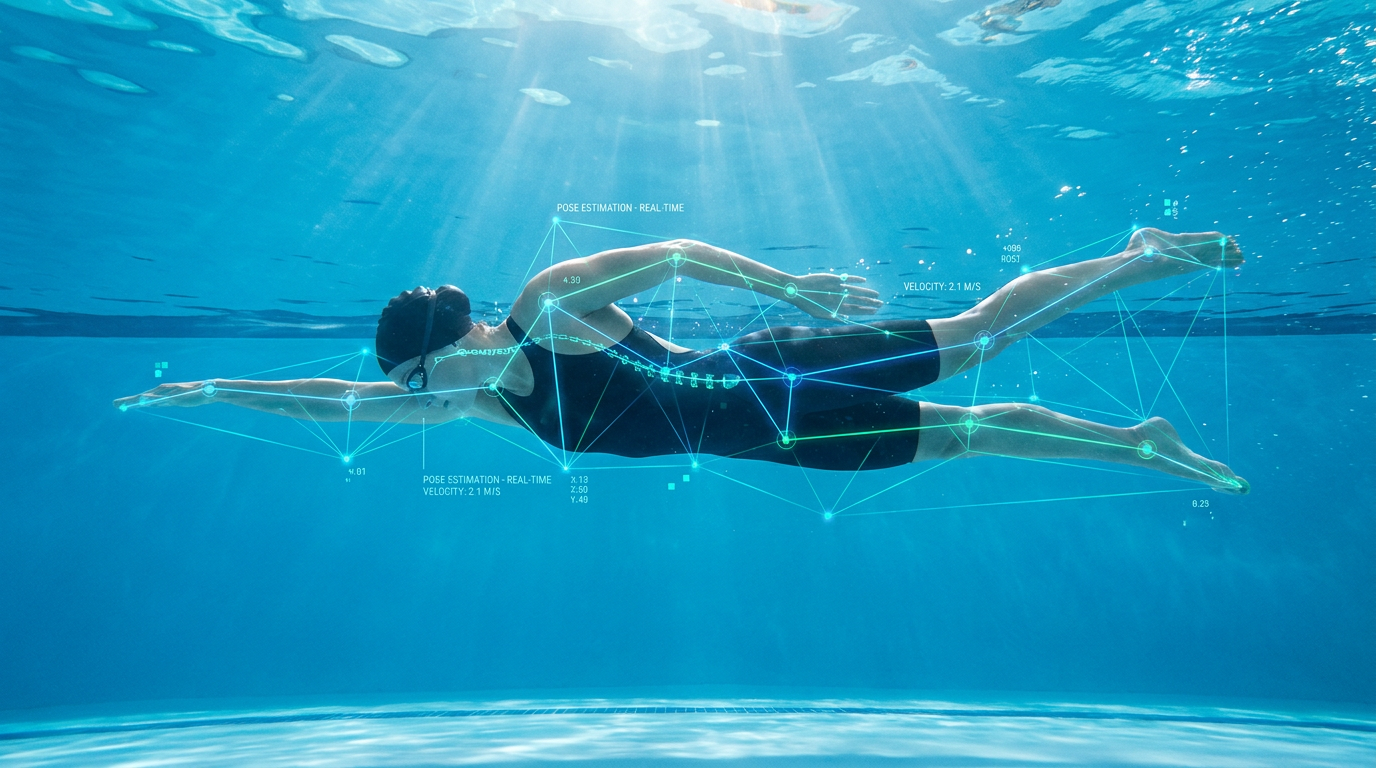
A convergence of waterproof wearable sensors, advanced fluid dynamics modeling, and underwater computer vision is fundamentally changing how humans move through water. By quantifying the exact interplay of propulsion and drag, researchers are decoding the biomechanics of the perfect stroke.[4][7]
The physics of swimming is a constant battle against resistance. To move forward, a swimmer must generate propulsive force while minimizing three primary types of drag: form drag (the resistance of the body's shape), friction drag (the water scraping against skin or fabric), and wave drag (the turbulence created at the surface).[6]

Swimmers who maintain a straight-line posture reduce the impact of form drag, allowing them to glide more effectively through the water. Even minor deviations, such as dropping the hips or lifting the head too high to breathe, exponentially increase resistance and sap energy.[6]
Yet, drag is not entirely the enemy; it is also the mechanism of propulsion. To move forward, a swimmer must anchor their hand and forearm in the water and pull their body past it. This requires maximizing the drag coefficient of the pulling arm.[5][7]
Counterintuitively, a perfectly flat, closed hand is not the most efficient paddle. Fluid dynamics researchers utilizing wind tunnels and computational models have discovered that spreading the fingers slightly—specifically by 10 degrees—creates a "rake" effect.[5]
Counterintuitively, a perfectly flat, closed hand is not the most efficient paddle.
This 10-degree spread obstructs water flow through the spaces between the fingers, increasing the hand's drag coefficient by 5 percent compared to a tightly closed hand. This increased drag directly translates to greater thrust, diminishing the power dissipated during the pull and increasing overall stroke efficiency.[5]

To measure these micro-adjustments in real-time, sports scientists are increasingly turning to Inertial Measurement Units (IMUs). These tiny, waterproof wearable sensors—often placed on the sacrum or wrists—track acceleration, rotation, and velocity hundreds of times per second.[3][6]
A 2026 study published in the journal Sports Biomechanics demonstrated how IMUs are being used to generate "velocity variation scores." By tracking the exact speed of a swimmer at every millisecond of their stroke cycle, researchers can pinpoint exactly where momentum is lost.[3]
This technology is proving particularly transformative in para-swimming. For athletes with unilateral impairments, IMUs have been used to determine optimal breathing strategies. Data revealed that breathing to the impaired side during freestyle significantly lowered forward velocity during the stroke transition, allowing coaches to prescribe highly individualized, data-backed technique adjustments.[3]
However, wearables have limitations. They can be intrusive, and placing them precisely on the body is difficult in a dynamic aquatic environment. This is where the next frontier of swimming tech comes in: markerless computer vision.[4][6]

AI-powered platforms like SportsReflector are now capable of performing real-time technique analysis using standard smartphone cameras. By employing pose estimation algorithms, these systems can track over 25 body joints simultaneously, scoring each repetition and identifying subtle flaws like asymmetrical hip rotation or overly bent elbows.[1]
A systematic review of AI in swimming published in Discover Applied Sciences found that modern neural networks achieve 90 to 99 percent accuracy in stroke classification and turn detection. Yet, the industry still faces a critical bottleneck: a lack of high-quality training data.[2]
Initiatives like the Data-driven Intelligent Video Evaluation (DIVE) project are attempting to solve this. Researchers note that there is currently no massive, publicly available dataset of annotated underwater swimming video. Most AI models are trained on synthetic 3D simulations or above-water footage, which misses the crucial underwater catch and pull phases.[4]

As open-source datasets grow and computer vision models become more sophisticated, the democratization of elite coaching is accelerating. The precise biomechanical feedback once reserved for Olympic training centers is rapidly becoming available to any swimmer with a smartphone, fundamentally altering the pursuit of speed in the water.[1][4][7]
How we got here
2000s
The 'eyeball test' and basic underwater cameras remain the standard for stroke analysis.
2016
Fluid dynamics researchers prove that a slight finger spread increases thrust, challenging traditional closed-hand techniques.
2024
Waterproof Inertial Measurement Units (IMUs) become sophisticated enough to track micro-accelerations during live swim practices.
2025
The DIVE project is launched to address the lack of open-source underwater video datasets for training AI models.
2026
Smartphone apps utilizing markerless computer vision bring real-time, joint-tracking biomechanical analysis to the consumer market.
Viewpoints in depth
Sports Biomechanists
Researchers focused on the precise physics and fluid dynamics of human movement in water.
For biomechanists, the pool is a complex physics equation. They focus on the exact interplay of propulsive forces and hydrodynamic resistance. By utilizing computational fluid dynamics and wind-tunnel testing, this camp seeks to quantify the exact angles, such as the 10-degree finger spread, that maximize thrust. Their primary goal is to translate abstract physical principles into measurable kinematic data that can definitively prove why one technique is faster than another.
Computer Vision Developers
Technologists building AI models to track and analyze stroke mechanics without physical sensors.
This camp views the reliance on physical wearables as a temporary bridge to a purely optical future. Developers are training neural networks to perform markerless pose estimation, tracking dozens of joints simultaneously from a simple smartphone video. Their main hurdle is the lack of massive, open-source underwater video datasets. By initiatives like the DIVE project, they aim to democratize elite sports science, making biomechanical analysis accessible to anyone with a camera.
Coaches and Athletes
The end-users who must translate raw data into actionable technique adjustments in the pool.
For coaches and swimmers, data is only useful if it translates to faster lap times. This perspective values tools that provide immediate, actionable feedback—such as identifying an asymmetrical hip rotation or an inefficient breathing pattern. They are less concerned with the underlying algorithms and more focused on practical applications, such as using velocity variation scores to customize training regimens for para-athletes or correcting a beginner's form.
What we don't know
- How quickly markerless computer vision will fully replace physical wearable sensors in elite competition environments.
- Whether the creation of massive open-source underwater video datasets will successfully eliminate the AI training bottleneck.
- How governing bodies will regulate the use of real-time AI feedback devices during official races.
Key terms
- Inertial Measurement Unit (IMU)
- A tiny electronic device that measures a body's specific force, angular rate, and orientation, used to track precise movements.
- Form Drag
- The resistance created by the shape and position of a swimmer's body as it moves through the water.
- Pose Estimation
- An AI computer vision technique that detects human figures in images and video, mapping specific joints to analyze movement.
- Kinematics
- The branch of mechanics that describes the motion of points, bodies, and systems without considering the forces that cause them.
Frequently asked
How do wearable sensors work underwater?
Waterproof Inertial Measurement Units (IMUs) are attached to the swimmer's body to track acceleration, rotation, and velocity hundreds of times per second, identifying exactly where momentum is lost.
Why is drag both good and bad in swimming?
Form and friction drag slow a swimmer down, but drag on the hands and forearms is necessary to generate forward thrust. Spreading the fingers slightly actually increases this beneficial drag.
Can amateur swimmers use AI coaching?
Yes. New smartphone apps use computer vision and pose estimation to analyze stroke technique from standard video, bringing elite-level biomechanical feedback to everyday swimmers.
Sources
Source coverage
7 outlets
3 viewpoints surfaced







[1]SportsReflectorComputer Vision Developers
AI-Powered Swimming Coaching & Form Analysis
Read on SportsReflector →[2]Discover Applied SciencesCoaches and Athletes
Artificial intelligence in swimming: a systematic review
Read on Discover Applied Sciences →[3]Sports BiomechanicsSports Biomechanists
Wearable technology for individualized technique recommendations in para-swimming
Read on Sports Biomechanics →[4]MediumComputer Vision Developers
DIVE: Data-driven Intelligent Video Evaluation for Swimming
Read on Medium →[5]ScienceDailySports Biomechanists
Note to elite swimmers: Spread your fingers for a faster crawl
Read on ScienceDaily →[6]MDPISports Biomechanists
Wearable Inertial Sensors for Biomechanical Analysis of Breaststroke
Read on MDPI →[7]Factlen Editorial TeamCoaches and Athletes
Synthesis by Factlen editorial team
Read on Factlen Editorial Team →
More in sports
See all 6 stories →WNBA 2026
WNBA Sustains Record Viewership in 2026 as Rookie Class Drives League's 30th Anniversary Season
8 sources
Sports Tech
The Invisible Engineering Behind Short Track Speed Skating
6 sources
WNBA Rookies
Minnesota Lynx Embrace Rookie Olivia Miles' First Pro Struggle as a 'Tremendous Growth Point'
6 sources

Backcountry Tech
The 2026 Splitboard Explainer: How 4-Part Boards and Smart Tech Are Opening the Backcountry
8 sources

Every angle. Every day.
Get sports stories with full source coverage and perspective breakdowns delivered to your inbox.