
Inside the U.S.-Iran Peace Deal: The 14-Point Agreement to End the 110-Day War
The United States and Iran have signed a historic memorandum of understanding to halt military operations, reopen the Strait of Hormuz, and begin a 60-day negotiation window for a permanent nuclear settlement.
By Factlen Editorial Team
- U.S. Administration
- The White House frames the deal as a historic victory that neutralizes the nuclear threat and saves the global economy.
- Iranian Leadership
- Tehran views the agreement as a successful defense of its sovereignty that secures vital sanctions relief.
- Israeli Government & Northern Residents
- Israel remains deeply skeptical of the bilateral pact, feeling sidelined on critical security issues.
- Global Markets & Mediators
- Focused entirely on the stabilization of the global economy and the immediate resumption of commercial transit.
What's not represented
- · Lebanese Civilians
- · European Energy Consumers
Why this matters
This 14-point agreement halts a 110-day war that crippled the global economy, reopening the vital Strait of Hormuz to stabilize energy prices while establishing a 60-day window to negotiate a permanent check on Iran's nuclear program.
Key points
- The U.S. and Iran signed a 14-point memorandum of understanding at Versailles to end their 110-day war.
- The agreement establishes a 60-day ceasefire and requires Iran to down-blend its 440kg stockpile of highly enriched uranium.
- In exchange, the U.S. will lift its naval blockade, unfreeze Iranian assets, and waive crude oil sanctions.
- The Strait of Hormuz has reopened for toll-free commercial shipping, immediately lowering global oil prices.
- A separate Israel-Hezbollah ceasefire was brokered days later to prevent the broader U.S.-Iran deal from collapsing.
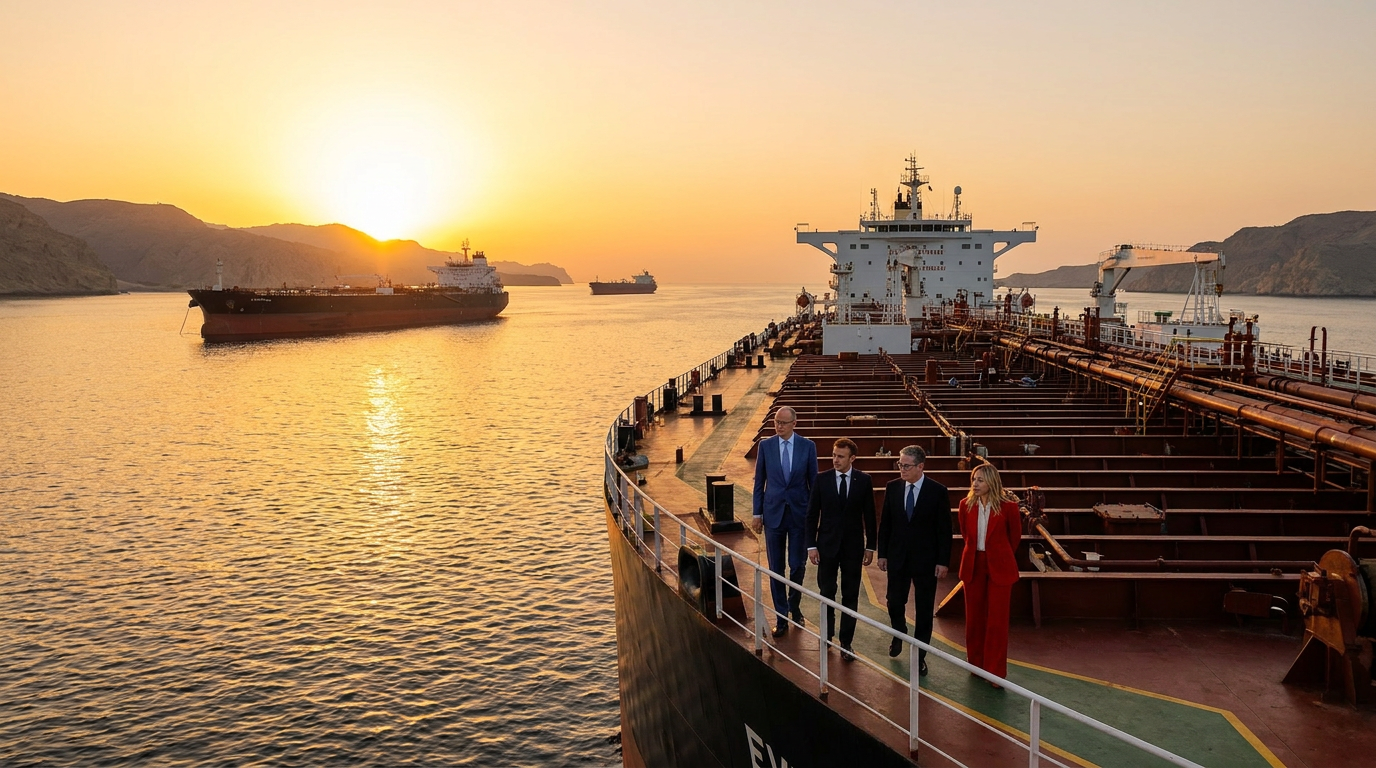
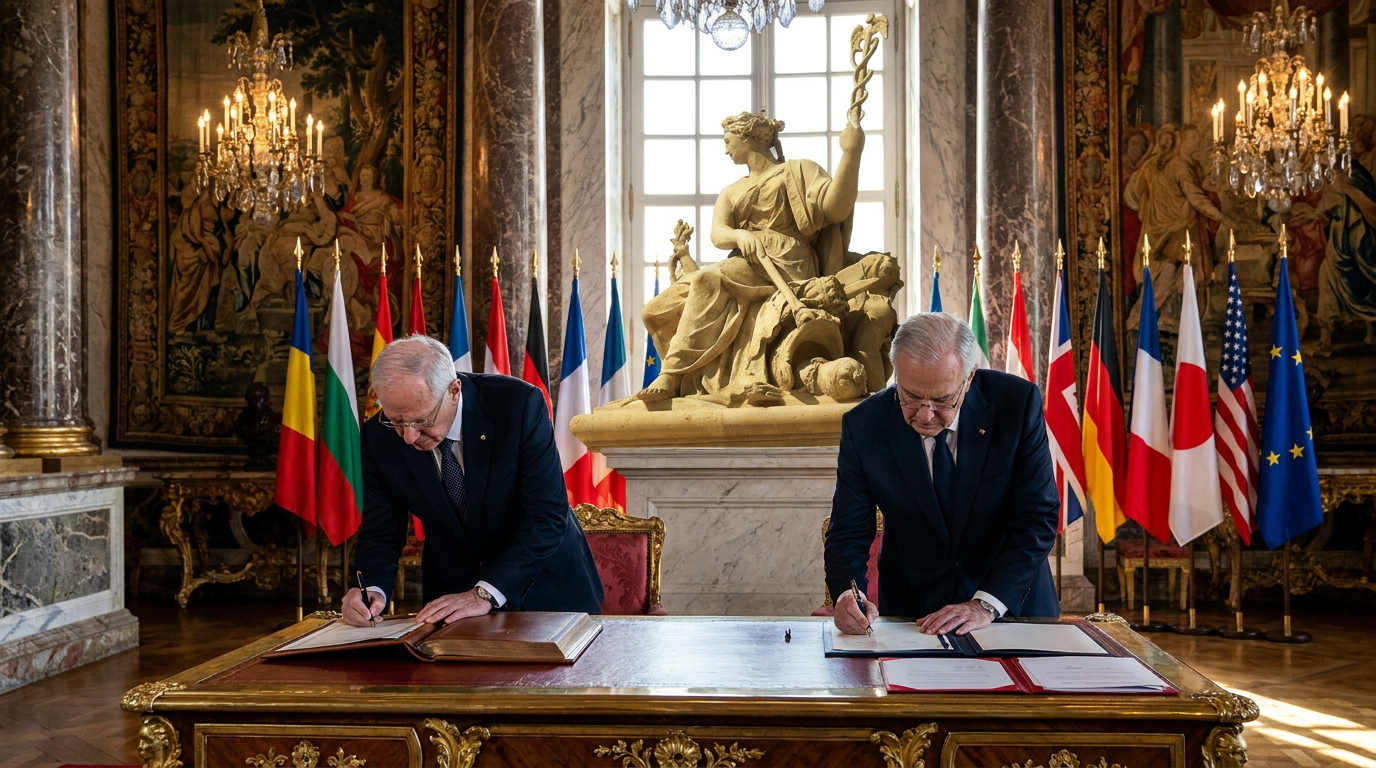
After 110 days of devastating conflict that rattled the global economy, the United States and Iran have signed a historic memorandum of understanding to end the war. In a highly orchestrated diplomatic summit at the Palace of Versailles on June 17, U.S. President Donald Trump and Iranian President Masoud Pezeshkian formalized a 14-point framework designed to halt military operations on all fronts. The agreement establishes a 60-day ceasefire and negotiation window, pausing a war that began in late February with joint U.S.-Israeli strikes that killed Iranian Supreme Leader Ali Khamenei.[3]
The stakes of the Versailles summit could not have been higher. The months-long conflict effectively shuttered the Strait of Hormuz, a critical maritime chokepoint through which roughly 20 percent of the world's oil and liquefied natural gas normally passes. The resulting energy shock sent global markets into a tailspin, prompting desperate mediation efforts from Pakistan, Qatar, and European allies terrified of a worldwide economic depression. The newly signed pact aims to reverse that trajectory, prioritizing the immediate restoration of commercial shipping alongside a complex web of nuclear and financial concessions.[3][6]
At the core of the memorandum is a delicate exchange of nuclear de-escalation for sweeping economic relief. According to the text dictated by senior U.S. officials, Iran has agreed to down-blend its 440-kilogram stockpile of highly enriched uranium, a critical step away from weapons-grade material. However, the agreement notably does not demand the complete dismantling of Iran's nuclear program. Tehran has signaled a willingness to suspend high-level enrichment for up to five years, provided it retains its fundamental rights under the Non-Proliferation Treaty to maintain civilian nuclear capabilities on its own soil.[1][4]

In exchange for these nuclear curbs, the United States has committed to a massive unwinding of economic pressure. The agreement mandates the immediate lifting of the U.S. naval blockade on Iranian ports and the issuance of waivers allowing Iranian crude oil to be shipped and sold abroad. Furthermore, the framework outlines the unfreezing of billions of dollars in Iranian assets that had been locked in foreign accounts. Negotiators have also floated the development of a $300 billion reconstruction fund, financed by regional partners in the Gulf, to help rebuild infrastructure destroyed during the bombing campaigns.[1]
The most immediate and tangible result of the pact has been the reopening of the Strait of Hormuz. The memorandum requires Iran to ensure toll-free passage for commercial vessels for the duration of the 60-day negotiation period, with a mandate to restore traffic to full pre-war capacity within 30 days. The economic relief was instantaneous: global oil prices, which had skyrocketed during the blockade, dropped by more than a dollar per barrel the morning after the signing. Within hours of the ink drying, U.S. officials reported that 12.5 million barrels of oil had already flowed safely through the strait.[1][3]

Yet, despite the diplomatic triumph in France, the agreement nearly collapsed before it could be implemented due to a glaring omission: Israel and Hezbollah were not signatories. The U.S.-Iran memorandum explicitly called for the immediate and permanent termination of military operations on all fronts, including in Lebanon. Washington intended this clause to force Tehran to rein in its proxy forces. However, the Israeli government, feeling sidelined by the bilateral talks and facing intense domestic pressure from displaced northern residents, insisted it retained the right to secure its borders and continued its military campaign in southern Lebanon.[1][5][8]
The U.S.-Iran memorandum explicitly called for the immediate and permanent termination of military operations on all fronts, including in Lebanon.
The persistence of hostilities in the Levant immediately threatened the broader peace framework. Just hours after the Versailles signing, Israeli airstrikes in southern Lebanon killed at least seven people, while Hezbollah retaliated with rocket fire. Viewing the continued Israeli presence as a violation of the memorandum, Iran abruptly delayed sending its delegation to follow-up technical talks scheduled in Switzerland, prompting the White House to cancel Vice President JD Vance's trip to Geneva. The entire 14-point plan teetered on the edge of failure as the proxy war threatened to drag Washington and Tehran back into direct conflict.[2][8]
Recognizing the imminent danger to the deal, the U.S. administration launched an aggressive, last-minute diplomatic intervention. President Trump personally contacted Israeli officials, urging them to accept a halt to the fighting in Lebanon to preserve the broader strategic victory over Iran's nuclear program. The high-level pressure campaign ultimately succeeded in breaking the deadlock. On June 19, less than 48 hours after the Versailles signing, Israel and Hezbollah agreed to a separate, U.S.-brokered ceasefire, effectively saving the overarching U.S.-Iran memorandum from an early demise and stabilizing the northern border.[2]
The resolution of the Lebanon crisis triggered vastly different reactions on the ground, reflecting the deep scars left by the conflict. In southern Lebanon, the announcement of the ceasefire was met with profound, immediate relief. Thousands of displaced civilians quickly began packing their cars with mattresses, suitcases, and whatever belongings they could carry, streaming back toward the border to reclaim homes they had fled months earlier. For these communities, the U.S.-Iran deal and the subsequent local truce represented the definitive end of a harrowing period of displacement and destruction.[5]

Conversely, the mood in northern Israel remained somber and deeply skeptical. Local leaders and displaced residents expressed despair over an agreement they view as a temporary bandage rather than a permanent solution. Many Israelis fear that the U.S.-Iran pact, by unfreezing billions in assets and lifting sanctions, will ultimately enrich Tehran and allow it to rebuild Hezbollah's military infrastructure right on Israel's doorstep. For these border communities, the cessation of hostilities feels less like a victory and more like a dangerous pause.[5]
Beyond the immediate geopolitical maneuvering, the peace deal has also resonated in unexpected cultural arenas. In Iran, the lifting of the threat of imminent strikes and the easing of international isolation have sparked hopes for a return to normalcy. Sports analysts note that the diplomatic breakthrough could significantly alter the atmosphere surrounding the Iranian national football team, 'Team Melli,' as they prepare for the 2026 World Cup, potentially reducing the intense political animosity that has shadowed their recent international appearances.[7]
As the dust settles on the initial signing, the international community is bracing for a highly volatile 60-day window. The memorandum is not a final treaty; it is a fragile framework that requires both sides to negotiate a comprehensive, binding settlement. U.S. officials have bluntly acknowledged that either side can walk away at any time if talks stall. If the negotiations collapse, Washington has signaled its readiness to reimpose the naval blockade and tighten economic pressure to unprecedented levels.[1]

Significant hurdles remain before a permanent peace can be secured. Chief among them is the long-term status of the Strait of Hormuz. While Iran has agreed to 60 days of toll-free passage, Iranian negotiators have publicly stated that the waterway will not return to its pre-war status quo, asserting Tehran's sovereign right to charge commercial vessels for transit services once the grace period expires. Gulf states and Western allies have vehemently rejected the idea of paying tolls, setting the stage for a fierce diplomatic clash in the coming weeks.[1]
For now, global leaders are breathing a collective sigh of relief. United Nations Secretary-General António Guterres praised the memorandum as a critical step toward ending a conflict that has devastated the global economy, commending the regional mediators who kept back-channel communications alive during the darkest days of the war. The next two months will determine whether the handshake at Versailles translates into a durable Middle Eastern peace, or if it merely serves as a brief intermission in a much larger conflict.[1][6]
How we got here
Feb 2026
The U.S. and Israel launch strikes against Iran, killing Supreme Leader Ali Khamenei and igniting a 110-day war.
April 2026
A fragile two-week ceasefire is brokered by Pakistan, but low-intensity conflict and the closure of the Strait of Hormuz persist.
June 17, 2026
U.S. and Iranian presidents sign a 14-point Memorandum of Understanding at the Palace of Versailles to end the war.
June 19, 2026
Following intense U.S. pressure, Israel and Hezbollah agree to a separate ceasefire in Lebanon to save the broader peace framework.
Viewpoints in depth
The U.S. Administration's View
The White House frames the deal as a historic victory that neutralizes the nuclear threat and saves the global economy.
U.S. officials emphasize that the 14-point memorandum achieves what years of prior negotiations could not: a verifiable commitment from Tehran to down-blend its 440-kilogram stockpile of highly enriched uranium. By securing an immediate reopening of the Strait of Hormuz, the administration argues it has averted a worldwide economic depression and stabilized energy markets. While acknowledging the fragility of the 60-day window, Washington maintains that the credible threat of overwhelming economic and military pressure forced Iran to the table, resulting in a framework that protects American interests and global trade.
The Iranian Leadership's View
Tehran views the agreement as a successful defense of its sovereignty that secures vital sanctions relief.
For Iran, the Versailles signing represents a triumph of endurance. Iranian officials highlight that the agreement forces the United States to lift its naval blockade, unfreeze billions of dollars in assets, and provide waivers for Iranian crude oil exports. Crucially, Tehran notes that the deal does not require the complete dismantling of its nuclear infrastructure, allowing the country to assert its rights under the Non-Proliferation Treaty to enrich uranium for civilian purposes. Iranian negotiators also view the inclusion of a $300 billion regional reconstruction fund as a necessary concession for the damages incurred during the 110-day conflict.
The Israeli Perspective
Israel remains deeply skeptical of the bilateral pact, feeling sidelined on critical security issues.
The Israeli government and residents of northern border communities have met the U.S.-Iran deal with profound frustration. Israeli officials argue that the bilateral negotiations focused too heavily on global economic stability and nuclear stockpiles, while initially failing to guarantee the removal of Hezbollah forces from southern Lebanon. Because Israel was not a party to the Versailles memorandum, it felt unbound by the mandate to halt operations in Lebanon, leading to continued strikes until a separate, U.S.-brokered ceasefire was reached. For many Israelis, the overarching fear is that sanctions relief will simply enrich Tehran, allowing it to rebuild its proxy networks across the Middle East.
What we don't know
- Whether Iran and the U.S. can finalize a permanent, binding nuclear treaty before the 60-day window expires.
- How the international community will respond to Iran's demand to charge toll fees for ships transiting the Strait of Hormuz after 60 days.
- Whether the separate Israel-Hezbollah ceasefire will hold, or if localized skirmishes will drag the broader region back into conflict.
Key terms
- Memorandum of Understanding (MoU)
- A preliminary diplomatic agreement outlining the broad terms of a ceasefire and framework for future negotiations, rather than a finalized, binding treaty.
- Down-blending
- The process of diluting highly enriched uranium with lower-grade material so that it can no longer be used to construct a nuclear weapon.
- Strait of Hormuz
- A narrow, strategically vital waterway between the Persian Gulf and the Gulf of Oman through which roughly 20 percent of the world's oil supply passes.
- Joint Comprehensive Plan of Action (JCPOA)
- The original 2015 nuclear agreement between Iran and world powers, which the current negotiations aim to replace or heavily modify.
Frequently asked
Does the agreement dismantle Iran's nuclear program?
No. The deal requires Iran to down-blend its stockpile of highly enriched uranium, but it does not dismantle the program entirely. Iran maintains its right to civilian enrichment under the Non-Proliferation Treaty.
Is the Strait of Hormuz fully open to shipping?
Yes. The agreement lifted the U.S. naval blockade and requires Iran to allow toll-free commercial passage for the next 60 days, restoring the flow of global oil.
Why did Israel and Hezbollah continue fighting?
Israel and Hezbollah were not direct parties to the U.S.-Iran memorandum. Israel insisted on its right to secure its northern border, leading to continued strikes until a separate ceasefire was brokered days later.
What happens after the 60-day ceasefire?
The U.S. and Iran have 60 days to negotiate a comprehensive, permanent agreement. If talks collapse, either side can walk away, potentially resuming hostilities.
Sources
Source coverage
8 outlets
4 viewpoints surfaced








[1]The GuardianGlobal Markets & Mediators
US-Iran deal takeaways: reopening the strait of Hormuz, waived oil sanctions and Lebanon
Read on The Guardian →[2]CBS NewsU.S. Administration
Israel and Hezbollah reach ceasefire after Trump intervention saves U.S.-Iran deal
Read on CBS News →[3]The HinduGlobal Markets & Mediators
Text of U.S.-Iran memorandum of understanding released by U.S.
Read on The Hindu →[4]TIMEIranian Leadership
What Did Iran and America Agree Upon?
Read on TIME →[5]The Times of IsraelIsraeli Government & Northern Residents
US-Iran deal met with despair in Israel, joy in Lebanon and hope in region
Read on The Times of Israel →[6]United NationsGlobal Markets & Mediators
Guterres welcomes US-Iran peace deal as 'critical step' toward ending conflict
Read on United Nations →[7]Al JazeeraIranian Leadership
What the US-Iran peace deal means for the ‘Team Melli’ World Cup campaign
Read on Al Jazeera →[8]NPRIsraeli Government & Northern Residents
Fighting persists in Lebanon despite a ceasefire as U.S.-Iran deal is under threat
Read on NPR →
More in news politics
See all 6 stories →Emissions Policy
Supreme Court Revokes California's Authority to Set Stricter Auto Emissions Standards
7 sources
US-Iran Relations
US-Iran Peace Talks Postponed as Israel-Hezbollah Clashes Shatter Ceasefire
8 sources
Iran Nuclear Deal
The U.S.-Iran Peace Framework and the 60-Day Race to Secure a Nuclear 'Blind Spot'
8 sources
Guaranteed Income
Fact-Checking the Guaranteed Income Pilots: What the Data Actually Shows
7 sources

Every angle. Every day.
Get news politics stories with full source coverage and perspective breakdowns delivered to your inbox.