
OLED vs. Mini-LED in 2026: How to Choose the Right Premium TV for Your Room
As OLED panels push past 2,000 nits and Mini-LEDs master pixel-level dimming, the 2026 premium television market offers two spectacular but distinct paths. We break down the exact trade-offs in brightness, contrast, and longevity to help you match the right technology to your living space.
By Factlen Editorial Team
- Home Cinema Purists
- This camp prioritizes absolute picture perfection, infinite contrast, and pixel-level accuracy above all else.
- Bright-Room Users
- This viewpoint values raw luminance, zero burn-in anxiety, and the ability to overpower ambient daylight.
- Large-Format Buyers
- This camp focuses on the immersive impact of sheer screen size and the price-to-performance ratio.
What's not represented
- · Environmental advocates concerned about the energy consumption of 3,000-nit displays
- · Budget consumers priced out of both premium technologies
Why this matters
A premium television is a multi-year investment that dictates how you experience movies, sports, and gaming in your home. Understanding the specific trade-offs between OLED and Mini-LED ensures you don't spend thousands of dollars on a screen that fights against the lighting conditions of your living room.
Key points
- The 2026 premium TV market is defined by a convergence of specs, with OLEDs getting brighter and Mini-LEDs improving their black levels.
- OLED remains the undisputed champion for dark rooms, offering perfect pixel-level contrast and sub-millisecond response times for gaming.
- Mini-LED dominates bright living rooms, easily exceeding 3,000 nits of peak brightness to overpower ambient sunlight and glare.
- Tandem OLED and MLA 3.0 technologies have pushed OLED brightness past 2,000 nits while significantly reducing the risk of permanent burn-in.
- Mini-LED offers superior price-to-performance at massive screen sizes, dominating the 85-inch, 98-inch, and 115-inch market segments.
- There is no single best television; buyers must match the panel technology to their specific room lighting, viewing habits, and budget.
The 2026 premium television market is defined by a fierce technological convergence, with the industry's two dominant panel types borrowing each other's best traits. For years, the buying advice was simple: buy an OLED for a dark basement and a Mini-LED for a bright living room. Today, that gap has narrowed significantly. Manufacturers have pushed OLED panels to unprecedented brightness levels while simultaneously refining Mini-LED backlights to mimic pixel-level contrast. This "Great Convergence" means consumers are no longer choosing between a flawed bright TV and a flawed dark TV, but rather selecting between two highly mature, spectacular display technologies that simply prioritize different visual strengths.[2][4]
To understand the trade-offs, one must understand the fundamental difference in how these screens create light. OLED, or Organic Light Emitting Diode, is a self-emissive technology. Every single pixel on an OLED screen generates its own light and color, meaning it can turn itself completely off to create absolute, perfect black. Mini-LED, by contrast, relies on a transmissive design. It uses a traditional LCD panel to create colors, which is illuminated from behind by a backlight made up of thousands of microscopic LEDs. These LEDs are grouped into "dimming zones" that can brighten or darken independently, though they cannot control light at the individual pixel level.[1][7]
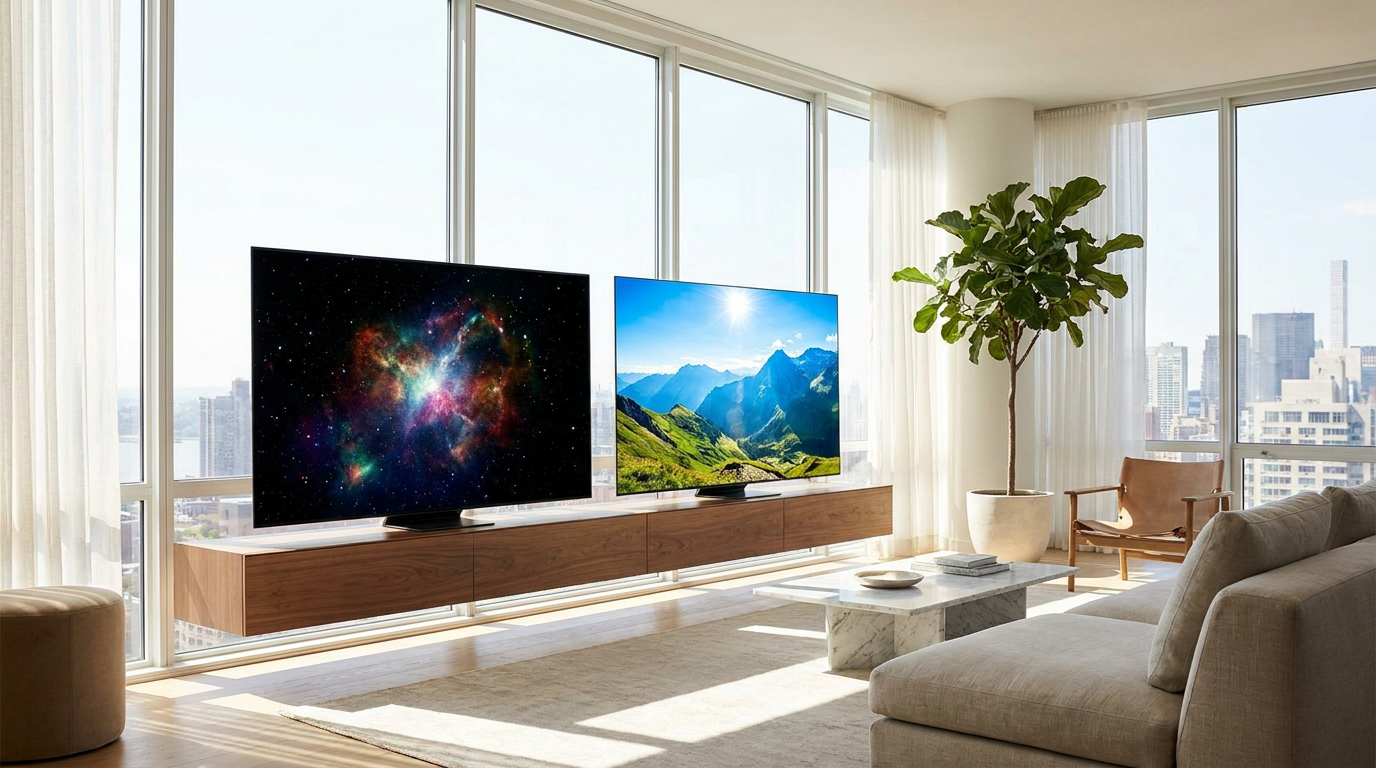
The case for OLED centers entirely on its infinite contrast ratio and pixel-perfect precision. Because each of its over eight million pixels operates independently, an OLED television can display a blindingly bright star right next to the pitch black of deep space without a single photon of light bleeding over. This creates a sense of depth and three-dimensionality that transmissive displays struggle to replicate. Furthermore, because the pixels sit right at the surface of the screen, OLEDs offer exceptionally wide viewing angles, ensuring that viewers sitting on the far edges of a wide sectional sofa see the exact same colors and contrast as someone sitting dead center.[1][6]
The evidence for OLED's dominance in cinematic environments is overwhelming. Professional calibrators and home theater enthusiasts consistently crown OLED as the undisputed king of dark-room viewing. When watching high-dynamic-range (HDR) movies with letterbox bars, those black bars remain perfectly invisible, blending seamlessly into the bezel of the television. Additionally, OLED panels often utilize the screen itself as an acoustic surface, vibrating the glass to produce highly localized, immersive audio that tracks with the action on screen—a feat traditional LCD televisions cannot match without external soundbars.[1][6][7]

The case against OLED has historically focused on two distinct vulnerabilities: lower peak brightness and the risk of permanent image retention, commonly known as burn-in. Because the pixels are made of organic compounds, they degrade over time as they emit light. If a static image—such as a news channel ticker, a sports scoreboard, or a video game heads-up display—is left on the screen for thousands of hours, those specific pixels can wear out faster than the rest of the screen, leaving a faint, permanent ghost image behind. To protect the panel, older OLEDs aggressively limited their maximum brightness.[3][7]
However, 2026 has brought massive architectural upgrades that directly address these OLED weaknesses. Manufacturers have introduced "Tandem OLED" structures, which stack multiple light-emitting layers to boost output without overdriving the organic materials. Combined with third-generation Micro Lens Array (MLA 3.0) technology and advanced quantum dot (QD-OLED) color filters, flagship OLEDs like the LG G5 and Samsung S95F are now capable of hitting peak brightness levels around 2,100 nits. These panels also incorporate sophisticated thermal management layers and pixel compensation algorithms that drastically slow the rate of organic wear, making burn-in a non-issue for the vast majority of mixed-content viewers.[2][3][4]
The case for Mini-LED is built on brute-force brightness and absolute peace of mind. By utilizing an inorganic LED backlight, these televisions can be driven to extreme luminance levels without any risk of permanent burn-in. The latest 2026 flagship Mini-LED models easily exceed 3,000 nits of peak brightness, with some pushing even higher. This massive output allows the television to maintain an incredibly high average picture level, meaning the entire screen can remain blindingly bright during a daytime sports broadcast or a snow-covered documentary scene, whereas an OLED would automatically dim the full-screen image to protect its power supply and panel.[5][7]
The evidence for Mini-LED's superiority in bright rooms is immediately apparent in modern, open-concept homes. In a living room surrounded by floor-to-ceiling windows and bathed in afternoon sunlight, an OLED's glossy screen can sometimes act like a dark mirror, reflecting the room back at the viewer. A premium Mini-LED television simply punches right through that ambient glare. The sheer volume of light it produces ensures that colors remain vibrant and shadow details remain visible, even when competing with direct sunlight, making it the ultimate "lower-regret" choice for casual, all-day viewing environments.[4][6]

The evidence for Mini-LED's superiority in bright rooms is immediately apparent in modern, open-concept homes.
The case against Mini-LED revolves around a visual artifact known as "blooming" or "haloing." Because the television's dimming zones are significantly larger than individual pixels, the backlight cannot perfectly match the shape of small, bright objects on the screen. When displaying white subtitles against a black background, or a bright streetlamp in a dark alleyway, the light from the active zone inevitably bleeds into the surrounding dark pixels, creating a faint, glowing halo. While minor, this artifact can distract discerning viewers and slightly wash out the deepest shadow details in complex cinematic scenes.[1][6]
Yet, the 2026 generation of Mini-LEDs has dramatically minimized this flaw through sheer computational power and hardware density. Manufacturers like Sony, TCL, and Hisense are now packing thousands of microscopic RGB dimming zones into their panels, completely removing traditional color filters for purer light output. Paired with advanced "Halo Control" algorithms that predict and suppress backlight bleed in real-time, the best Mini-LEDs now mimic OLED's black levels so closely that the difference is often indistinguishable outside of a pitch-black testing laboratory.[2]
Gaming performance presents another fascinating trade-off between the two technologies. OLED televisions offer near-instantaneous, sub-millisecond pixel response times. When a character moves rapidly across the screen, the pixels change color instantly, resulting in crystal-clear motion with virtually zero blur. This makes OLED the absolute gold standard for fast-paced esports, competitive shooters, and high-framerate PC gaming, where motion clarity and input lag can be the difference between winning and losing.[1][7]
Conversely, Mini-LED offers a distinct advantage for a different type of gamer: the marathon player. Gamers who spend hundreds of hours playing a single title with a static heads-up display—such as a health bar or a mini-map—often experience a low-level anxiety about burn-in on an OLED screen. Mini-LED completely eliminates this worry. Players can leave a game paused for hours, or grind the same role-playing game all weekend, with the absolute certainty that the inorganic LCD panel will not suffer permanent image retention.[1][7]

This longevity factor extends directly into productivity and non-traditional television use. As more consumers use large screens as primary PC monitors or leave financial news networks running continuously in the background, the durability of the panel becomes paramount. Extensive testing at the 10,000-hour mark reveals a clear divergence: while OLED's thermal management has improved vastly, it still shows differential wear under heavy, static light-mode workloads. Mini-LED remains the definitively safer, low-risk fit for users who demand an always-on, bright interface without the need to babysit the screen.[3]
The size and value equation is perhaps the most decisive factor in the current market, heavily favoring Mini-LED. OLED manufacturing is incredibly complex, and while pricing has become highly competitive in the 55-inch to 77-inch "sweet spot," the cost scales poorly beyond that. An 83-inch or 97-inch OLED television remains an ultra-premium luxury item, often costing thousands of dollars more than a comparably sized LCD counterpart, forcing buyers to choose between picture perfection and sheer cinematic scale.[5][7]
Mini-LED, meanwhile, absolutely dominates the ultra-large category. Buyers looking to fill a massive wall with an 85-inch, 98-inch, or even 115-inch screen will find that Mini-LED delivers exceptional price-to-performance. Because LCD fabrication at massive scales is highly efficient, consumers can purchase a flagship 85-inch Mini-LED for roughly the same price as a 65-inch flagship OLED. This massive value proposition is why Mini-LED currently maintains a dominant 62 percent volume share of the premium television market.[2][5]

Ultimately, the 2026 landscape proves there is no single "best" television—only the best television for a specific room and lifestyle. The decision requires an honest assessment of viewing habits. A buyer must weigh the cinematic perfection and instant response of self-emissive pixels against the blinding brightness, massive scale, and zero-maintenance durability of an advanced transmissive backlight. Both technologies have reached a level of maturity where buyer's remorse is highly unlikely, provided the screen is matched to its proper environment.[4][7]
OLED fits well when the primary use is watching cinematic movies in a dark or light-controlled room, when seating arrangements require wide viewing angles, and when the budget accommodates premium pricing for sizes under 80 inches. It is the definitive choice for home theater purists and competitive gamers who prioritize absolute contrast and motion clarity. It does not fit well for all-day static news broadcasts, sun-drenched rooms with direct glare, or buyers looking for massive 85-inch-plus screens on a strict budget.[1][6][7]
Mini-LED fits well when the television lives in a bright, open-concept living room, when the household leaves the TV on for background noise or productivity, and when the goal is to secure a massive screen without breaking the bank. It is the ultimate "lower-regret" choice for mixed-use family rooms and marathon gamers who want zero burn-in anxiety. It does not fit well for dedicated, pitch-black home theaters where perfect shadow detail is the absolute priority, or for rooms with extremely wide, off-angle seating arrangements.[3][5][7]
How we got here
2013
The first large-format OLED televisions hit the consumer market, introducing perfect blacks but struggling with low brightness and high costs.
2019
Mini-LED technology emerges in premium consumer televisions, offering a high-brightness alternative to OLED with vastly improved local dimming over traditional LCDs.
2022
QD-OLED panels are introduced, combining OLED contrast with quantum dot color volume to significantly boost HDR performance.
2024
Mini-LED zone counts explode into the thousands, drastically reducing blooming artifacts and closing the contrast gap with OLED.
2026
Tandem OLED and MLA 3.0 technologies push OLED brightness past 2,000 nits, while RGB Mini-LEDs break the 3,000-nit barrier, resulting in the 'Great Convergence'.
Viewpoints in depth
Home Cinema Purists
This camp prioritizes absolute picture perfection, infinite contrast, and pixel-level accuracy above all else.
For home theater enthusiasts and professional calibrators, OLED remains the undisputed champion. They argue that while Mini-LEDs have gotten incredibly bright, human vision is logarithmic—meaning the jump from 1,000 to 3,000 nits is less perceptible than the jump from a glowing gray to a perfect, zero-nit black. This camp values the three-dimensional 'pop' that only self-emissive pixels can provide, and they are willing to control their room lighting and manage static content to preserve that flawless image quality.
Bright-Room & Productivity Users
This viewpoint values raw luminance, zero burn-in anxiety, and the ability to overpower ambient daylight.
Users in modern, sun-drenched homes or those who use their screens for PC productivity champion Mini-LED as the practical winner. They point out that perfect blacks are irrelevant if the screen is reflecting the living room windows. For this camp, the peace of mind that comes from an inorganic backlight—allowing them to leave news tickers, spreadsheets, or static video game HUDs on screen for 12 hours a day without fear of permanent image retention—far outweighs the minor blooming artifacts visible only in pitch-black rooms.
Large-Format Value Buyers
This camp focuses on the immersive impact of sheer screen size and the price-to-performance ratio.
Market analysts and budget-conscious home theater builders argue that immersion is driven more by the field of view than by microscopic contrast differences. They advocate for Mini-LED because it allows buyers to step up to massive 85-inch, 98-inch, or even 115-inch panels for the same price as a much smaller OLED. In their view, the sheer cinematic scale of a 98-inch Mini-LED provides a vastly superior movie-watching experience than a technically perfect but physically smaller 65-inch OLED.
What we don't know
- Whether MicroLED—a technology that combines OLED's perfect blacks with Mini-LED's inorganic brightness—will ever become affordable enough to replace both.
- Exactly how the new Tandem OLED panels will age over a 10-year lifespan under real-world, heavy-use conditions.
- If manufacturing yields for 83-inch and 97-inch OLED panels will ever improve enough to match the aggressive pricing of massive Mini-LEDs.
Key terms
- Tandem OLED
- A new panel architecture that stacks multiple organic light-emitting layers to increase overall brightness and extend the lifespan of the screen.
- MLA (Micro Lens Array)
- A layer of billions of microscopic lenses placed over the OLED pixels to focus scattered light directly toward the viewer, significantly boosting brightness.
- Local Dimming
- A technology used in Mini-LED TVs where the backlight is divided into thousands of independent zones that can dim or brighten to improve contrast.
- Nits
- A standard unit of measurement for the brightness of a display; a higher number indicates a brighter screen.
- QD-OLED
- A hybrid display technology that combines the perfect blacks of an OLED panel with a quantum dot color filter to produce exceptionally vibrant colors at high brightness.
Frequently asked
Does OLED still suffer from burn-in in 2026?
While the risk of permanent image retention still exists for organic panels, 2026 technologies like Tandem OLED and MLA 3.0 have vastly improved thermal management, making burn-in a non-issue for typical mixed-content viewing.
What is blooming on a Mini-LED TV?
Blooming, or haloing, occurs when the backlight zones behind the LCD panel are larger than the bright object on screen, causing a faint glow to bleed into the surrounding dark pixels.
Which TV is better for a bright living room?
Mini-LED is generally better for bright rooms because it can achieve significantly higher peak brightness (often exceeding 3,000 nits) to punch through ambient sunlight and glare.
Why are OLED TVs so expensive at larger sizes?
Manufacturing large sheets of organic self-emissive pixels without defects is highly complex. While 55-inch and 65-inch OLEDs are competitively priced, the fabrication costs scale exponentially for sizes 83 inches and above.
Sources
Source coverage
7 outlets
3 viewpoints surfaced







[1]RTINGSHome Cinema Purists
OLED vs Mini LED: Which Panel Technology Is Better?
Read on RTINGS →[2]Alibaba Market InsightsLarge-Format Buyers
OLED vs Mini LED TV: 2026 Market Insights and Product Trends
Read on Alibaba Market Insights →[3]KTC PlayBright-Room Users
OLED vs Mini-LED Longevity for Productivity Use
Read on KTC Play →[4]Data Wire SolutionsLarge-Format Buyers
Best TVs for 2026: 10 OLED and Mini-LED Picks
Read on Data Wire Solutions →[5]100% AppliancesBright-Room Users
OLED vs. Mini LED: Which TV Technology is Right for Your Home?
Read on 100% Appliances →[6]Caleb Denison / YouTubeHome Cinema Purists
Is the TCL X11L an OLED killer? Not so fast.
Read on Caleb Denison / YouTube →[7]Doms TV MountingBright-Room Users
TV Technology Guide: OLED vs. Mini LED
Read on Doms TV Mounting →

Every angle. Every day.
Get shopping stories with full source coverage and perspective breakdowns delivered to your inbox.