
Trump's New Iran Framework Reopens Strait of Hormuz but Defers Nuclear Limits
A newly signed US-Iran memorandum of understanding ends a four-month military conflict and grants Tehran immediate sanctions relief, but critics warn it leaves the fate of Iran's highly enriched uranium unresolved.
By Factlen Editorial Team
- Nonproliferation Experts
- Warns that the deal surrenders critical leverage without securing verifiable caps on Iran's enrichment capabilities.
- US Administration
- Argues the framework successfully ends a costly war and secures a non-nuclear Iran from a position of strength.
- Foreign Policy Analysts
- Highlights the precarious linkage between the nuclear framework and the ongoing conflict in Lebanon.
- Iranian Negotiators
- Views the deal as a pragmatic victory that ends military strikes while maintaining their right to domestic nuclear technology.
What's not represented
- · Israeli Government Officials
- · European Union Diplomats
- · Lebanese Civilians
Why this matters
The framework ends a devastating four-month regional war and reopens a critical artery for global oil, but it defers the hardest questions about Iran's nuclear program. By granting immediate sanctions relief without securing the removal of highly enriched uranium, the deal gambles that future negotiations can permanently dismantle Tehran's nuclear infrastructure before the fragile ceasefire collapses.
Key points
- President Trump signed a memorandum of understanding with Iran to end the recent military conflict and reopen the Strait of Hormuz.
- The deal grants Iran immediate sanctions relief, allowing it to freely sell oil on the global market.
- Specifics regarding Iran's nuclear program and its 60% enriched uranium stockpile are deferred to a 60-day negotiation window.
- Critics warn the framework lacks the strict enrichment caps of the 2015 JCPOA and surrenders US economic leverage upfront.
- The agreement explicitly ties the US-Iran ceasefire to a halt in Israeli military operations in Lebanon.
- Follow-up talks in Switzerland were abruptly postponed by Iran due to ongoing Israeli strikes against Hezbollah.
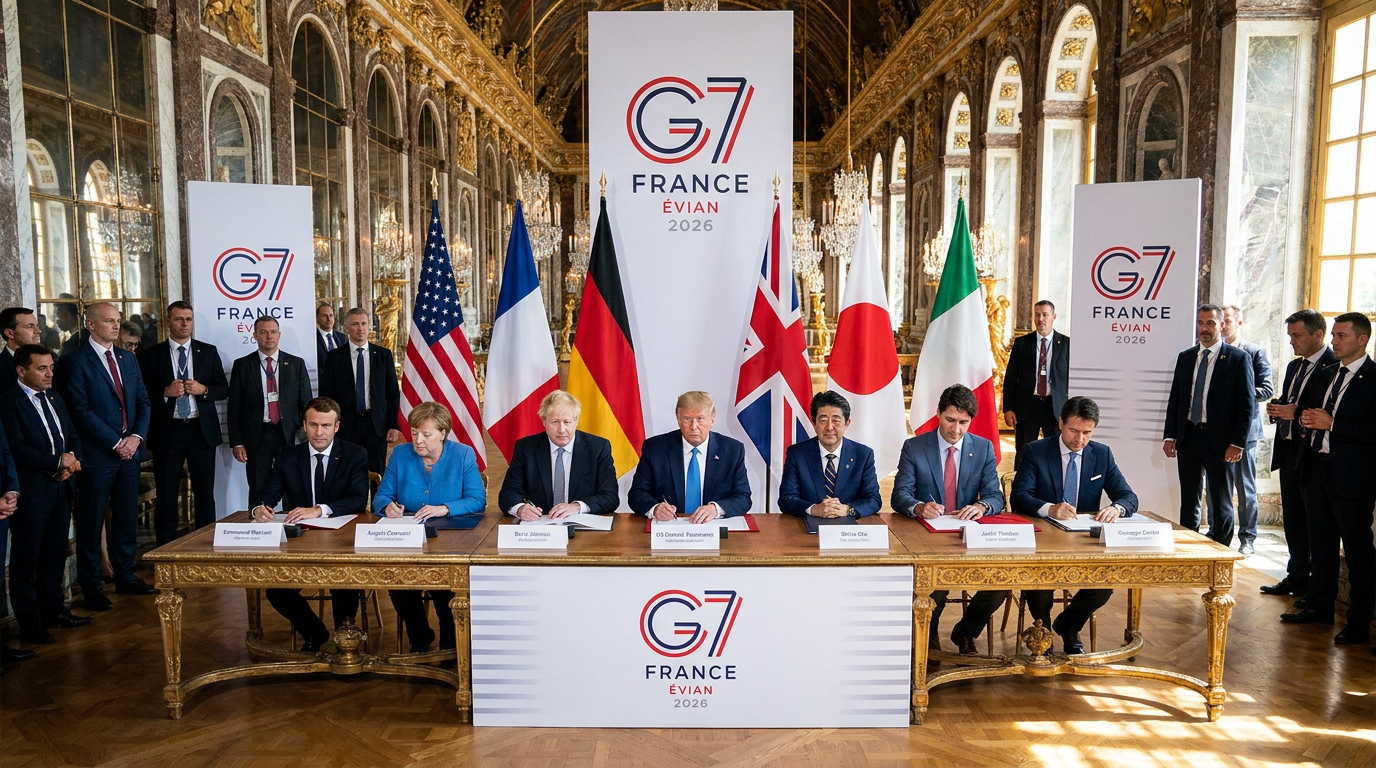
US President Donald Trump has signed a landmark memorandum of understanding with Iran, aiming to end a devastating four-month military conflict and reopen the strategically vital Strait of Hormuz. Brokered with the help of intermediaries including Pakistan, the framework agreement was formalized during the G7 summit in Versailles, France. The deal effectively halts the US-Israeli bombing campaign that began in late February 2026 and lifts the US naval blockade, while Tehran has agreed to allow international shipping to resume through the Gulf. Global oil markets immediately reacted to the news, with prices tumbling as the prospect of unhindered energy trade returned.[2][4][5]
However, the diplomatic breakthrough has ignited fierce debate over its sequencing and the concessions granted to Tehran. Under the terms of the memorandum, the United States will issue immediate waivers on wide-ranging sanctions, allowing Iran to freely export its crude oil. In exchange, Iran has affirmed it will not procure or develop nuclear weapons, and both sides have agreed to a 60-day window to negotiate the technical specifics of Iran's nuclear program. Critics argue this structure surrenders Washington's primary economic leverage before securing a verifiable dismantling of Iran's nuclear infrastructure.[1][4]

The most glaring blind spot in the framework, according to nonproliferation experts, is the unresolved fate of Iran's highly enriched uranium. Unlike the 2015 Joint Comprehensive Plan of Action (JCPOA)—which strictly capped Iranian uranium enrichment at 3.67% purity and mandated the removal of excess stockpiles—the new memorandum lacks immediate, hard caps. Iran currently possesses uranium enriched to 60% purity, a short technical step away from the 90% threshold required for weapons-grade material. The current text only specifies that the material must be "downblended" on-site as a minimum, leaving the exact methodology to the upcoming 60-day talks.[1][4]
President Trump has publicly dismissed concerns over the uranium stockpile, arguing that the material poses no immediate threat. Speaking to reporters at the G7, Trump noted that much of Iran's 60% enriched uranium is currently buried under the rubble of nuclear facilities destroyed by US airstrikes earlier this year. "Nobody is going to get that for a long time, unless we want to get it," the president stated, adding that the administration is not pursuing regime change and found the Iranian negotiators "rational" to deal with.[3]

Despite the administration's assurances, foreign policy hawks and regional security analysts warn that the US has significantly retreated from its pre-war demands. Documents tabled by the US in 2025 demanded that Iran maintain no domestic enrichment capabilities and ship all enriched stockpiles out of the country immediately. The new framework abandons those red lines, allowing domestic enrichment to continue in some form and deferring the hardest questions to future committees. Observers note that by granting sanctions relief upfront, the US may struggle to enforce strict compliance if the 60-day talks end in a stalemate.[2][5]
Despite the administration's assurances, foreign policy hawks and regional security analysts warn that the US has significantly retreated from its pre-war demands.
The agreement also introduces a highly volatile new variable: it explicitly links the US-Iran ceasefire to a halt in military operations in Lebanon. The text mandates that with the signing of the memorandum, hostilities between Israel and the Iran-backed militant group Hezbollah must stop. This inclusion represents a significant diplomatic victory for Tehran, which successfully tethered its own nuclear negotiations to the broader regional conflict, effectively forcing Washington to pressure Israel into a ceasefire.[5][6]
Unsurprisingly, the Israeli security establishment has reacted with deep alarm. Israeli officials are reportedly frustrated that the framework leaves Iran's nuclear threshold largely intact while simultaneously constraining Israeli military operations on its northern border. Israel has rejected the prospect of withdrawing its forces from Lebanon, and the Israeli military recently published expanded occupation maps, signaling a refusal to comply with the terms dictated by the US-Iran memorandum.[4][5]

This linkage has already thrown the fragile framework into immediate turbulence. High-stakes follow-up talks scheduled to take place in Switzerland this week—which US Vice President JD Vance was expected to attend—were abruptly postponed. Iranian officials declined to proceed with the negotiations, stating that ongoing Israeli strikes in Lebanon made diplomatic progress untenable. The disruption highlights the central vulnerability of the Trump administration's approach: the entire nuclear track is now dependent on de-escalation in a separate conflict over which Washington has limited direct control.[6]
If the diplomatic hurdles can be cleared, the economic incentives for Iran are massive. Beyond the immediate resumption of oil exports, which could generate upwards of $60 billion annually, reports indicate that the US has discussed the possibility of a $300 billion international investment fund to help rebuild Iran's war-torn infrastructure. These financial benefits are theoretically contingent on Iran's strict adherence to the final nuclear settlement, though the exact mechanisms for verifying compliance remain undefined.[2][4]
As the 60-day clock ticks down, the international community faces a precarious waiting game. The memorandum of understanding has successfully pulled the United States and Iran back from the brink of total war and reopened a critical artery of global commerce. Yet, by deferring the most intractable nuclear disputes and entangling the deal with the intractable Israel-Hezbollah conflict, the framework may have simply traded an immediate military crisis for a complex, multi-front diplomatic standoff.[1][5][6]
How we got here
Feb 28, 2026
The US and Israel launch a military campaign against Iran, targeting nuclear sites, prompting Iran to blockade the Strait of Hormuz.
May 2026
Intermediaries, including Pakistan, help draft a framework agreement to end the hostilities and reopen maritime trade.
Mid-June 2026
President Trump signs the memorandum of understanding at the G7 summit, granting Iran immediate sanctions relief.
June 19, 2026
Iran postpones follow-up nuclear talks in Switzerland, citing ongoing Israeli military operations in Lebanon.
Viewpoints in depth
The US Administration's view
The White House argues the framework successfully ends a costly war and secures a non-nuclear Iran from a position of strength.
President Trump and his allies emphasize that the primary goals of the military campaign have been achieved: the Strait of Hormuz is open, and Iran has formally committed to never acquiring a nuclear weapon. The administration views the immediate sanctions relief as a necessary diplomatic catalyst to bring Tehran to the table for the 60-day technical talks. Furthermore, officials argue that the destruction of Iranian nuclear facilities during the war renders immediate concerns about the 60% enriched uranium stockpile moot, as the material is currently inaccessible under the rubble.
Nonproliferation Experts' view
Nuclear watchdogs warn that the deal surrenders critical leverage without securing verifiable caps on Iran's enrichment capabilities.
Arms control advocates and security hawks are deeply concerned by the absence of strict enrichment limits in the memorandum. Unlike the 2015 JCPOA, which capped enrichment at 3.67%, the current framework leaves Iran's 60% enriched uranium stockpile largely unaddressed, mandating only vague 'downblending' protocols to be negotiated later. Experts argue that by granting comprehensive sanctions relief upfront, the US has stripped itself of the economic leverage needed to force Iran into accepting intrusive IAEA inspections and permanent dismantlement of its nuclear infrastructure during the upcoming 60-day window.
Regional Security Analysts' view
Middle East observers highlight the precarious linkage between the nuclear framework and the ongoing conflict in Lebanon.
Analysts point out that Tehran scored a major tactical victory by tying the US-Iran ceasefire to a halt in Israeli military operations against Hezbollah in Lebanon. This linkage effectively outsources the survival of the nuclear deal to the volatile northern Israeli border. With Israel refusing to halt its campaign and Iran subsequently postponing follow-up talks in Switzerland, observers warn that the entire diplomatic framework is built on a fragile foundation that could collapse before the technical nuclear negotiations even begin.
What we don't know
- It remains unclear how the US will verify the downblending of Iran's highly enriched uranium if the 60-day talks fail.
- We do not know if Israel will ultimately comply with the framework's demand to halt military operations in Lebanon.
- The exact mechanisms and conditions for the proposed $300 billion international investment fund for Iran have not been finalized.
Key terms
- Memorandum of Understanding (MOU)
- A formal agreement between two or more parties that outlines the terms of a mutual understanding, often serving as the foundation for a final, binding treaty.
- Highly Enriched Uranium
- Uranium that has been processed to increase the concentration of the U-235 isotope to 20% or higher; 90% purity is required for weapons-grade material.
- Downblending
- The process of mixing highly enriched uranium with natural or depleted uranium to reduce its purity level, making it unsuitable for nuclear weapons.
- Strait of Hormuz
- A crucial maritime chokepoint between the Persian Gulf and the Gulf of Oman, through which a significant portion of the world's oil supply passes.
Frequently asked
What does the new US-Iran agreement do?
The memorandum of understanding ends the recent US-Iran military conflict, reopens the Strait of Hormuz, and provides Iran with immediate sanctions relief in exchange for a 60-day window to negotiate nuclear limits.
What happens to Iran's highly enriched uranium?
The framework requires Iran to 'downblend' its highly enriched uranium on-site as a minimum, but leaves the exact disposition and future enrichment caps to be negotiated over the next 60 days.
Why were the follow-up talks in Switzerland postponed?
Iranian officials refused to proceed with the technical negotiations, citing ongoing Israeli military operations against Hezbollah in Lebanon, which the framework explicitly aimed to halt.
Sources
Source coverage
6 outlets
4 viewpoints surfaced






[1]Fox NewsNonproliferation Experts
Trump’s new Iran deal faces nuclear blind spot over uranium stockpile, experts warn
Read on Fox News →[2]The GuardianForeign Policy Analysts
Iran peace deal makes clear how far US has been forced to retreat since 2025
Read on The Guardian →[3]CBS NewsUS Administration
Facing bipartisan criticism of Iran deal, Trump lashes out at 'fools'
Read on CBS News →[4]CBCNonproliferation Experts
How Trump's Iran deal compares to the 2015 nuclear agreement
Read on CBC →[5]Council on Foreign RelationsForeign Policy Analysts
Trump's Iran Deal Reopens the Strait. Much Remains to Be Done.
Read on Council on Foreign Relations →[6]SalonIranian Negotiators
Trump's Iran framework hits immediate turbulence after announced deal
Read on Salon →

More in news politics
See all 8 stories →Strait of Hormuz
Iran Closes Strait of Hormuz, Threatening Fragile U.S. Peace Deal Over Lebanon Escalation
8 sources
Universal Meals
Fact-Checking the Impact of Universal School Meals: What the 2026 Data Shows
6 sources

Strait of Hormuz
Iran Closes Strait of Hormuz, Shattering Three-Day-Old Ceasefire Over Lebanon Strikes
7 sources
Strait of Hormuz
Iran Closes Strait of Hormuz as U.S.-Brokered Ceasefire Collapses Over Lebanon Strikes
9 sources

Every angle. Every day.
Get news politics stories with full source coverage and perspective breakdowns delivered to your inbox.