
UN Climate Talks End in Gridlock Over $300 Billion Finance Goal Amid G7 Silence
The UN climate conference in Bonn concluded in a stalemate as developing nations demanded concrete public finance commitments, while wealthy countries at the simultaneous G7 summit prioritized critical minerals over new climate funding.
By Factlen Editorial Team
- Developing & Vulnerable Nations
- Argue that adaptation and energy transitions are impossible without the promised $300 billion in public finance, accusing wealthy nations of erasing past commitments.
- Climate Justice Advocates
- Warn that the UN multilateral process is failing due to corporate capture and a lack of political will, demanding immediate, binding financial trajectories.
- Developed Economies
- Maintain they are meeting baseline obligations amid fiscal constraints, emphasizing the need to mobilize private capital and secure critical mineral supply chains.
- UN & Institutional Mediators
- Urge all parties to accelerate implementation of the Paris Agreement, warning that stalled negotiations deepen global economic instability.
What's not represented
- · Private sector renewable energy investors
- · Fossil fuel industry representatives
- · Local frontline communities facing immediate climate impacts
Why this matters
The breakdown in trust between the Global North and South threatens to derail the upcoming COP31 summit, jeopardizing the funding required to protect vulnerable communities from extreme weather and transition the global economy away from fossil fuels.
Key points
- The UN climate talks in Bonn ended in gridlock over how to fund the $300 billion annual climate finance target.
- Developing nations demanded concrete public finance, while developed nations pushed to mobilize private capital.
- The simultaneous G7 summit in France prioritized critical minerals over new climate finance commitments.
- The stalemate threatens the credibility of the upcoming COP31 summit in Antalya, Turkey.
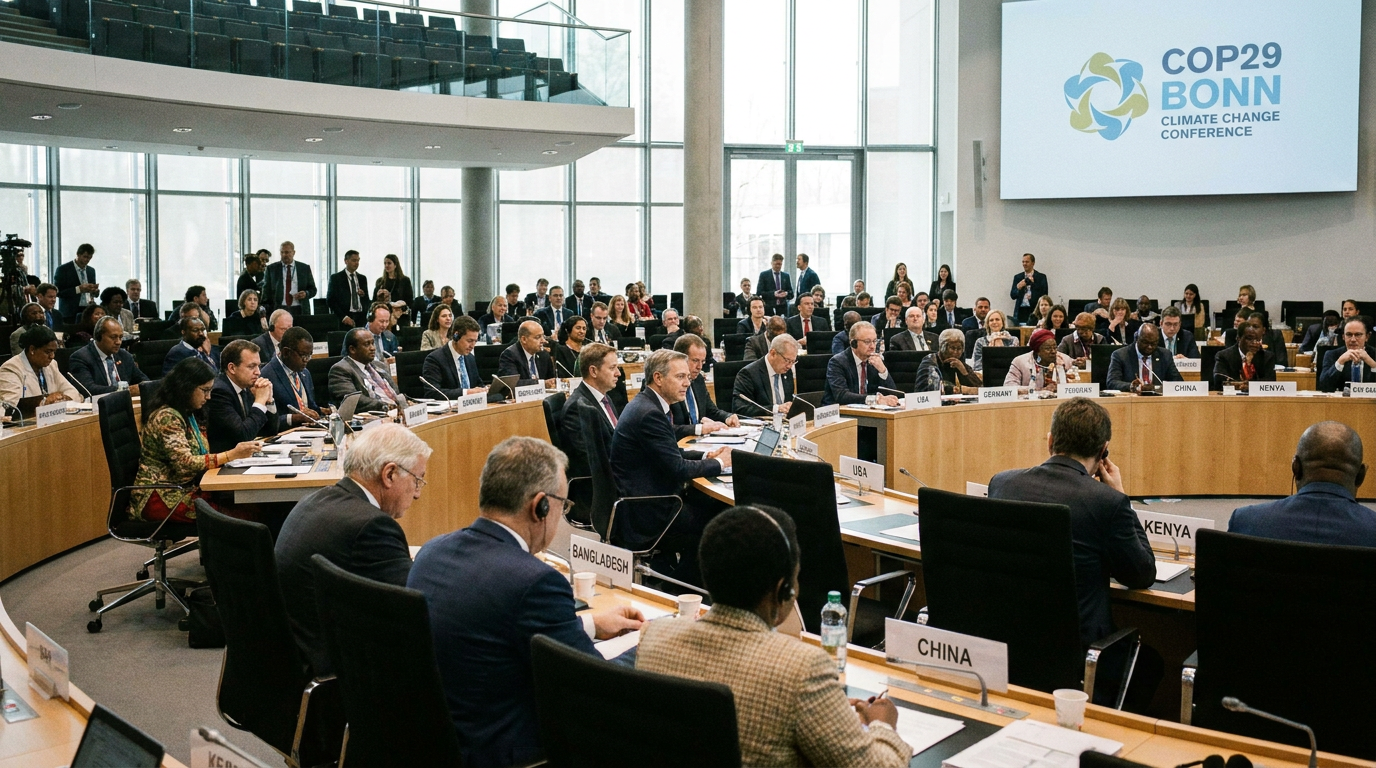
The United Nations climate talks in Bonn, formally known as SB64, concluded in a state of deep gridlock on Thursday, exposing a severe and widening rift between the Global North and South over who will pay for the escalating costs of the climate crisis. Billed as a crucial stepping stone to the COP31 summit in Antalya, Turkey, the two-week conference was meant to transition the world from making climate pledges to implementing them. Instead, negotiators left Germany with few tangible outcomes, as entrenched disputes over climate finance and adaptation funding stalled progress across nearly every agenda item, leaving the multilateral process in a precarious position.[1][3]
The stalemate in Bonn was heavily influenced by the simultaneous G7 Summit in Évian-les-Bains, France. While developing nations in Germany pleaded for public finance, the leaders of the world's wealthiest economies gathered on the shores of Lake Geneva to prioritize critical mineral supply chains, industrial competitiveness, and geopolitical security. Climate change was conspicuously absent from the core economic declarations produced at the G7 summit. Analysts noted that French President Emmanuel Macron structured the Évian agenda to avoid subjects that would provoke clashes with the US administration, effectively sidelining new climate finance commitments to maintain unity among the G6 and Washington.[5][6]
That diplomatic silence echoed loudly in the halls of the World Conference Center Bonn. The primary fault line centered on the "new collective quantified goal" (NCQG)—a target agreed upon in 2024 that requires developed nations to provide $300 billion annually to developing countries by 2035. Developing nations, represented by the G77, the African Group, and the Alliance of Small Island States (AOSIS), demanded concrete progress on how this $300 billion will actually be delivered. They argued that without guaranteed public finance, their national plans to adapt to extreme weather and transition away from fossil fuels are essentially unfunded mandates that cannot be executed.[1][4]

Developed countries, including the United States, the European Union, and Canada, pushed back forcefully against demands for new public grants. Pointing to recent data showing that developed nations delivered a record $136.7 billion in climate finance in 2024, they argued they are meeting their baseline obligations despite severe domestic fiscal constraints. Instead of new public money, wealthy nations advocated for a "streamlined" approach that focuses on mobilizing private sector capital and expanding the donor base to include emerging economies. This stance infuriated developing nations, who argue that private investors rarely fund vital adaptation projects like seawalls or drought-resistant agriculture, which offer little financial return.[1][8]
Developed countries, including the United States, the European Union, and Canada, pushed back forcefully against demands for new public grants.
The dispute paralyzed negotiations over the Global Goal on Adaptation (GGA), a critical framework for vulnerable nations. Developing countries insisted that the text include a specific target to triple adaptation finance by 2035—a commitment loosely made at COP30 in Brazil. Developed nations blocked the inclusion of this financial target, leaving the adaptation framework stuck in technical debates over metrics rather than funding. For communities already facing catastrophic floods and extreme heat, developing country delegates argued that adaptation is not an abstract exercise in measurement, but a matter of immediate survival that requires direct financial intervention.[1][7]

Civil society groups and climate justice advocates expressed outrage at the proceedings, staging protests outside the venue. Representatives from Power Shift Africa and 350.org accused developed nations of attempting to "erase" their previous commitments, warning that the failure to provide adaptation finance is a profound moral failure. The Bonn talks also saw fierce debates over the role of fossil fuel interests. Several delegations and advocacy groups denounced what they described as "coordinated attacks" on climate science by industry lobbyists, prompting open dialogues on transparency and corporate capture within the United Nations framework.[1][4][8]
Meanwhile, the G7's focus on a new "critical minerals alliance" drew sharp criticism from climate advocates monitoring the Évian summit. The agreement aims to secure lithium, cobalt, nickel, and other transition minerals while diversifying supply chains away from China. However, critics warned that the G7 is essentially forming a "consumer club" that secures resources for the Global North while excluding resource-rich developing nations from shaping the economic standards of the green transition. This dynamic further fueled the narrative in Bonn that wealthy nations are prioritizing their own industrial transitions over global climate equity.[5][6]

Despite the overarching gridlock, there were minor technical victories. Negotiators made incremental progress on operationalizing a "Just Transition Mechanism," designed to ensure that the global shift away from fossil fuels does not devastate workers and fossil-dependent communities. Yet, as the dust settles on SB64, the pressure on the international community is immense. UN Climate Change Executive Secretary Simon Stiell urged countries to "go further, faster," warning that the current trajectory is deepening global economic instability. The failure in Bonn leaves a mountain of unresolved political questions for COP31 in Antalya this November, threatening the credibility of the entire Paris Agreement.[1][2][3]
How we got here
2015
The Paris Agreement is signed, establishing the 1.5°C temperature limit and the framework for global climate finance.
2024
Developed nations report delivering a record $136.7 billion in climate finance, though developing nations criticize the reliance on loans.
Nov 2025
COP30 in Belém, Brazil, concludes with a loose agreement to triple adaptation finance, setting the stage for future battles.
June 15-17, 2026
The G7 Summit in Évian, France, prioritizes critical minerals and geopolitical security, sidelining new climate finance commitments.
June 18, 2026
The UN Bonn Climate Conference (SB64) ends in gridlock over the $300 billion finance goal, escalating tensions ahead of COP31.
Viewpoints in depth
Developing Nations' View
Developing countries argue that adaptation and energy transitions are impossible without guaranteed public finance.
Represented by blocs like the G77 and the African Group, developing nations argue that the Global North is attempting to erase previous commitments. They maintain that relying on private capital is fundamentally flawed, as private investors rarely fund vital adaptation projects like seawalls or drought-resistant agriculture, which offer little financial return. For these nations, the failure of the G7 to signal new public finance is seen as a betrayal that leaves their national climate plans as unfunded mandates.
Developed Economies' View
Wealthy nations emphasize fiscal constraints and the need to mobilize private capital to meet climate goals.
Developed countries, including the US and the EU, point to the record $136.7 billion delivered in 2024 as proof they are meeting their baseline obligations. Facing severe domestic fiscal constraints and geopolitical pressures, they argue that public grants alone cannot cover the trillions needed for the global transition. Instead, they advocate for a streamlined approach that leverages private sector investment and expands the donor base to include emerging economies, while simultaneously securing critical mineral supply chains to ensure their own industrial competitiveness.
Climate Justice Advocates' View
Advocacy groups warn that the UN process is failing due to corporate capture and a lack of political will.
Civil society organizations and climate justice groups argue that the multilateral process is being undermined by fossil fuel interests and wealthy nations prioritizing their own economies. They point to the G7's focus on a 'critical minerals alliance' as evidence of a 'consumer club' that secures resources for the Global North while ignoring the immediate survival needs of vulnerable communities. These groups demand immediate, binding financial trajectories and warn that the failure to provide adaptation finance is a profound moral failure that will cost lives.
What we don't know
- Whether developed nations will offer new public finance commitments before the COP31 summit in November.
- How the newly proposed 'critical minerals alliance' will impact resource-rich developing nations in practice.
Key terms
- NCQG (New Collective Quantified Goal)
- The post-2025 global climate finance target, currently set at $300 billion annually, intended to support developing nations.
- Global Goal on Adaptation (GGA)
- A framework established under the Paris Agreement to enhance global capacity to adapt to climate impacts, which developing nations want tied to specific funding targets.
- SB64
- The 64th session of the UN Framework Convention on Climate Change's Subsidiary Bodies, the formal name for the June Bonn climate talks.
- Just Transition Mechanism
- A proposed framework to ensure that the shift away from fossil fuels does not disproportionately harm workers and vulnerable communities.
Frequently asked
What is the NCQG in climate negotiations?
The New Collective Quantified Goal (NCQG) is the post-2025 climate finance target, currently set at $300 billion annually, designed to help developing nations transition to clean energy and adapt to climate impacts.
Why did the Bonn climate talks end in gridlock?
Negotiators reached a stalemate primarily over climate finance. Developing nations demanded concrete public funding commitments, while developed nations pushed to mobilize private capital instead.
How did the G7 summit impact the UN climate talks?
The simultaneous G7 summit in France focused heavily on critical minerals and geopolitical issues, failing to signal any new public climate finance, which deepened mistrust among developing nations in Bonn.
Sources
Source coverage
8 outlets
4 viewpoints surfaced








[1]Carbon BriefClimate Justice Advocates
Bonn climate talks: Key outcomes from the June 2026 UN climate conference
Read on Carbon Brief →[2]UN NewsUN & Institutional Mediators
Countries urged to 'go further, faster' and deliver on climate commitments
Read on UN News →[3]Climate Action NetworkClimate Justice Advocates
Bonn climate talks expose delivery tests governments must meet by COP31
Read on Climate Action Network →[4]EnviroNews NigeriaDeveloping & Vulnerable Nations
Developed nations accused of 'erasing COP30 commitments' as Bonn climate talks end in frustration
Read on EnviroNews Nigeria →[5]Climate Home NewsDeveloped Economies
Warning against 'consumer club' as G7 forms critical minerals alliance
Read on Climate Home News →[6]Chatham HouseDeveloped Economies
Macron's Evian summit shows the limits Trump places on the G7
Read on Chatham House →[7]Common DreamsClimate Justice Advocates
Bonn climate talks signal momentum but leave climate vulnerable nations on the lurch
Read on Common Dreams →[8]Center for International Environmental LawClimate Justice Advocates
June Climate Talks Expose Hard Truth: COP31 Must Reform the UNFCCC to Deliver Climate Action
Read on Center for International Environmental Law →

More in news politics
See all 8 stories →Strait of Hormuz
Iran Re-Closes Strait of Hormuz, Citing Israeli Strikes in Lebanon as Breach of US Peace Deal
10 sources
Electoral Reform
Fact-Checking the Evidence: Does Ranked-Choice Voting Actually Reduce Political Polarization?
8 sources

Strait of Hormuz
Iran Closes Strait of Hormuz, Threatening Fragile U.S. Peace Deal Over Lebanon Escalation
8 sources
Universal Meals
Fact-Checking the Impact of Universal School Meals: What the 2026 Data Shows
6 sources

Every angle. Every day.
Get news politics stories with full source coverage and perspective breakdowns delivered to your inbox.