
The Flavor Cascade: Inside the Science of the Maillard Reaction
The chemical process responsible for the golden crust on bread and the savory sear on a steak is a complex molecular cascade that transforms raw ingredients. Understanding the mechanics of the Maillard reaction allows home cooks to manipulate heat, moisture, and pH to unlock hundreds of new flavor compounds.
By Factlen Editorial Team
- Culinary Professionals
- Focus on the practical application of the reaction, emphasizing moisture control, heat management, and maximizing flavor complexity in the kitchen.
- Food Scientists & Chemists
- Analyze the molecular cascade, mapping the Amadori rearrangements and identifying the specific volatile compounds that create distinct aromas.
- Evolutionary Biologists
- View the human preference for Maillard-derived flavors as an evolutionary adaptation that guided early humans toward safe, calorie-dense cooked foods.
- Public Health Researchers
- Monitor the reaction's byproducts, specifically the formation of advanced glycation end-products and acrylamides at extreme temperatures.
What's not represented
- · Industrial food flavorists who synthesize Maillard byproducts for processed foods
Why this matters
Cooking is fundamentally applied chemistry. By understanding the specific triggers of the Maillard reaction, home cooks can stop relying on guesswork and intentionally manipulate temperature and moisture to dramatically improve the flavor of their meals.
Key points
- The Maillard reaction is a chemical cascade between amino acids and reducing sugars triggered by high heat.
- It is responsible for the savory, roasted, and nutty flavors in foods like seared steak, baked bread, and coffee.
- The reaction requires a dry environment and temperatures above 285°F (140°C) to proceed rapidly.
- Unlike caramelization, which only involves sugars, the Maillard reaction strictly requires the presence of proteins.
- Moisture control is the most critical technique for home cooks looking to maximize flavor development.
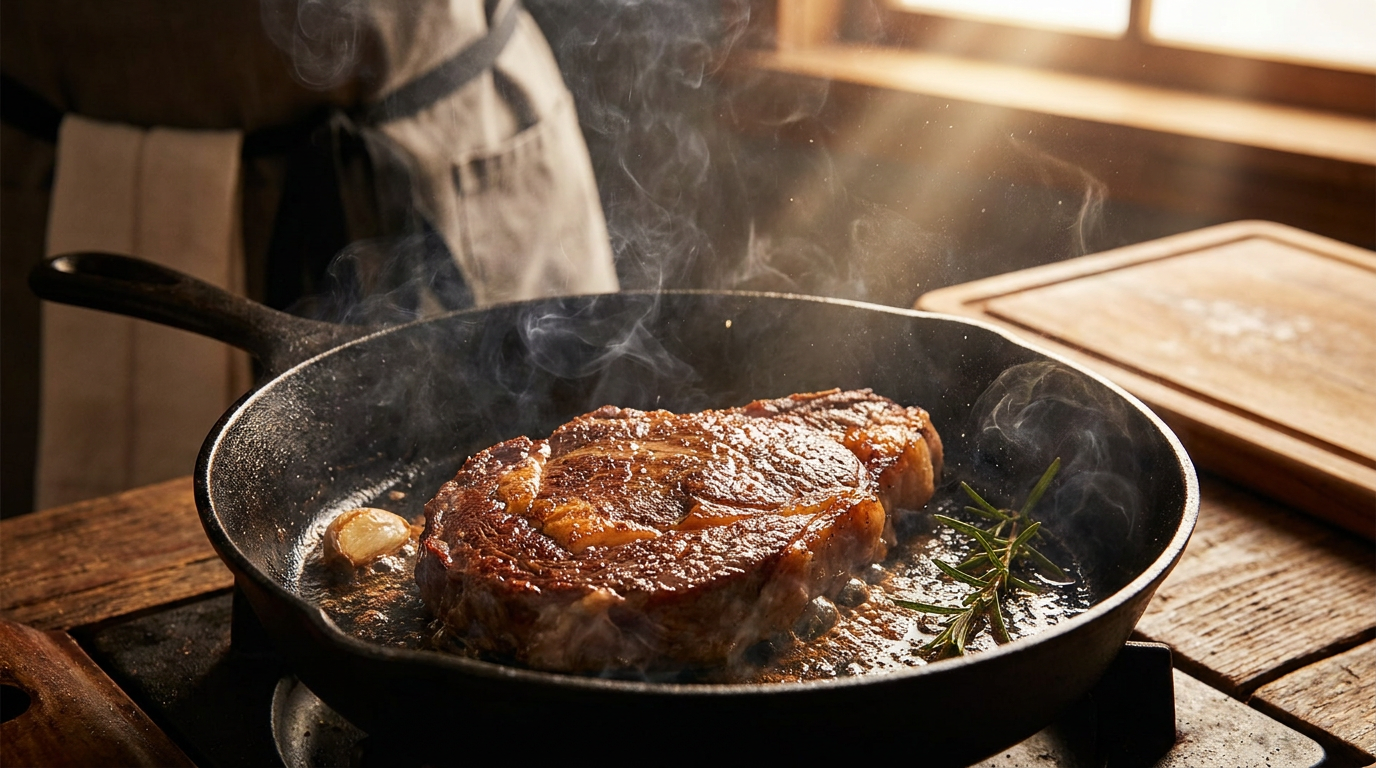
Walk past a bustling restaurant patio or a backyard barbecue, and the aroma that stops you in your tracks is not just the smell of food getting hot. It is the airborne evidence of a violent, microscopic collision of molecules. The deep, savory scent of a searing steak, the nutty aroma of baking bread, and the complex bitterness of roasted coffee all share a single chemical origin. This transformative process is known as the Maillard reaction, and it is arguably the most important scientific concept in the culinary arts.[1][2]
Despite its ubiquity in the kitchen, the reaction was not discovered by a chef. In 1912, French chemist Louis-Camille Maillard was attempting to understand biological protein synthesis when he observed that heating sugars and amino acids together resulted in a distinct brown color and a rich aroma. For decades, his discovery was largely ignored by the culinary world, viewed merely as an obscure biochemical curiosity. It wasn't until World War II, when the military needed to develop palatable, long-lasting rations, that food scientists began to seriously study the mechanics of Maillard's browning.[6][7]
At its core, the Maillard reaction is a form of non-enzymatic browning. It requires two primary building blocks: amino acids, which are the structural components of proteins, and reducing sugars, such as glucose or fructose. When these two elements are subjected to heat, the reactive carbonyl group of the sugar attacks the nucleophilic amino group of the protein. This initial collision forms an unstable intermediate structure called a Schiff base, which quickly undergoes a structural shift known as the Amadori rearrangement.[3][6]

From this point, the reaction ceases to be a single, linear process and instead becomes a cascading waterfall of chemical transformations. The Amadori compounds break down and recombine in wildly unpredictable ways, generating literally hundreds of new, highly volatile molecules. These secondary and tertiary reactions produce pyrazines, furans, and thiophenes—the chemical compounds responsible for the earthy, meaty, and roasted flavors that humans find irresistible.[1][3][5]
Because of this massive generation of new aromatic compounds, culinary scientists often argue that "browning" is a woefully inadequate term. The Maillard reaction is fundamentally a "flavor reaction." While the process does eventually produce melanoidins—the large, complex polymers that give a crust its brown pigment—the color is merely a visual indicator that the flavor cascade has successfully occurred. A raw potato and a roasted potato contain the same baseline calories, but the roasted potato possesses a vastly superior flavor profile entirely because of these newly synthesized molecules.[4][7]
To trigger this cascade effectively, heat alone is not enough; the environment must be dry. The Maillard reaction proceeds rapidly only at temperatures between 285°F and 330°F (140°C to 165°C). Because water boils and turns to steam at 212°F (100°C), any moisture on the surface of the food acts as a thermal ceiling. As long as liquid water is present, the surface temperature cannot exceed 212°F, making rapid Maillard browning physically impossible. This is why boiling, poaching, and steaming produce pale foods with distinctly different, milder flavor profiles.[2][3]

To trigger this cascade effectively, heat alone is not enough; the environment must be dry.
This thermodynamic reality dictates the most crucial technique in savory cooking: moisture control. To achieve a proper sear on a steak or a scallop, the surface must be patted completely dry before it hits the pan. If the protein is wet, the thermal energy of the pan is wasted on evaporating the surface water, effectively steaming the meat rather than searing it. Once the moisture is gone, the surface temperature can rapidly climb into the 300°F range, initiating the molecular cascade.[1][4]
It is a common misconception to confuse the Maillard reaction with caramelization. While both processes require high heat and result in browning, their chemical pathways are entirely distinct. Caramelization is the thermal degradation of sugars in the absence of amino acids. When you heat pure sugar in a pan to make caramel, or when the natural sugars in an onion break down after hours of slow cooking, that is caramelization. The Maillard reaction, by contrast, strictly requires the presence of proteins. In many foods, such as a chocolate chip cookie or a roasted carrot, both reactions occur simultaneously, layering complex savory notes over deep sweetness.[1][3][7]

Beyond temperature and moisture, the pH level of the food significantly influences the speed of the reaction. The Maillard cascade accelerates in alkaline environments because the amino groups become deprotonated, increasing their reactivity. Bakers and food manufacturers frequently exploit this chemical quirk. Traditional pretzels are dipped in a highly alkaline lye solution before baking, which hyper-accelerates the Maillard reaction and produces their signature dark, glossy crust in a matter of minutes. Home cooks can achieve a similar, albeit milder, effect by adding a pinch of baking soda to onions to speed up their browning.[6][7]
Evolutionary biologists suggest that our profound attraction to Maillard-derived flavors is not an accident of the palate, but a hardwired survival mechanism. Early humans who developed a preference for cooked foods gained a massive evolutionary advantage. Cooking denatures proteins, neutralizes pathogens, and breaks down complex starches into easily digestible calories. The aromas produced by the Maillard reaction serve as a reliable olfactory signal that the food is safe, calorie-dense, and ready to consume.[7]
Despite over a century of intense study, the Maillard reaction remains partially shrouded in mystery. The sheer speed and complexity of the branching chemical pathways make it incredibly difficult to map at the microscopic level. In a single piece of seared meat, scientists have identified over 600 distinct flavor compounds, many of which exist in such minute quantities that they are difficult to isolate. Advanced liquid chromatography and mass spectrometry continue to reveal new radical intermediates, proving that the chemistry of a simple weeknight dinner is as complex as anything found in a laboratory.[4][5]

However, there is a delicate balance to strike. If the temperature is pushed too high—generally above 350°F (175°C)—the Maillard reaction gives way to pyrolysis. This is the final breakdown of the molecules, leading to burning, carbonization, and the development of harsh, acrid flavors. Furthermore, extreme high-heat cooking can lead to the formation of acrylamide, a byproduct currently studied by public health officials as a probable carcinogen. The culinary sweet spot lies in maintaining the heat high enough to trigger the flavor cascade, but low enough to prevent the onset of pyrolysis.[3][6]
Modernist chefs have even found ways to cheat the thermodynamic rules of the reaction. By using a pressure cooker, which raises the boiling point of water well above 212°F, cooks can initiate the Maillard reaction in wet environments. This technique allows for the rapid development of deep, roasted flavors in liquid-heavy dishes like stocks and stews, achieving in 45 minutes what traditionally takes hours of slow simmering.[4][7]
Ultimately, understanding the Maillard reaction bridges the gap between following a recipe and truly mastering the craft of cooking. It transforms the kitchen from a place of guesswork into a laboratory of applied thermodynamics. By controlling heat, managing moisture, and respecting the chemical cascade, anyone can unlock the profound, complex flavors that define great food.[1][7]
How we got here
1912
French chemist Louis-Camille Maillard publishes the first paper describing the reaction between amino acids and sugars.
1940s
During WWII, military food scientists begin heavily researching the reaction to improve the flavor and shelf-life of soldier rations.
1953
American chemist John E. Hodge publishes a definitive paper establishing the specific multi-step chemical pathways of the reaction.
1990s-Present
Advanced mass spectrometry allows scientists to identify hundreds of specific micro-compounds generated during the reaction.
Viewpoints in depth
Culinary Professionals
Chefs view the reaction as a mechanical process to be managed through heat and moisture control.
For culinary professionals, the Maillard reaction is less about molecular diagrams and more about practical thermodynamics. The primary obstacle in a kitchen is water. Because water caps surface temperatures at 212°F, chefs emphasize techniques like dry-brining, aggressive pat-drying, and using heavy cast-iron pans that retain massive amounts of thermal energy. Their goal is to push the surface of a protein or vegetable past the 285°F threshold as quickly as possible, maximizing the creation of flavor compounds without overcooking the interior.
Food Scientists & Chemists
Researchers focus on the microscopic cascade of Amadori rearrangements and volatile compound generation.
To a food chemist, a seared steak is a chaotic laboratory. The initial nucleophilic attack of an amino group on a sugar is just the beginning. Scientists are fascinated by the subsequent breakdown into hundreds of volatile compounds—like pyrazines, which provide roasted notes, and furans, which offer sweet, caramel-like aromas. Much of modern food science is dedicated to isolating these specific compounds to understand exactly how they interact with human olfactory receptors, and how they can be replicated or enhanced in commercial food production.
Evolutionary Biologists
Biologists argue that our love for browned food is a hardwired survival mechanism.
Evolutionary theory suggests that the human preference for Maillard-derived flavors is not a cultural accident, but a biological imperative. Cooking food denatures tough proteins, kills harmful bacteria, and unlocks calories that would otherwise be indigestible. The complex aromas generated by the Maillard reaction act as an olfactory beacon, signaling to the brain that the food is safe, nutritious, and calorie-dense. In this view, our craving for a crusty loaf of bread or a roasted piece of meat is a trait that directly contributed to the survival and brain development of early hominids.
What we don't know
- The exact sequence of all secondary and tertiary chemical pathways, as hundreds of compounds form and break down simultaneously in fractions of a second.
- The precise long-term health impacts of consuming high levels of advanced glycation end-products (AGEs) generated by the reaction.
Key terms
- Amino Acids
- Organic molecules that serve as the fundamental building blocks of proteins, essential for initiating the Maillard reaction.
- Reducing Sugars
- Simple carbohydrates, such as glucose and fructose, that can act as reducing agents in chemical reactions.
- Melanoidins
- Complex, brown-colored polymer compounds formed at the end of the Maillard reaction, responsible for the visual browning of food.
- Caramelization
- A distinct browning process that involves the thermal breakdown of sugars in the absence of proteins.
- Pyrazines
- A class of volatile chemical compounds produced during the Maillard reaction, responsible for roasted and nutty aromas.
- Acrylamide
- A chemical compound that can form in some foods during extreme high-temperature cooking, currently studied as a potential health risk.
Frequently asked
Why doesn't boiled food turn brown?
Boiling water caps the temperature of the food's surface at 212°F (100°C). The Maillard reaction requires temperatures above 285°F (140°C) to proceed rapidly, making browning impossible while liquid water is present.
Is the Maillard reaction the same as caramelization?
No. Caramelization involves the thermal breakdown of sugars alone. The Maillard reaction requires the interaction of both reducing sugars and amino acids (proteins).
Can the Maillard reaction happen at room temperature?
Yes, the chemical pathways can occur at room temperature, but the process takes months or years. The gradual darkening of aged balsamic vinegar or soy sauce is a result of slow Maillard browning.
How can I get a better sear on my steak?
Pat the surface of the meat completely dry with paper towels before cooking. Surface moisture must evaporate before the temperature can rise high enough for the Maillard reaction to begin.
Sources
Source coverage
7 outlets
4 viewpoints surfaced







[1]Food52Culinary Professionals
Why the Maillard Reaction is the Most Important Concept in Cooking
Read on Food52 →[2]Tasting TableCulinary Professionals
The Maillard Reaction Explained: What Happens When You Cook
Read on Tasting Table →[3]Serious EatsCulinary Professionals
An Introduction to the Maillard Reaction: The Science of Browning, Aroma, and Flavor
Read on Serious Eats →[4]Modernist CuisineFood Scientists & Chemists
The Maillard Reaction: The Flavor Reaction
Read on Modernist Cuisine →[5]Journal of Agricultural and Food ChemistryFood Scientists & Chemists
Studies on Radical Intermediates in the Early Stage of the Nonenzymic Browning Reaction of Carbohydrates and Amino Acids
Read on Journal of Agricultural and Food Chemistry →[6]WikipediaFood Scientists & Chemists
Maillard reaction
Read on Wikipedia →[7]Factlen Editorial TeamPublic Health Researchers
Synthesis by Factlen editorial team
Read on Factlen Editorial Team →
Every angle. Every day.
Get food drink stories with full source coverage and perspective breakdowns delivered to your inbox.