
Why 'Libraries of Things' Are Becoming the Ultimate Neighborhood Amenity
Communities are rapidly expanding lending libraries that offer power tools, camping gear, and electronics, saving residents money and reducing environmental waste.
By Factlen Editorial Team
- Municipal Planners & Libraries
- View the model as a public service that increases equity, saves residents money, and modernizes the role of the public library.
- Circular Economy Advocates
- Focus on the macro impact of reduced consumption, arguing that sharing economies are essential for hitting climate targets.
- Independent Tool Libraries
- Grassroots organizations focused on hyper-local resilience and skill-building, though often struggling with long-term funding.
What's not represented
- · Traditional hardware retailers
- · Tool manufacturers
Why this matters
By socializing the cost of expensive, rarely used items, these community hubs effectively raise the local standard of living without requiring higher incomes, while simultaneously cutting down on household clutter and environmental waste.
Key points
- Libraries of Things allow residents to borrow tools, electronics, and gear instead of buying them.
- The model saves households money and frees up storage space in smaller urban apartments.
- Sharing items reduces the environmental impact associated with manufacturing and shipping new goods.
- Public library systems across the US are rapidly adopting and expanding these collections in 2026.
- Independent non-profit tool libraries often face funding and staffing challenges despite high demand.
The classic dilemma of modern homeownership is the power drill. You need to hang a single shelf, so you purchase a drill for $60. You use it for exactly twelve minutes, place it in a closet, and there it sits for the next five years. Multiply that single idle tool by every household in a neighborhood, and the economic and material inefficiency becomes staggering. For decades, the default solution to needing an item temporarily was simply to buy it and store it. But a quiet revolution in local communities is challenging that premise.
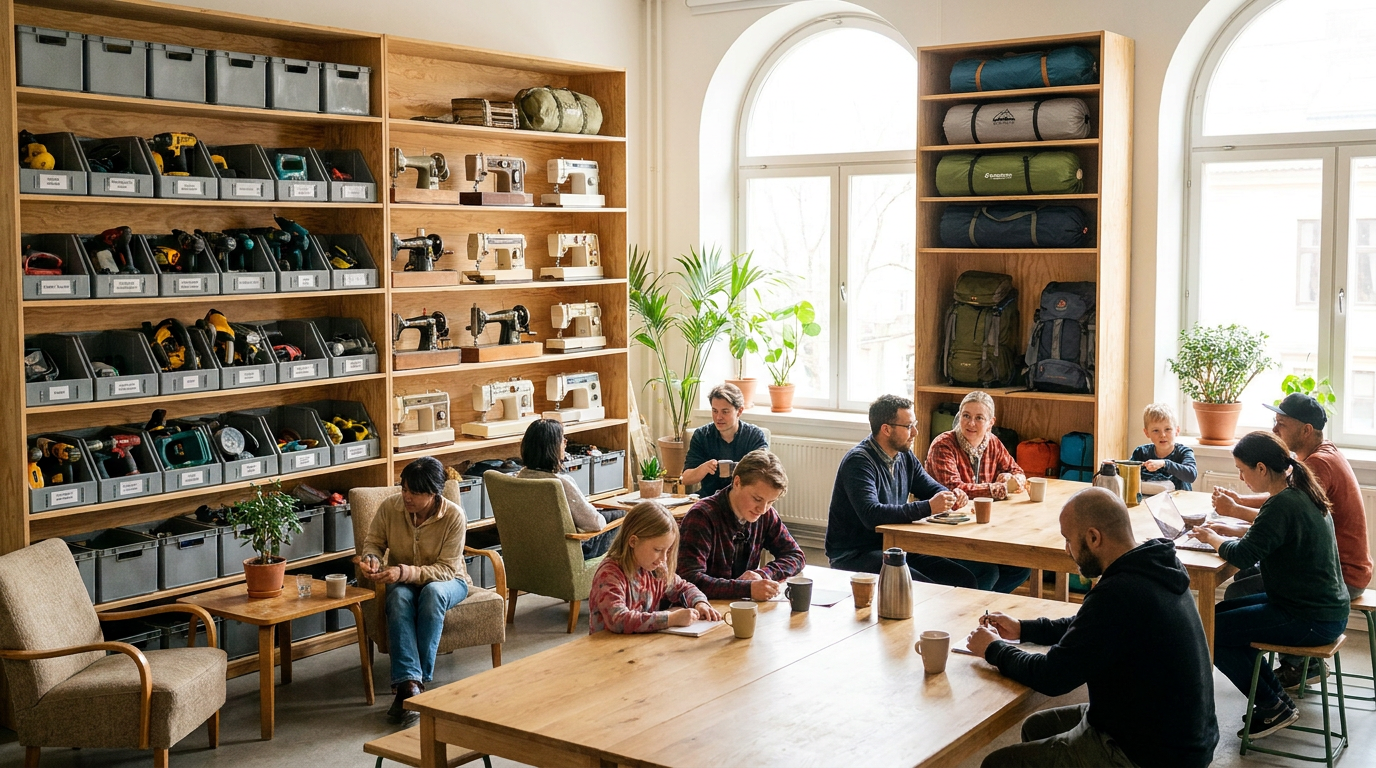
Enter the "Library of Things" (LoT) or the community tool library. The concept is exactly what it sounds like: a centralized community hub where residents can borrow physical items instead of purchasing them. These collections go far beyond traditional books and media, offering everything from pressure washers and sewing machines to camping tents, pasta makers, and specialized electronics. By socializing the cost of ownership, these libraries are reshaping how neighborhoods interact with material goods.
While the concept of lending objects has historical roots—the first recorded tool library opened in Grosse Pointe Farms, Michigan, in 1943 with the intention of offering training to young people—the modern iteration is experiencing a massive resurgence. Across North America and Europe, municipalities and non-profits are rapidly expanding these collections in 2026, driven by a combination of environmental awareness, inflation, and a desire for stronger community ties.[1]

The mechanism is straightforward and increasingly digitized. Patrons typically browse an online catalog, reserve an item, and pick it up from a central location or an automated locker system. Some of these libraries operate as independent, grassroots non-profits, while an increasing number are being integrated directly into existing public library systems, utilizing established infrastructure to reach a broader demographic.
In Indianapolis, the public library system is significantly expanding its Library of Things pilot program throughout 2026, offering items like pickleball sets, floor blowers, and science experiment toolboxes across multiple branches. Similarly, the Amarillo Public Library in Texas launched its own collection in April 2026. Funded entirely by local philanthropy, the Amarillo program provides patrons with specialized cookware, gardening equipment, and niche technology that would otherwise be cost-prohibitive for many families.[5][6]
The primary driver behind this municipal adoption is economic efficiency. For low- and moderate-income households, the cost of acquiring specialized tools can be a significant barrier to home maintenance or pursuing new skills. By providing free or low-cost access to these items, communities grant their residents the ability to improve their living conditions and explore new hobbies. It effectively raises the local standard of living without requiring higher individual incomes.
The primary driver behind this municipal adoption is economic efficiency.
There is also a profound environmental claim underpinning the movement: the transition toward a "circular economy." The traditional linear economy operates on a model of extract, manufacture, use, and discard. A Library of Things disrupts this cycle by maximizing the utility of a single manufactured item. Instead of one hundred drills sitting idle in one hundred homes, a single high-quality drill is shared among the community, drastically reducing the carbon footprint associated with manufacturing, shipping, and eventual disposal.[1][7]

The UK-based social enterprise simply named "Library of Things" illustrates the potential scale of this model. Founded in a South London shipping container in 2014, the organization now operates in 22 locations across the country. As of late 2025, it boasts nearly 40,000 members and has facilitated over 70,000 rentals. Their explicit mission is to make borrowing easier and more appealing than owning, partnering with local councils to install self-service kiosks in accessible public spaces.[2]
Urban density is another major catalyst for the movement's growth. As housing costs rise and living spaces shrink in major metropolitan areas, few apartment dwellers have the garage space required to store ladders, hedge trimmers, or carpet cleaners. The Library of Things model allows residents to "borrow instead of store," effectively treating the community hub as a shared neighborhood garage and freeing up valuable square footage in private homes.
Beyond the physical items themselves, these spaces frequently function as engines for community engagement. Many independent tool libraries host "repair cafes" or skill-sharing workshops where experienced locals teach their neighbors how to mend clothes, fix broken electronics, or safely operate power tools. This transforms the library from a mere transactional counter into a vibrant center for mutual learning and intergenerational connection.
Local governments are also using these libraries to gauge and respond directly to community interests. In Hillsboro, Oregon, the city government recently invited residents to vote on which items to add to their collection for early 2026. Based on over 1,500 community votes, the library purchased kids' telescopes, document scanners, and portable PA systems. This democratic approach ensures the collection reflects the diverse, evolving needs of the specific neighborhood it serves.[3]

However, the model is not without its operational uncertainties and challenges. Maintaining a fleet of heavily used power tools requires dedicated staff, a supply of spare parts, and rigorous safety protocols. The Tacoma Tool Library in Washington, which sees an impressive average of 991 tools checked out monthly, recently had to restructure its staff and eliminate its executive director position due to funding constraints. This highlights the fragile financial reality of many independent, non-profit models that rely heavily on grants and volunteers.[4]
Liability is another open question that organizers must navigate. Lending out chainsaws, pole saws, or heavy machinery carries inherent physical risks. Most libraries mitigate this by requiring users to sign comprehensive liability waivers, and some mandate brief safety orientations or proof of prior experience before releasing dangerous equipment. Yet, securing affordable insurance remains a significant hurdle for smaller operations looking to expand their inventories.

Despite these friction points, the trajectory of the movement is clear. As municipalities look for tangible, highly visible ways to support residents amidst economic pressures and climate concerns, the Library of Things offers a universally popular solution. It represents a quiet but profound shift in consumer culture: a growing recognition that we often do not want to own the drill itself, but simply need the hole in the wall.[7]
How we got here
1943
The first recorded tool library opens in Grosse Pointe Farms, Michigan, to train young people.
1970s
A new wave of tool libraries emerges in the US, focusing on neighborhood revitalization and affordable home repair.
2014
The 'Library of Things' social enterprise is founded in a South London shipping container, eventually scaling across the UK.
2020
The European Union's Erasmus+ project begins funding networking and expansion between European Libraries of Things.
2025-2026
Major public library systems across the US formally integrate or expand Library of Things collections into their standard offerings.
Viewpoints in depth
Municipal Planners' view
Focuses on equity, public service expansion, and modernizing the library.
For city governments and public library directors, the Library of Things is a natural evolution of civic infrastructure. They view the model as a highly efficient way to provide tangible value to taxpayers, particularly low-income residents who cannot afford specialized equipment. By housing these collections within existing public libraries, municipalities can leverage established logistics and trust to improve the local standard of living without requiring complex new social programs.
Environmental Advocates' view
Focuses on the macro impact of reduced consumption and circular economics.
Sustainability experts argue that sharing economies are essential for hitting global climate targets. They point out that manufacturing fewer goods directly reduces resource extraction, energy consumption, and greenhouse gas emissions. From this perspective, a tool library is not just a neighborhood convenience, but a scalable climate intervention that disrupts the wasteful 'take, make, dispose' linear economy.
Grassroots Organizers' view
Focuses on community resilience, skill-building, and human connection.
Organizers of independent tool libraries value the human connections formed around the items just as much as the items themselves. They see these spaces as antidotes to modern isolation, where neighbors meet at repair cafes and skill-sharing workshops. However, they frequently highlight the precarious nature of this work, noting that without consistent municipal funding, these vital community hubs often burn out their volunteer bases.
What we don't know
- Whether independent non-profit tool libraries can find sustainable long-term funding models without relying entirely on volunteer labor.
- How traditional hardware and tool manufacturers will respond if collaborative consumption significantly impacts retail sales.
Key terms
- Library of Things (LoT)
- A community collection that loans out non-traditional items like tools, electronics, and recreational gear instead of books.
- Circular Economy
- An economic system aimed at eliminating waste and the continual use of resources, contrasting with a 'take, make, dispose' linear model.
- Collaborative Consumption
- A model of sharing, swapping, trading, or renting products and services, enabling access over ownership.
- Repair Cafe
- A community gathering where people with repair skills help others fix broken items, often hosted in conjunction with tool libraries.
Frequently asked
Do I have to pay to use a Library of Things?
Many public libraries offer these items for free with a standard library card. Independent non-profit tool libraries often charge a small annual membership fee or operate on a sliding scale based on income.
What happens if an item breaks while I am using it?
Most libraries expect normal wear and tear and have volunteers or staff to repair items. Borrowers are typically only charged if the item was lost, stolen, or damaged due to gross negligence.
Can I donate my old tools to a local library?
It depends on the location. Many welcome high-quality, working donations, but some restrict donations to avoid becoming a dumping ground for broken or obsolete items.
How do libraries handle safety for dangerous tools?
Libraries often require borrowers to sign specific liability waivers for power tools, and some mandate a brief safety orientation or proof of experience before checkout.
Sources
Source coverage
7 outlets
3 viewpoints surfaced






[1]Active SustainabilityCircular Economy Advocates
The Library of Things where you can borrow anything you need
Read on Active Sustainability →[2]Cooperative CityCircular Economy Advocates
Library of Things: Making borrowing easier than owning
Read on Cooperative City →[3]City of HillsboroMunicipal Planners & Libraries
New Library of Things Items Coming in 2026: Community Voting Results
Read on City of Hillsboro →[4]Tacoma Tool LibraryIndependent Tool Libraries
Impact Report 2025
Read on Tacoma Tool Library →[5]Amarillo Public LibraryMunicipal Planners & Libraries
Library of Things Ready to Launch
Read on Amarillo Public Library →[6]Indianapolis Public LibraryMunicipal Planners & Libraries
Library of Things
Read on Indianapolis Public Library →[7]Factlen Editorial TeamIndependent Tool Libraries
Synthesis by Factlen editorial team
Read on Factlen Editorial Team →
Every angle. Every day.
Get community stories with full source coverage and perspective breakdowns delivered to your inbox.