
How Intergenerational Co-Housing is Engineering the Cure for Loneliness
As social isolation reaches epidemic levels, a new wave of intentional communities and modern 'third places' is proving that architectural design can foster deep human connection.
By Factlen Editorial Team
- Social Scientists & Researchers
- Argue that human health is fundamentally tied to social connection and that loneliness is a structural public health crisis.
- Urban Planners & Architects
- Focus on how physical design, zoning, and the integration of third places can organically foster community interaction.
- Intergenerational Advocates
- Emphasize the mutual benefits of mixing age groups, where seniors gain purpose and youth gain mentorship.
What's not represented
- · Traditional Real Estate Developers
- · Introverted Residents
Why this matters
The Harvard Study of Adult Development has proven that social connection is the single greatest predictor of human health and longevity. By redesigning how we live to naturally include multiple generations and shared spaces, we can structurally eliminate the isolation that drives modern anxiety and cognitive decline.
Key points
- The 85-year Harvard Study of Adult Development proves that relationship quality is the top predictor of lifelong health.
- Modern society has seen a sharp decline in 'third places,' the informal public spaces crucial for civic connection.
- Intentional co-housing developments are reversing this trend by designing neighborhoods that force organic daily interactions.
- Intergenerational communities mix seniors and young families, providing mutual benefits like mentorship and reduced cognitive decline.
- Studies show that residents moving into co-housing experience a dramatic, measurable drop in loneliness within just six months.
For decades, the pursuit of a healthy life has been dominated by metrics we can measure on a smartwatch: steps taken, calories burned, and hours slept. But the longest-running study on human happiness suggests we have been optimizing the wrong variables.[1]
Since 1938, the Harvard Study of Adult Development has tracked the physical and emotional well-being of hundreds of individuals, eventually expanding to include their spouses and descendants. After more than 85 years of gathering brain scans, blood samples, and psychological profiles, the researchers arrived at a definitive conclusion: the quality of our relationships is the single most important predictor of long-term health and happiness.[1]
The data is stark. Loneliness and social isolation pose health risks comparable to smoking or alcoholism, while strong social ties protect against cognitive decline and can add up to 15 years to a person's life. Yet, modern society is structurally engineered for isolation.[1][8]

Sociologist Ray Oldenburg famously coined the term "third places" to describe the informal gathering spots—cafés, libraries, barbershops, and community centers—that exist outside of the home (the first place) and the workplace (the second place). These neutral grounds are the living rooms of society, where people gather simply to enjoy companionship.[4]
However, recent data highlights the quiet disappearance of these shared spaces. A 2024 American Social Capital Survey found that 63 percent of Americans seldom or never visited a library in the past year, and half rarely visited a park. As these organic hubs of civic life fade, urban planners and sociologists are looking for ways to build connection directly into our housing.[4][8]
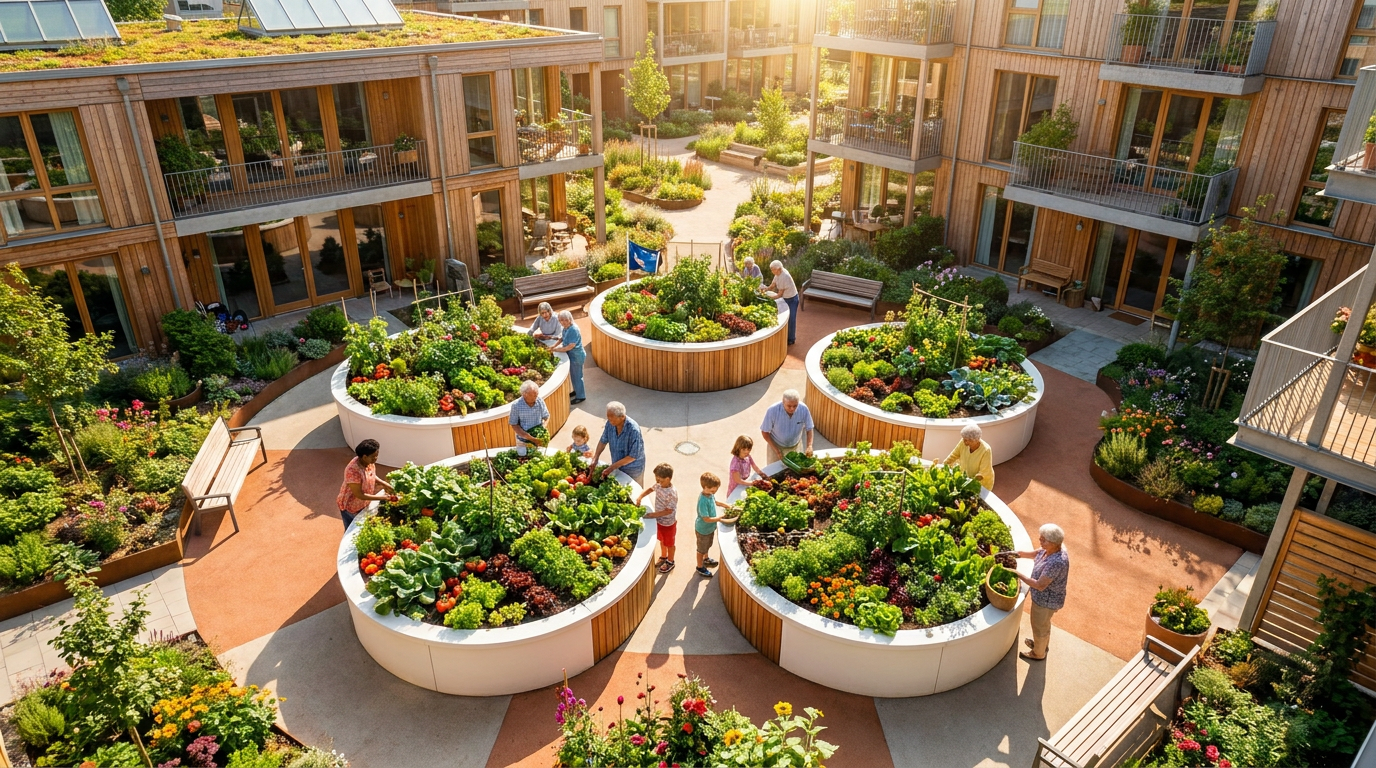
Enter the modern co-housing movement. Unlike traditional subdivisions or anonymous apartment blocks, co-housing communities are intentionally designed to foster daily interaction. Residents own or rent their private homes but share extensive communal spaces, such as large kitchens, gardens, workshops, and recreational areas.[2][3]
The social science backing these communities is remarkable. A recent study tracking residents moving into a new co-housing development found that before moving in, only 40 percent reported rarely or never feeling lonely. Just six months after moving in, that number skyrocketed to 100 percent. Every single surveyed resident reported interacting with their neighbors on a daily or weekly basis.[2]

A recent study tracking residents moving into a new co-housing development found that before moving in, only 40 percent reported rarely or never feeling lonely.
This dramatic shift is not an accident; it is the result of deliberate physical and social design. By placing parking on the periphery and centering homes around pedestrian walkways and shared courtyards, developers create natural collision points. Residents are forced to bump into one another, turning strangers into acquaintances, and acquaintances into a reliable support network.[2][3]
But the most transformative evolution of this model is the rise of intergenerational living. For decades, Western housing has largely segregated people by age, placing young professionals in city centers, families in suburbs, and older adults in isolated retirement facilities.[6][7]
Intergenerational communities dismantle these silos by intentionally housing seniors, young families, and students within the same ecosystem. The benefits flow in both directions. For older adults, regular interaction with younger generations provides a profound sense of purpose, combats cognitive decline, and encourages physical activity.[6][8]
For younger residents, the presence of elders offers mentorship, emotional grounding, and practical support, such as informal childcare. In the UK, the award-winning Belong Chester development became the first in the country to fully integrate a children's nursery directly into a senior care village, proving that mutual caregiving can thrive when the architecture allows it.[6]

This concept is scaling up rapidly. In North Manchester, a massive 600-home "Healthy Neighbourhood" is currently under development. Integrated within a health and social care environment, the project blends family housing, later living, dementia care, and key worker accommodations into a single, vibrant community designed to promote social inclusion and healthy aging.[6]
The commercial real estate sector is also taking note, reimagining mixed-use developments to serve as modern third places. Developers are increasingly integrating co-working lounges, wellness areas, and community hubs into residential masterplans. These spaces offer the creative freedom and spontaneous interaction of a traditional third place, but with the convenience of being just downstairs.[5]
Despite the overwhelming evidence of their benefits, intentional communities face significant hurdles. A recent "Blueprint for Intergenerational Living," published by Generations United and Harvard researchers, points out that zoning laws often restrict multi-household developments.[7]
Developers frequently have to navigate complex rezoning processes, city council hearings, and financing models that are geared toward traditional single-family homes or standard apartment complexes. The blueprint argues that scaling these communities requires a shift in both public policy and financial infrastructure.[2][7]

Yet, the momentum is undeniable. As the loneliness epidemic forces a reckoning with how we build our cities, the demand for community-led housing is surging. People are realizing that while privacy is valuable, isolation is lethal.[3][8]
The solution to modern disconnection may not lie in another wellness app or self-care routine, but in the physical spaces we inhabit. By designing neighborhoods that prioritize shared experiences and intergenerational bonds, we are not just building houses—we are engineering the cure for loneliness.[1][8]
How we got here
1938
The Harvard Study of Adult Development begins tracking participants to understand the roots of a healthy life.
1989
Sociologist Ray Oldenburg publishes 'The Great Good Place', popularizing the concept of the 'third place'.
2023
The UK's Belong Chester opens, becoming the first development to fully integrate a children's nursery into a senior care village.
2024
Harvard and Generations United publish a blueprint to help scale intergenerational housing models across the US.
Viewpoints in depth
Social Scientists & Researchers
Argue that human health is fundamentally tied to social connection and that loneliness is a structural public health crisis.
This camp views the loneliness epidemic not as a personal failure, but as a public health crisis on par with smoking or obesity. Drawing heavily on longitudinal data like the Harvard Study of Adult Development, they argue that humans are biologically wired for connection. When deprived of it, the body experiences chronic stress that accelerates cognitive decline and cardiovascular disease. They advocate for structural interventions to boost 'social fitness,' emphasizing that medicalizing loneliness is insufficient if the environments people live in remain inherently isolating.
Urban Planners & Architects
Focus on how physical design, zoning, and the integration of third places can organically foster community interaction.
Designers and planners argue that community cannot be forced, but it can be engineered. By prioritizing pedestrian walkways, shared amenities, and mixed-use zoning over car-centric sprawl, they believe the built environment can naturally generate the 'third places' society has lost. They point to the success of co-housing layouts—where parking is pushed to the periphery and homes face shared courtyards—as proof that spatial design dictates social behavior. Their primary frustration lies with outdated zoning laws that make multi-household, shared-space developments difficult to finance and build.
Intergenerational Advocates
Emphasize the mutual benefits of mixing age groups, where seniors gain purpose and youth gain mentorship.
This perspective champions the dismantling of age-segregated living, which they view as a relatively recent and harmful historical anomaly. They point to evidence that isolating seniors in retirement facilities accelerates cognitive decline and depression. Conversely, mixing generations creates a symbiotic ecosystem: older adults find renewed purpose and physical activity through mutual caregiving, while younger families receive emotional grounding, mentorship, and practical support like informal childcare. They view intergenerational living not just as a housing trend, but as a restoration of the natural human village.
What we don't know
- How quickly local governments will update restrictive zoning laws to allow for more multi-household, shared-space developments.
- Whether the long-term health benefits observed in niche co-housing communities will scale identically when applied to mass-market real estate.
- How the financing models for intergenerational living will adapt to make these communities affordable for lower-income populations.
Key terms
- Third Place
- A public, informal gathering space outside of home and work that fosters community connection and civic engagement.
- Co-housing
- An intentional community of private homes clustered around shared spaces, designed to encourage regular social interaction among neighbors.
- Intergenerational Living
- Housing models that intentionally mix different age groups—such as seniors, students, and young families—to promote mutual support and combat age segregation.
- Social Fitness
- The proactive practice of building and maintaining strong, healthy relationships, treated with the same importance as exercising for physical health.
Frequently asked
What is a 'third place'?
A sociological term for a social environment outside of the home (first place) and workplace (second place), like a café or library, where people gather informally to connect.
How does co-housing differ from a regular apartment?
Co-housing features private homes but includes extensive, intentionally designed shared spaces—like communal kitchens and gardens—managed collaboratively by the residents to encourage daily interaction.
Why is intergenerational living beneficial for seniors?
Regular interaction with younger people provides a sense of purpose, combats isolation, and has been shown to improve memory, physical health, and overall longevity.
What did the Harvard Study of Adult Development find?
After more than 85 years of research, it concluded that the quality of a person's relationships is the single greatest predictor of their lifelong health and happiness.
Sources
Source coverage
8 outlets
3 viewpoints surfaced







[1]Harvard Study of Adult DevelopmentSocial Scientists & Researchers
Lessons from the longest study on happiness
Read on Harvard Study of Adult Development →[2]Strong TownsUrban Planners & Architects
Measuring Changes in Wellbeing in Cohousing
Read on Strong Towns →[3]MDPISocial Scientists & Researchers
Community-Led Housing and Loneliness
Read on MDPI →[4]Washington MonthlyUrban Planners & Architects
The quiet disappearance of shared space
Read on Washington Monthly →[5]Construction WeekUrban Planners & Architects
How 'third places' are redefining community spaces in today's dynamic world
Read on Construction Week →[6]ARCO UKIntergenerational Advocates
From Crisis to Community: The Power of Intergenerational Living
Read on ARCO UK →Healthier Lives Across Generations: A Blueprint for Intergenerational Living
Read on Harvard Joint Center for Housing Studies →[8]Factlen Editorial TeamIntergenerational Advocates
Synthesis by Factlen editorial team
Read on Factlen Editorial Team →

Every angle. Every day.
Get lifestyle stories with full source coverage and perspective breakdowns delivered to your inbox.