
Battery Storage Costs Fall Below Gas Power as Clean Energy Meets 60% of New Demand
Utility-scale battery storage costs have officially fallen below the cost of new gas power plants, crossing a critical economic threshold in the global energy transition. Driven by plummeting technology costs, clean energy met nearly 60% of all new global electricity demand in 2025.
By Factlen Editorial Team
- Energy Economists
- Focus on the LCOE crossover point, emphasizing that renewables plus storage now outcompete fossil fuels purely on market fundamentals.
- Grid Operators & Utilities
- Highlight the operational challenges of integrating intermittent renewables and the rising demand from AI data centers.
- Climate Policy Analysts
- View the capacity additions as a massive win but warn that overall investment levels still fall short of a 2050 net-zero pathway.
What's not represented
- · Fossil Fuel Industry Executives
- · Local Communities Near Mining Sites
Why this matters
For decades, the transition to renewable energy was framed as a moral imperative that required economic sacrifice. The 2026 data proves that clean energy paired with battery storage is now fundamentally cheaper than fossil fuels, meaning raw market forces—not just government policies—will drive the next phase of global decarbonization.
Key points
- The global benchmark cost for a four-hour battery storage project fell 27% to $78/MWh in 2025.
- Battery storage is now officially cheaper to build and operate than new combined-cycle gas turbines.
- Clean energy sources supplied nearly 60% of the total increase in global electricity demand in 2025.
- The world added a record 692 gigawatts of new renewable capacity last year, driven primarily by solar.
- Achieving a global net-zero pathway by 2050 will still require an estimated $235 trillion in cumulative investment.
For decades, the global transition to renewable energy faced a fundamental, seemingly intractable math problem. The sun sets, the wind stops blowing, and storing that intermittent power for when it was actually needed cost exponentially more than simply burning fossil fuels. This economic reality forced grid operators to rely on natural gas and coal to maintain baseline stability, treating solar and wind as helpful but ultimately supplementary additions to the energy mix.[6]
In early 2026, that underlying mathematical reality definitively flipped. According to the latest comprehensive Levelized Cost of Electricity (LCOE) analysis published by BloombergNEF, utility-scale battery storage is now officially cheaper to build and operate than new gas-fired power plants. This crossover point represents a holy grail for energy economists, signaling that the transition is no longer reliant on government subsidies or carbon taxes, but is instead being driven by raw market fundamentals.[1]
The specific numbers from the report illustrate a structural shift in global grid economics. The global benchmark cost for a standard four-hour battery storage project plummeted by 27% year-on-year, landing at $78 per megawatt-hour (MWh) in 2025. This dramatic reduction was fueled by an oversupply of lithium-ion cells, advancements in battery chemistry, and massive scaling in manufacturing capacity across Asia and North America.[1]
This $78/MWh benchmark marks the lowest level recorded since BloombergNEF began tracking the data in 2009. The cost declines are not isolated to a single region; in six major global markets, the LCOE for four-hour battery systems has now dropped well below the critical $100/MWh threshold, making it the default economic choice for developers looking to provide dispatchable power during peak evening hours.[1]

Conversely, the fossil-fuel alternatives that have traditionally dominated this sector are becoming increasingly expensive. The LCOE for new combined-cycle gas turbines rose 16% over the same period to $102/MWh. This price inflation is being driven by persistent supply chain constraints, volatile global liquefied natural gas (LNG) markets, and surging demand for reliable, round-the-clock power from the rapidly expanding artificial intelligence sector.[1]
Historical data confirms that this crossover is not a temporary market anomaly, but the culmination of a relentless, decade-long technological learning curve. Research published in Energy & Environmental Materials details how the LCOE of utility-scale solar photovoltaics fell by over 90% between 2010 and 2023. In sun-rich regions, solar generation costs have reached as low as $0.03 per kilowatt-hour, making it the cheapest source of electricity in human history.[5]
Battery storage costs have followed a nearly identical, albeit slightly delayed, trajectory. Over that same 2010 to 2023 timeframe, the cost of utility-scale battery storage collapsed by 89%, falling from a prohibitive $2,511 per kilowatt-hour down to $273 per kilowatt-hour, setting the stage for the record-breaking price drops witnessed throughout 2024 and 2025.[5]
Forecasters expect this downward cost curve to persist well into the next decade. BloombergNEF projects a further 30% reduction in solar LCOE and a 25% reduction in battery LCOE by 2035. If these projections hold, the cost of utility-scale battery storage will reach an astonishing $58/MWh, fundamentally altering how national grids are designed and operated.[1]
The global energy market is already reacting aggressively to these new economics. The International Energy Agency (IEA) reported in its latest outlook that clean energy sources supplied nearly 60% of the total increase in global electricity demand throughout 2025, marking a historic shift in how the world powers its economic growth.[2]
The global energy market is already reacting aggressively to these new economics.
This surge in clean energy deployment occurred even as overall global electricity consumption grew by 3%—a rate more than twice the pace of broader energy demand growth. This unprecedented thirst for electricity is being fueled by the rapid adoption of electric vehicles, the electrification of heavy industry, and the massive power requirements of new digital infrastructure and data centers.[2]
To meet this demand, total renewable capacity additions are shattering historical records. The International Renewable Energy Agency (IRENA) documented that the world added a staggering 692 gigawatts (GW) of new renewable capacity in 2025 alone. This massive build-out brought the total global renewable energy capacity to 5,149 GW, underscoring the accelerating momentum of the transition.[3]

Solar power was the undisputed engine of this expansion, contributing over 500 GW to the total. This means that solar energy alone accounted for nearly three-quarters of all new power generation capacity added worldwide, a testament to its unmatched scalability and rock-bottom deployment costs.[3]
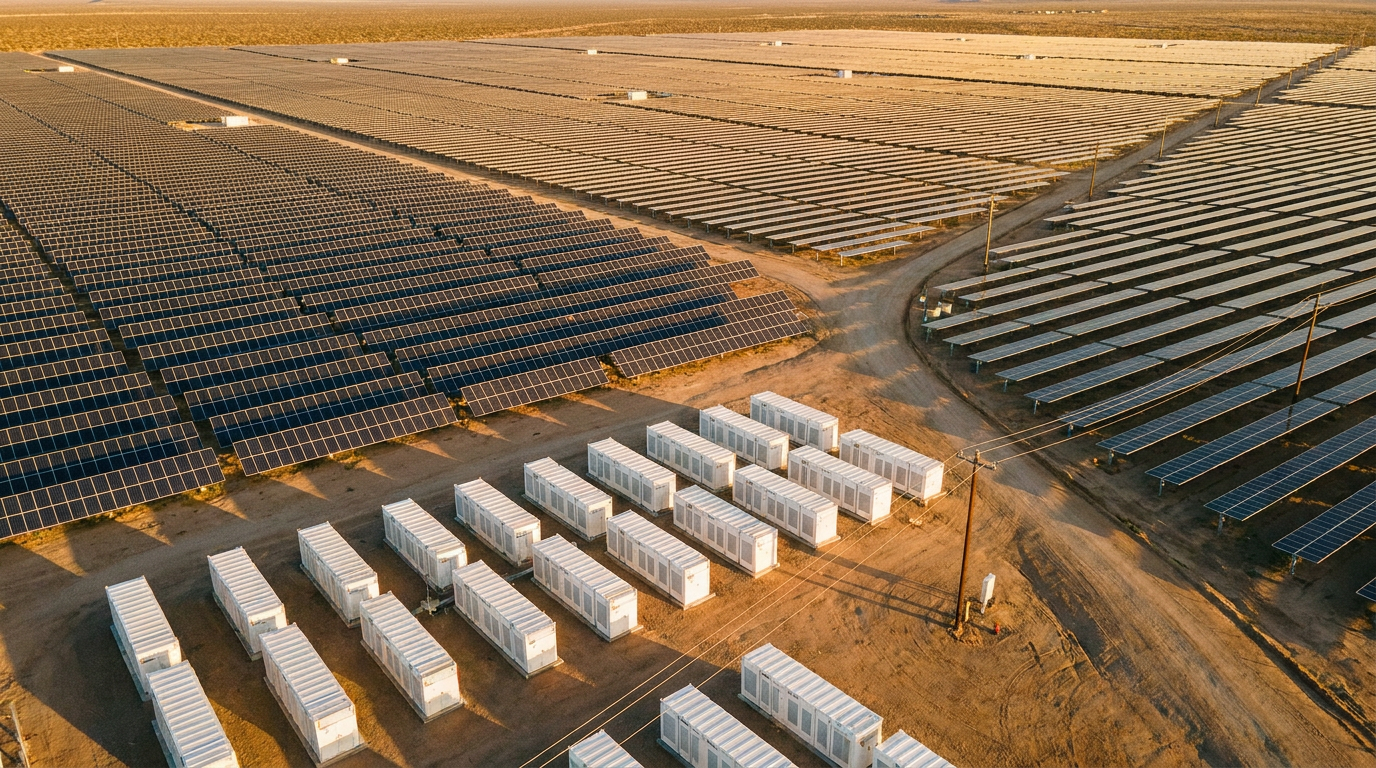
With generation costs solved, the integration of storage directly with new solar and wind farms has become the industry's primary focus. In Europe, the capacity of co-located renewable energy and battery storage facilities is projected to increase by more than 450% by 2030, rising from 6.3 GW in 2025 to approximately 35 GW.[6]
This co-location strategy is absolutely essential for managing excess generation and preventing grid overload. Without on-site storage, grid operators are forced into curtailment—the wasteful practice of shutting off perfectly functional solar panels because the grid cannot absorb their output. Across Europe's major power markets, curtailment is forecast to rise to 33 terawatt-hours by 2030, making batteries a critical relief valve.[6]
The economic gravity of cheap renewables is accelerating the transition even in the world's most coal-dependent economies. The China Electricity Council recently announced that the country's cumulative installed capacity of renewable energy is expected to officially surpass that of coal, driven by optimized power supply policies and an aggressive push toward green energy independence.[4]
Macroeconomic modeling suggests that the long-term financial benefits of this transition will be staggering. A recent comprehensive analysis of national fossil fuel phase-out roadmaps indicates that a rapid transition to electrified, renewable-powered systems could generate roughly $280 billion in net economic savings between 2026 and 2050, driven primarily by massive efficiency gains and eliminated fuel costs.[6]

Despite these overwhelmingly positive indicators, the data also highlights significant hurdles that remain unresolved. While the per-unit cost of generation and storage is falling rapidly, the sheer scale of the transition requires unprecedented capital. Achieving a global net-zero pathway by 2050 will require an estimated $235 trillion in cumulative investment.[6]
Mobilizing this capital requires directing 84% of all global energy investment toward low-carbon technologies, representing a 24% increase above current funding levels. While private markets are eagerly funding profitable solar and battery projects, securing investment for less lucrative grid modernization and transmission infrastructure remains a critical bottleneck.[6]
Furthermore, the explosive growth of the artificial intelligence sector is placing unexpected strain on the transition timeline. The massive, continuous power requirements of new AI data centers are forcing some utilities to delay the retirement of existing fossil fuel plants, as the current pace of renewable deployment—while record-breaking—still struggles to keep up with this localized, hyper-concentrated demand.[2][6]
Ultimately, the 2026 data provides definitive proof that the primary barrier to a clean energy future is no longer the cost of the technology itself. With battery storage officially undercutting gas power, the challenge has shifted entirely from economics to logistics—specifically, how quickly humanity can manufacture the hardware, permit the land, and build the physical transmission lines required to harness the cheapest energy in history.[6]
How we got here
2010-2023
Utility-scale solar PV costs plummet by over 90%, making daytime solar the cheapest energy source in history.
2024
China's cumulative installed capacity of renewable energy surpasses coal for the first time.
2025
Global renewable capacity additions hit a record 692 GW, with solar accounting for nearly three-quarters of the growth.
Feb 2026
BNEF reports that 4-hour battery storage LCOE has fallen below new gas turbine costs, crossing a critical economic threshold.
2030 (Projected)
Europe's co-located renewable and battery storage capacity is forecast to increase by 450%.
Viewpoints in depth
The Economic Case
Why market fundamentals are now driving the transition faster than policy.
Energy economists argue that the energy transition has crossed a point of no return. With battery storage LCOE falling below new gas turbines, the financial incentive to build fossil fuel peaker plants has evaporated. Analysts point to the 89% drop in battery costs over the last decade as evidence of a structural, irreversible trend driven by manufacturing scale and technological learning curves, rather than temporary subsidies.
The Grid Reality
The physical bottlenecks threatening to slow deployment.
While the generation economics are solved, grid operators caution that the physical infrastructure is lagging dangerously behind. The surge in electricity demand from AI data centers and electric vehicles is straining legacy grids. Utilities emphasize that without massive, immediate investments in transmission lines and smart grid technologies, the cheap power generated by new solar farms will be lost to curtailment, forcing reliance on existing fossil fuel assets during peak hours.
The Policy Gap
The shortfall in total capital required for net-zero.
Despite record-breaking capacity additions, climate policy analysts warn against complacency. Achieving a global net-zero pathway by 2050 requires an estimated $235 trillion in cumulative investment—a 24% increase above current levels. These analysts stress that while the private sector is aggressively funding solar and battery deployment, governments must step in to de-risk investments in emerging markets and fund the unglamorous but essential grid modernization projects.
What we don't know
- Whether global supply chains for critical battery minerals can scale fast enough to meet the projected 2035 demand without triggering price spikes.
- How the exponential growth in electricity demand from AI data centers will impact the retirement schedule of existing fossil fuel plants.
- If national grid infrastructures can be modernized quickly enough to handle the massive influx of decentralized, intermittent power sources.
Key terms
- Levelized Cost of Electricity (LCOE)
- A metric that calculates the average total cost to build and operate a power-generating asset over its lifetime, divided by the total energy output.
- Curtailment
- The deliberate reduction of electricity generation—often shutting off solar or wind farms—when supply exceeds the grid's capacity to absorb or store it.
- Peaker Plant
- A power plant, typically running on natural gas, that only operates during periods of high electricity demand to prevent blackouts.
- Co-location
- The practice of building battery storage facilities at the exact same site as solar or wind farms to capture excess energy before it hits the broader grid.
Frequently asked
Why did gas power become more expensive while batteries got cheaper?
Gas turbine costs rose 16% due to supply chain constraints and surging demand from new AI data centers, while battery costs fell due to massive scaling in manufacturing and technological improvements.
What is LCOE and why does it matter?
Levelized Cost of Electricity (LCOE) measures the average net present cost of electricity generation over a plant's lifetime. It is the standard metric used to compare the true cost of different energy sources.
Are batteries replacing coal and gas completely?
Not yet. While batteries are now cheaper for building new capacity, existing fossil fuel plants still provide baseline power. However, batteries are rapidly replacing gas 'peaker' plants used during high-demand hours.
Sources
Source coverage
6 outlets
3 viewpoints surfaced





[1]BloombergNEFEnergy Economists
Levelized Cost of Electricity 2026: Storage Crosses the Threshold
Read on BloombergNEF →[2]International Energy AgencyGrid Operators & Utilities
Electricity 2026: Clean Energy Meets 60% of Incremental Demand
Read on International Energy Agency →[3]IRENAClimate Policy Analysts
Renewable Capacity Statistics 2026
Read on IRENA →[4]China Electricity CouncilGrid Operators & Utilities
2026 Power Sector Outlook: Renewables Surpass Coal Capacity
Read on China Electricity Council →[5]Energy & Environmental MaterialsEnergy Economists
Long-term structural trends in solar and battery LCOE
Read on Energy & Environmental Materials →[6]Factlen Editorial TeamClimate Policy Analysts
Synthesis by Factlen editorial team
Read on Factlen Editorial Team →
Every angle. Every day.
Get data analysis stories with full source coverage and perspective breakdowns delivered to your inbox.