
Iran Declares Strait of Hormuz Closed Over Lebanon Strikes, Testing Fragile U.S. Peace Deal
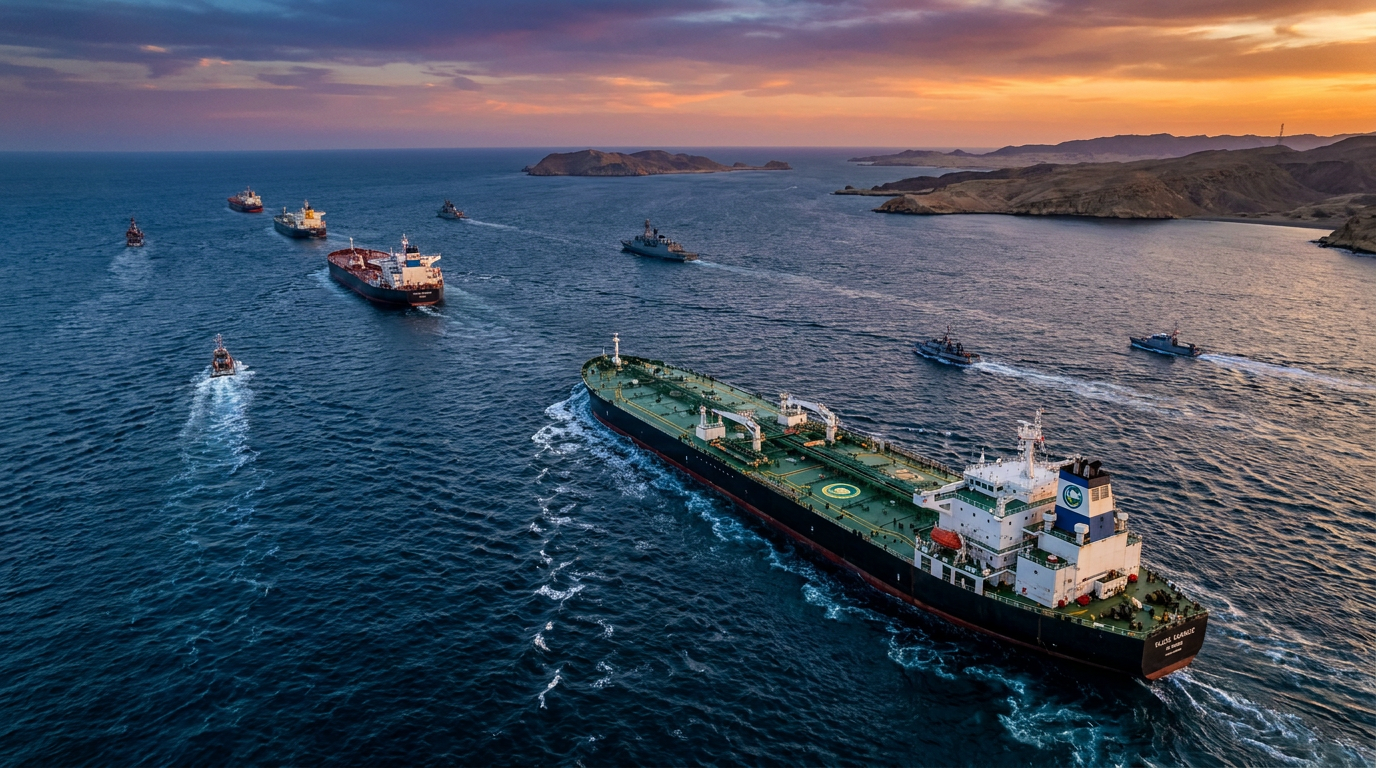
Iran's military command announced a renewed closure of the critical Strait of Hormuz on Saturday, citing continued Israeli strikes in Lebanon as a breach of a recent ceasefire agreement. The U.S. military denied the waterway was shut, but the conflicting claims immediately sent global oil prices surging.
By Factlen Editorial Team
- U.S. Administration
- Maintains that the strait is open and views Iran's declaration as empty posturing.
- Global Markets & Analysts
- Reacts to the perceived risk and uncertainty, regardless of physical blockades.
- Iranian State & Military
- Views the closure as a justified retaliation against U.S. and Israeli breaches of the ceasefire.
What's not represented
- · Lebanese civilians affected by the strikes
- · Crews of the commercial vessels transiting the strait
Why this matters
The Strait of Hormuz is the transit point for 20 percent of the world's oil. Even the threat of its closure immediately spikes global energy prices, which directly impacts inflation, shipping costs, and the price consumers pay at the gas pump.
Key points
- Iran's military command declared the Strait of Hormuz closed in retaliation for Israeli strikes in Lebanon.
- The U.S. military denied the closure, reporting that 55 commercial vessels safely transited the strait on Saturday.
- Global oil prices spiked 7 percent following the announcement, erasing recent market gains.
- Diplomatic teams from the U.S. and Iran are still proceeding to Switzerland for scheduled technical talks.
The fragile peace holding the global energy market together fractured on Saturday, as Iran’s top joint military command announced a renewed closure of the Strait of Hormuz. The declaration by the Khatam al-Anbiya Central Headquarters shattered the brief optimism that followed a landmark Memorandum of Understanding (MoU) signed just days earlier between Washington and Tehran.[3][4][6]
The immediate trigger for the crisis lies not in the Persian Gulf, but in the Levant. Iranian military officials cited continued Israeli military operations against the Hezbollah militant group in southern Lebanon as a "blatant breach" of the ceasefire commitments outlined in the U.S.-Iran agreement. Tehran views the cessation of hostilities on all fronts, including Lebanon, as a non-negotiable pillar of the 14-point peace framework.[1][4]
Iran framed the closure as a necessary "first step" in retaliation, warning that further measures would be taken if the United States failed to compel Israel to halt its strikes and withdraw from southern Lebanese territory. The Islamic Revolutionary Guard Corps (IRGC) Navy subsequently warned all commercial vessels to stay away from the strategic waterway, stating that their security could no longer be guaranteed.[4][6]

The United States immediately and categorically disputed the Iranian declaration. Vice President JD Vance, speaking in a televised interview on Saturday morning, stated that the administration was "not seeing any evidence" of a renewed shutdown. He asserted that the U.S. holds the diplomatic leverage and that the straits remain open for global commerce.[2][3]
The U.S. military provided concrete data to back up the political denials. U.S. Central Command (CENTCOM) released a statement confirming that its forces remain "present and vigilant" in the region, actively supporting freedom of navigation. According to CENTCOM, 55 commercial merchant ships carrying more than 17 million barrels of oil safely transited the international waterway on Saturday without Iranian interference.[3][4]
This stark divergence in narratives—a declared blockade by Tehran versus a documented flow of traffic by Washington—creates a perilous environment for the global economy. The Strait of Hormuz is the world's most critical energy chokepoint, a narrow maritime corridor between Iran and Oman through which roughly 20 percent of the world's seaborne crude oil and significant volumes of liquefied natural gas must pass.[5][7]
This stark divergence in narratives—a declared blockade by Tehran versus a documented flow of traffic by Washington—creates a perilous environment for the global economy.
Energy markets, which abhor uncertainty, reacted violently to the conflicting reports. Crude oil prices jumped sharply on futures marketplaces, with the international Brent benchmark rising 7 percent to $82 a barrel, while West Texas Intermediate (WTI) climbed to $79. This sudden spike erased the relief rally that had pushed prices to a three-month low earlier in the week when the peace deal was first announced.[5][7]

The economic mechanics of the strait mean that a physical blockade is not strictly necessary to disrupt global trade. The mere declaration of a closure by the IRGC Navy is enough to trigger massive spikes in maritime insurance premiums. Shipping conglomerates, unwilling to risk multi-million-dollar vessels and their crews, often reroute or anchor their fleets at the first sign of credible military threats, effectively choking off supply even if the waterway remains physically navigable.[4][8]
The timing of the crisis threatens to derail a highly anticipated diplomatic summit. Despite the military posturing in the Gulf, technical-level negotiations between the U.S. and Iran are still scheduled to begin on Sunday in Switzerland. Key mediators from Pakistan and Qatar have spent the weekend scrambling to keep the talks on track, urging both sides to compartmentalize the Lebanon dispute from the broader nuclear and sanctions negotiations.[1][3]
The Iranian delegation, led by Parliament Speaker Mohammad Bagher Ghalibaf, departed for Geneva on Saturday. Internal directives from Iran's Supreme National Security Council reportedly instructed state media to project absolute unity, ensuring that the military's closure announcement and the diplomatic team's departure are not viewed as a fracture within the regime, but rather as a coordinated strategy of maximum pressure.[6]
On the American side, the stakes are equally high. U.S. envoys Steve Witkoff and Jared Kushner are already en route to the Alpine nation, with Vice President Vance expected to join them shortly. The Trump administration has invested significant political capital in the peace deal, viewing the stabilization of global oil prices as a crucial domestic priority ahead of the upcoming midterm elections.[2][3]

The core vulnerability of the MoU is its ambitious scope. By attempting to resolve the direct U.S.-Iran conflict while simultaneously demanding a comprehensive ceasefire across all regional proxy fronts, the agreement gave multiple actors veto power over its success. U.S. intelligence officials had previously warned that the Israeli government, intent on degrading Hezbollah's capabilities, might continue operations that would inevitably provoke an Iranian response.[1][3]
The coming days will test the durability of the 60-day negotiation window established by the MoU. If commercial vessels continue to transit the strait under U.S. naval observation without drawing Iranian fire, the crisis may be downgraded to a diplomatic pressure tactic. However, if the IRGC Navy moves to physically intercept or harass a tanker, the U.S. military's Operation Project Freedom could be forced into direct confrontation.[3][4]
For now, the global economy remains hostage to a 21-mile-wide stretch of water. As diplomats gather in Switzerland and warships patrol the Persian Gulf, the disconnect between the signed agreements and the reality on the ground highlights the immense difficulty of unwinding one of the most severe geopolitical crises in modern history.[4][7]
How we got here
Late Feb 2026
U.S.-Israel coalition and Iran engage in direct military conflict; Iran heavily restricts the Strait of Hormuz.
June 15, 2026
U.S. and Iran announce a preliminary framework to end the war, sending oil prices to a three-month low.
June 17, 2026
U.S. President Donald Trump and Iranian President Masoud Pezeshkian sign a formal Memorandum of Understanding (MoU) to lift blockades.
June 19, 2026
A renewed ceasefire between Israel and Hezbollah is announced, but fighting continues in southern Lebanon.
June 20, 2026
Iran's military command declares the Strait of Hormuz closed in retaliation for the Lebanon strikes; the U.S. denies the closure.
Viewpoints in depth
Iran's Military Command
Views the closure as a justified retaliation against U.S. and Israeli breaches of the ceasefire.
Iranian military officials argue that the comprehensive ceasefire outlined in the recent Memorandum of Understanding is indivisible. By allowing Israel to continue its military operations against Hezbollah in southern Lebanon, they claim the United States has failed to uphold its end of the bargain. From this perspective, restricting access to the Strait of Hormuz is a necessary 'first step' to force compliance and demonstrate that Tehran will not accept a piecemeal application of the peace framework.
U.S. Administration
Maintains that the strait is open and views Iran's declaration as empty posturing.
The U.S. perspective, articulated by Vice President JD Vance and Central Command, is grounded in physical reality over rhetorical declarations. By pointing to the 55 commercial vessels that safely transited the strait on Saturday, the administration argues that Iran does not actually control the waterway. The U.S. strategy appears focused on projecting confidence, maintaining freedom of navigation through naval presence, and pushing forward with diplomatic talks in Switzerland without validating Iran's blockade claims.
Energy Markets & Shippers
Reacts to the perceived risk and uncertainty, regardless of physical blockades.
For global markets and the shipping industry, the distinction between a rhetorical closure and a physical blockade is often moot. The mere threat of Iranian interception is enough to drastically alter risk assessments. When military commands issue warnings, maritime insurance premiums skyrocket, and shipping conglomerates often choose to reroute or anchor their fleets rather than risk multi-million-dollar assets. Consequently, the market prices in the disruption immediately, as evidenced by the 7 percent spike in Brent crude.
What we don't know
- Whether the IRGC Navy will attempt to physically intercept or board commercial vessels transiting the strait.
- How the military standoff will impact the technical negotiations scheduled to begin in Switzerland.
- Whether the U.S. will be able to pressure Israel into halting its military operations in southern Lebanon.
Key terms
- Strait of Hormuz
- A narrow maritime chokepoint between the Persian Gulf and the Gulf of Oman, through which roughly one-fifth of the world's oil passes.
- Memorandum of Understanding (MoU)
- The preliminary 14-point peace agreement signed by the U.S. and Iran to end their recent military conflict and lift blockades.
- Brent Crude
- The primary pricing benchmark for oil from the Atlantic basin, used to price two-thirds of the world's internationally traded crude oil.
- U.S. Central Command (CENTCOM)
- The unified combatant command of the U.S. Department of Defense responsible for military operations in the Middle East, Central Asia, and parts of South Asia.
Frequently asked
Why did Iran announce the closure of the Strait of Hormuz again?
Iran's military command cited continued Israeli military operations against Hezbollah in southern Lebanon, which Tehran views as a violation of the comprehensive ceasefire outlined in the recent U.S.-Iran peace agreement.
Is the Strait of Hormuz actually physically blocked right now?
The situation is highly contested. While Iran declared the waterway closed to commercial traffic, the U.S. military stated that 55 merchant ships safely transited the strait on Saturday under its observation.
How have global oil markets reacted to the news?
Crude oil prices immediately jumped, with the Brent benchmark rising 7 percent to $82 a barrel, erasing the relief rally that had followed the initial peace deal announcement earlier in the week.
Does this mean the U.S.-Iran peace deal is dead?
Not necessarily. Diplomatic teams from both the U.S. and Iran are still traveling to Switzerland for scheduled technical talks, though the military standoff severely complicates the negotiations.
Sources
Source coverage
8 outlets
3 viewpoints surfaced








[1]CNBCGlobal Markets & Analysts
Iran reportedly closes Strait of Hormuz again, casting shadow over nuclear talks
Read on CNBC →[2]ForbesU.S. Administration
Iran Says Strait Of Hormuz Is Closed After Lebanon Attacks—U.S. Denies It's Shut
Read on Forbes →[3]The Washington PostU.S. Administration
Iran's military command says it is closing Strait of Hormuz
Read on The Washington Post →[4]The HinduGlobal Markets & Analysts
Iran's military says it has closed Strait of Hormuz over ceasefire violations
Read on The Hindu →[5]BenzingaGlobal Markets & Analysts
Crude Oil Price Pops As Iran Closes Strait Of Hormuz
Read on Benzinga →[6]Iran InternationalIranian State & Military
Iran says it will close Strait of Hormuz to shipping
Read on Iran International →[7]The GuardianGlobal Markets & Analysts
Oil prices hit three-month low and markets rally
Read on The Guardian →[8]Al JazeeraGlobal Markets & Analysts
Stock markets soar, oil falls as US and Iran announce framework to end war
Read on Al Jazeera →


Every angle. Every day.
Get business stories with full source coverage and perspective breakdowns delivered to your inbox.