
How AI and Markerless Motion Capture Are Eradicating Preventable Sports Injuries
Professional sports teams are rapidly adopting advanced computer vision systems that analyze player biomechanics in real-time, identifying fatigue and injury risks before a tear or sprain occurs.
By Factlen Editorial Team
- Performance & Medical Staff
- Focuses on the technology's ability to extend careers, optimize training loads, and prevent catastrophic injuries.
- Data Scientists & Technologists
- Prioritizes the accuracy of the computer vision models, camera frame rates, and the evolution of predictive algorithms.
- Player Welfare Advocates
- Raises concerns regarding biometric data ownership, privacy, and how predictive algorithms might impact contract negotiations.
What's not represented
- · Amateur athletes lacking access to expensive tech
- · Traditional scouts who rely on the 'eye test'
Why this matters
By shifting sports medicine from reactive treatment to proactive prediction, this technology is extending the careers of generational athletes and protecting massive team investments. Furthermore, these biomechanical models are already trickling down to consumer apps, promising to revolutionize physical therapy and injury prevention for everyday runners and amateur athletes.
Key points
- Markerless motion capture uses stadium cameras and AI to track player biomechanics in real-time without wearable sensors.
- The systems create a 3D digital twin of the athlete, measuring joint angles and torque loads.
- By detecting micro-deviations in an athlete's movement baseline, AI can predict soft-tissue injuries before they occur.
- The technology is extending careers but raising new questions about biometric data ownership and privacy.
The worst sound in sports isn't a booing crowd; it's the silence that follows a non-contact injury. For decades, a torn anterior cruciate ligament (ACL) or a blown ulnar collateral ligament (UCL) was treated as an unavoidable hazard of professional athletics, a cruel roll of the physiological dice.[1]
That fatalistic approach is rapidly becoming obsolete. Across global soccer, baseball, and basketball, a quiet revolution in sports analytics is shifting the medical paradigm from reactive surgery to proactive prevention. Teams are no longer waiting for a player to break down; they are predicting the breakdown before it happens.[1][2]
The engine driving this monumental change is markerless motion capture, powered by advanced computer vision and artificial intelligence. It represents the most significant leap in sports medicine since the advent of the MRI.[3]
Historically, capturing precise biomechanical data required athletes to wear cumbersome suits covered in reflective ping-pong balls while performing in a specialized, sterile laboratory. While this provided excellent data for academic studies, it was entirely useless for live-game scenarios where adrenaline, fatigue, and opponents alter how an athlete moves.[5]

Today, arrays of high-speed, high-resolution cameras—often shooting at 120 frames per second or more—are installed in the rafters of professional stadiums. These optical tracking systems, such as those developed by Hawk-Eye and KinaTrax, do not require the athlete to wear any sensors or specialized gear.[5][6]
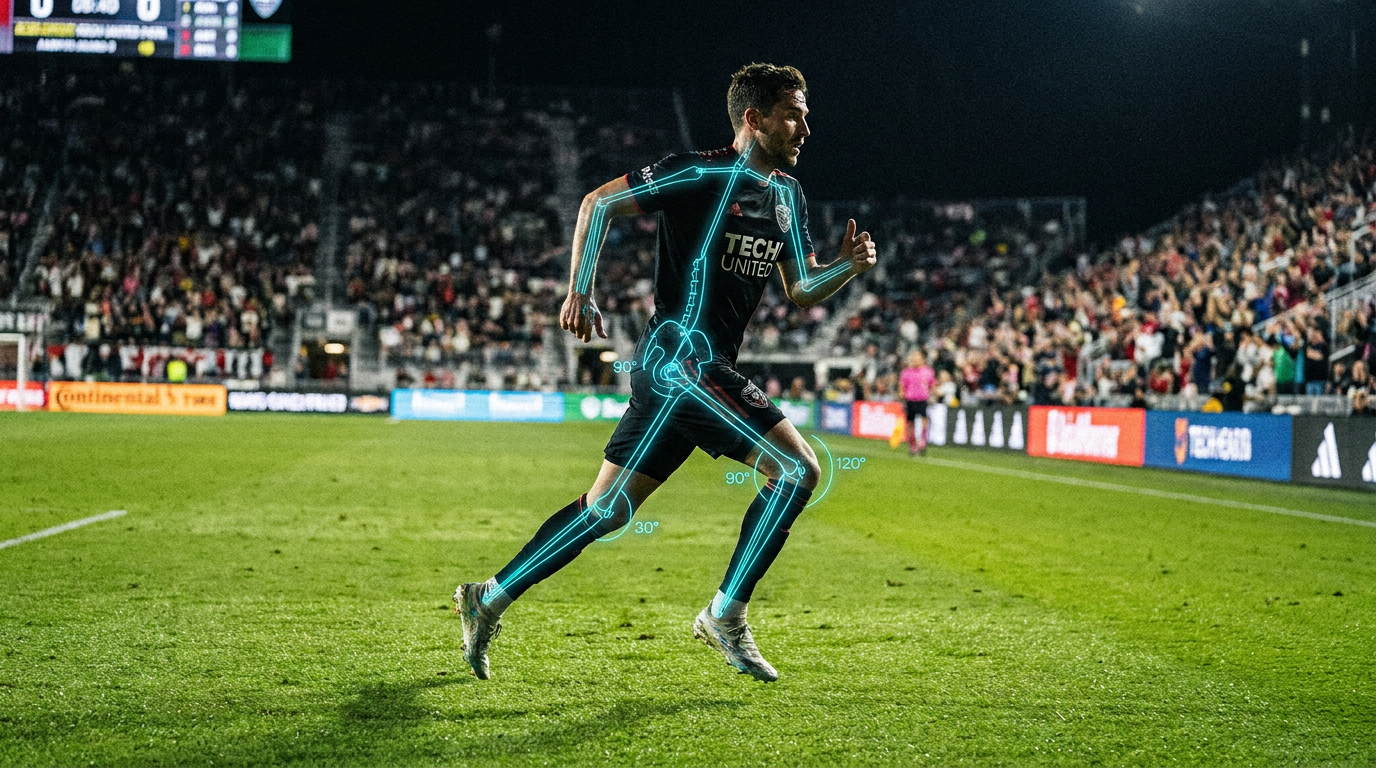
Instead, they use sophisticated machine learning algorithms to identify and track over 300 distinct points on the human skeleton in real-time, regardless of lighting conditions or overlapping players on the field.[3][6]
As a player runs, jumps, or throws, the system generates a flawless 3D digital twin of their skeletal movement. It measures joint angles, rotational velocities, and the exact amount of torque being placed on specific ligaments, feeding millions of data points into a central server every second.[5]
In baseball, this technology has revolutionized the management of pitchers. By analyzing the kinematic sequence—the transfer of energy from the legs, through the torso, and into the arm—teams can pinpoint exactly when a pitcher's mechanics begin to degrade due to muscular fatigue.[4][6]
In baseball, this technology has revolutionized the management of pitchers.
A drop in elbow slot by just a few degrees, or a fractional delay in hip rotation, drastically increases the stress on the elbow. The AI flags this micro-deviation long before the pitcher consciously feels any pain or tightness, allowing the manager to pull them from the game before a catastrophic tear occurs.[4]
In endurance-heavy sports like soccer and basketball, the focus shifts to soft-tissue injuries, such as hamstring strains, groin pulls, and Achilles tears, which account for the vast majority of missed games.[2][7]

Every athlete has a unique biomechanical baseline—their optimal, healthy stride length, ground reaction force, and asymmetrical balance. The AI models ingest weeks of training and match data to learn this baseline perfectly, creating a customized physiological profile for every player on the roster.[1][7]
When a player begins to overcompensate for a minor, unfelt muscle tightness, their mechanics subtly shift. Their stride might shorten by a few millimeters, or they might land with five percent more force on their right leg than their left. These deviations are invisible to the naked eye of a coach or trainer.[2][3]
The analytics dashboard immediately alerts the medical staff to this asymmetrical loading. The player is then rested, given targeted physical therapy, or subjected to a modified training load, effectively neutralizing a hamstring tear that the algorithm calculated was highly likely to happen within the next 48 hours.[1][2]
However, the integration of these predictive models is not without friction. The primary tension lies in data ownership and privacy. Players' associations are increasingly asking who owns this deeply personal biometric data, and whether a predictive algorithm could be weaponized against a player to devalue them in contract negotiations.[7]

Furthermore, there is the inherent 'black box' problem of artificial intelligence. Coaches and athletes sometimes struggle to trust an algorithm that recommends benching a star player for a crucial playoff game when the player insists they feel one hundred percent healthy and ready to perform.[1][3]
Despite these cultural and ethical hurdles, the results are undeniable. Early adopters of comprehensive biomechanical tracking have reported up to a 25 percent reduction in preventable soft-tissue injuries over a multi-season span, keeping their best players on the field and protecting massive financial investments.[1][2]
The most exciting aspect of this technology is its future trajectory. As computer vision models become more computationally efficient and capable of running on standard smartphone cameras, this elite-level analysis is beginning to democratize.[3][5]
Within a few years, amateur runners, high school athletes, and physical therapy patients will be able to prop up their phones, record their movements, and receive the same biomechanical injury-prevention insights currently reserved for superstars, fundamentally changing how the general public approaches physical health.[1][5]

How we got here
2015
Major League Baseball introduces Statcast, primarily using radar to track ball flight and basic player speed.
2020
Hawk-Eye introduces advanced optical tracking in tennis and baseball, moving toward markerless skeletal mapping.
2023
Widespread adoption of markerless biomechanical tracking begins across top-tier European soccer leagues and the NBA.
2026
AI predictive models become a standard medical tool, shifting team strategies from injury treatment to injury prevention.
Viewpoints in depth
Sports Scientists & Medical Staff
Viewing the technology as a revolutionary tool for career longevity and preventative care.
For medical professionals, markerless motion capture is the holy grail of sports science. Traditionally, trainers relied on subjective player feedback or lagging indicators like soreness to gauge injury risk. Now, they have objective, real-time data showing exactly how much load a specific tendon is bearing. This allows them to intervene with targeted physical therapy or rest days precisely when the body begins to compensate for fatigue, effectively neutralizing injuries before the tissue actually tears.
Players Associations & Unions
Expressing concern over the ethical implications of predictive health data and biometric privacy.
While players universally want to avoid injury, their unions are raising alarms about the weaponization of predictive data. If an algorithm determines a 24-year-old star has a biomechanical flaw that makes him 60% more likely to tear his Achilles in the next three years, teams could use that proprietary data to lower contract offers. Unions are fighting to ensure that biometric data remains the property of the player and is used strictly for medical care, not financial leverage.
Front Office Executives
Treating biomechanical AI as a crucial risk-management tool for protecting financial investments.
From a management perspective, professional athletes are massive financial assets. When a $200 million player misses a season due to a preventable hamstring tear, the franchise suffers both competitively and financially. Front offices view these AI systems as an insurance policy. By investing a few million dollars in stadium cameras and data scientists, they can drastically reduce the 'days lost to injury' metric, ensuring their highest-paid assets remain on the field generating value.
What we don't know
- Who ultimately owns the rights to an athlete's deeply personal biomechanical data.
- How accurately these 'black box' AI models can predict injuries in highly chaotic, contact-heavy sports like football or rugby.
- The long-term psychological impact on athletes who are constantly told by an algorithm that they are at risk of injury.
Key terms
- Markerless Motion Capture
- A technology that uses standard or high-speed cameras and artificial intelligence to track human movement in 3D without requiring the subject to wear reflective markers or sensors.
- Biomechanical Baseline
- An athlete's unique, optimal pattern of movement when fully healthy, used as a reference point to detect fatigue or overcompensation.
- Kinematic Sequence
- The order and efficiency in which energy is transferred through the body's segments (e.g., from the legs, to the hips, to the arm) during an athletic motion like pitching or swinging.
- Soft-Tissue Injury
- Damage to muscles, ligaments, or tendons (such as a hamstring strain or ACL tear), which are often preventable through proper load management.
Frequently asked
Do athletes need to wear sensors for this to work?
No. Modern markerless motion capture uses high-speed stadium cameras and computer vision to track the skeleton optically, eliminating the need for wearable GPS or sensor vests.
How does the AI predict an injury?
The AI learns an athlete's healthy 'baseline' movement. If fatigue causes them to alter their stride or throwing motion by even a few millimeters, the system flags the deviation as an injury risk before the player feels pain.
What sports are using this technology?
It is widely used in Major League Baseball for pitcher mechanics, and is rapidly becoming standard in elite soccer (like the Premier League) and the NBA to monitor soft-tissue fatigue.
Will this technology be available to the public?
Yes. As computer vision models become more efficient, developers are creating smartphone apps that can perform basic biomechanical analysis for amateur runners and physical therapy patients.
Sources
Source coverage
7 outlets
3 viewpoints surfaced







[1]Factlen Editorial TeamPerformance & Medical Staff
Synthesis by Factlen editorial team
Read on Factlen Editorial Team →[2]Journal of Sports SciencesPerformance & Medical Staff
The efficacy of markerless motion capture in predicting lower extremity injuries
Read on Journal of Sports Sciences →[3]MIT Sloan Sports Analytics ConferenceData Scientists & Technologists
Beyond the Box Score: Computer Vision and the Future of Player Health
Read on MIT Sloan Sports Analytics Conference →[4]American Journal of Sports MedicinePerformance & Medical Staff
Kinematic sequencing and ulnar collateral ligament stress in elite baseball pitchers
Read on American Journal of Sports Medicine →[5]IEEE Transactions on Biomedical EngineeringData Scientists & Technologists
Real-time skeletal tracking algorithms using multi-camera stadium arrays
Read on IEEE Transactions on Biomedical Engineering →[6]Major League Baseball Advanced MediaData Scientists & Technologists
Statcast and Hawk-Eye: The Evolution of Biomechanical Tracking
Read on Major League Baseball Advanced Media →[7]FIFA Football LanguagePlayer Welfare Advocates
Player Welfare and High-Performance Data Integration
Read on FIFA Football Language →


Every angle. Every day.
Get sports stories with full source coverage and perspective breakdowns delivered to your inbox.