
The "Library of Things" Movement: Why Communities Are Sharing Tools Instead of Buying Them
A growing global network of over 2,000 "Libraries of Things" is allowing residents to borrow power tools, camping gear, and appliances, saving millions of dollars and reducing environmental waste.
By Factlen Editorial Team
- Community Organizers
- Focus on building social fabric, mutual aid, and providing equitable access to resources for low-income residents.
- Environmental Advocates
- View the movement as a crucial mechanism for the circular economy, focusing on reducing raw material extraction and emissions.
- Tool Manufacturers
- See lending libraries as a valuable testing ground for product durability, despite the inherent tension with traditional sales models.
What's not represented
- · Traditional hardware store owners who may lose retail sales to community lending networks.
- · Gig-economy workers who rely on owning their own tools for contracting work.
Why this matters
The average household spends hundreds of dollars on items they use only a few times a year. By shifting from individual ownership to community access, neighborhoods are lowering the cost of living while drastically reducing manufacturing emissions and landfill waste.
Key points
- Over 2,000 formal 'Libraries of Things' now operate globally, lending tools and appliances.
- The model saves residents money by eliminating the need to purchase rarely used items.
- Borrowing drastically reduces carbon emissions and e-waste by maximizing product lifespans.
- Wales has integrated 28 lending libraries directly into its public infrastructure.
- Major tool manufacturers are partnering with libraries to test product durability.
- Many modern networks use digital catalogs and self-service lockers for convenience.
Imagine needing a power drill to hang a single shelf, or a carpet cleaner to handle a one-time spill. For decades, the default consumer response has been to purchase these items, use them once or twice, and relegate them to a garage or closet for the rest of their functional lives. This cycle of hyper-consumption is expensive for households and devastating for the environment. But a quiet revolution is challenging the necessity of ownership. It is called the "Library of Things" movement, and it is transforming how communities access the physical goods they need.[1][7]
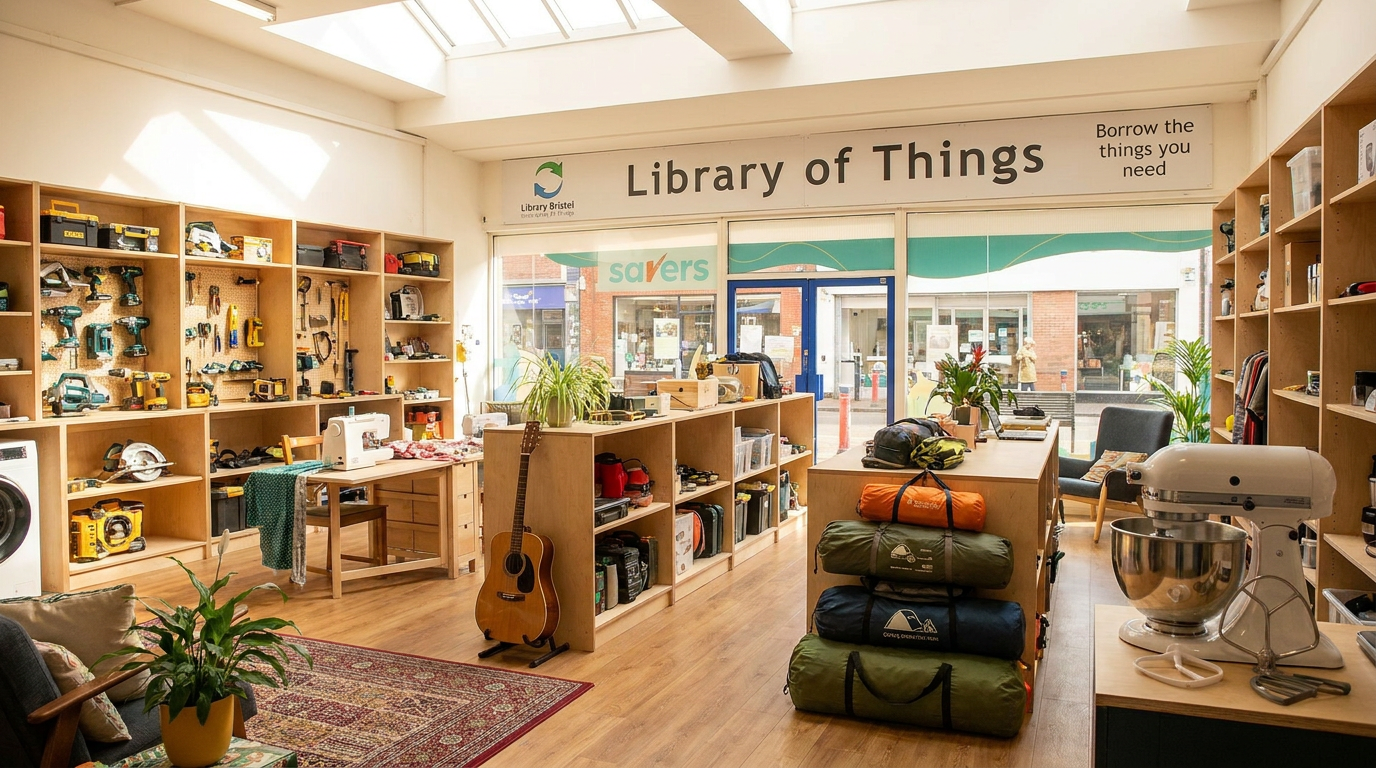
A Library of Things operates on the same fundamental principle as a traditional public library, but instead of books, it lends out practical, everyday items. The inventory typically includes power tools, gardening equipment, camping gear, sewing machines, and specialized kitchen appliances. According to recent global surveys, there are now roughly 2,000 formally organized lending libraries worldwide, operating alongside countless informal neighborhood sharing networks.[1][6]
The movement is rooted in the broader sharing economy, but unlike venture-backed platforms that monetize spare bedrooms or vehicle seats, these libraries are inherently hyper-local and community-driven. They are designed to democratize access to resources, ensuring that a person's ability to repair their home, maintain a garden, or host a community event is not gated by their disposable income.[5][6]
The mechanics of a modern Library of Things are surprisingly sophisticated. While early iterations consisted of volunteer-run storage units, today's networks often utilize digital catalogs, automated reservation systems, and self-service lockers. In the United Kingdom, a social enterprise simply named "Library of Things" operates in over two dozen locations, allowing users to browse items online, pay a small daily rental fee, and pick up their tools from secure kiosks located in public libraries or community centers.[2][5]

To protect the organization and the community, these libraries rely on structured legal frameworks. Borrowers are typically required to sign liability waivers before checking out equipment, particularly for power tools or heavy machinery. Items are rigorously maintained, cleaned, and tested between uses to ensure safety and reliability. This professionalization has been crucial in moving the concept from a fringe activist project to a mainstream civic utility.[4][5]
The environmental impact of this shift from ownership to access is staggering. At the heart of the global climate crisis is a rate of raw material extraction that far exceeds the Earth's regenerative capacity. By maximizing the utility of a single manufactured item, community libraries directly reduce the demand for new plastics, metals, and electronics.[4][6]
Data from the UK network illustrates this impact clearly. The organization reports that 50 percent of its rentals directly prevent a new purchase. Since its inception, the UK network alone has saved more than 110 tons of e-waste from entering landfills and prevented 220 tons of carbon emissions. When a single power drill is shared among fifty households rather than sitting idle in fifty separate garages, the embedded carbon footprint of that tool is effectively divided by fifty.[2][5]

The organization reports that 50 percent of its rentals directly prevent a new purchase.
Beyond environmental metrics, the economic relief provided by these libraries is substantial. In an era marked by inflation and a rising cost of living, affordable access to tools is a tangible financial lifeline. The UK network estimates that its users have saved a collective £600,000 by borrowing rather than buying, keeping that capital circulating within local household budgets.[2][5]
This economic model is currently being tested at a national scale in Wales. Through an initiative called Benthyg Cymru—Welsh for "to borrow"—Wales has established a network of 28 libraries of things embedded directly into its public infrastructure. Co-created with local communities, housing associations, and city councils, the network has facilitated over 18,000 borrows, saving residents an estimated £500,000.[3]
The Welsh model demonstrates what happens when the sharing economy is treated as essential civic infrastructure rather than a novelty. By integrating these libraries into existing community centers and public spaces, the government is actively fostering a "wellbeing economy"—one that prioritizes equity, sustainability, and collective care over endless consumer growth.[3][7]
Interestingly, the rise of the Library of Things has caught the attention of the very manufacturers whose sales models it disrupts. Major tool brands like Bosch, Stihl, and Kärcher have begun partnering with lending networks. For these companies, the libraries serve as a unique testing ground. They receive direct, aggregated feedback on how their tools perform under heavy, varied use, which informs future product design.[5]
However, this corporate involvement highlights a core tension within the movement. On one hand, manufacturers benefit from the brand exposure and trust built when users successfully complete projects with their tools. On the other hand, the fundamental goal of a Library of Things is to reduce the total volume of products sold. Reconciling the capitalist imperative for continuous sales growth with the circular economy's mandate for resource reduction remains an unresolved paradox.[5][7]
Operational challenges also persist for the libraries themselves. The vast majority of the world's 2,000 formal lending libraries operate on annual budgets of less than $10,000 and rely entirely on volunteer labor. Scaling these operations requires sustainable funding models. While some libraries charge a one-time lifetime membership fee, others rely on pay-per-use models or municipal grants. Finding the right balance—charging enough to cover maintenance and space without pricing out low-income residents—is a constant balancing act.[1][5]

Furthermore, inventory management can be complex. Many libraries have stopped accepting random public donations, finding that low-quality or broken items cost more to repair and store than they are worth. Instead, successful networks curate their collections deliberately, purchasing commercial-grade, durable goods that can withstand the rigors of constant communal use.[5]
Despite these hurdles, the trajectory of the movement is clear. As urban living spaces shrink and environmental awareness grows, the logic of hyper-individualized ownership is fracturing. The Library of Things offers a practical, immediate alternative that aligns economic incentives with ecological boundaries.[6][7]
Ultimately, these libraries build more than just a circular economy; they build social fabric. When neighbors share resources, they inevitably share skills, advice, and time. In a society often characterized by isolation, the simple act of borrowing a drill can become a catalyst for community resilience and connection.[3][7]
How we got here
1943
One of the earliest recorded tool libraries opens in Grosse Pointe Farms, Michigan, to offer training to young people.
2012
The Toronto Tool Library is founded, helping to popularize the modern community-lending model.
2014
The 'Library of Things' social enterprise is founded in South London, eventually expanding to dozens of self-service kiosks across the UK.
2024
Research identifies over 2,000 formal Libraries of Things operating globally, alongside countless informal networks.
2025
Wales successfully scales 'Benthyg Cymru,' establishing a national network of 28 community lending libraries integrated into public infrastructure.
Viewpoints in depth
Community Organizers
A tool for mutual aid and equity.
For grassroots organizers, the Library of Things is primarily a vehicle for social equity. By removing the financial barrier to accessing tools, these libraries empower residents to improve their homes, repair their belongings, and host community events. Organizers emphasize that the physical items are often secondary to the social fabric created; the library becomes a hub where neighbors exchange skills, build trust, and practice mutual aid outside of the traditional capitalist market.
Environmental Advocates
A practical application of the circular economy.
Climate researchers and environmental advocates view the movement as a necessary corrective to hyper-consumption. They argue that the current rate of raw material extraction is ecologically unsustainable. By maximizing the lifespan and utility of a single manufactured item, lending libraries directly reduce the demand for new plastics and metals, effectively shrinking the carbon footprint of everyday household tasks.
Tool Manufacturers
A testing ground with a built-in paradox.
Major tool brands like Bosch and Stihl approach the movement with a mix of curiosity and strategic partnership. They utilize these high-volume lending environments to test the durability of their products and gather user feedback. However, industry analysts note a fundamental tension: while manufacturers benefit from brand exposure, the ultimate goal of a sharing economy is to reduce the total volume of goods sold, directly challenging the traditional corporate mandate for continuous sales growth.
What we don't know
- Whether the volunteer-led model can scale sustainably without significant municipal or government funding.
- How traditional big-box hardware retailers will respond if community lending networks capture a significant portion of the occasional-use tool market.
Key terms
- Circular Economy
- An economic model focused on minimizing waste and making the most of resources by reusing, repairing, and recycling existing materials.
- Sharing Economy
- An economic system based on people sharing access to goods, services, and data, often facilitated by community networks or digital platforms.
- Library of Things (LoT)
- A community-based lending facility where residents can borrow physical items—such as tools, electronics, and camping gear—instead of purchasing them.
- E-waste
- Electronic products that are unwanted, not working, and nearing or at the end of their useful life, which can leak toxic chemicals if placed in a landfill.
Frequently asked
How much does it cost to borrow an item?
Costs vary by location. Some libraries offer free borrowing with a standard public library card, while others charge a small daily rental fee or an annual membership subscription.
What happens if an item breaks while I am using it?
Most libraries understand that standard wear and tear happens. Borrowers are typically asked to report the damage so the item can be repaired, though gross negligence may result in a replacement fee outlined in the initial liability waiver.
Can I donate my old tools to a local Library of Things?
Many libraries accept donations, but they often have strict quality standards. To avoid becoming a storage space for broken items, many networks now prefer to purchase commercial-grade tools that can withstand heavy communal use.
Sources
Source coverage
7 outlets
3 viewpoints surfaced






[1]ShareableCommunity Organizers
Library of Things Toolkit and State of the Movement
Read on Shareable →[2]Library of Things UK
Impact Calculation Methodology
Read on Library of Things UK →[3]The Progress PlaybookCommunity Organizers
How Wales is building a sharing economy through its 'libraries of things'
Read on The Progress Playbook →[4]Georgetown Environmental Law ReviewEnvironmental Advocates
The Library Economy: A Legal Framework for Sharing
Read on Georgetown Environmental Law Review →[5]Cooperative CityTool Manufacturers
Library of Things: The new face of the sharing economy
Read on Cooperative City →[6]CityChangersEnvironmental Advocates
Lending Libraries: An Explainer
Read on CityChangers →[7]Factlen Editorial Team
Synthesis by Factlen editorial team
Read on Factlen Editorial Team →
Every angle. Every day.
Get community stories with full source coverage and perspective breakdowns delivered to your inbox.