
Community Tool Libraries and Repair Cafés Hit Major Global Milestones in 2026
The grassroots movement to share tools and repair broken goods has transitioned into a mainstream economic safety net, with global networks reporting record growth and massive carbon savings.
By Factlen Editorial Team
- Community Organizers
- Focus on social cohesion, skill-sharing, and local empowerment.
- Environmental Advocates
- Focus on the circular economy, reducing landfill waste, and lowering carbon emissions.
- Economic Pragmatists
- Focus on cost-saving for households and reducing the financial burden of owning rarely-used items.
- Right-to-Repair Campaigners
- Focus on fighting planned obsolescence and pushing manufacturers to make repairable goods.
What's not represented
- · Traditional hardware retailers
- · Consumer electronics manufacturers
Why this matters
By shifting from a model of individual ownership to community access, these initiatives are helping households save thousands of dollars on rarely used items while actively combating the growing crisis of electronic waste. The movement proves that local, collective action can provide a viable economic safety net during times of high living costs.
Key points
- The global community repair and sharing movement has reached critical mass in 2026, with over 4,000 active Repair Cafés and thousands of Libraries of Things.
- The Welsh Government announced its national network of repair cafes has successfully prevented one million kilograms of carbon dioxide emissions.
- The Buffalo Tool Library achieved its largest single-year growth, reaching 1,900 members and purchasing a permanent historic building.
- Volunteer technicians at recent global repair events reported a 70 percent success rate in fixing broken household items and electronics.
- The movement is providing crucial data to "Right to Repair" advocates fighting against planned obsolescence and unrepairable product designs.
In community centers, church basements, and retrofitted storefronts across the globe, a quiet revolution against disposable culture is hitting critical mass in 2026. What began as a scattered collection of eco-conscious hobbyists has matured into a robust, international infrastructure of sharing and maintenance.[1]
The twin movements—Repair Cafés and Libraries of Things—have transitioned from niche environmental projects to mainstream economic safety nets. As the cost of living remains a persistent pressure for households, the appeal of borrowing a power drill or fixing a broken toaster has broadened far beyond the climate movement.[1][7]
Recent milestones highlight the sheer scale of this shift. In Wales, the government recently announced that its national network of over 130 repair cafes has successfully prevented one million kilograms of carbon dioxide emissions. Officials noted this is the equivalent of taking an average car off the road for over 11 million miles.[2]

Across the Atlantic, the Buffalo-based "Tool Library" just celebrated its largest single-year growth, surging to 1,900 members. The community cooperative successfully raised $500,000 to purchase a historic building, quadrupling its footprint to meet surging local demand for shared resources.[4]
The mechanics of these initiatives are simple but transformative. Libraries of Things operate much like traditional public libraries, but instead of checking out books, patrons borrow physical items. Inventories typically include power tools, sewing machines, camping gear, and even specialized equipment like PA systems and carpet cleaners.[3][7]
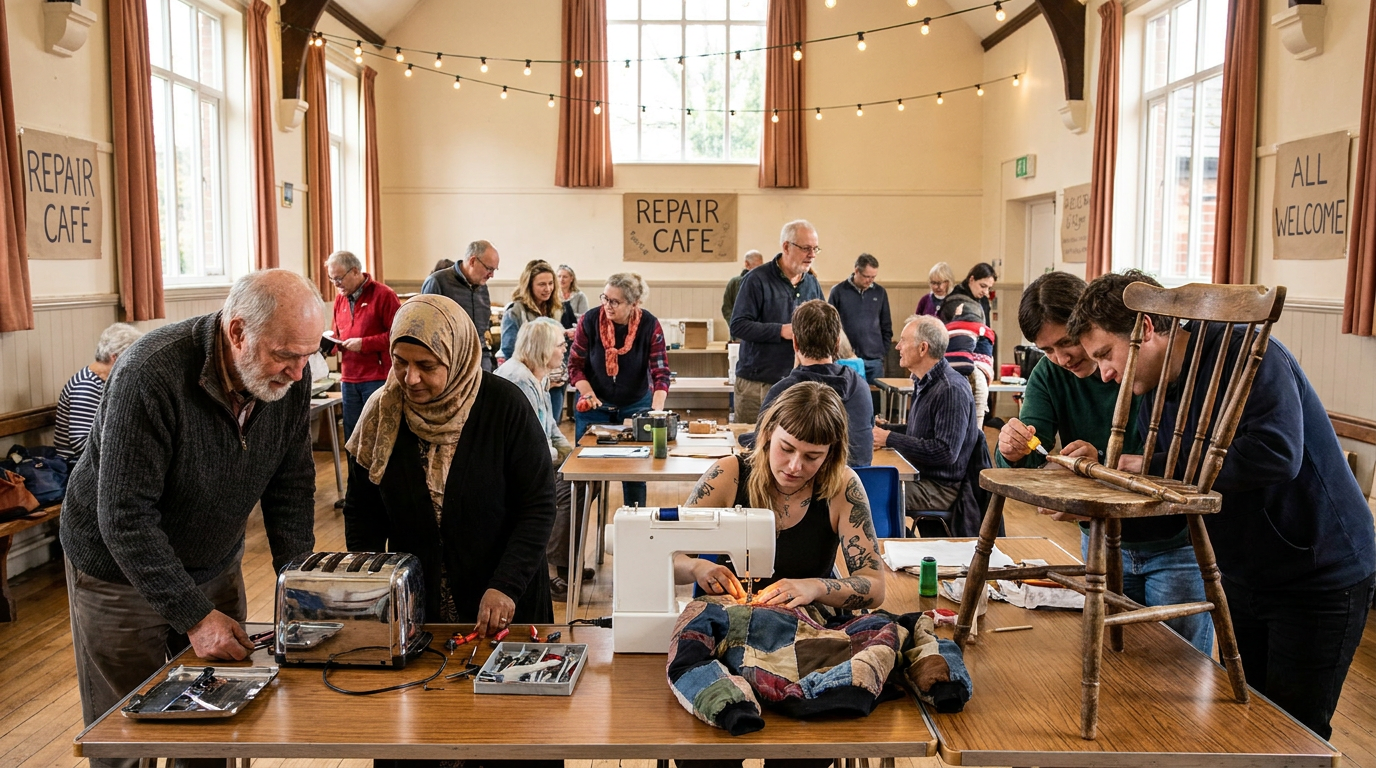
Meanwhile, Repair Cafés act as community hubs where volunteers with technical expertise help neighbors fix broken household items for free. Visitors bring in everything from malfunctioning sound mixers and blunt knives to torn jackets and antique fans, working alongside fixers to learn the repair process themselves.[1][5]

Meanwhile, Repair Cafés act as community hubs where volunteers with technical expertise help neighbors fix broken household items for free.
The scale of the repair movement is now staggering. According to the Open Repair Alliance and the Repair Cafe International Foundation, there are now over 4,000 active community repair groups globally. Together, these local chapters are performing hundreds of thousands of successful repairs annually.[5][6]
Recent data from 2026 shows that volunteer technicians are achieving a 70 percent success rate in repairing items brought in by the public. Common interventions include replacing failed capacitors in audio equipment, resoldering loose connections, and mechanically restoring jammed zippers.[6]
Economic pragmatism is a major driver of this growth. With household budgets stretched, families are increasingly looking for ways to avoid purchasing expensive, rarely-used items or replacing appliances that suffer minor faults. Organizers note that the movement allows people to bypass major online retailers for their occasional needs.[1][7]
The environmental benefits are equally profound, directly challenging the waste generated by modern consumerism. Research indicates that the average power drill is used for only about 15 minutes over its entire lifetime. By pooling these resources, communities dramatically increase utilization rates and reduce the material consumption required to manufacture new goods.[3]

However, the movement is also exposing the artificial barriers to repair built into modern products. Volunteer fixers frequently encounter devices sealed with industrial adhesives rather than mechanical fasteners, making them nearly impossible to open without specialized heat guns.[6]
The continued use of proprietary screw heads and the absence of publicly available service manuals remain primary obstacles. By meticulously logging every failed repair attempt, these community groups are providing hard, on-the-ground data to lawmakers pushing for robust "Right to Repair" legislation across Europe and North America.[5][6]
Ultimately, organizers say the most enduring impact of these spaces isn't just the money saved or the carbon reduced—it is the restoration of community ties. In an era of digital isolation, these physical hubs are rekindling a communal spirit, proving that collective stewardship can build more resilient and connected neighborhoods.[4][5]
How we got here
2009
The world's first Repair Café is hosted in Amsterdam by Martine Postma, sparking a global movement.
2017
The Open Repair Alliance is formed to collect and share data on community repair efforts worldwide.
2019
The Library of Things model begins to scale rapidly across the UK, US, and Australia, moving beyond traditional tool libraries.
2024
The global network logs over 200,000 repair attempts, providing crucial data for Right to Repair legislation.
Mid-2026
The Welsh Government announces its repair network has saved 1 million kilograms of carbon, while global active repair groups surpass 4,000.
Viewpoints in depth
Community Organizers
For local leaders, the primary value of these spaces is social connection rather than just material exchange.
Organizers emphasize that in an era of digital isolation, physical spaces where neighbors collaborate on tangible projects are increasingly rare. The act of sharing a tool or learning to solder a wire fosters intergenerational connections and builds local resilience. When a community collectively stewards its resources, it creates a safety net that extends beyond the items themselves, empowering residents to improve their own neighborhoods and homes.
Right-to-Repair Campaigners
Advocates view community repair data as vital ammunition in the fight against planned obsolescence.
By meticulously logging every failed repair attempt, these groups provide hard evidence of hostile product design. Campaigners point to the widespread use of industrial adhesives, proprietary screw heads, and the refusal of manufacturers to release service manuals as artificial barriers to ownership. They argue that the success of local repair cafes proves consumers want to maintain their goods, and they use this momentum to push for sweeping legislation that forces tech and appliance giants to design for longevity.
What we don't know
- Whether major consumer electronics manufacturers will voluntarily change their design practices in response to the community repair movement.
- How traditional retail businesses will adapt if the 'borrow instead of buy' model continues to capture mainstream market share.
- If local governments will provide sustained, long-term funding to keep volunteer-run libraries and cafes operational.
Key terms
- Circular Economy
- An economic system aimed at eliminating waste and the continual use of resources by reusing, repairing, refurbishing, and recycling existing materials and products.
- Planned Obsolescence
- A policy of designing a product with an artificially limited useful life, ensuring it will become obsolete or non-functional after a certain period to force repeat purchases.
- Right to Repair
- A legislative and social movement advocating for consumers' ability to repair and modify their own consumer products, particularly electronics and automotive parts.
- Library of Things
- A community-based lending model that allows people to borrow physical resources—such as tools, electronics, or recreational gear—rather than purchasing them.
Frequently asked
What is a Library of Things?
A Library of Things operates like a traditional public library, but instead of books, patrons can borrow physical items like power tools, gardening equipment, camping gear, and kitchen appliances for a short period.
Are Repair Cafés free to attend?
Yes, Repair Cafés are generally free community events where skilled volunteers help people fix their broken household items, though donations are often encouraged to cover operating costs.
What kinds of items can be fixed at a Repair Café?
Volunteers typically tackle a wide range of items, including small household appliances, consumer electronics, clothing, bicycles, and toys. Recent data shows a 70 percent success rate for repairs.
How do these initiatives help the environment?
By extending the lifespan of products and facilitating the sharing of rarely used tools, these programs significantly reduce the amount of waste sent to landfills and lower the carbon emissions associated with manufacturing new goods.
Sources
Source coverage
7 outlets
4 viewpoints surfaced







[1]Fast CompanyEconomic Pragmatists
Why Repair Cafés are becoming more popular amid the anti-consumerism movement
Read on Fast Company →[2]Welsh GovernmentEnvironmental Advocates
Deputy First Minister Launches Fix it February at a Pop-Up Repair Café in Cardiff
Read on Welsh Government →[3]ShareableEnvironmental Advocates
State of Libraries of Things 2026 Report
Read on Shareable →[4]The Tool LibraryCommunity Organizers
Borrow tools, build community! Phase 1 Capital Campaign Success
Read on The Tool Library →[5]Network of WellbeingCommunity Organizers
The History of Repair Cafés
Read on Network of Wellbeing →[6]FinexusRight-to-Repair Campaigners
Repair Cafe global numbers 2026
Read on Finexus →[7]IBTEKREconomic Pragmatists
The Library of Things: When Sharing Becomes a Way of Life
Read on IBTEKR →
Every angle. Every day.
Get community stories with full source coverage and perspective breakdowns delivered to your inbox.