
The Science of Shio Koji: How an Ancient Mold Transforms Home Cooking
Shio koji, a traditional Japanese fermented marinade powered by the Aspergillus oryzae mold, is moving from restaurant kitchens to home pantries. By using natural enzymes to break down proteins and starches, it acts as both a rapid meat tenderizer and a powerful umami enhancer.
By Factlen Editorial Team
- Culinary Scientists
- Focus on the enzymatic breakdown of proteins and starches into glutamates and sugars.
- Home Cooks & Recipe Developers
- Focus on practical application, ease of use, and replacing salt and harsh marinades.
- Plant-Based Innovators
- Focus on using koji to extract deep umami flavors from vegetables and legumes without animal products.
What's not represented
- · Industrial food manufacturers
- · Traditional Japanese sake brewers
Why this matters
Understanding how enzymes manipulate flavor and texture allows home cooks to achieve restaurant-quality results with minimal effort. Shio koji offers a natural, foolproof way to elevate everyday meals, reduce sodium, and unlock deep umami in both meats and plant-based dishes.
Key points
- Shio koji is a traditional Japanese marinade made from rice inoculated with the Aspergillus oryzae mold, salt, and water.
- It tenderizes meat and vegetables using natural protease and amylase enzymes rather than harsh acids.
- The enzymes break down proteins into amino acids, naturally generating glutamates that create a deep umami flavor.
- Because it converts starches to simple sugars, shio koji accelerates the Maillard reaction, creating a faster, richer crust when searing.
The quest for the perfect home-cooked meal often leads to a plateau where salt, pepper, and heat are no longer enough to elevate a dish. Enter a centuries-old biological tool that is quietly revolutionizing Western home kitchens: Aspergillus oryzae, a domesticated mold that acts as a culinary superpower. For generations, this microscopic powerhouse was confined to commercial breweries and traditional Asian fermentation houses. Today, however, it is becoming highly accessible to the everyday cook, offering a scientifically proven method to dramatically improve the texture and flavor of almost any ingredient it touches.[1][2]
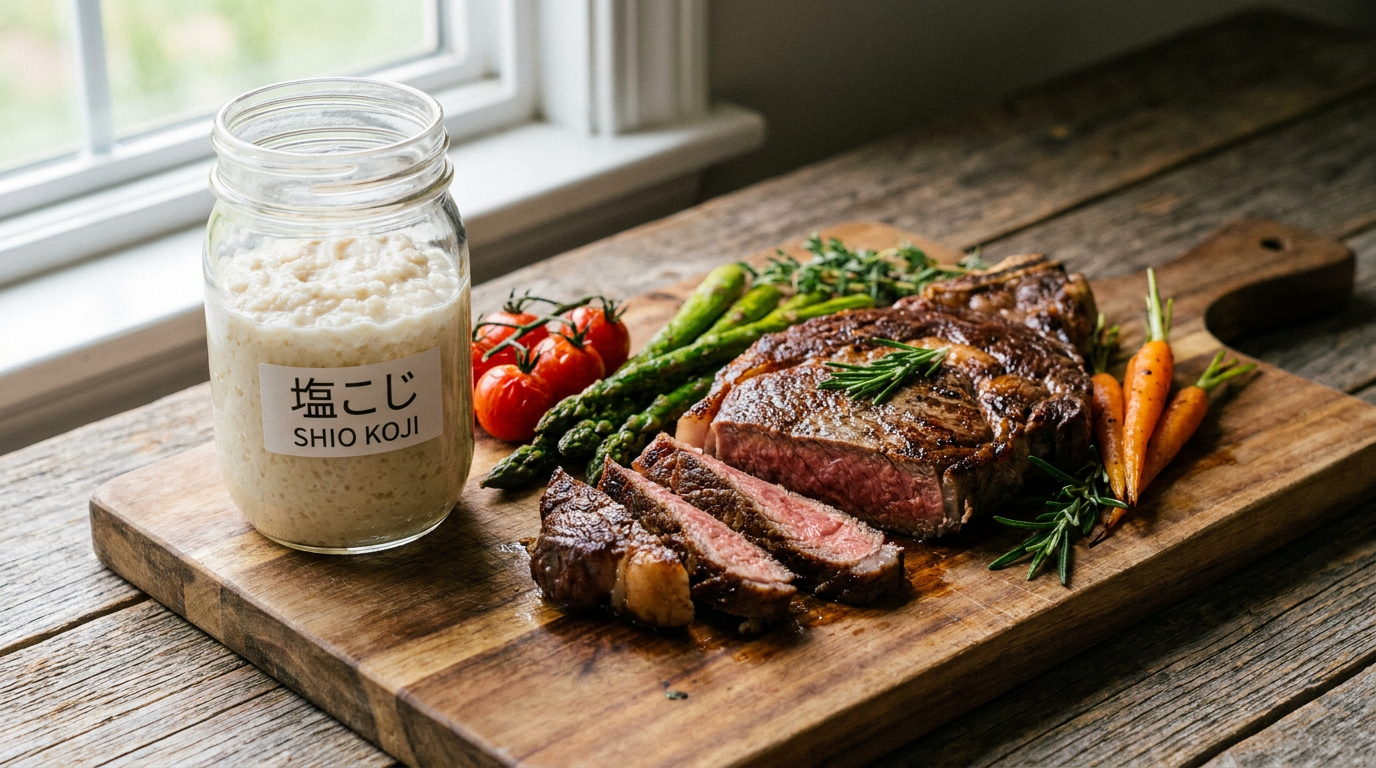
Known colloquially as koji, this filamentous fungus has been the backbone of East Asian fermentation for over two millennia. It is the invisible architect behind foundational ingredients like soy sauce, miso paste, sake, and mirin. But while those traditional staples take months or even years to mature in controlled environments, modern home cooks are harnessing koji in a much faster, more direct format known as shio koji. Translating simply to "salt koji," it is a rustic, porridge-like slurry made from just three ingredients: koji-inoculated rice, salt, and water.[1][3][5]
The magic of shio koji lies not in live bacterial fermentation, like the processes that create sauerkraut or kimchi, but in a potent payload of naturally occurring enzymes. When Aspergillus oryzae is cultivated on steamed rice, the mold secretes a massive amount of digestive enzymes designed to break down the grain's rigid structure so the fungus can feed. When a cook takes that enzyme-rich rice and transfers it to a piece of meat or a vegetable, those biological tools immediately go to work on the new host ingredient.[3][5]
The first and most critical of these enzymes is protease. Proteases act like microscopic scissors, snipping the long, tightly wound protein chains of muscle fibers into smaller fragments called peptides, and eventually into individual free amino acids. This enzymatic dismantling achieves two distinct culinary goals simultaneously: it physically tenderizes the food by breaking down its structural integrity, and it fundamentally alters its flavor profile by releasing trapped compounds.[1][3]

Among the amino acids released during this intensive proteolysis is glutamic acid. Glutamates are the chemical compounds responsible for umami—the deeply savory, mouth-watering "fifth taste" that humans naturally crave and associate with rich, satisfying meals. By breaking down tasteless protein chains into free glutamates, shio koji essentially manufactures umami directly inside the ingredient. It amplifies the inherent meatiness of the dish without requiring the cook to add external flavorings or artificial additives.[3][4]
The second major enzyme at play in the shio koji matrix is amylase. While proteases dismantle proteins, amylases attack complex carbohydrates, converting dense starches into simple sugars. This dual action is why shio koji carries a subtle, floral sweetness alongside its salty funk. When applied to starchy vegetables like potatoes, squash, or root vegetables, the amylase converts their rigid cellular structures into a softer, sweeter version of themselves, preparing them perfectly for the oven or the grill.[3][5]
These two enzymatic actions—the release of free amino acids and the creation of simple sugars—set the stage for a spectacular Maillard reaction. The Maillard reaction is the chemical process responsible for the browning and complex flavor development of seared foods. When a shio koji-marinated steak or chicken thigh hits a hot pan, the newly abundant sugars and amino acids combine rapidly under the heat. The result is a deeply caramelized, mahogany crust that develops much faster and more evenly than it would on untreated meat.[1][3]
However, this accelerated browning comes with a practical caveat for home cooks. Because the surface of the food is now incredibly rich in simple sugars, it is highly prone to burning if left unattended over a high flame. Culinary experts and recipe developers advise wiping off the excess shio koji marinade before searing, and cooking the protein over slightly lower, more controlled heat than usual. This ensures a perfect, flavorful crust without the bitter taste of scorched sugars.[1]

However, this accelerated browning comes with a practical caveat for home cooks.
As a meat tenderizer, shio koji offers distinct scientific advantages over traditional acidic marinades. Common tenderizers like lemon juice, vinegar, or yogurt rely on harsh acids to denature proteins. While effective in the short term, acids can quickly turn the surface of meat mushy, chalky, or stringy if left too long—a phenomenon familiar to anyone who has accidentally over-marinated a batch of ceviche or chicken breasts.[1]
Shio koji, by contrast, works gradually and gently. Because it relies on targeted enzymatic action rather than blunt acidity, it penetrates deeper into the tissue without destroying the structural integrity of the surface. A chicken breast marinated for four to six hours emerges remarkably juicy and firm, while tougher cuts like beef short ribs or pork shoulder can be left in the paste for up to 24 hours to dissolve stubborn connective tissues without ruining the meat's texture.[1]
The application of shio koji extends far beyond the realm of carnivores and traditional barbecue. In fact, plant-based chefs and vegan recipe developers are increasingly turning to koji to solve the historical lack of umami in vegetable-centric diets. Because umami is traditionally associated with animal proteins, bone broths, or long-aged dairy cheeses, purely plant-based meals can sometimes feel lacking in savory depth and palate-coating richness.[4]
By coating mushrooms, eggplant, or firm tofu in shio koji, cooks can trigger the exact same protease and amylase reactions found in meat preparations. The enzymes break down the plant proteins and starches, unlocking a savory richness that mimics the deep satisfaction of eating meat. Roasted cauliflower tossed in the marinade becomes deeply caramelized and complex, while a single spoonful stirred into a vegetable broth provides the heavy, comforting base notes usually reserved for slow-simmered chicken stock.[2][4]

Making shio koji at home is surprisingly accessible, requiring no specialized equipment beyond a clean glass jar. The process requires dried koji rice—now widely available online or in Asian grocers—water, and a high-quality sea salt. The standard ratio is roughly 10 parts koji, 10 parts water, and 3 parts salt by weight. This specific salt concentration, which usually hovers around 10% to 12% of the total volume, is a crucial food safety mechanism.[3]
At this specific salinity, the environment becomes entirely hostile to unwanted, spoilage-causing bacteria and wild yeasts that might otherwise ruin the ferment. However, the salt level is perfectly calibrated to allow the Aspergillus oryzae enzymes to remain highly active. The mixture is simply left at room temperature for seven to ten days and stirred daily, slowly breaking down into a sweet, funky, porridge-like consistency as the enzymes digest the rice itself.[3]
Once the initial room-temperature fermentation is complete, the paste can be stored in the refrigerator for up to six months, serving as a ready-to-use flavor bomb for weeknight dinners. Cooks can substitute it for standard kosher salt in almost any recipe, using roughly two teaspoons of shio koji for every teaspoon of salt called for. It instantly upgrades salad dressings, pan sauces, and even baked goods with a subtle, savory depth that plain salt cannot provide.[2]

Despite its growing popularity in Western kitchens, there are still frontiers of koji science being actively explored. Researchers and avant-garde chefs are experimenting with growing Aspergillus oryzae on non-traditional substrates like quinoa, lentils, buckwheat, and even stale bread. By mapping how different base grains alter the resulting enzyme profiles, scientists hope to create custom koji strains tailored for specific culinary applications, from gluten-free baking to novel meat alternatives.[5]
There is also ongoing culinary debate about the exact thermal death point of these enzymes in home-cooking environments, and how to maximize their activity before the heat of the pan denatures them completely. Some experimental chefs advocate for holding marinated meats at a warm room temperature—around 85 degrees Fahrenheit—for an hour before cooking to send the enzymes into overdrive, though food safety guidelines generally recommend keeping marinating meats refrigerated.[6]
Ultimately, the rise of shio koji represents a beautiful convergence of ancient biotechnology and modern culinary science. It demystifies the often-intimidating world of fermentation, offering home cooks a safe, foolproof, and profoundly effective tool. By simply harnessing the natural digestive processes of a microscopic mold, anyone can unlock a new dimension of flavor, tenderness, and complexity in their everyday meals.[6]
How we got here
2000+ years ago
Aspergillus oryzae is domesticated in East Asia for brewing and food preservation.
Edo Period (1603–1867)
Shio koji is traditionally used in Japan, primarily for pickling vegetables and curing fish.
2010s
A renewed interest in traditional fermentation sparks a 'shio koji boom' in Japan, moving it from a niche ingredient to a supermarket staple.
2018–2020
High-end Western restaurants, popularized by guides like the Noma Guide to Fermentation, begin showcasing koji-aged meats.
2026
Shio koji becomes a mainstream pantry staple for Western home cooks seeking natural umami and tenderizing solutions.
Viewpoints in depth
Culinary Scientists
Focus on the enzymatic breakdown of proteins and starches into glutamates and sugars.
Food scientists view shio koji primarily as a biological delivery system for enzymes. Rather than focusing on the mold itself, they analyze the specific protease and amylase outputs that Aspergillus oryzae generates. By measuring the exact conversion rates of muscle proteins into free amino acids, scientists can quantify the precise increase in glutamic acid—the chemical responsible for umami. They argue that shio koji is superior to acidic marinades because it fundamentally alters the chemical structure of the food without denaturing the surface proteins, resulting in a scientifically verifiable improvement in both tenderness and flavor complexity.
Home Cooks & Recipe Developers
Focus on practical application, ease of use, and replacing salt and harsh marinades.
For recipe developers and everyday cooks, the appeal of shio koji lies in its foolproof utility. While the science is fascinating, the practical reality is that it acts as a "magic bullet" for weeknight dinners. This camp values shio koji as a direct 2-to-1 replacement for kosher salt that simultaneously tenderizes cheap cuts of meat and guarantees a perfect sear. They emphasize that unlike complex fermentation projects that require specialized equipment or strict temperature controls, making and using shio koji requires zero technical skill, making it one of the most accessible ways to upgrade home cooking.
Plant-Based Innovators
Focus on using koji to extract deep umami flavors from vegetables and legumes without animal products.
Vegan chefs and plant-based food innovators see koji as the key to solving the umami deficit in meatless diets. Because the deeply savory notes of Western cuisine are traditionally derived from bone broths, aged cheeses, and roasted meats, vegetables can sometimes lack palate-coating richness. This camp argues that by applying shio koji to mushrooms, root vegetables, and tofu, they can unlock the exact same enzymatic reactions that make meat taste satisfying. For them, koji is not just a tenderizer, but a crucial tool for making sustainable, plant-based eating more appealing to a broader audience.
What we don't know
- The exact thermal death point of all koji enzymes in a home-cooking environment, and how to perfectly maximize activity just before searing.
- How different non-traditional substrates (like quinoa or oats) alter the specific ratio of proteases to amylases produced by the mold.
- The long-term commercial viability of scaling zero-salt koji ferments without risking botulism or wild yeast contamination.
Key terms
- Aspergillus oryzae
- A domesticated filamentous fungus (mold) used in East Asian fermentation to saccharify grains and legumes.
- Shio Koji
- A fermented mixture of koji-inoculated rice, salt, and water used as a marinade and seasoning.
- Protease
- An enzyme that breaks down proteins into smaller peptides and individual amino acids.
- Amylase
- An enzyme that breaks down complex carbohydrates and starches into simple sugars.
- Umami
- The fifth basic taste, characterized by a savory, brothy flavor, primarily triggered by glutamates.
Frequently asked
Can I make shio koji at home?
Yes. By mixing dried koji rice, salt, and water, and letting it sit at room temperature for 7 to 10 days, you can easily ferment your own batch.
Does shio koji make food taste like mold?
No. It imparts a sweet, savory, and slightly floral umami flavor, without any of the musty notes typically associated with household mold.
How long should I marinate meat in shio koji?
Lean meats like chicken breast need 4 to 6 hours, while tougher cuts like beef short ribs benefit from up to 24 hours of marination.
Can I use shio koji on vegetables?
Absolutely. It works beautifully on mushrooms, root vegetables, and tofu, breaking down starches and adding a deep, meaty savoriness to plant-based dishes.
Sources
Source coverage
6 outlets
3 viewpoints surfaced






[1]Food RepublicHome Cooks & Recipe Developers
What Is Shio Koji And How Does It Tenderize Meat?
Read on Food Republic →[2]The Splendid TableHome Cooks & Recipe Developers
Koji: The ancient mold that makes soy sauce and tenderizes meat
Read on The Splendid Table →[3]Cosmos SocietyCulinary Scientists
The Science Behind Shio Koji: Fermentation and Enzymes
Read on Cosmos Society →[4]EdlongPlant-Based Innovators
Umami Fermentation: How Fermentation Creates Umami
Read on Edlong →[5]IndoGulf BioAgCulinary Scientists
Aspergillus oryzae: The Culinary Applications of Koji
Read on IndoGulf BioAg →[6]Factlen Editorial TeamPlant-Based Innovators
Synthesis by Factlen editorial team
Read on Factlen Editorial Team →
Every angle. Every day.
Get food drink stories with full source coverage and perspective breakdowns delivered to your inbox.