
Fresh Dog Food vs. Premium Kibble: A 2026 Cost and Nutrition Comparison
As fresh, gently cooked dog food subscriptions surge in popularity, pet owners face a choice between the high bioavailability of fresh meals and the cost-effective convenience of premium kibble. We break down the veterinary consensus, monthly costs, and the growing trend of hybrid feeding.
By Factlen Editorial Team
- Veterinary Consensus
- Prioritizes AAFCO compliance, board-certified formulation, and pathogen safety over food format.
- Fresh Food Advocates
- Believes minimally processed, high-moisture diets offer superior bioavailability and health outcomes.
- Practical Pet Owners
- Seeks a balance between nutritional quality, monthly budget, and storage convenience.
What's not represented
- · Raw Diet (BARF) Proponents
- · Sustainable/Insect-Protein Pet Food Brands
Why this matters
Dog food is a major recurring expense that directly impacts your pet's lifespan and daily health. Understanding the exact trade-offs between fresh and extruded diets helps owners optimize both their budget and their dog's well-being without falling for marketing hype.
Key points
- Premium kibble costs between $70 and $130 per month for a medium dog, offering shelf stability and convenience.
- Fresh dog food subscriptions range from $100 to $350 monthly, providing superior hydration and up to 40 percent higher digestibility.
- Veterinarians emphasize that meeting WSAVA guidelines and AAFCO nutrient profiles is more important than the food's format.
- Hybrid feeding—using fresh food as a partial topper over kibble—has emerged as a popular compromise for budget-conscious owners.
The pet food aisle has undergone a radical transformation over the past decade, shifting from a monolithic wall of dry bags to a complex landscape of dietary philosophies. At the forefront of this shift is the explosive rise of fresh, gently cooked dog food subscriptions, which are increasingly challenging the long-held dominance of traditional premium kibble. For pet owners, deciding what to put in the bowl has never been more complicated, as marketing claims blur the lines between genuine nutritional science and premium-priced trends. As direct-to-consumer fresh brands scale their operations and premium kibble manufacturers reformulate their recipes to compete, consumers are left to navigate a maze of cost, convenience, and health outcomes. This comparison breaks down the exact trade-offs between the two dominant feeding formats in 2026, cutting through the noise to help owners make an informed, evidence-based decision for their canine companions.[1][5]
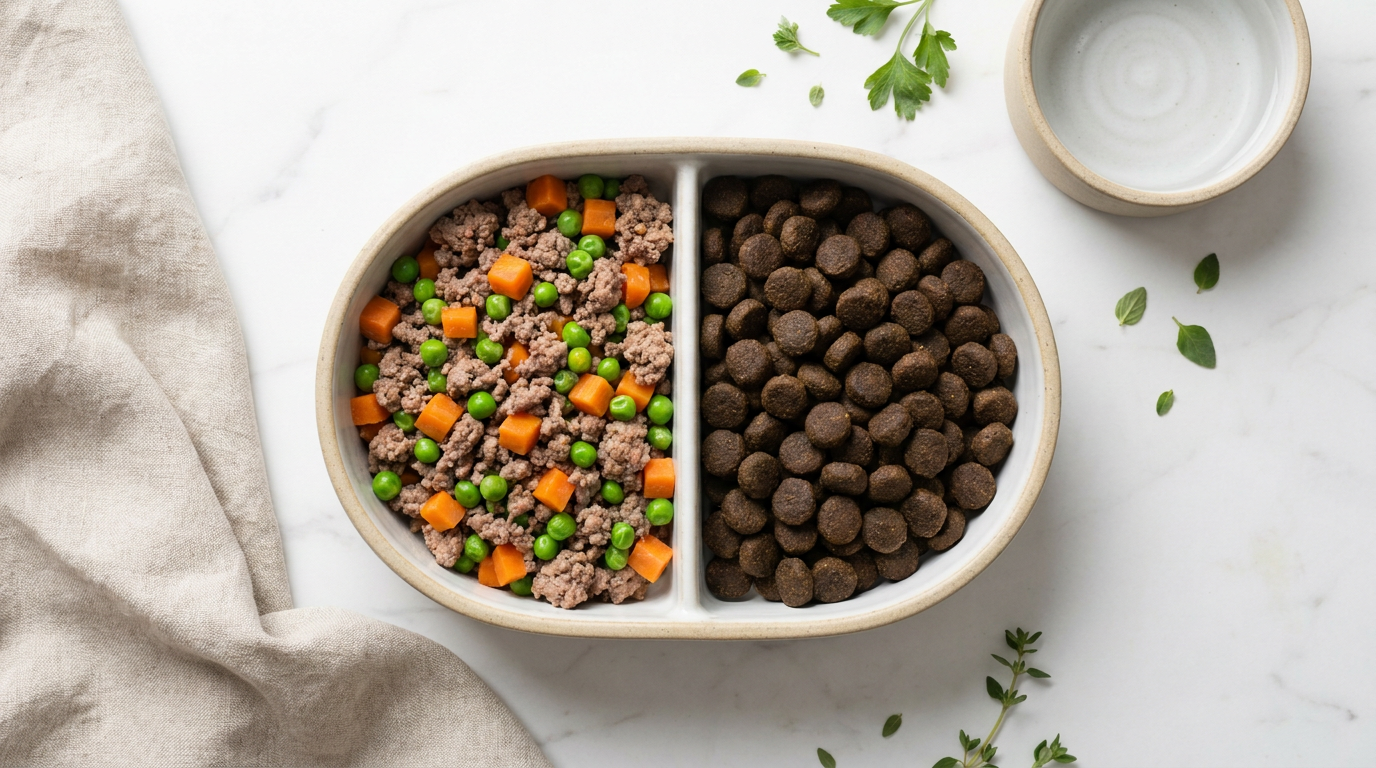
To understand the debate, it is essential to define what these two formats actually are and how they are manufactured. Kibble is created through a high-heat extrusion process, where a dough of proteins, carbohydrates, and fats is cooked rapidly under intense pressure, pushed through a die, and dried. This method makes the food incredibly shelf-stable, calorically dense, and easy to distribute on a massive scale. In contrast, fresh dog food is made from whole-food ingredients—such as ground meats, visible vegetables, and grains—that are gently cooked at much lower temperatures. This gentle cooking is designed to kill harmful pathogens while preserving the natural moisture and delicate whole-food nutrients that high-heat extrusion often destroys. Because it lacks synthetic preservatives and retains a high moisture content, fresh food must be immediately frozen or refrigerated to maintain its safety and nutritional integrity before it reaches the dog's bowl.[1][5]
The most immediate and tangible trade-off between the two diets is the financial commitment required from the owner. In 2026, feeding a medium-sized dog weighing between thirty and fifty pounds a high-quality, premium kibble typically costs between $70 and $130 per month. These premium dry foods often feature named meat meals as the first ingredient and avoid cheap fillers, providing excellent value per calorie. Conversely, a full fresh-food subscription for that same medium-sized dog ranges from $100 to $350 monthly, depending heavily on the specific brand, the protein source selected, and the dog's exact caloric needs. For a large or giant breed, the cost of a fully fresh diet can easily exceed $500 a month, making it a significant line item in a household budget and forcing many owners to carefully weigh the promised health benefits against the undeniable financial strain.[2]

The primary argument for fresh food centers heavily on nutritional bioavailability and superior hydration. A recent comprehensive study published by the National Institutes of Health demonstrated that dogs consuming fresh diets took in significantly more total water on a daily basis. This is because fresh dog food averages roughly 71 percent moisture, closely mimicking a natural ancestral diet, compared to the mere 6 percent moisture found in standard dry kibble. This drastic difference in water intake is particularly beneficial for dogs prone to urinary tract issues or those that simply do not drink enough water from their bowls throughout the day. Advocates argue that this built-in hydration supports better kidney function and overall cellular health over the course of a dog's lifespan.[3]
Furthermore, the evidence supporting the digestibility of fresh diets is compelling. Clinical evaluations indicate that gently cooked fresh diets can be up to 40 percent more digestible than their highly processed kibble counterparts. Because the ingredients are less altered by heat, dogs are able to absorb a higher percentage of the nutrients per bite. In practical terms, this high bioavailability results in noticeably smaller, firmer, and less frequent stools—a highly appealing benefit for owners managing yard cleanup or urban dog walking. Additionally, many owners report that the transition to a highly digestible fresh diet quickly resolves chronic mild gastrointestinal issues and leads to a softer, shinier coat, whereas kibble's lower moisture and higher carbohydrate content can sometimes make it harder for sensitive dogs to process efficiently.[3][5]

When evaluating safety and veterinary consensus, the conversation shifts away from the format of the food and toward the scientific rigor of the manufacturer. The World Small Animal Veterinary Association (WSAVA) does not endorse specific brands or formats; instead, it sets rigorous global guidelines that urge owners to ask critical questions. These guidelines require that a food be formulated by a board-certified veterinary nutritionist, meet the Association of American Feed Control Officials (AAFCO) nutrient profiles, and undergo strict quality control testing. Top-tier brands in both the premium kibble and fresh food categories successfully meet these exacting standards, proving that both formats can deliver complete and balanced nutrition when engineered by qualified professionals rather than marketing teams.[4]
When evaluating safety and veterinary consensus, the conversation shifts away from the format of the food and toward the scientific rigor of the manufacturer.
Crucially, the veterinary community broadly prefers gently cooked fresh food over raw diets, often referred to as the BARF diet. While raw feeding has its passionate proponents, it carries significant, documented risks of bacterial contamination, posing a danger not only to the dog but to the human household handling the food. The gentle cooking process used by reputable fresh food brands effectively eliminates dangerous pathogens like Salmonella, E. coli, and Listeria while maintaining the integrity of the whole-food ingredients. Premium kibble also easily clears this safety bar, as the high-heat extrusion process inherently sterilizes the product, making both premium kibble and gently cooked fresh food vastly safer alternatives to raw feeding.[1][4]
Where premium kibble wins unequivocally is in the realm of logistics, storage, and daily convenience. Dry food requires absolutely no refrigeration, travels effortlessly on road trips or flights, and boasts a shelf life that can last for months or even years if stored properly in an airtight container. It is easy to measure, simple to pour, and can be left out for dogs that prefer to graze throughout the day. Conversely, fresh food demands significant dedicated freezer space, requires owners to manage a daily thawing rotation in the refrigerator, and spoils within a few days once a package is opened. For busy households, the operational friction of managing a fresh food subscription can become a genuine hurdle.[2][5]
Rather than viewing this as an all-or-nothing choice, a massive segment of pet owners in 2026 is adopting a hybrid feeding strategy. Recognizing the financial and logistical barriers of a fully fresh diet, owners are increasingly using fresh food as a 25 to 50 percent "topper" over a base of premium kibble. This compromise provides the dog with the enhanced hydration, superior palatability, and whole-food nutrient benefits of fresh ingredients, while keeping the overall monthly costs manageable and drastically reducing the strain on freezer space. Many major fresh food brands have recognized this trend and now explicitly offer topper-sized subscription plans, making the hybrid approach the most popular middle ground in modern canine nutrition.[2][6]

When synthesizing the trade-offs, a full fresh food diet fits well when your household budget comfortably allows for a $150 to $350 monthly expense without stress. It is an exceptional choice if your dog is an incredibly picky eater, struggles with specific food sensitivities, or suffers from chronic digestive issues that have not resolved on dry food. Furthermore, it fits well if you have ample freezer space and prioritize absolute ingredient transparency, wanting to see recognizable whole foods in the bowl. For owners who place a premium on maximizing their dog's daily hydration through diet, gently cooked fresh food is currently the gold standard on the market.[1][6]
Conversely, a full fresh food diet does not fit when you travel frequently with your pet, as managing coolers and thawing schedules on the road is highly impractical. It is also a poor fit if you have limited kitchen refrigeration space, or if you own a large or giant breed dog where the sheer volume of fresh food required pushes the monthly cost into prohibitive territory. Additionally, if your dog is a grazer who prefers to eat slowly over several hours, fresh food is not suitable, as it cannot be safely left at room temperature for extended periods without risking bacterial growth and spoilage.[2][6]
On the other side of the spectrum, premium kibble fits well when you need a highly convenient, shelf-stable option that delivers complete, AAFCO-compliant nutrition at a predictable and lower monthly cost. It is an excellent, practical choice for multi-dog households, large breeds with massive caloric requirements, and owners who rely heavily on interactive puzzle feeders or training toys that require dry food. For healthy dogs without specific dietary sensitivities, a high-quality extruded diet formulated by veterinary nutritionists provides all the essential building blocks for a long, active life without the logistical headaches of frozen meal delivery.[4][6]
However, premium kibble does not fit when your dog struggles with chronic dehydration or urinary tract issues that require high dietary moisture intake. It is also less than ideal if your dog has missing teeth, severe dental pain, or a jaw structure that makes chewing hard extruded pellets difficult or painful. Finally, if your dog consistently refuses dry meals despite brand rotations, flavor enhancements, and strict feeding schedules, the high palatability of fresh food may be necessary to ensure they maintain a healthy weight and receive adequate daily nutrition.[3][6]
How we got here
1950s
Extruded kibble becomes the dominant commercial dog food due to post-war convenience and long shelf life.
2010s
The raw food (BARF) movement gains traction, though veterinarians raise alarms over bacterial contamination risks.
2019
Direct-to-consumer fresh dog food subscriptions begin scaling rapidly, offering gently cooked alternatives to raw diets.
2026
Hybrid feeding emerges as the dominant trend, with major brands offering 'topper' plans to balance cost and fresh nutrition.
Viewpoints in depth
Veterinary Nutritionists
Focuses on evidence-based formulation, safety, and meeting AAFCO nutrient profiles regardless of the food format.
Veterinary consensus emphasizes that the format of the food—whether extruded dry or gently cooked fresh—matters less than the science behind its formulation. The World Small Animal Veterinary Association (WSAVA) urges owners to look for brands that employ board-certified nutritionists and conduct rigorous quality control testing. While many vets praise the hydration benefits of fresh food, they caution that poorly formulated fresh diets can lead to deficiencies, making brand credibility the most critical factor.
Fresh Food Advocates
Argues that minimally processed, whole-food ingredients provide superior long-term health outcomes.
Proponents of fresh diets argue that high-heat extrusion destroys natural enzymes and vitamins, forcing kibble manufacturers to rely on synthetic nutrient packs. They point to anecdotal and emerging clinical evidence showing that dogs on fresh diets exhibit higher energy levels, softer coats, and fewer digestive issues. For this camp, the higher upfront monthly cost is an investment that pays dividends through reduced veterinary bills and an extended lifespan.
Practical Pet Owners
Prioritizes a balance of nutritional adequacy, budget sustainability, and daily convenience.
For the average household, the logistics of feeding a dog must fit into a busy lifestyle and a realistic budget. This perspective highlights that generations of dogs have thrived on high-quality kibble. They view the fresh food movement as beneficial but often cost-prohibitive, especially for large breeds. Consequently, this group is driving the trend toward 'hybrid feeding'—using premium kibble as a caloric base and adding fresh food as a high-value topper.
What we don't know
- Whether the long-term lifespan benefits of gently cooked fresh diets definitively outweigh those of premium kibble across all dog breeds.
- How upcoming regulatory changes to AAFCO labeling standards will impact the marketing claims of boutique fresh food brands.
Key terms
- Extrusion
- A high-heat manufacturing process used to cook and shape dry kibble, making it shelf-stable.
- Bioavailability
- The proportion of a nutrient that is successfully absorbed and used by the dog's body.
- AAFCO
- The Association of American Feed Control Officials, which sets the baseline nutritional standards for pet food in the United States.
- WSAVA Guidelines
- A set of criteria created by global veterinarians to help owners evaluate the safety and scientific rigor of pet food brands.
- Gently Cooked
- A preparation method that uses lower temperatures to kill pathogens while preserving more natural nutrients than high-heat extrusion.
Frequently asked
Is it safe to mix fresh dog food with kibble?
Yes. Mixing fresh food as a topper with a base of premium kibble is a highly recommended strategy to improve hydration and palatability while keeping costs manageable.
Does fresh dog food clean a dog's teeth better than kibble?
No. While kibble's abrasive texture is often credited with scraping away plaque, fresh food does not provide this mechanical cleaning. Owners feeding fresh diets should maintain a regular tooth-brushing routine.
How long does fresh dog food last in the fridge?
Once thawed and opened, most gently cooked fresh dog food must be consumed within four to five days to prevent spoilage.
Are raw diets the same as fresh dog food?
No. Raw diets contain uncooked meat and carry significant bacterial risks. Fresh dog food is gently cooked to eliminate pathogens like Salmonella while retaining whole-food nutrients.
Sources
Source coverage
6 outlets
3 viewpoints surfaced






[1]NBC SelectFresh Food Advocates
Is fresh dog food actually better than kibble? We asked vets.
Read on NBC Select →[2]PawFavPractical Pet Owners
Kibble vs Wet vs Raw vs Fresh vs Freeze-Dried: Every Dog Food Type Compared (2026)
Read on PawFav →[3]National Institutes of HealthVeterinary Consensus
Evaluation of fresh food for its impact on total water consumption and urine relative supersaturation in healthy adult dogs
Read on National Institutes of Health →[4]Dog Food AdvisorVeterinary Consensus
WSAVA Global Nutrition Committee Guidelines on Selecting Pet Foods
Read on Dog Food Advisor →[5]Spot & TangoFresh Food Advocates
Fresh Dog Food vs. Kibble: Which Is Better for Your Dog?
Read on Spot & Tango →[6]Factlen Editorial TeamPractical Pet Owners
Synthesis by Factlen editorial team
Read on Factlen Editorial Team →

More in shopping
See all 6 stories →Display Tech
OLED vs. Mini-LED in 2026: Which TV Technology Actually Wins?
7 sources

Smart Home Protocols
Matter over Thread vs. Wi-Fi: Which Smart Home Protocol Should You Choose?
6 sources

Wearable Tech
Smart Rings vs. Smartwatches: The 2026 Clinical Evidence on Wearable Accuracy
9 sources

Wearable Tech
Smart Rings vs. Smartwatches: The 2026 Health Tracking Comparison
7 sources

Every angle. Every day.
Get shopping stories with full source coverage and perspective breakdowns delivered to your inbox.