
Penn Physicists Create Light-Matter Particle to Slash AI Energy Consumption
Researchers at the University of Pennsylvania have developed a hybrid quasiparticle that allows AI chips to process data using light rather than electricity. The breakthrough could drastically reduce the massive energy and cooling demands of modern artificial intelligence systems.
By Factlen Editorial Team
- Photonic Computing Researchers
- Advocates for optical logic see this as the necessary evolution of computing.
- AI Infrastructure Providers
- Data center operators view optical chips as a lifeline for grid-constrained AI scaling.
- Silicon Manufacturing Engineers
- Hardware veterans emphasize the gap between lab breakthroughs and commercial fabrication.
What's not represented
- · Environmental advocates monitoring data center emissions
- · Cloud computing pricing analysts
Why this matters
As AI models grow exponentially larger, the energy required to power and cool the data centers running them is becoming unsustainable. By shifting computation from heat-generating electrons to frictionless light, this technology could make future AI systems vastly faster and dramatically greener.
Key points
- Penn physicists have created a hybrid light-matter particle called an exciton-polariton.
- The quasiparticle allows computer chips to process data using light instead of electricity.
- The breakthrough solves the inability of normal photons to perform complex logic switching.
- The team demonstrated all-optical switching using just 4 quadrillionths of a joule of energy.
- If scaled, the technology could drastically reduce the massive power and cooling demands of AI data centers.
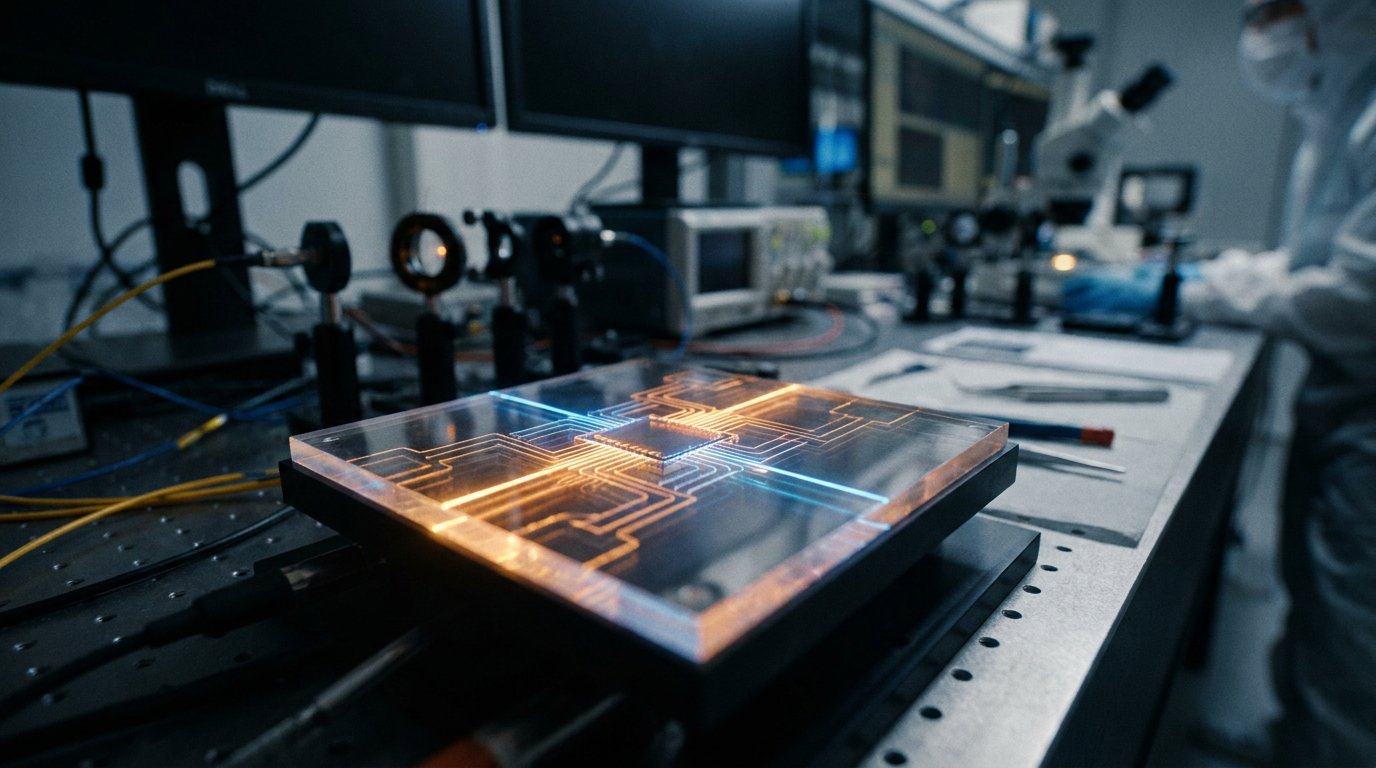
Eighty years after researchers at the University of Pennsylvania launched the electronic computing era with the ENIAC, a new generation of Penn physicists is attempting to move past the electron entirely. In a breakthrough that could fundamentally alter the trajectory of artificial intelligence hardware, scientists have successfully engineered a hybrid light-matter particle capable of performing computational logic at a fraction of the energy cost of traditional silicon. The discovery, published in the journal Physical Review Letters, addresses one of the most severe bottlenecks facing the modern tech industry: the staggering, unsustainable power consumption required to run and cool massive AI data centers. By shifting the burden of computation from heat-generating electrons to frictionless particles of light, the Penn team has demonstrated a viable path toward ultra-efficient, high-speed optical processors.[1][2][7]
The timing of the breakthrough is critical. As generative AI models scale from billions to trillions of parameters, the physical infrastructure supporting them is hitting a wall. Modern computer chips rely on the exact same fundamental architecture that the ENIAC pioneered in the 1940s: they move electrons through conductive materials to perform mathematical operations. But electrons carry an electrical charge. As they are pushed through billions of microscopic transistors billions of times per second, they encounter physical resistance. This resistance generates immense amounts of heat, which in turn requires massive, energy-hungry cooling systems to prevent the servers from melting down.[1][3]
Because they carry a charge, electrons lose energy as heat, encounter resistance as they move through materials, and become harder to manage as chips incorporate more transistors and handle larger volumes of data. For the companies building the physical backbone of the AI boom, power has become the ultimate limiting factor. Data centers are currently straining municipal power grids and raising local temperatures, prompting a desperate industry-wide search for hardware that can process more data without requiring a proportional increase in electricity.[1][4]
To solve this thermal crisis, physicists led by Bo Zhen, the Jin K. Lee Presidential Associate Professor in Penn's Department of Physics and Astronomy, looked to the electron's massless counterpart: the photon. Photons are the fundamental particles of light. Because they are charge-neutral and possess zero rest mass, they can carry information at the speed of light over vast distances with virtually no energy loss. This is why fiber-optic cables have entirely replaced copper wires for global internet transmission.[1][5]

However, the exact properties that make photons perfect for transmitting data make them terrible for processing it. That neutrality means they barely interact with their environment, making them bad at the sort of signal-switching logic that computers depend on, explained Li He, a former postdoctoral researcher in the Zhen Lab and co-first author of the study. In a traditional computer chip, one electrical signal can easily be used to block or allow another electrical signal—the basic mechanism of a transistor. Because photons do not carry a charge, two beams of light will simply pass right through each other without interacting, making it impossible to build a purely optical logic gate.[1][3]
The tech industry has attempted to compromise by building hybrid photonic AI chips. These existing processors use light to perform straightforward, linear mathematical calculations at blinding speeds. But artificial intelligence requires more than just simple math; neural networks rely on nonlinear activation steps, which are essentially complex decision-making rules. Because photons cannot interact with each other to make these decisions, current photonic chips are forced to constantly convert the optical signals back into electronic signals, perform the logic step, and then convert the data back into light.[2][4]
The tech industry has attempted to compromise by building hybrid photonic AI chips.
This constant translation between light and electricity is a fatal flaw for efficiency. The repeated conversions erode the speed advantages of using light in the first place and consume massive amounts of power, severely limiting the real-world utility of current photonic computing. Zhen's team realized that to build a truly efficient AI chip, they needed a way to force light to interact with itself without ever converting it back into an electron.[3][4]
The solution the Penn team developed is a specialized quasiparticle known as an exciton-polariton. To create it, the researchers coupled photons with electrons inside an atomically thin semiconductor material known as a transition metal dichalcogenide (TMD). By trapping the light inside a nanoscale cavity and forcing it into tight proximity with the ultrathin matter, the two elements effectively merge.[6][7]

The resulting exciton-polariton is a hybrid that enjoys the best traits of both its parents. It maintains the frictionless, zero-mass speed of a photon, but it inherits the interactive, charged properties of the matter it is coupled with. For the first time, this allowed the researchers to make a beam of light interact strongly enough with its environment to perform actual signal-switching logic. The light could finally make a decision.[5][7]
The energy efficiency of this all-optical switching is staggering. The Penn team demonstrated that their exciton-polariton system could perform a logic switch using just four femtojoules of energy—roughly four quadrillionths of a joule. To put that into perspective, it is a microscopic fraction of the energy required to briefly illuminate a tiny LED, and vastly less power than a standard silicon transistor burns to perform the exact same operation.[6][7]

By using exciton-polaritons, the team demonstrated all-light switching at about 4 quadrillionths of a joule, which is an extraordinarily small amount of energy, the university reported. If this nanoscale laboratory breakthrough can be successfully scaled up into commercial chip manufacturing, the implications for the artificial intelligence industry would be transformative. AI data centers could theoretically process exponentially larger models while slashing their electricity consumption and cooling requirements.[1][2]
Beyond simply saving power in server farms, the technology opens up entirely new architectures for edge computing and computer vision. Because the chips process light directly, future AI systems equipped with these processors could theoretically take in optical data straight from a camera lens and analyze it instantly, without ever needing to digitize the image into an electronic format. This would allow autonomous vehicles, robotics, and medical imaging devices to react to visual stimuli with near-zero latency.[3][4]

The researchers also noted that the exciton-polariton platform could eventually serve as a bridge to even more advanced computing paradigms. The strong light-matter interactions demonstrated in the Penn lab are highly sought after in the field of quantum mechanics, suggesting that this architecture could eventually support basic quantum computing capabilities directly on a semiconductor chip.[4][5]
While the physics have been proven, the road to commercialization remains steep. Integrating atomically thin transition metal dichalcogenides into the standardized, highly rigid supply chains of global semiconductor foundries will require years of specialized engineering. However, by proving that light can be forced to perform complex logic at four femtojoules, the Penn team has dismantled one of the most stubborn physical barriers standing between the current electronic era and an ultra-efficient optical future.[1][7]
How we got here
1945
Penn researchers J. Presper Eckert and John Mauchly launch the electronic computing era with the ENIAC.
Early 2020s
AI models scale exponentially, pushing traditional electronic chips to their thermal and energy limits.
April 2026
The Penn research team publishes their exciton-polariton breakthrough in Physical Review Letters.
May 2026
The scientific community highlights the 4-femtojoule optical switching as a major milestone for sustainable AI hardware.
Viewpoints in depth
Photonic Computing Researchers
Advocates for optical logic see this as the necessary evolution of computing.
Researchers in this camp argue that the 80-year reign of the electron is reaching its physical limits. They point out that while we have continually shrunk transistors, we cannot eliminate the fundamental heat generated by electrical resistance. To them, the exciton-polariton breakthrough solves the final missing puzzle piece—nonlinear logic—that has kept light-based computing from fully replacing silicon in heavy-duty AI tasks.
AI Infrastructure Providers
Data center operators view optical chips as a lifeline for grid-constrained AI scaling.
For the companies building the physical backbone of the AI boom, power is the ultimate bottleneck. Data centers are currently raising local temperatures and straining municipal power grids just to keep electronic chips cool. Infrastructure providers see ultra-low-energy optical switching not just as a speed upgrade, but as an existential necessity that will allow them to keep scaling AI models without requiring dedicated nuclear reactors for every server farm.
Silicon Manufacturing Engineers
Hardware veterans emphasize the gap between lab breakthroughs and commercial fabrication.
While acknowledging the elegant physics of the Penn discovery, traditional chip engineers focus on the brutal realities of manufacturing. Integrating atomically thin transition metal dichalcogenides (TMDs) into standard semiconductor foundries is notoriously difficult. This camp warns that while 4-femtojoule switching is a triumph in a controlled nanoscale cavity, reliably printing billions of these hybrid light-matter gates onto commercial wafers will require years of entirely new supply chain and fabrication development.
What we don't know
- How long it will take to adapt atomically thin semiconductors for mass commercial fabrication.
- Whether the 4-femtojoule efficiency will hold up when scaled to chips containing billions of logic gates.
- How the cost of manufacturing these hybrid optical chips will compare to traditional silicon foundries.
Key terms
- Photon
- A fundamental particle of light that carries no mass and no electrical charge.
- Exciton-polariton
- A hybrid quasiparticle that blends the properties of light and matter, allowing for high-speed, low-energy computing.
- Nonlinear activation
- A crucial step in AI computing where a system makes a decision or applies a rule, traditionally requiring electrical logic gates.
- Femtojoule
- A unit of energy equal to one quadrillionth of a joule, representing an extraordinarily small amount of power.
- Transition Metal Dichalcogenide (TMD)
- An atomically thin semiconductor material used to couple light and electrons in this breakthrough.
Frequently asked
What is an exciton-polariton?
It is a hybrid quasiparticle created by coupling a particle of light (a photon) with an electron in a super-thin semiconductor, combining light's speed with matter's ability to interact.
Why are current AI chips running into limits?
Current chips rely on electrons, which carry an electrical charge. Moving them generates friction and heat, requiring massive amounts of electricity just to cool the servers down.
Don't we already have optical chips?
Yes, but current optical chips can only do simple math with light. To make complex decisions, they have to convert the light back into electricity, which slows them down and wastes power.
How much energy does this new method use?
The Penn team demonstrated optical switching using about 4 femtojoules (four quadrillionths of a joule)—a microscopic fraction of the energy used by traditional transistors.
Sources
Source coverage
7 outlets
3 viewpoints surfaced







[1]Penn TodayPhotonic Computing Researchers
Penn physicists led by Bo Zhen have created hybrid light-matter particles that interact strongly enough to compute
Read on Penn Today →[2]ScienceDailyPhotonic Computing Researchers
Forget electrons, this breakthrough uses light-matter particles to power AI
Read on ScienceDaily →[3]SciTechDailyAI Infrastructure Providers
Penn scientists may have found a way to power future AI with exotic light-matter particles instead of electrons
Read on SciTechDaily →[4]DataconomyAI Infrastructure Providers
Penn physicists use light-matter particles to boost AI chip speeds
Read on Dataconomy →[5]The DebriefSilicon Manufacturing Engineers
Physicists have created a new hybrid light-matter particle that could fundamentally reshape the future of AI and computation
Read on The Debrief →[6]The Brighter Side of NewsSilicon Manufacturing Engineers
A Penn team built a light-matter system that switches optical signals using only 4 femtojoules of energy
Read on The Brighter Side of News →[7]Physical Review LettersPhotonic Computing Researchers
Strongly Nonlinear Nanocavity Exciton Polaritons in Gate-Tunable Monolayer Semiconductors
Read on Physical Review Letters →


Every angle. Every day.
Get ai stories with full source coverage and perspective breakdowns delivered to your inbox.