
The Rise of the 'Cozy Web': How Internet Users Are Reclaiming Digital Third Places
Exhausted by algorithmic feeds and performative public squares, millions of users are retreating into private group chats, Discord servers, and gated communities to find authentic connection.
By Factlen Editorial Team
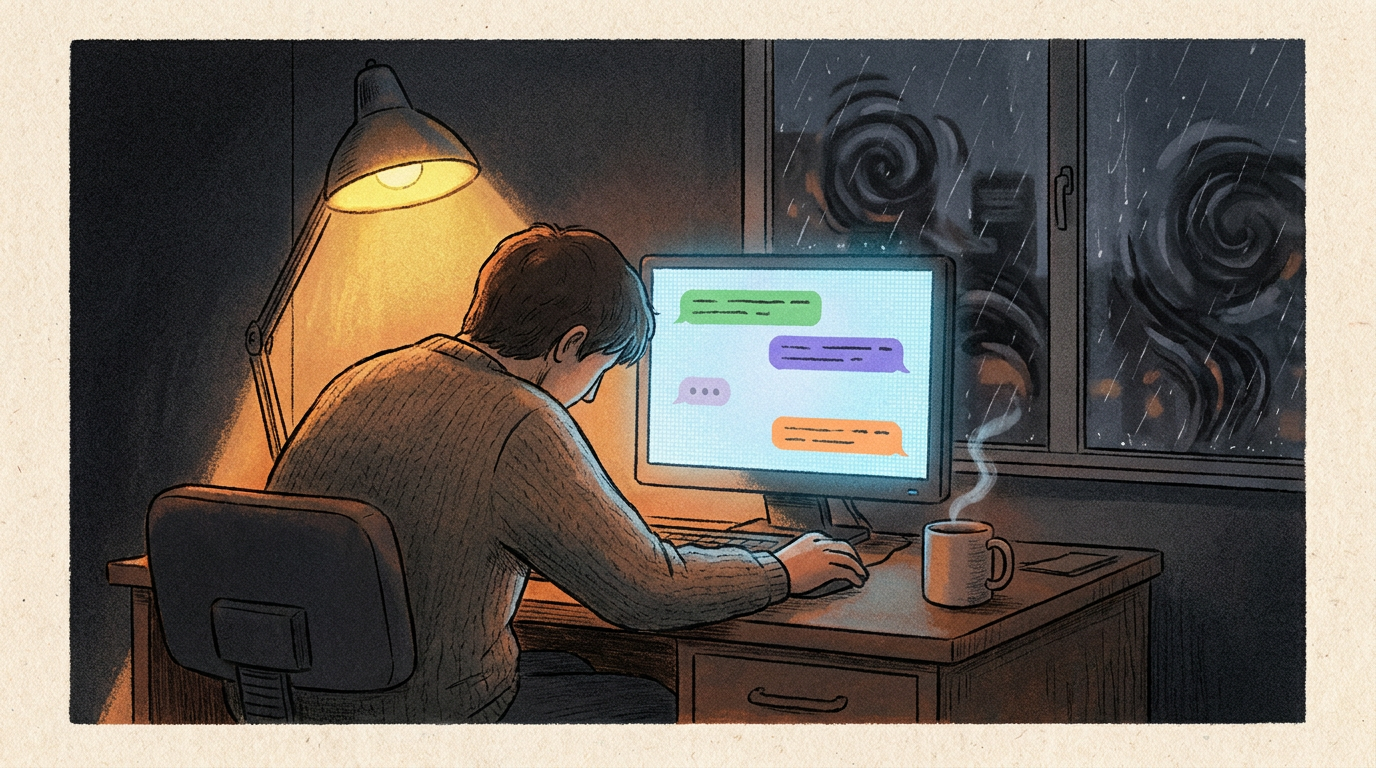
- Digital Anthropologists
- View the retreat to private spaces as a necessary and healthy return to human-scale communication and authentic community building.
- Gen Z & Millennial Users
- Value the emotional safety, lack of algorithmic pressure, and intimacy of closed group chats over the performative nature of public feeds.
- Marketers & Advertisers
- View the fragmentation of the internet as a major challenge, struggling to reach audiences in private spaces where traditional ads are unwelcome.
- Public Platform Advocates
- Worry that abandoning the open web fragments the universal 'water cooler' and accelerates the creation of isolated ideological echo chambers.
What's not represented
- · Platform engineers designing the algorithms
- · Creators whose livelihoods depend on public reach
Why this matters
The era of broadcasting our lives to thousands of strangers is ending. Understanding the shift toward private digital spaces explains why public social media feels increasingly empty, and how we can build healthier, more sustainable relationships with technology.
Key points
- Users are abandoning public social media feeds in favor of private group chats and gated communities.
- The 'Dark Forest' theory suggests the public web has become too hostile, driving users underground.
- These private spaces act as 'Digital Third Places,' replacing physical cafes and community centers.
- The shift prioritizes intimacy, authenticity, and low-pressure interaction over reach and engagement.
- Brands and advertisers are struggling to adapt as culture moves behind closed digital doors.
For over a decade, the internet was defined by the public square. Platforms like Facebook, Twitter, and Instagram trained a generation to broadcast their lives, thoughts, and photos to the widest possible audience. The metric of success was reach, and the currency was engagement. But today, the "Golden Age" of public social media is quietly ending. Users are not logging off entirely, but they are disappearing from public feeds, migrating instead to a hidden ecosystem of private group chats, Discord servers, and invite-only communities [1][5].[1][5]
This mass migration is a direct response to what the open web has become. The public internet—often referred to as the "Clearnet"—is increasingly dominated by algorithmic feeds designed to maximize outrage, engagement-farming bots, and the constant pressure of performative posting. In 2023, the Pew Research Center found that 68% of Gen Z adults reported feeling overwhelmed by the sheer volume of public content, while a separate McCrindle survey noted that 82% of Gen Z students felt they spent too much time online [5][7].[5][7]
To explain this retreat, digital anthropologists often point to the "Dark Forest" theory of the internet, a concept popularized by writer Yancey Strickler [2]. Borrowing from Liu Cixin's science fiction novel *The Dark Forest*, the theory suggests that the universe is quiet because it is filled with hidden predators. If you make noise, you become a target. The modern internet operates on a similar principle: the public web is a dark forest filled with trolls, data-scraping algorithms, cancel culture, and aggressive advertisers [2][3].[2][3]
To survive the dark forest, internet users have learned to stay quiet in public and retreat to safer, hidden spaces. This underground sanctuary has been dubbed the "Cozy Web" by technology theorist Venkatesh Rao [3]. If the Clearnet is a bustling, hostile neon metropolis, the Cozy Web is a network of subterranean burrows. It is a high-gatekeeping, slum-like space comprising Slack channels, WhatsApp threads, Discord servers, private Substacks, and intimate Telegram groups [3].[3]

In the Cozy Web, the rules of engagement are entirely different. There are no algorithmic feeds dictating what you see, no "trending" topics, and no metrics of public approval like follower counts or retweets. Instead, the Cozy Web operates on a human protocol. It is driven by people copy-pasting links, sharing inside jokes, and engaging in depressurized conversation [1][3]. It is a space where users can drop their curated public personas and exist authentically without the fear of context collapse—the phenomenon where a post intended for one audience is weaponized by another.[1][3]
Sociologists argue that these private digital spaces are successfully replacing the physical "third places" that have slowly vanished from modern urban life [6]. Coined by sociologist Ray Oldenburg, a third place is a social surrounding separate from the two usual social environments of home (first place) and the workplace or school (second place). Think of local cafes, public parks, or neighborhood pubs. As physical third places have become increasingly commercialized or inaccessible, the human need for them has migrated online [6].[6]
Sociologists argue that these private digital spaces are successfully replacing the physical "third places" that have slowly vanished from modern urban life [6].
Researchers studying this phenomenon have identified a "REAL" framework that explains why platforms like Discord have become the new digital living rooms for Gen Z and Millennials [1][6]. These spaces are Relational (focused on deep, small-group bonds), Exclusive (guarded by invites or shared interests), Authentic (free from performance anxiety), and Low-Pressure (devoid of algorithmic gamification) [6]. In these environments, a shared meme among five close friends holds vastly more cultural and emotional capital than a viral video viewed by five million strangers [5].[1][5][6]

The shift toward intimacy over reach is fundamentally altering how internet culture is generated. For years, cultural moments, slang, and viral trends were born in the public squares of Twitter or TikTok. Today, culture is increasingly cultivated in ad-free, closed-off group chats before it ever reaches the public eye [4]. By the time a trend hits the mainstream algorithmic feeds, it has already been thoroughly digested by the Cozy Web.[4]
This fragmentation presents a massive, existential challenge for brands and advertisers. The entire digital marketing industry was built on the premise of buying attention in public squares [4]. But advertisers cannot easily spend their way into a private Discord server or a family WhatsApp group. As users lock their digital doors, marketers are finding that their traditional metrics—reach, impressions, and click-through rates—are becoming less relevant [4][5].[4][5]
In response, forward-thinking organizations are abandoning the broadcast model and attempting to build "owned and operated" communities. The focus is shifting from renting attention on massive platforms to fostering genuine membership [5]. However, entering the Cozy Web requires a delicate touch; communities built on trust and low-pressure interaction are highly allergic to corporate intrusion and traditional sales pitches [4].[4][5]
While the retreat to the Cozy Web offers profound psychological relief for individuals, some digital scholars warn of the macro-level consequences. The public internet, for all its flaws, served as a universal water cooler—a place where diverse groups were forced to interact and share a baseline reality [1]. As users retreat into highly curated, ideologically homogeneous silos, there is a risk that the shared public square will fracture entirely, leaving behind only echo chambers [1][6].[1][6]

Despite these concerns, the migration shows no signs of slowing. Global data indicates that time spent on public social media has hit a ceiling, while usage of private messaging apps continues to surge [4]. Even within mainstream apps like Instagram, the primary mode of interaction has shifted from posting on the main grid to sharing content privately via Direct Messages and "Close Friends" stories [4][5].[4][5]
Ultimately, the rise of the Cozy Web represents a maturation of internet culture. After two decades of treating the web as a global stage, users are remembering that technology is best used as a tool for human connection, not just a broadcast tower. By reclaiming digital third places, millions are proving that the internet doesn't have to be a dark forest—as long as you know where to build your campfire.[1][2][3]
How we got here
2010s
The 'Golden Age' of public social media, defined by broadcasting and the pursuit of maximum reach.
2019
Yancey Strickler publishes the 'Dark Forest' theory of the internet, articulating the growing hostility of the public web.
2020–2022
Pandemic lockdowns accelerate the adoption of Discord and private group chats as primary social lifelines.
2023
Pew Research data confirms widespread social media fatigue, particularly among Gen Z users.
2024–2026
Brands and advertisers begin aggressively pivoting strategies to reach consumers hidden within the 'Cozy Web'.
Viewpoints in depth
Digital Anthropologists
Viewing the retreat as a healthy correction to a decade of performative oversharing.
Sociologists and digital anthropologists argue that human beings were never psychologically equipped to maintain relationships with thousands of strangers simultaneously. From this perspective, the Cozy Web is not a retreat, but a correction. By moving back into small, tribal group chats and gated communities, users are re-establishing the 'Dunbar's number' limits of human connection. These experts see the rise of digital third places as a vital defense mechanism against the mental health toll of algorithmic gamification and context collapse.
Marketers & Advertisers
Facing an existential crisis as the public squares they rely on empty out.
For the advertising industry, the Cozy Web represents a 'dark funnel' where culture happens out of sight and out of reach. Marketers express deep concern over the inability to track metrics, measure sentiment, or inject branded messaging into these spaces without causing immediate backlash. Industry leaders argue that to survive this shift, brands must stop acting like broadcasters and start acting like community managers, offering genuine utility or entertainment in exchange for permission to enter these private digital living rooms.
Public Platform Advocates
Warning that the death of the public square will accelerate societal polarization.
While acknowledging the toxicity of the Clearnet, some tech theorists and journalists warn that abandoning the public square entirely carries severe democratic risks. They argue that when users retreat into the Cozy Web, they self-segregate into ideologically pure echo chambers. Without a shared public timeline to force serendipitous encounters with opposing viewpoints, society loses its shared baseline of reality. From this view, fixing the public web is a better solution than abandoning it for private silos.
What we don't know
- Whether the Cozy Web will eventually be monetized and corrupted by the same forces that ruined the public web.
- How the total fragmentation of digital culture will impact broader societal cohesion and shared reality.
- If emerging decentralized platforms (like the Fediverse) can successfully bridge the gap between public reach and private safety.
Key terms
- Cozy Web
- The informal, untracked, and private spaces of the internet, such as group chats and Discord servers, where algorithmic feeds do not exist.
- Clearnet
- The public, easily accessible portion of the internet, including major social media platforms, search engines, and news sites.
- Digital Third Place
- An online environment that serves the social function of a physical cafe or park—a space separate from home and work where people gather to connect.
- Context Collapse
- The phenomenon where a piece of content intended for a specific audience is viewed by a completely different audience, often leading to misunderstanding or outrage.
Frequently asked
What is the Dark Forest theory of the internet?
Coined by Yancey Strickler, it compares the public internet to a dark forest full of predators (trolls, bots, advertisers). To survive, users stay quiet and hide in private spaces.
What exactly is the Cozy Web?
The Cozy Web refers to the private, gatekeeper-bounded spaces of the internet—like Discord, Slack, and group chats—where people interact authentically without algorithms or public scrutiny.
Are people using social media less?
Not necessarily less, but differently. Time spent on public broadcasting platforms has plateaued, while time spent in private messaging apps and closed communities is surging.
Why is this a problem for brands?
Advertisers rely on buying attention in public spaces. As users retreat into private group chats, brands lose their ability to track metrics, target ads, and insert themselves into cultural conversations.
Sources
Source coverage
7 outlets
4 viewpoints surfaced







[1]Factlen Editorial TeamPublic Platform Advocates
Synthesis by Factlen editorial team
Read on Factlen Editorial Team →[2]MediumDigital Anthropologists
The Dark Forest Theory of the Internet
Read on Medium →[3]Maggie AppletonDigital Anthropologists
The Dark Forest and the Cozy Web
Read on Maggie Appleton →[4]DigidayMarketers & Advertisers
Why marketers are eyeing the 'cozy web' as culture fragments
Read on Digiday →[5]Inflow NetworkMarketers & Advertisers
The Great Migration from the Public Square to the Private Living Room
Read on Inflow Network →[6]ResearchGateGen Z & Millennial Users
Youth Well-being in Digital Spaces: The Role of Digital Third Places
Read on ResearchGate →[7]Pew Research CenterGen Z & Millennial Users
Teens, Social Media and Technology 2023
Read on Pew Research Center →
Every angle. Every day.
Get culture stories with full source coverage and perspective breakdowns delivered to your inbox.