
Do Smart Rings Actually Improve Sleep Tracking? An Evidence-Based Review
As smart rings from Samsung, Oura, and Ultrahuman dominate the 2026 wearables market, independent clinical data reveals exactly where finger-based health tracking excels—and where it falls short.
By Factlen Editorial Team
- Clinical Researchers
- Focuses on the necessity of polysomnography validation and the limitations of consumer devices.
- Consumer Tech Reviewers
- Prioritizes user experience, ecosystem integration, and the financial implications of subscription models.
- Quantified Self Advocates
- Values raw data accuracy, actionable recovery metrics, and continuous biometric monitoring.
What's not represented
- · Traditional watchmakers losing market share to screenless wearables
- · Patients with diagnosed sleep disorders who rely on medical-grade equipment
Why this matters
Millions of consumers are replacing bulky smartwatches with discreet rings to track their sleep and recovery. Understanding the clinical accuracy of these devices prevents you from wasting money on unvalidated tech or misinterpreting your own health data.
Key points
- Smart rings have largely replaced wrist-based wearables for overnight sleep tracking due to superior comfort and sensor placement.
- Independent clinical studies confirm that top-tier smart rings achieve up to 95% sensitivity in detecting sleep versus wakefulness.
- The finger provides a cleaner optical signal for measuring heart rate variability (HRV) compared to the wrist.
- While highly accurate for healthy adults, smart ring sleep staging accuracy drops significantly when used by individuals with sleep disorders.
- The market is currently divided between highly validated, subscription-based models and newer, subscription-free ecosystem alternatives.
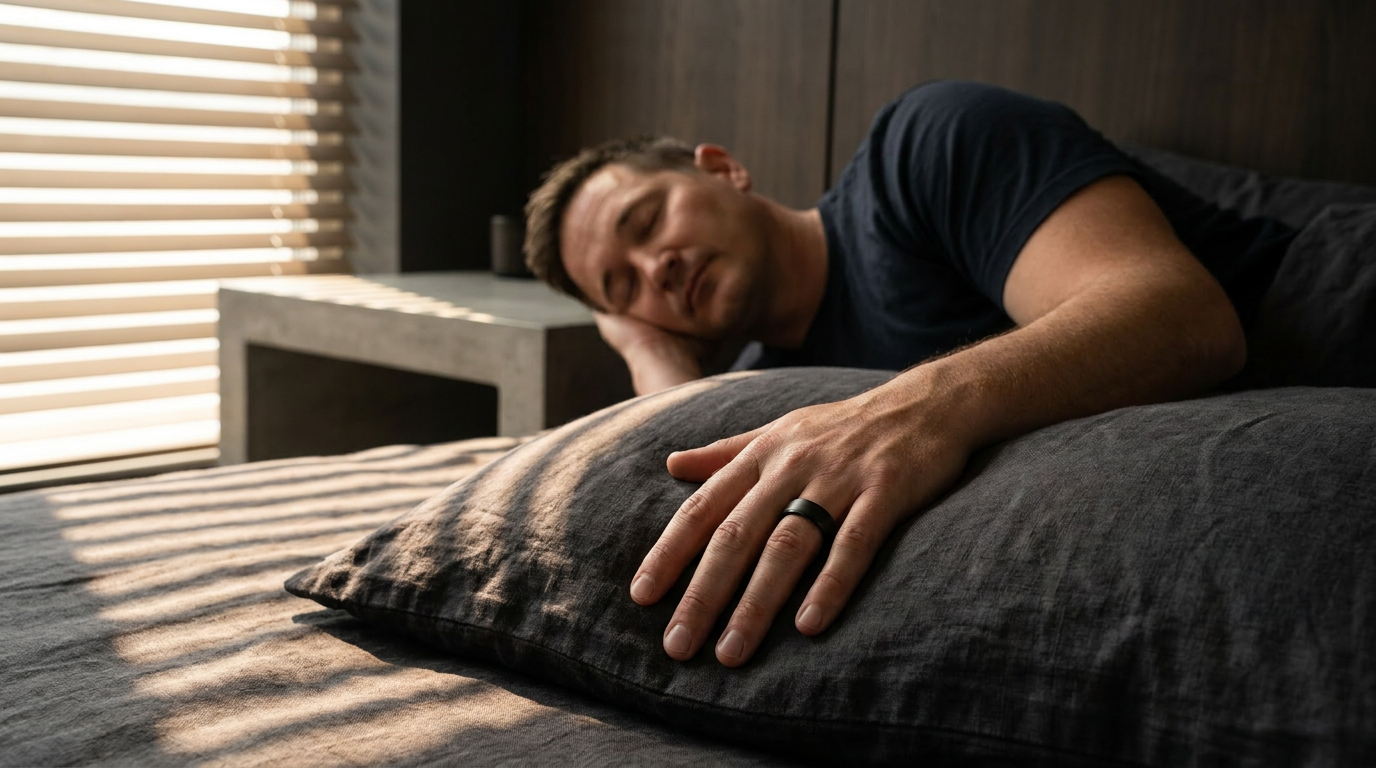
The wearable technology landscape has undergone a quiet revolution. In 2026, the bulky, glowing smartwatches that once dominated nightstands are increasingly being replaced by sleek, titanium smart rings. Devices like the Oura Ring 4, the Samsung Galaxy Ring, and the Ultrahuman Ring AIR promise continuous, unobtrusive health monitoring, with a specific focus on sleep and recovery metrics.[8]
But as the market floods with subscription-free alternatives and tech-giant entrants, a critical question remains for consumers: do these miniaturized sensors actually provide accurate medical data, or are they just expensive mood rings? To answer this, we must look past the marketing materials and examine the peer-reviewed clinical evidence comparing smart rings against the gold standard of sleep medicine: polysomnography.[8]
The central promise of the smart ring is its ability to map your night, dividing your rest into light, deep, and REM sleep. According to a 2024 study published in Sensors conducted at Brigham and Women's Hospital, the Oura Ring Gen 3 demonstrated a 95% sensitivity for simply detecting sleep versus wakefulness.[2]
When it comes to the more complex task of four-stage sleep classification, the evidence is nuanced. The same study found the Oura Ring achieved a sensitivity of 76.0% to 79.5% across individual sleep stages. While this might sound low to a layperson, it is remarkably high for a consumer wearable, outperforming both the Fitbit Sense (61.7–78.0%) and the Apple Watch (50.5–86.1% with high variance).[2]

A massive multi-night validation study from the University of Tokyo, analyzing over 421,000 sleep epochs across 96 participants, corroborated these findings. The researchers concluded that the Oura Ring's sleep staging algorithm showed almost perfect agreement with polysomnography for basic sleep classification, cementing its status as the most validated consumer device on the market.[1]
However, there is a significant caveat to this accuracy. A 2025 systematic review published by the National Institutes of Health highlighted that nearly all validation studies have been conducted on healthy adults. When tested on clinical populations—individuals with insomnia, sleep apnea, or other sleep disorders—the four-stage classification accuracy of consumer rings dropped to approximately 53%.[3]
Ring manufacturers argue that moving sensors from the wrist to the finger yields better data. The clinical evidence strongly supports this claim, primarily due to the physics of photoplethysmography, the optical technology used to measure blood flow.[8]
Ring manufacturers argue that moving sensors from the wrist to the finger yields better data.
The underside of the finger has a higher density of capillaries and less tissue depth than the top of the wrist. This allows the ring's LEDs to capture a significantly cleaner arterial pulse signal. Furthermore, rings are less prone to the motion artifact that plagues loose-fitting smartwatches during the night, resulting in fewer gaps in the data.[8]

This physical advantage translates directly to adherence. A 2025 systematic review of smart rings in clinical medicine noted that while long-term adherence to all wearables declines over time, rings consistently outperform wrist devices for overnight wear. Users simply find them less obtrusive for side-sleeping and less likely to cause skin irritation.[3]
The launch of the Samsung Galaxy Ring and the rise of the Ultrahuman Ring AIR have challenged Oura's dominance, largely by eliminating the controversial monthly subscription fee. But the clinical validation for these newer entrants remains a mixed picture.[4][5]
The Samsung Galaxy Ring excels in ecosystem integration and hardware design, offering a seamless experience for Android users. However, independent testing by consumer tech reviewers has noted inconsistencies in its sleep staging. Reviewers reported instances of the Galaxy Ring inexplicably splitting single nights of sleep into separate cycles, resulting in skewed recovery scores compared to the Oura Ring.[5][6]

Ultrahuman, meanwhile, has published internal validation data comparing its Ring AIR to FDA-approved medical devices like SleepImage. Their data shows a highly impressive mean absolute error of just 2.4% for heart rate detection during sleep.[7]
Yet, independent researchers note a gap in the literature: Ultrahuman lacks the extensive, third-party, peer-reviewed polysomnography validation that Oura has accumulated over the years. While the hardware is highly capable, the algorithms translating that raw data into sleep stages remain less proven in independent clinical settings.[7][8]
Where top-tier smart rings truly shine is in measuring Heart Rate Variability (HRV). HRV—the variation in time between each heartbeat—has become the ultimate metric for measuring nervous system recovery and physical strain. Because it requires measuring the exact millisecond between beats, it is notoriously difficult for optical sensors to capture accurately.[8]
Here, the evidence is overwhelmingly positive. A 2025 independent study compared consumer wearables against an ECG-grade Polar H10 chest strap across 536 nights. The Oura Ring achieved a Concordance Correlation Coefficient of 0.99—indicating nearly perfect agreement with the medical gold standard.[3][8]

Ultimately, the evidence suggests that for healthy individuals looking to track baseline recovery, heart rate variability, and general sleep trends, smart rings are not just a gimmick—they are currently the most accurate and practical consumer form factor available.[8]
However, consumers must align their expectations with the science. These devices are exceptional at measuring physiological output like resting heart rate and temperature trends, but they are not diagnostic tools. If you suspect a genuine sleep disorder, the clinical consensus remains clear: skip the titanium ring and schedule a medical polysomnography study.[1][3]
How we got here
2015
Oura launches its first-generation smart ring via Kickstarter, introducing the form factor.
2021
Oura Gen 3 introduces advanced temperature sensing and improved sleep staging algorithms.
2023
Ultrahuman and RingConn enter the market, challenging the subscription model.
Late 2024
Samsung launches the Galaxy Ring, bringing a major tech giant into the smart ring ecosystem.
2025
Independent meta-analyses confirm top-tier smart rings match ECG accuracy for overnight HRV.
Viewpoints in depth
Clinical Researchers' view
Focuses on the necessity of polysomnography validation and the limitations of consumer devices.
Medical professionals and sleep researchers emphasize that while smart rings are excellent tools for tracking baseline trends in healthy adults, they cannot replace clinical diagnostics. They point to data showing that wearable accuracy drops significantly in populations with actual sleep disorders, warning against using consumer tech to self-diagnose conditions like sleep apnea or insomnia.
Consumer Tech Reviewers' view
Prioritizes user experience, ecosystem integration, and the financial implications of subscription models.
Tech analysts evaluate smart rings through the lens of daily friction and cost of ownership. They highlight that the best sensor in the world is useless if the device requires daily charging or traps the user in a costly monthly subscription. For this camp, the rise of the Samsung Galaxy Ring represents a crucial shift toward subscription-free, ecosystem-integrated health tracking, even if the sleep staging algorithms trail slightly behind the market leader.
Quantified Self Advocates' view
Values raw data accuracy, actionable recovery metrics, and continuous biometric monitoring.
This community of athletes and biohackers views smart rings primarily as recovery management tools. They are less concerned with exact sleep stage minutes and more focused on the reliability of Heart Rate Variability (HRV) and resting heart rate trends. They advocate for devices that provide transparent, un-smoothed data that can be used to modulate daily training intensity and lifestyle habits.
What we don't know
- How the long-term durability of the internal batteries will hold up after 3-5 years of continuous daily charging.
- Whether newer entrants like Samsung and Ultrahuman will eventually match Oura's extensive peer-reviewed clinical validation.
- How upcoming FDA regulations might impact the health claims and diagnostic features that smart ring manufacturers are allowed to market.
Key terms
- Polysomnography (PSG)
- The medical gold standard for sleep studies, using brain waves, blood oxygen, and heart rate to diagnose sleep disorders.
- Photoplethysmography (PPG)
- An optical technique that uses light to detect blood volume changes in the microvascular bed of tissue, used to calculate heart rate.
- Heart Rate Variability (HRV)
- The measure of the specific time variation between each heartbeat, used as a primary indicator of nervous system recovery and stress.
- Concordance Correlation Coefficient (CCC)
- A statistical metric used to measure the agreement between a new device and a gold-standard medical reference.
Frequently asked
Do I need to pay a subscription to use a smart ring?
It depends on the brand. The Oura Ring requires a monthly subscription for full data access, while the Samsung Galaxy Ring, Ultrahuman Ring AIR, and RingConn offer subscription-free models.
Can a smart ring diagnose sleep apnea?
No. While smart rings can detect blood oxygen drops and breathing disturbances that indicate potential issues, they are not FDA-cleared diagnostic tools. A clinical polysomnography study is required for a diagnosis.
Which finger is best for wearing a smart ring?
Most manufacturers recommend the index, middle, or ring finger for the most accurate biometric readings, as these fingers have optimal blood vessel density for the optical sensors.
Sources
Source coverage
8 outlets
3 viewpoints surfaced








[1]Sleep MedicineClinical Researchers
Validity and reliability of the Oura Ring Generation 3 against multi-night ambulatory polysomnography
Read on Sleep Medicine →[2]SensorsClinical Researchers
Accuracy of Consumer Wearable Sleep Trackers Compared to Polysomnography
Read on Sensors →[3]National Institutes of HealthClinical Researchers
Smart rings in clinical medicine: a systematic review and meta-analysis
Read on National Institutes of Health →[4]Runner's WorldConsumer Tech Reviewers
Samsung Galaxy Ring review: The ultimate sleep tracker or just a gadget?
Read on Runner's World →[5]Garage Gym ReviewsConsumer Tech Reviewers
Samsung Galaxy Ring Review: Hands-On Testing
Read on Garage Gym Reviews →[6]Best Buy BlogConsumer Tech Reviewers
Samsung Galaxy Ring review
Read on Best Buy Blog →[7]Ultrahuman ScienceQuantified Self Advocates
Sleep heart rate sensing by Ultrahuman Ring AIR demonstrates high overlap with FDA-approved device
Read on Ultrahuman Science →[8]Factlen Editorial TeamConsumer Tech Reviewers
Synthesis by Factlen editorial team
Read on Factlen Editorial Team →


Every angle. Every day.
Get shopping stories with full source coverage and perspective breakdowns delivered to your inbox.