
The End of the Endless Scroll: How 2026 Became the Year Streaming Finally Fixed Discovery
Major platforms and hardware makers are rolling out unified search hubs and AI-driven personalization, ending the era of app fragmentation and "subscription fatigue."
By Factlen Editorial Team
- Consumer Advocates
- Value the return of unified search and the rise of high-quality free options, ending the frustration of app-hopping.
- Platform Aggregators
- Hardware makers and mega-apps aiming to own the living room 'front door' via universal search.
- Streaming Technologists
- Focused on using AI and edge computing to deliver flawless, hyper-personalized video delivery.
What's not represented
- · Independent Filmmakers
- · Traditional Cable Providers
Why this matters
Consumers have spent years paying rising subscription fees only to waste 20 minutes a night hunting for something to watch. The shift toward universal search and premium free channels saves viewers both time and money, making home entertainment relaxing again.
Key points
- Major platforms are rolling out unified search hubs to combat 'subscription fatigue.'
- Amazon and Roku are positioning themselves as the default 'front door' to the living room.
- Free Ad-Supported Streaming TV (FAST) has matured into a premium, highly curated alternative to paid apps.
- AI is drastically reducing the time it takes viewers to find their next show.
- Top-tier internet creators are bypassing social media to license content directly to connected TVs.
For the better part of a decade, the "streaming wars" operated on a simple, frustrating premise: build a walled garden and force the viewer to come inside. The result was widespread "subscription fatigue" and the dreaded endless scroll, with audiences often spending more time hunting for a movie across half a dozen isolated apps than actually watching one.[5]
But in 2026, the entertainment industry is finally waving a white flag on fragmentation. Driven by consumer exhaustion and the looming threat of algorithm-driven social video platforms that effortlessly serve up content, major streaming services and hardware makers are tearing down the walls that made modern television so tedious to navigate.[5]
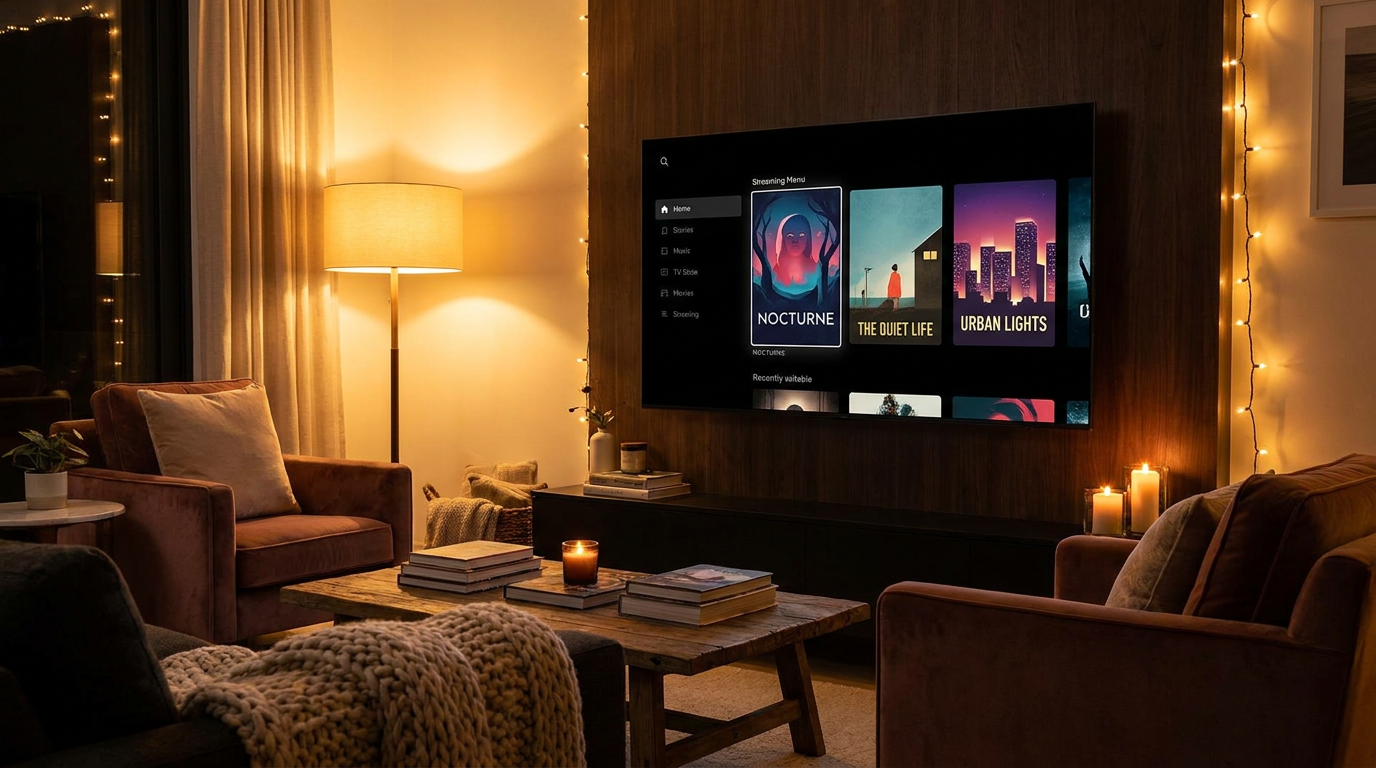
The defining breakthrough of the year is the rapid adoption of "unified discovery"—cross-platform search engines that aggregate content from competing services into a single, seamless interface. Nearly 38% of industry leaders now point to unified discovery as the primary driver for the next generation of streaming user interfaces.[1]
Amazon is leading the charge, positioning Prime Video not just as a standalone service, but as a universal viewing hub. Industry analysts project that Amazon's new universal search experience will allow consumers to centralize and manage their subscriptions across platforms, effectively making it the default "front door" to the living room.[1][2]

Hardware giants are equally invested in solving the discovery problem. Roku has deployed a new wave of AI-driven personalization designed to drastically shrink the time it takes viewers to find their next watch. By analyzing viewing habits across all downloaded apps, the operating system now surfaces the right show regardless of which corporate banner it lives under.[3]
Hardware giants are equally invested in solving the discovery problem.
This shift could not come at a better time for viewers' wallets. The average U.S. household now pays roughly $69 a month for four paid streaming services. As prices for premium ad-free tiers have crept up over the last two years, the consumer tolerance for clunky, isolated apps has plummeted.[5]
To offset these costs, 2026 has also seen the triumphant maturation of Free Ad-Supported Streaming TV (FAST). Once dismissed as the bargain bin of old reruns, FAST platforms like Samsung TV Plus, Pluto TV, and The Roku Channel have evolved into premium, highly curated destinations with massive libraries.[1][2]
The numbers reflect a massive shift in consumer behavior. Samsung TV Plus recently surpassed 100 million monthly active users globally, driven by a massive injection of high-quality channels and live events. Viewers are flocking to these services because they offer the lean-back, frictionless experience of traditional cable without the monthly bill.[7]

Behind the scenes, artificial intelligence is doing more than just recommending shows. Streaming networks are utilizing AI to upscale lower-resolution videos, reduce buffering through edge computing, and generate real-time dubbing, ensuring that a show produced in South Korea can become an instant, high-quality hit in Mexico or the UK.[4]
The living room screen is also democratizing in unprecedented ways. In 2026, top-tier internet creators are bypassing social media algorithms entirely, licensing their high-production-value content directly to connected TV platforms. This convergence means viewers can watch a blockbuster film and a premium creator-led travel series on the exact same interface.[3]

How we got here
Early 2020s
The 'streaming wars' lead to massive fragmentation, with every major studio launching its own isolated app.
2024–2025
Subscription prices rise across the board, leading to widespread consumer 'subscription fatigue.'
January 2026
Samsung TV Plus surpasses 100 million monthly active users, signaling the mainstream arrival of premium FAST.
Mid 2026
Major platforms begin rolling out unified cross-platform search and AI-driven discovery hubs.
Viewpoints in depth
Consumer Advocates
Value the return of unified search and the rise of high-quality free options, ending the frustration of app-hopping.
For years, consumer advocates have warned that the fragmentation of the streaming market was unsustainable. With the average U.S. household spending $69 a month across four different services, viewers reached a breaking point. The push toward unified discovery and the massive expansion of high-quality FAST channels are seen as necessary relief valves that finally put the viewer's convenience and budget ahead of corporate walled gardens.
Platform Aggregators
Hardware makers and mega-apps aiming to own the living room 'front door' via universal search.
For companies like Amazon, Roku, and Samsung, solving the discovery problem is a highly lucrative business strategy. By offering a universal search bar that pulls in content from Netflix, Disney, and Max, these aggregators position themselves as the default operating system of the living room. They own the user relationship, control the advertising inventory on the home screen, and ensure that viewers never have to leave their ecosystem to find what they want.
Streaming Technologists
Focused on using AI and edge computing to deliver flawless, hyper-personalized video delivery.
Behind the user interface, technologists are focused on the infrastructure required to make streaming effortless. By deploying edge computing—processing data closer to the user—they are virtually eliminating buffering. Furthermore, the integration of AI allows for real-time video upscaling and dynamic subtitle generation, ensuring that a unified platform can seamlessly deliver global content to any device without a drop in quality.
What we don't know
- Whether major holdouts will fully integrate their exclusive libraries into third-party universal search engines.
- How the rise of premium FAST channels will impact the long-term profitability of ad-free subscription tiers.
Key terms
- FAST
- Free Ad-Supported Streaming TV; platforms that offer scheduled, linear television channels over the internet at no cost to the viewer.
- Unified Discovery
- A user interface that aggregates content from multiple competing streaming services into a single, searchable menu.
- AVOD
- Advertising-Based Video on Demand; streaming services that are free or discounted because they include commercial breaks.
- Edge Computing
- Processing data closer to the user's location to reduce buffering and improve live streaming quality.
Frequently asked
What is unified streaming discovery?
It is a feature that allows users to search for and launch shows across all their subscribed apps from a single search bar, without having to open each app individually.
Are streaming prices still going up?
While premium ad-free tiers remain expensive, the massive growth of high-quality Free Ad-Supported TV (FAST) channels in 2026 has given consumers more free viewing options than ever.
How is AI changing streaming?
AI is being used to power hyper-personalized recommendations, upscale video quality in real-time, and dynamically translate subtitles for global audiences.
What is a FAST channel?
FAST stands for Free Ad-Supported Streaming TV. These are linear, scheduled channels streamed over the internet for free, similar to traditional cable but without the subscription fee.
Sources
Source coverage
7 outlets
3 viewpoints surfaced




[1]Media Play NewsConsumer Advocates
The macro trends shaping 2026: workflow simplification and autonomous advertising
Read on Media Play News →[2]Streaming MediaPlatform Aggregators
Paramount, Amazon, and the 2026 Streaming Power Balance
Read on Streaming Media →[3]RokuPlatform Aggregators
Roku's 2026 Predictions: TV gets way more personalized
Read on Roku →[4]CDNetworksStreaming Technologists
8 Streaming Trends and Technologies in 2026
Read on CDNetworks →[5]Hargreaves LansdownConsumer Advocates
Streaming wars: what's next for Netflix, Disney and the rest?
Read on Hargreaves Lansdown →[6]TVBIZZ MagazineStreaming Technologists
Global streaming market shifts in Q1 2026
Read on TVBIZZ Magazine →[7]SamsungPlatform Aggregators
Samsung TV Plus Kicks Off 2026 with More Than 100 Million Monthly Active Users
Read on Samsung →



Every angle. Every day.
Get entertainment stories with full source coverage and perspective breakdowns delivered to your inbox.