
How the Open-Source Godot Engine is Reshaping Indie Game Development in 2026
Fueled by zero licensing fees and a lightweight architecture, the Godot game engine is seeing exponential adoption among independent developers, challenging the long-standing dominance of Unity.
By Factlen Editorial Team
- Open-Source Advocates
- Argue that zero licensing risk and community-driven development are the only sustainable path for indie creators.
- Commercial Indie Studios
- Take a pragmatic approach, balancing Godot's workflow advantages against the friction of console porting.
- AAA & 3D Developers
- Maintain that industry-standard proprietary engines are still required for high-fidelity, large-scale games.
What's not represented
- · Console Manufacturers (Sony/Nintendo/Microsoft)
- · Game Development Educators & Universities
Why this matters
Game engines are the foundational infrastructure of the $85 billion indie gaming market. A shift toward a free, open-source standard lowers the barrier to entry for solo creators and protects small studios from sudden corporate licensing changes.
Key points
- The Godot engine has seen exponential growth, with Steam releases doubling annually since 2023.
- Its MIT license guarantees zero fees or royalties, protecting developers from sudden corporate pricing changes.
- Godot's 120MB editor allows for near-instant iteration, saving weeks of production time over a standard development cycle.
- The engine dominates 2D development thanks to a native pipeline, though Unity retains an edge in high-end 3D.
- Console porting remains Godot's biggest hurdle, requiring developers to hire third-party studios to access proprietary SDKs.
The global indie game market has ballooned to an estimated $85 billion in 2026, representing more than a third of the total gaming industry. Yet behind the colorful pixel art and sprawling digital worlds, a quiet infrastructural revolution is taking place. For over a decade, independent developers relied almost exclusively on proprietary game engines, primarily Unity, to build their titles. Today, that duopoly is fracturing as a free, open-source alternative—the Godot engine—achieves exponential adoption.[1][4]
The catalyst for this migration traces back to 2023, when Unity announced a controversial "Runtime Fee" that would charge developers per game install. Although Unity eventually walked back the most aggressive terms, the incident permanently altered the industry's risk calculus. Developers realized that building their livelihoods on a closed ecosystem meant a corporate entity could change the financial rules mid-project. In response, thousands of creators began looking for an engine where the terms were immutable.[1][2][4]
They found their answer in Godot. Released under the MIT license, Godot is entirely free and open-source, meaning it carries zero licensing fees, no runtime royalties, and no vendor lock-in. A developer can ship a game that makes ten dollars or ten million dollars, and they will never owe the Godot Foundation a cent. For independent studios operating on razor-thin margins, this zero-risk licensing model has become a primary draw.[1][2][3]
The adoption metrics for 2026 illustrate a staggering shift. According to industry data, the number of Godot-built games released on Steam has roughly doubled every year since the Unity controversy. In the 2023-2024 window, Steam saw 618 Godot releases; by the 2025-2026 tracking period, that number surged to 2,864. Furthermore, Godot's penetration in grassroots game jams—often a leading indicator of future commercial engine use—is approaching 50%.[4]

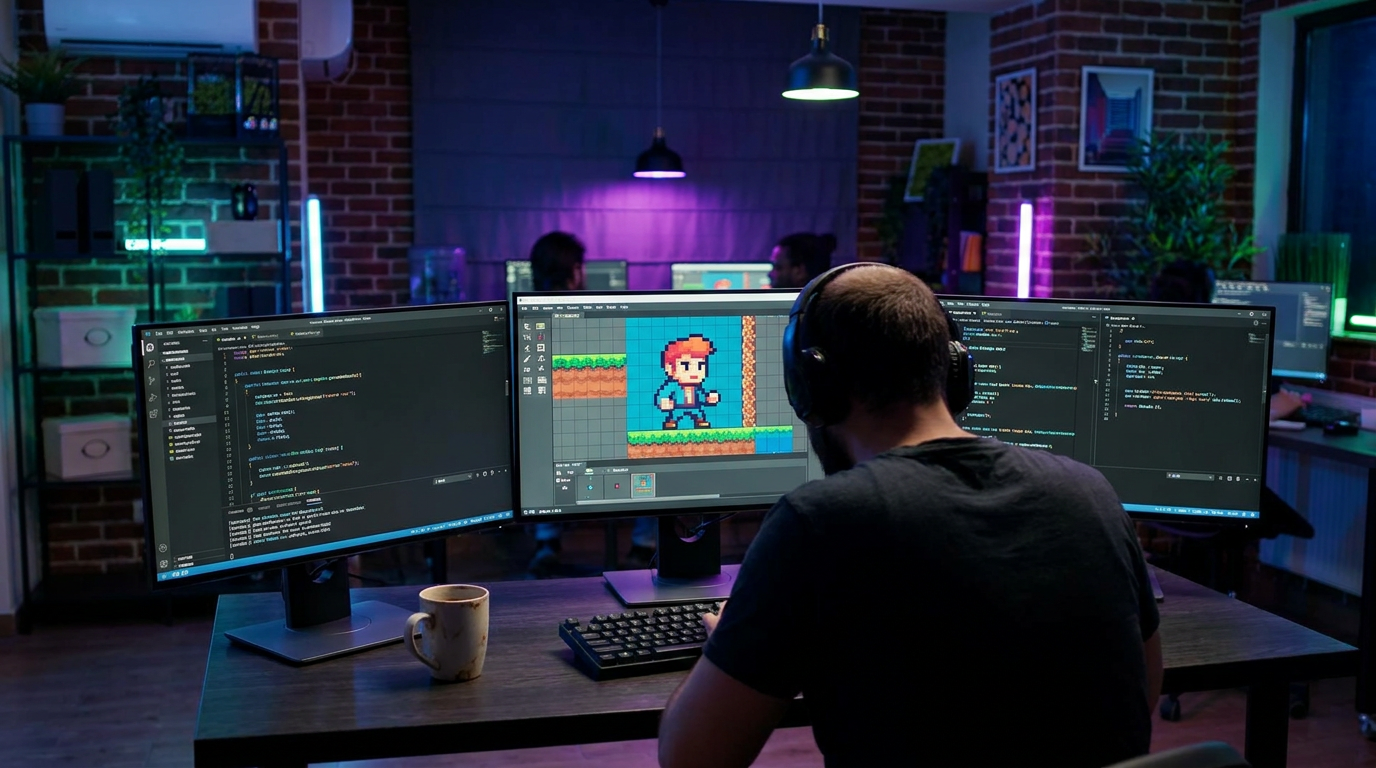
But licensing alone does not explain Godot's staying power. The engine's structural design fundamentally caters to the realities of solo and small-team development. Godot's editor is remarkably lightweight, requiring roughly 120 megabytes of storage compared to the 15-plus gigabytes often demanded by Unity or Unreal Engine. It launches almost instantly and can run smoothly on modest hardware, making game development accessible to creators without high-end workstations.[1][3]
This lightweight footprint translates directly into iteration speed, which developers cite as Godot's core technical advantage. In game design, finding the "fun" requires constantly tweaking variables, recompiling, and testing. While heavier engines might take 30 seconds to reimport an asset or reload a domain, Godot switches scenes in real-time. Over an 18-month development cycle, shaving seconds off every test play saves weeks of production time, allowing for deeper polish.[1][5]
This lightweight footprint translates directly into iteration speed, which developers cite as Godot's core technical advantage.
Godot's architecture is built around a unique "node" system. Instead of complex, monolithic game scripts, developers build scenes by snapping together modular nodes—a sprite, a hitbox, a camera—which can then be saved and nested inside other scenes. This object-oriented approach keeps codebases clean and intuitive. The engine also features its own Python-like scripting language, GDScript, which is highly readable and allows beginners to prototype mechanics rapidly.[3][5]

The engine's absolute dominance currently lies in 2D game development. Unlike many 3D engines that simulate 2D by locking a camera on a flat plane, Godot features a dedicated, native 2D rendering pipeline. This means pixel snapping, sprite sorting, and 2D lighting behave exactly as expected, without the physics quirks that plague simulated 2D environments. For genres like platformers, roguelikes, and farming simulators, Godot is now widely considered the path of least resistance.[1][5]
However, the ecosystem is not without its trade-offs, and commercial studios remain pragmatic about where Godot falls short. Unity still holds a commanding lead in high-end 3D rendering and photorealistic lighting pipelines. While Godot 4.4 has made massive strides in 3D—introducing Vulkan support and better global illumination—it cannot yet match the out-of-the-box visual fidelity of Unity's High Definition Render Pipeline (HDRP) or Unreal Engine's Nanite.[2][5]
The most significant hurdle for commercial Godot developers in 2026 remains console publishing. Because Godot is fully open-source, it cannot legally include the proprietary, closed-source software development kits (SDKs) required to export games directly to the PlayStation 5 or Nintendo Switch. Developers targeting consoles must either rewrite parts of their engine backend themselves or pay third-party porting studios—often costing between $10,000 and $50,000—to handle the conversion. Unity, by contrast, offers official, frictionless console support.[1][6]

There is also the question of AAA scalability. Godot is intentionally designed to be simple, which means it lacks the complex, data-oriented tech stacks required to manage massive open worlds with millions of entities. While a studio with a AAA budget could theoretically modify Godot's C++ source code to build those features, most large-scale developers still default to Unreal Engine for high-fidelity, performance-heavy titles.[6][7]
Despite these limitations, the broader indie ecosystem is rapidly filling the gaps. The asset marketplace for Godot is expanding, and new AI-assisted development tools are increasingly integrating directly into the Godot editor, allowing solo developers to generate code and scenes on the fly. As the community grows, the volume of high-quality tutorials and third-party plugins is beginning to rival Unity's decade-old library.[1][4]
Ultimately, the rise of Godot reflects a maturing indie game market. With the median lifetime revenue for a Steam indie game sitting at just $4,000, developers are prioritizing tools that minimize overhead, reduce friction, and eliminate financial risk. By providing a robust, free foundation, Godot has not only broken a long-standing corporate duopoly but has ensured that the next generation of digital worlds will be built on open-source infrastructure.[1][4]
How we got here
2014
The Godot engine is officially open-sourced under the MIT license.
Sept 2023
Unity announces a controversial 'Runtime Fee,' sparking massive developer backlash and a search for alternatives.
Late 2023
Thousands of developers migrate to Godot, doubling its user base almost overnight.
2024
Godot 4.3 releases, bringing major improvements to 3D rendering and performance.
2026
Godot-built games on Steam approach 3,000 annual releases, cementing its status as a top-tier indie engine.
Viewpoints in depth
Open-Source Advocates
Argue that zero licensing risk and community-driven development are the only sustainable path for indie creators.
This camp, which includes the Godot Foundation and a massive influx of hobbyists, views proprietary engines as an inherent risk to developer livelihoods. They point to Unity's 2023 runtime fee proposal as proof that corporate-controlled tools can change their terms of service mid-project. For them, Godot's MIT license is a structural guarantee of freedom, and the engine's rapid iteration speed is a direct result of thousands of community contributors fixing the exact bugs that affect their daily workflows.
Commercial Indie Studios
Take a pragmatic approach, balancing Godot's workflow advantages against the friction of console porting.
Professional indie developers acknowledge Godot's superiority for 2D projects and rapid prototyping, but they remain cautious about abandoning Unity entirely. Their primary concern is distribution. Because Godot cannot natively export to closed console ecosystems like the PS5 or Switch, studios must budget tens of thousands of dollars for third-party porting services. For teams whose business models rely on multi-platform releases, this upfront cost often offsets the savings of Godot's free license.
AAA & 3D Developers
Maintain that industry-standard proprietary engines are still required for high-fidelity, large-scale games.
Developers working on massive 3D open worlds or photorealistic graphics argue that Godot is simply not built for their needs. They emphasize that Unreal Engine and Unity have spent decades optimizing their rendering pipelines, global illumination, and data-oriented tech stacks to handle millions of on-screen polygons. While Godot's lightweight, object-oriented design is perfect for indie titles, this camp notes that it encounters performance bottlenecks when scaled to AAA fidelity.
What we don't know
- Whether Godot will eventually develop a standardized, low-cost pipeline for console porting.
- How Unity's upcoming engine iterations will attempt to win back the indie developers who migrated to open-source alternatives.
Key terms
- Game Engine
- The foundational software framework used to build and run video games, handling graphics, physics, and input.
- MIT License
- A highly permissive free software license that allows users to modify and distribute code without paying royalties.
- Runtime Fee
- A controversial pricing model that charges developers a fee every time a user installs their game.
- Node-based Architecture
- A design system where game elements are broken down into small, reusable building blocks (nodes) rather than complex scripts.
- Render Pipeline
- The specific sequence of steps a game engine takes to turn 3D models and lighting data into the 2D image seen on a screen.
Frequently asked
Is Godot completely free to use?
Yes. Godot operates under the MIT license, meaning it is 100% free for both personal and commercial use, with no royalties or hidden fees regardless of how much money a game makes.
Can I make 3D games in Godot?
Yes. While Godot is famous for its exceptional 2D capabilities, recent updates in the 4.x series have significantly improved its 3D rendering, making it highly capable for stylized and mid-tier 3D games.
Why can't Godot export directly to consoles?
Because Godot is open-source, it cannot legally include the proprietary, closed-source software development kits (SDKs) required by Sony, Microsoft, and Nintendo. Developers must use third-party porting services to reach these platforms.
Sources
Source coverage
7 outlets
3 viewpoints surfaced







[1]Dev.toCommercial Indie Studios
Godot 4.4 vs Unity 6: Core Comparison for Indie Developers in 2026
Read on Dev.to →[2]Games AtlasCommercial Indie Studios
What is Godot engine and why its commercial footprint now demands attention
Read on Games Atlas →[3]Uniday StudioCommercial Indie Studios
Choosing a Game Engine in 2026: Unity vs Unreal vs Godot
Read on Uniday Studio →[4]ZivaOpen-Source Advocates
Every Metric Points Up: Godot's 2026 Growth
Read on Ziva →[5]Sunstrike StudiosCommercial Indie Studios
Real-world breakdown from a game studio that ships on both engines
Read on Sunstrike Studios →[6]Godot Engine OfficialOpen-Source Advocates
Can Godot handle AAA fidelity in 2026 and future?
Read on Godot Engine Official →[7]Team of KeysAAA & 3D Developers
The game development landscape in 2026
Read on Team of Keys →
Every angle. Every day.
Get gaming esports stories with full source coverage and perspective breakdowns delivered to your inbox.