
How Adaptive Technology is Opening Professional Esports to Everyone
Breakthroughs in modular hardware and sound accessibility are shattering physical barriers in competitive gaming. Players with severe motor impairments and total blindness are now competing—and winning—on the world's biggest esports stages.
By Factlen Editorial Team
- Accessibility Advocates
- Focuses on the empowerment, community building, and leveling of the playing field that adaptive technology provides.
- Hardware & Game Developers
- Focuses on the technical innovations and design challenges required to build modular inputs and accessible software engines.
- Tournament Organizers
- Focuses on the logistics of integrating adaptive tech into competitive environments and standardizing rules for fair play.
What's not represented
- · Able-bodied competitors adjusting to mixed-ability brackets
- · Grassroots tournament organizers lacking resources for accessibility checks
Why this matters
For decades, competitive gaming was restricted to those with standard physical mobility and vision. The rise of adaptive esports proves that with inclusive design, the definition of an elite athlete can expand, offering a blueprint for accessibility that extends far beyond the digital arena.
Key points
- Adaptive controllers act as modular hubs, allowing players to use custom switches, foot pedals, and chin-operated joysticks to compete.
- Sound accessibility features in games like Street Fighter 6 enable blind players to track the action entirely through stereo-panned audio cues.
- Para esports players are successfully competing in mainstream, mixed-ability tournaments, with some reaching the top 5% of global brackets.
- Major institutions, including the Tokyo Metropolitan Government and the ASEAN Paragames, are officially integrating esports into adaptive sports frameworks.
For decades, the professional esports stage was defined by a rigid physical standard: lightning-fast reflexes executed across a standard plastic controller or a mouse and keyboard. If a player lacked the fine motor control to manipulate dual thumbsticks, or the vision to track pixels across a monitor, the competitive arena was effectively closed to them. But a quiet revolution in adaptive technology and inclusive software design is shattering that barrier. Today, gamers with severe motor impairments and total blindness are not just participating in casual play; they are entering global tournaments and defeating able-bodied competitors on the world's biggest stages.[7]
The transformation is being driven by a combination of modular hardware and groundbreaking software accessibility. Historically, video game controllers were monolithic devices that assumed a specific range of hand mobility. The introduction of devices like the Xbox Adaptive Controller and the PlayStation Access Controller fundamentally changed the hardware paradigm. Instead of forcing the player to adapt to the controller, these devices act as centralized hubs. They allow players to plug in an array of external switches, foot pedals, and specialized joysticks, mapping standard button inputs to whatever physical movement the player can comfortably perform.[4][6]
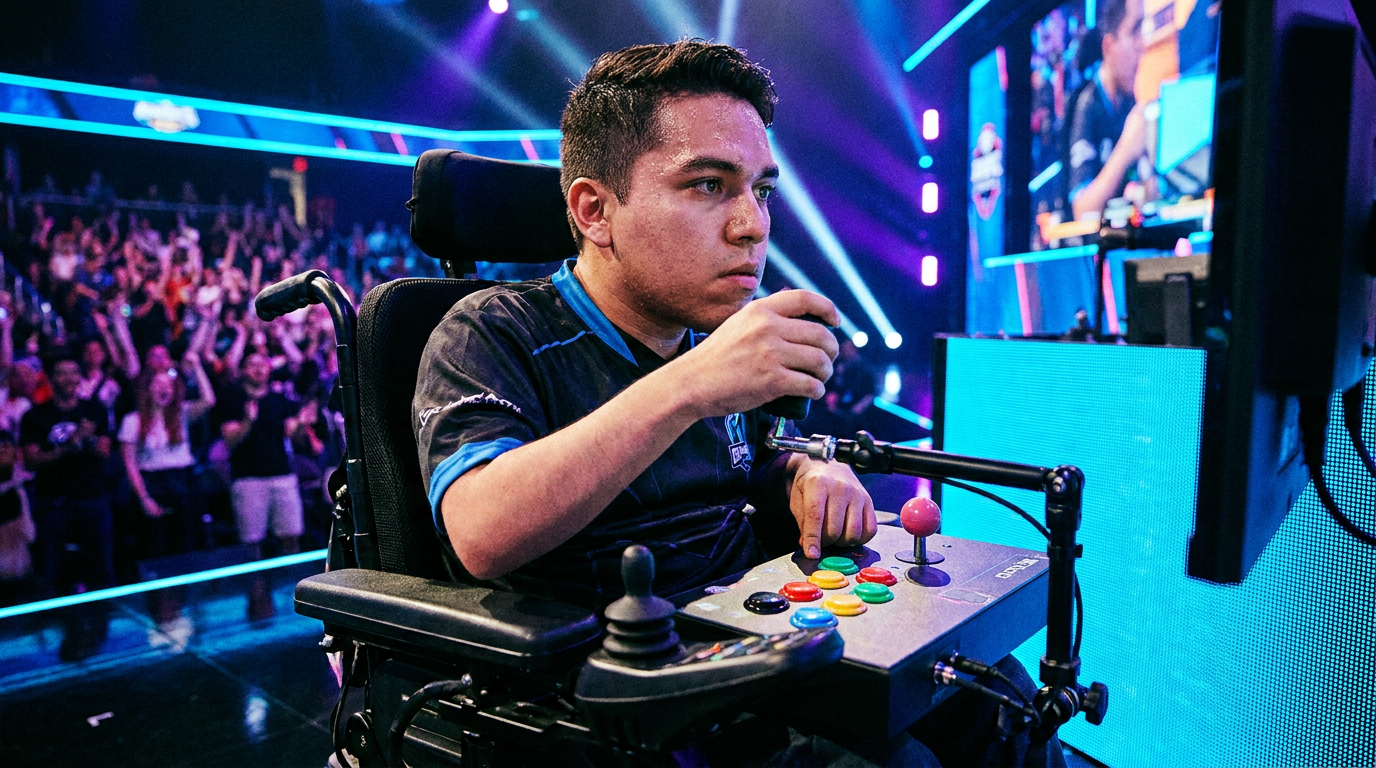
This modularity allows for highly individualized setups that can accommodate almost any physical requirement. For example, a player might use a sip-and-puff switch for trigger inputs, a large arcade-style button mounted near their knee for jumping, and a chin-operated joystick for directional movement. Organizations like AbleGamers and The Controller Project have spent years refining these custom 3D-printed modifications, turning "impossible" into "I'm possible" for thousands of gamers. In the competitive sphere, this hardware is the great equalizer, translating diverse physical inputs into identical digital actions on the screen.[1][4]

The competitive viability of these setups was dramatically proven at EVO 2024, the world's largest fighting game tournament. Jeni, a Japanese esports competitor with muscular dystrophy, entered the Street Fighter 6 bracket using a custom rig that combined a chin-operated controller with specialized hand switches. Competing against a massive field of traditional pad and arcade-stick users, Jeni fought his way to an astonishing 257th place out of 5,300 competitors. His run demonstrated that when the hardware barrier is removed, tactical brilliance and game knowledge can shine through regardless of physical limitations.[2]
While hardware innovations have opened doors for players with motor impairments, software design is driving a parallel revolution for visually impaired gamers. Fighting games, which rely heavily on spatial awareness and split-second reactions, might seem impossible to play without sight. However, developers are increasingly building "sound accessibility" directly into the game engine. Street Fighter 6, released by Capcom, is widely considered a pioneer in this space. The game features an intricate suite of audio cues designed specifically to allow blind players to track the action entirely through sound.[4][5]
While hardware innovations have opened doors for players with motor impairments, software design is driving a parallel revolution for visually impaired gamers.
In Street Fighter 6, every action has a distinct, stereo-panned audio signature. Players can toggle specific sound effects that indicate the exact distance between characters, whether an attack hits high or low, and the remaining level of a player's super meter. The game even differentiates the sound of a character blocking a high attack versus a low attack, and amplifies the rustling of fabric when a character moves. By interpreting this dense soundscape, blind players can react to attacks, execute complex combos, and manage spacing with the same precision as sighted players.[2][5]

The impact of these audio features has been profound. NAOYA, a player who was born completely blind, utilized these sound accessibility features to become the first blind player in Japan to reach "Master Rank" in Street Fighter 6—the highest competitive tier in the game's online ecosystem. Similarly, renowned blind gamer BlindWarriorSven has built a massive following by competing in major tournaments and providing direct feedback to developers on how to refine audio cues. These players rely on stage sounds, footsteps, and specialized accessibility chimes to build a mental map of the fight, proving that visual information is not a strict prerequisite for elite performance.[2][5]
Recognizing the immense potential of adaptive gaming, major institutions are now building dedicated competitive ecosystems. Logitech G, in partnership with AbleGamers, Adaptive Action Sports, and Mount Sinai, launched the Adaptive Esports Tournaments (AET). This professional series is designed specifically for gamers who use adaptive technology, featuring community broadcasts, high-stakes brackets, and prize pools exceeding $50,000. These tournaments provide a vital proving ground for adaptive players, offering the same production value, sponsorships, and competitive prestige found in mainstream esports leagues.[1][3]
The movement is also gaining traction at the governmental and international levels. The Tokyo Metropolitan Government has begun hosting official "Exhibition Matches with Para Esports Players," explicitly designed to create a forum where people with and without disabilities can compete on an equal footing. These events feature top-tier adaptive players like Jeni and NAOYA competing against general public challengers. Furthermore, the 2026 ASEAN Paragames in Thailand is introducing esports as an official medal category, signaling a massive institutional shift in how virtual sports are categorized alongside traditional Paralympic events.[2][7]

Despite this incredible progress, the integration of adaptive technology into mainstream esports is not without friction. Tournament organizers face complex logistical challenges when verifying custom hardware. In a highly competitive environment where macro-enabled controllers and hardware cheats are strictly banned, referees must carefully inspect adaptive rigs to ensure they map one physical action to one digital input, without automating gameplay. Balancing the need for strict competitive integrity with the necessity of highly customized, non-standard controllers requires ongoing dialogue between accessibility advocates and tournament administrators.[6][7]
Beyond the bright lights of the tournament stage, the rise of accessible esports carries a profound social impact. For many individuals with severe physical disabilities, traditional avenues for competitive sports and team-based recreation are heavily restricted. Esports provides a vital space for social connection, teamwork, and identity-building. Organizations like AbleGamers emphasize that their mission is not just about playing games, but about combating social isolation. When a disabled player can join a squad, communicate strategy over a headset, and contribute to a hard-fought victory, the psychological benefits extend far beyond the digital arena, fostering a sense of belonging and empowerment.[1][7]
Looking forward, the trajectory of accessible esports suggests a future where the concept of a "standard" gamer is entirely obsolete. As adaptive hardware becomes more affordable and game engines natively incorporate multi-sensory feedback, the talent pool for professional esports will expand exponentially. Unlike physical sports, which often require separate leagues for disabled athletes, the digital nature of esports offers a unique opportunity for true, integrated competition. When the interface is fully accessible, the only things that matter are strategy, execution, and the will to win.[1][7]
How we got here
Late 2010s
Microsoft releases the Xbox Adaptive Controller, establishing a new industry standard for modular, accessible gaming hardware.
Dec 2022
Logitech G and AbleGamers launch the Adaptive Esports Tournaments (AET), creating a dedicated professional circuit for disabled gamers.
Jun 2023
Capcom releases Street Fighter 6, featuring revolutionary sound accessibility options designed with input from blind players.
Aug 2024
Para esports player Jeni competes at EVO 2024 using a chin-operated controller, placing in the top 5% of a 5,300-player bracket.
Jan 2026
The Tokyo Metropolitan Government hosts official Exhibition Matches integrating Para Esports players with the general public.
Viewpoints in depth
Accessibility Advocates
Focuses on the empowerment, community building, and leveling of the playing field that adaptive technology provides.
For advocacy groups, adaptive esports is primarily a tool for social inclusion and personal empowerment. Organizations like AbleGamers emphasize that gaming combats the profound social isolation often experienced by individuals with severe disabilities. By providing the means to compete on equal footing, adaptive technology allows disabled gamers to build identities around their skills rather than their limitations. Advocates argue that true accessibility means not just the ability to play, but the ability to compete, win, and be recognized as elite athletes in integrated environments.
Hardware & Game Developers
Focuses on the technical innovations and design challenges required to build modular inputs and accessible software engines.
From an engineering perspective, the challenge lies in creating universal systems that can accommodate highly individualized needs. Hardware developers focus on modularity—building centralized hubs like the Xbox Adaptive Controller that can accept a vast array of third-party switches and joysticks. Meanwhile, software developers are pushing the boundaries of game engines to include rich, multi-sensory feedback, such as stereo-panned audio cues for blind players. Their goal is to build accessibility into the foundational architecture of the game, rather than patching it in as an afterthought.
Tournament Organizers
Focuses on the logistics of integrating adaptive tech into competitive environments and standardizing rules for fair play.
For the administrators running global esports events, the rise of adaptive technology presents unique logistical hurdles. Tournaments rely on strict standardization to prevent cheating, particularly the use of hardware macros that automate complex inputs. Organizers must develop new frameworks for inspecting and approving custom, 3D-printed controller rigs to ensure they map one physical movement to one digital action. They are actively working to balance the absolute necessity of inclusive access with the rigorous competitive integrity required when tens of thousands of dollars are on the line.
What we don't know
- How quickly major mainstream esports titles outside the fighting game genre (like tactical shooters or MOBAs) will adopt comprehensive sound accessibility features.
- Whether international governing bodies will create a unified, global standard for verifying custom adaptive hardware in mixed-ability tournaments.
- The long-term impact of AI-assisted accessibility tools and whether they will be permitted in professional competitive play.
Key terms
- Adaptive Controller
- A customizable gaming device designed to meet the needs of players with limited mobility by supporting external switches, mounts, and joysticks.
- Sound Accessibility
- Software features that use distinct, directional audio cues to convey on-screen visual information, enabling blind or low-vision users to play.
- Remappable Controls
- A software feature that allows players to change which buttons or physical inputs correspond to specific in-game actions.
- Macro
- A programmed sequence of inputs triggered by a single button press, which is generally banned in competitive esports to ensure fair play.
- Sip-and-Puff Switch
- An assistive technology device used to send signals to a computer or controller using air pressure by inhaling or exhaling into a tube.
Frequently asked
What is an adaptive controller?
An adaptive controller is a modular hardware hub that allows players to plug in custom switches, foot pedals, and specialized joysticks. This lets gamers map standard button inputs to whatever physical movements they can comfortably perform.
How do blind players compete in fighting games?
Blind players rely on 'sound accessibility' features built into the game engine. Titles like Street Fighter 6 use stereo-panned audio cues and distinct sound effects to indicate distance, attack height, and meter levels, allowing players to track the fight entirely by ear.
Are adaptive controllers allowed in standard esports tournaments?
Yes, but they are subject to strict inspection. Tournament organizers must verify that custom rigs map one physical action to one digital input, ensuring that the hardware does not use banned macros to automate gameplay.
What are Para Esports?
Para Esports refers to competitive video gaming played by individuals with disabilities. It is rapidly gaining institutional recognition, with events like the 2026 ASEAN Paragames introducing esports as an official medal category.
Sources
Source coverage
7 outlets
3 viewpoints surfaced







[1]AbleGamersAccessibility Advocates
Making Esports Accessible
Read on AbleGamers →[2]Tokyo Metropolitan GovernmentTournament Organizers
Exhibition Match with Para Esports Players
Read on Tokyo Metropolitan Government →[3]Logitech G Adaptive EsportsHardware & Game Developers
Logitech Adaptive Esports Tournaments
Read on Logitech G Adaptive Esports →[4]TestDevLabHardware & Game Developers
Accessibility in video games: A comprehensive guide
Read on TestDevLab →[5]ePARAAccessibility Advocates
Blind eSports Research Project and Sound Accessibility
Read on ePARA →[6]UW CREATETournament Organizers
Accessible eSports Showcase
Read on UW CREATE →[7]Factlen Editorial TeamTournament Organizers
Synthesis by Factlen editorial team
Read on Factlen Editorial Team →
Every angle. Every day.
Get gaming esports stories with full source coverage and perspective breakdowns delivered to your inbox.