
Bolivian President Declares State of Emergency, Deploys Military to Clear Protest Blockades
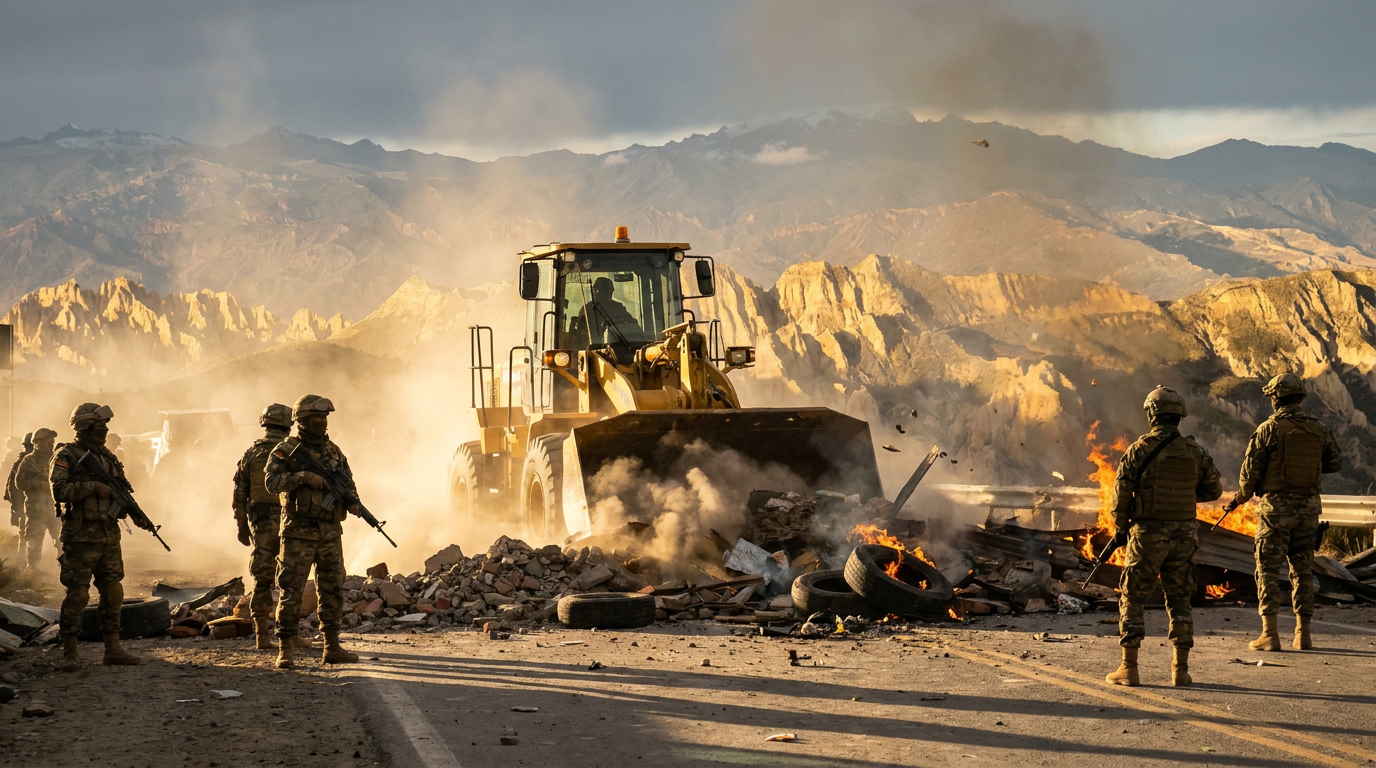
President Rodrigo Paz has declared a 90-day state of emergency in Bolivia, sending the military and bulldozers to dismantle anti-government roadblocks after 50 days of paralyzing protests.
By Factlen Editorial Team
- Paz Administration
- Argues the blockades are an illegal siege and military force is required to save the economy.
- Rural & Indigenous Protesters
- Views the government's austerity measures as an attack on the poor and demands the president's resignation.
- Urban Residents & Businesses
- Exhausted by severe shortages of food and fuel, prioritizing the immediate reopening of transport routes.
What's not represented
- · International human rights observers
- · International Monetary Fund (IMF) negotiators
Why this matters
The deployment of the military marks a dangerous escalation in Bolivia's political crisis, risking violent clashes while attempting to rescue an economy starved of food, fuel, and basic goods for nearly two months.
Key points
- President Rodrigo Paz declared a 90-day state of emergency to clear nationwide roadblocks.
- The military and bulldozers have been deployed to dismantle barricades in cities like El Alto.
- The 50-day protests began over fuel subsidy cuts and have caused severe food and medicine shortages.
- While the government reached a deal with a major labor union, rural factions refused to negotiate.
Bolivian President Rodrigo Paz has declared a 90-day state of emergency, deploying the military and heavy machinery to dismantle protest barricades that have paralyzed the Andean nation for nearly two months. The sweeping decree, announced in a predawn televised address on Saturday, authorizes the armed forces to assist national police in clearing highways and restoring the flow of essential goods. The aggressive intervention marks a critical escalation in a 50-day standoff between Bolivia's first conservative government in two decades and a sprawling coalition of rural unions, coca farmers, and Indigenous groups. The blockades have brought the country to a standstill, cutting off major transport corridors and plunging the economy into a deep crisis.[1][3]
Hours after the president’s address, the military moved into action. In the sprawling high-altitude city of El Alto, which overlooks the capital of La Paz, squads of soldiers and armed police advanced in convoys alongside heavy bulldozers. The machinery tore through makeshift walls of rubble, felled logs, and burning debris that had choked off the primary transport routes into the capital. The operation aims to break a siege that has stranded thousands of freight trucks and systematically starved major urban centers of basic necessities. For weeks, these barricades have served as the physical manifestation of the protesters' leverage, effectively cutting the country into isolated fragments.[1][5]
The economic and humanitarian toll of the blockades has been devastating. Over the past six weeks, major cities have suffered acute shortages of fuel, food, and medical supplies. Supermarket shelves in La Paz have been stripped bare, and hospitals have reported critical shortages of oxygen and emergency medicines. The national economy has hemorrhaged billions of dollars in lost trade and productivity, pushing an already fragile financial system to the brink of collapse. Citizens have been forced to wait in miles-long queues for heavily rationed gasoline, while the cost of available black-market goods has skyrocketed beyond the reach of average families.[1][2][6]

In his national address, President Paz framed the military deployment as a necessary rescue operation rather than a crackdown on civil liberties. "This is not a state of emergency to restrict people's lives," Paz told the nation. "It is a state of emergency to give freedom back to the people, to free Bolivia from those who use political conflict to block roads and harm the population." He accused the protest leaders of orchestrating an organized attempt to destabilize the country's democratic institutions, arguing that the government had exhausted all peaceful avenues to restore the constitutional right to free movement.[2][3]
The roots of the current crisis trace back to severe austerity measures introduced shortly after Paz took office in November 2025. Inheriting a severe foreign currency shortage and a ballooning fiscal deficit, Paz abruptly slashed long-standing fuel subsidies to stabilize the economy and facilitate negotiations with the International Monetary Fund. The subsidy cuts triggered an immediate spike in the cost of living, igniting furious backlash from working-class and rural Bolivians who rely heavily on cheap fuel for agriculture and transport. What began as localized strikes quickly morphed into a coordinated national shutdown.[4][6]
The roots of the current crisis trace back to severe austerity measures introduced shortly after Paz took office in November 2025.
While the government subsequently attempted to walk back some of the most unpopular land reforms and adjust fuel pricing, the concessions failed to quell the unrest. The protests rapidly metastasized from economic grievances into a broader political rebellion. Demonstrators, many of whom are closely aligned with former President Evo Morales and the socialist MAS party that governed Bolivia for 20 years, expanded their demands to include sweeping wage increases and Paz's immediate resignation. The barricades became a tool not just to reverse a policy, but to challenge the legitimacy of the conservative administration itself.[1][4]

The government attempted a last-minute diplomatic off-ramp on Friday night, successfully signing an agreement with the Bolivian Workers' Confederation (COB) to ease tensions and begin dismantling the blockades. However, the compromise fractured the protest movement rather than ending it entirely. Rural factions and loyalists to former President Evo Morales, who control the most critical and heavily fortified highway choke points, rejected the union's deal outright and refused to abandon their posts. By refusing to negotiate and maintaining their stranglehold on the nation's supply chains, these hardline groups forced Paz's hand, leaving the administration with little choice but to deploy military force to prevent the total starvation of the capital and the collapse of the formal economy.[4][6]
The emergency decree grants the executive branch broad constitutional powers to bypass standard civil procedures to restore order. While the measure goes into effect immediately, Bolivian law requires the president to formally notify Congress within 24 hours of issuing the decree. Lawmakers then have a 72-hour window to either approve or reject the state of emergency. However, with bulldozers already clearing the roads and the military actively engaged in the streets, the administration has established facts on the ground before the legislature can intervene, daring the opposition-controlled Congress to halt the operation.[2][3]

Public reaction to the military deployment underscores the deep polarization fracturing Bolivian society. In urban centers exhausted by the deprivations of the blockade, the arrival of the armed forces was met with palpable relief. In El Alto, some residents applauded the military convoys as they passed, with one shopkeeper handing a bag of bread to police officers riding in the back of a pickup truck. For these citizens, the ideological battles over IMF loans and fuel subsidies have been entirely eclipsed by the immediate, desperate need for food, medicine, and a return to normalcy.[1][5]
Conversely, the rural and Indigenous coalitions view the state of emergency as a dangerous return to state violence and authoritarianism, echoing the dark history of military interventions in Latin American politics. Protest leaders have warned that deploying the military against unarmed civilians will only deepen the crisis, and they have vowed to rebuild the barricades as soon as the soldiers move on to other regions. The coming days will test whether the armed forces can secure thousands of miles of highway without triggering violent, mass-casualty clashes. It is a high-stakes gamble for President Paz—one that could either solidify his mandate and rescue the economy, or ignite a full-scale national uprising that ultimately consumes his government.[6]
How we got here
Nov 2025
Rodrigo Paz takes office, ending 20 years of uninterrupted rule by the socialist MAS party.
Late April 2026
The government slashes long-standing fuel subsidies to curb the fiscal deficit, sparking initial protests.
May 2026
Protests escalate into nationwide highway blockades, cutting off major cities from food and fuel.
June 19, 2026
The government signs a peace agreement with the main workers' union, but rural factions reject the deal.
June 20, 2026
President Paz declares a 90-day state of emergency and deploys the military to clear the roads.
Viewpoints in depth
The Paz Administration's View
The government argues the blockades are an anti-democratic siege that must be broken to save the economy.
President Rodrigo Paz and his cabinet view the 50-day blockade not as a legitimate protest, but as an orchestrated campaign of economic sabotage designed to topple the country's first conservative government in two decades. By cutting off food, fuel, and medical supplies to major cities, the administration argues that Morales-aligned factions have taken the general population hostage. The state of emergency is framed as a constitutional necessity to restore freedom of movement and prevent a total collapse of the national economy.
Rural & Indigenous Protesters' View
Demonstrators view the government's austerity measures as an attack on the working class.
For the unions, coca farmers, and Indigenous groups manning the barricades, the crisis was entirely manufactured by the Paz administration's decision to slash fuel subsidies. They argue that the government's pivot toward the International Monetary Fund prioritizes foreign debt obligations over the survival of Bolivia's poorest citizens. The deployment of the military is seen as a return to the violent state repression of past decades, hardening their resolve to demand the president's resignation.
Urban Residents' View
City dwellers are exhausted by the shortages and broadly support clearing the roads.
Caught in the crossfire are millions of urban Bolivians who have spent the last six weeks queuing for scarce fuel, facing empty supermarket shelves, and watching local businesses go bankrupt. While many may not enthusiastically support Paz's broader economic agenda, the immediate desperation for food, medicine, and normalcy has led to widespread urban relief at the military's intervention. For these residents, the ideological battle has been eclipsed by the basic need for survival.
What we don't know
- Whether the military can maintain control of the highways without sparking violent, mass-casualty clashes with protesters.
- If the Bolivian Congress will approve or reject the state of emergency decree within the mandatory 72-hour window.
- How the ongoing political instability will impact Bolivia's critical debt negotiations with the International Monetary Fund.
Key terms
- State of Emergency
- A legal decree that grants the government expanded constitutional powers to bypass standard procedures, often allowing the military to be deployed domestically to restore order.
- Movement Toward Socialism (MAS)
- The left-wing political party, formerly led by Evo Morales, that governed Bolivia for two decades before Rodrigo Paz's election.
- Bolivian Workers' Confederation (COB)
- The largest national trade union federation in Bolivia, which recently reached a tentative agreement with the government to ease the protests.
Frequently asked
Why did the protests in Bolivia start?
The unrest began when President Rodrigo Paz cut long-standing fuel subsidies to reduce the national deficit and secure an IMF agreement, which caused an immediate spike in the cost of living.
What does the state of emergency do?
The 90-day decree grants the president expanded constitutional powers, specifically allowing the armed forces to assist the police in clearing roadblocks and securing the nation's highways.
Did the government try to negotiate before using the military?
Yes. The government reached an agreement with the main labor union (COB) on Friday, but rural and Indigenous groups aligned with the former president rejected the deal and refused to lift the blockades.
Sources
Source coverage
6 outlets
3 viewpoints surfaced






[1]The GuardianUrban Residents & Businesses
Bolivian president declares state of emergency and deploys military to quell anti-government protests
Read on The Guardian →[2]BBC NewsUrban Residents & Businesses
Bolivian president declares state of emergency
Read on BBC News →[3]ReutersPaz Administration
Bolivia's Paz declares state of emergency over blockade crisis
Read on Reuters →[4]Associated PressPaz Administration
Bolivian president declares state of emergency to clear road blockades
Read on Associated Press →[5]Agence France-PresseUrban Residents & Businesses
Bolivia deploys military, bulldozers to clear protest barricades
Read on Agence France-Presse →[6]Al JazeeraRural & Indigenous Protesters
Bolivia declares emergency as protests paralyse country
Read on Al Jazeera →
More in news politics
See all 7 stories →U.S.-Iran Deal
U.S. and Iran Begin High-Stakes Peace Talks in Switzerland Amid Regional Fragility
8 sources
AI Verification
Fact-Checking the Detectors: How Well Do AI Content Filters Actually Work in 2026?
8 sources

Bolivia Crisis
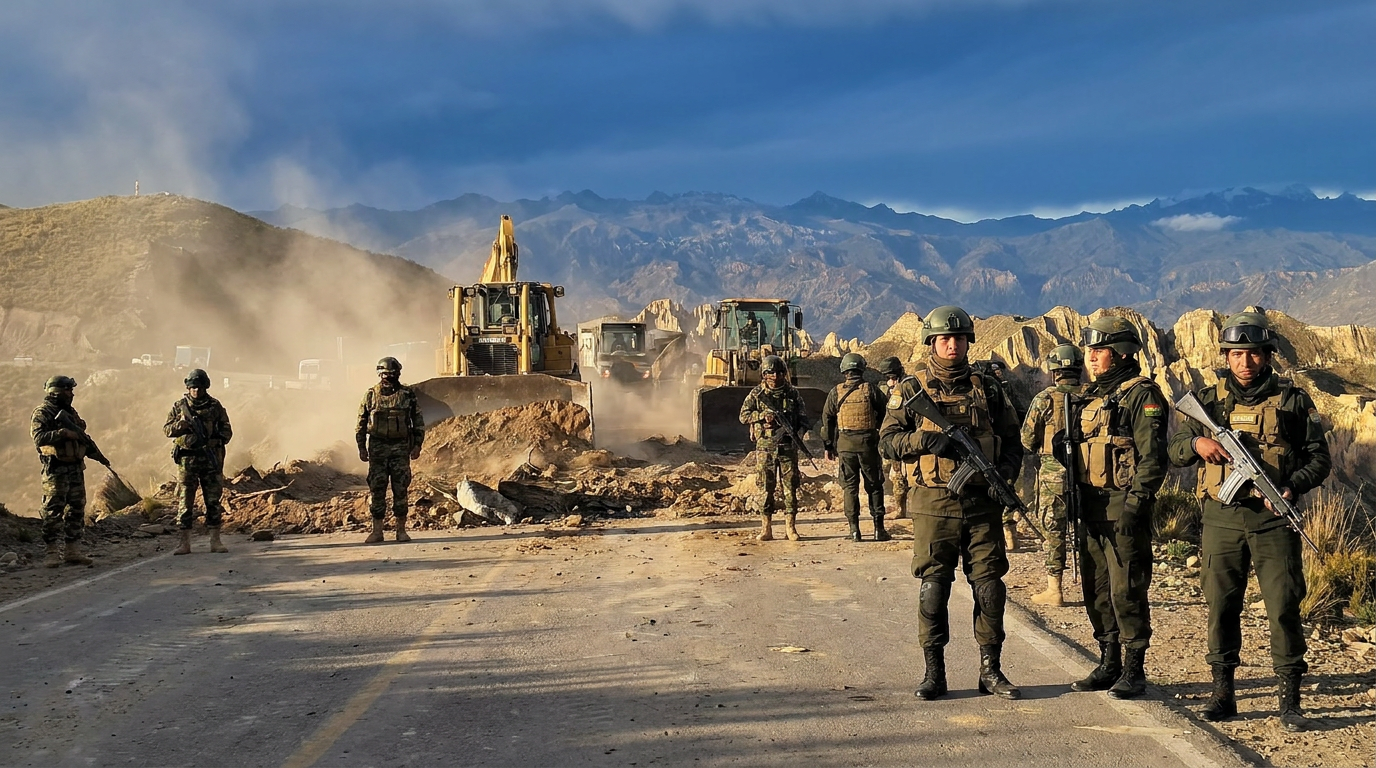
Bolivian President Declares State of Emergency, Deploys Military to Clear Protest Blockades
6 sources
U.S.-Iran Talks
Inside the High-Stakes U.S.-Iran Peace Talks in Switzerland
7 sources
Every angle. Every day.
Get news politics stories with full source coverage and perspective breakdowns delivered to your inbox.