
Smart Ring vs. Smartwatch: Which Health Tracker Fits Your Life in 2026?
As smart rings match smartwatches in biometric accuracy, choosing the right wearable comes down to whether you need an active digital companion or a passive health observer.
By Factlen Editorial Team
- Passive Trackers
- Advocates for invisible, continuous health monitoring without digital distractions.
- Active Performers
- Athletes who require real-time data, GPS, and pacing to optimize their training.
- Hybrid Adopters
- Users who wear both devices to capture the strengths of each form factor.
What's not represented
- · Medical professionals evaluating the clinical utility of consumer wearable data
- · Budget-conscious consumers priced out of the $300+ wearable market
Why this matters
Wearable technology is a $200 to $800 investment that only works if you actually wear it. Understanding the structural trade-offs between wrist and finger tracking ensures you buy a device that matches your habits, rather than one that ends up abandoned in a drawer.
Key points
- Smart rings offer superior comfort and compliance for overnight sleep tracking.
- Smartwatches remain unmatched for real-time workout feedback and built-in GPS.
- Rings typically boast 4 to 10 days of battery life, while most smartwatches require daily charging.
- Watches offer advanced medical features like ECG and highly specific sleep apnea detection.
- Rings provide a distraction-free, screenless experience for passive health monitoring.
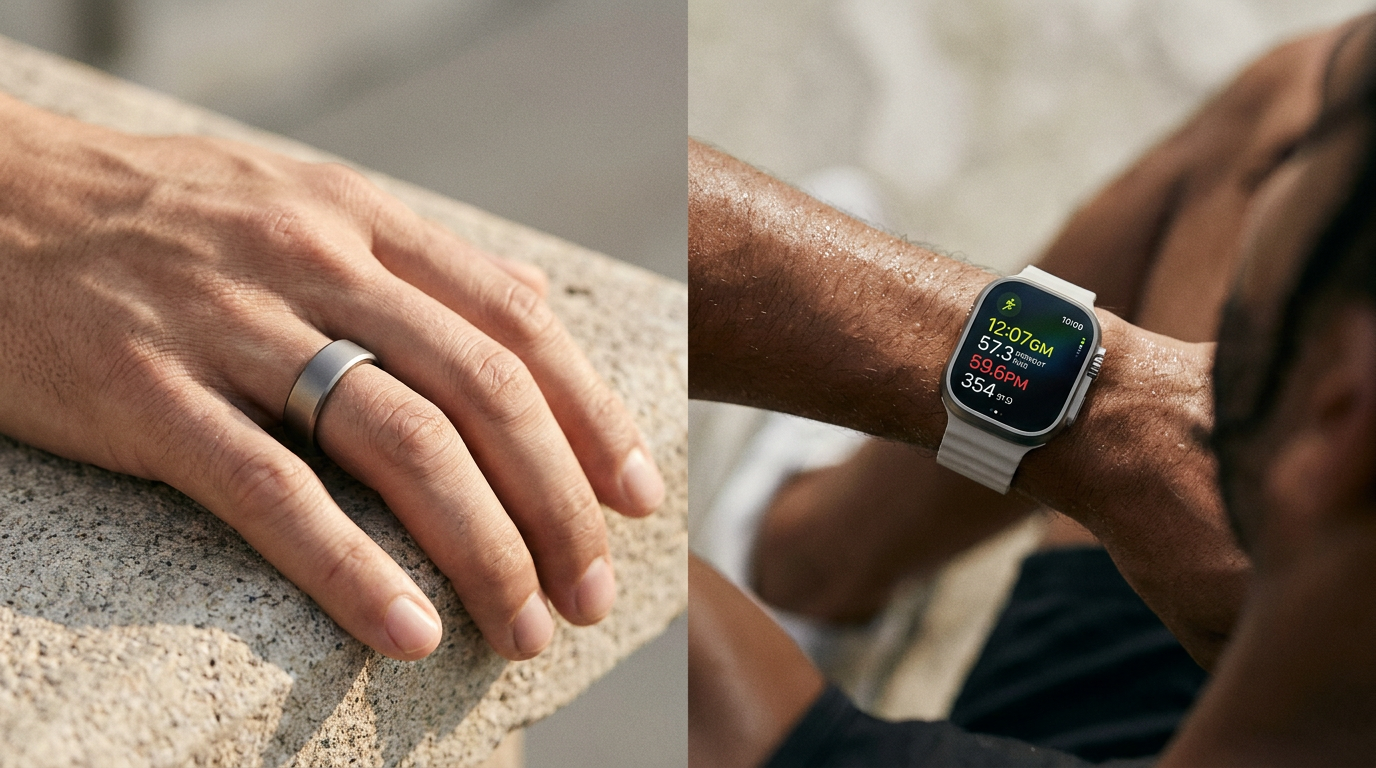
The wearable technology market has officially split into two distinct philosophies in 2026. On one side is the smartwatch, an active digital companion that delivers real-time data, notifications, and GPS tracking directly to your wrist. On the other side is the smart ring, a passive observer that sits quietly on your finger, collecting biometric data around the clock without ever demanding your attention. With heavyweights like the Oura Ring 4 and Samsung Galaxy Ring now matching the health-tracking prowess of the Apple Watch Series 11 and Garmin's fitness lineup, the choice is no longer about which device is objectively better. It is entirely about which form factor fits your daily habits.[3][4][6]
The most significant trade-off between the two devices centers on sleep tracking and overnight comfort. Smart rings hold a massive structural advantage here. Weighing between three and seven grams, a titanium ring is virtually unnoticeable, leading to significantly higher overnight compliance rates. Smartwatches, which typically weigh between 40 and 80 grams, can feel bulky against a pillow, prompting many users to take them off before bed. If a device is sitting on a nightstand, it cannot track your recovery.[5][7]

When evaluating the evidence for sleep accuracy, the anatomy of the finger provides a distinct edge. The arteries in the finger are closer to the skin's surface and feature a denser capillary network than the wrist, giving the ring's photoplethysmography sensors a cleaner signal with less ambient noise. Clinical data shows the Oura Ring boasts a 79.5 percent sensitivity for detecting deep sleep, an area where wrist-based trackers often struggle by confusing deep sleep with light sleep. However, the Apple Watch remains incredibly precise at detecting exact moments of wakefulness, capturing brief midnight disruptions that rings sometimes miss.[1][6]
The argument flips entirely when analyzing active workout tracking. During exercise, smartwatches are the undisputed champions. A smartwatch provides real-time heart rate zones, pacing metrics, and built-in GPS for mapping runs without a phone. The physical design of a watch strap also allows it to be tightened during vigorous movement, keeping the sensor flush against the skin. Smart rings lack screens for live feedback and can be thrown off by activities like weightlifting, where gripping a cold, heavy barbell shifts the ring and disrupts the sensor's reading.[2][6]

Battery life presents another major point of friction. Because they lack screens and GPS antennas, modern smart rings sip power. Devices like the Samsung Galaxy Ring and Oura Ring 4 easily last between four and eight days on a single charge, while the RingConn Gen 2 pushes past ten days. Conversely, feature-rich smartwatches like the Apple Watch often require daily charging. This creates a logistical hurdle for 24/7 health tracking, as users must find a dedicated window to charge their watch, often sacrificing either daytime activity data or nighttime sleep metrics.[3][4][7]
Because they lack screens and GPS antennas, modern smart rings sip power.
When it comes to advanced medical diagnostics, smartwatches still carry heavier clinical credentials. Higher-end Apple Watch and Samsung Galaxy Watch models feature electrocardiogram capabilities that can detect atrial fibrillation, a potentially life-saving feature that rings cannot currently replicate. Furthermore, the Apple Watch's sleep apnea detection algorithm has demonstrated a remarkable 98.5 percent specificity in clinical trials. While smart rings excel at tracking baseline temperature shifts and overnight heart rate variability to predict illness or measure recovery, they serve more as holistic wellness coaches than diagnostic medical tools.[1][5]
Cost and long-term ownership models also diverge sharply. Smartwatches require a higher upfront investment, typically ranging from $200 to $800, but rarely lock basic health data behind paywalls. Smart rings generally cost between $200 and $400 upfront, but some models, most notably Oura, require a monthly subscription fee of around $6 to access detailed insights. However, the market is shifting in 2026, with the Samsung Galaxy Ring and RingConn offering comprehensive data without ongoing subscription costs, making the long-term financial comparison much tighter.[2][3][4]
Ultimately, a smart ring fits well when your primary goals are sleep optimization, recovery tracking, and long-term health awareness. It is the perfect choice for data-driven users who want biometric insights without the distraction of a screen, or for traditionalists who prefer wearing a classic mechanical watch on their wrist. It provides a seamless, set-it-and-forget-it approach to wellness that integrates invisibly into daily life.[6][7]
Conversely, a smart ring does not fit well when you are a dedicated athlete who needs real-time pacing, GPS route tracking, or interval timers. It is also a poor choice for heavy weightlifters whose grip might scratch the titanium or disrupt the sensors. If you want to leave your phone at home during a run but still stream music and track your route, a ring simply cannot accommodate those needs.[2][6]

A smartwatch fits well when you want an all-in-one digital command center. It is ideal for runners, cyclists, and fitness enthusiasts who rely on live feedback to adjust their effort mid-workout. It also serves users who value smart features like wrist-based payments, quick text replies, and safety features like fall detection and ECG readings.[1][2][7]
A smartwatch does not fit well when you suffer from sleep sensory issues and cannot tolerate bulk on your wrist overnight. It is also a frustrating choice for users who despise daily charging routines or those who find constant notifications detrimental to their mental focus. For many, the ultimate 2026 solution is a hybrid approach: wearing a Garmin or Apple Watch during the day for active tracking, and switching to an Oura or Galaxy Ring at night for unparalleled sleep data.[1][6][7]
Viewpoints in depth
Passive Trackers
Users who prioritize invisible, continuous health monitoring without digital distractions.
This camp values the 'set it and forget it' nature of smart rings. They argue that the best health data comes from a device you never have to take off, pointing to the high compliance rates of ring wearers. For these users, the lack of a screen is a feature, not a bug, as it prevents the anxiety of constant notifications and allows them to focus purely on morning readiness scores and long-term recovery trends.
Active Performers
Athletes and fitness enthusiasts who require real-time data to optimize their training.
For runners, cyclists, and gym-goers, health tracking is an active pursuit. This perspective argues that a wearable must provide actionable feedback in the moment—such as heart rate zones during a sprint or GPS pacing on a trail. They view smart rings as incomplete tools because they cannot guide a workout or allow a user to leave their smartphone at home during exercise.
Hybrid Adopters
Users who wear both devices to capture the strengths of each form factor.
A growing segment of the market refuses to compromise, utilizing a smartwatch during the day for connectivity and workout tracking, and switching to a smart ring at night for frictionless sleep monitoring. Industry data notes that up to 40 percent of Oura Ring users also own an Apple Watch, highlighting that for those with the budget, the devices are complementary rather than strictly competitive.
What we don't know
- How quickly smart ring manufacturers will be able to miniaturize advanced sensors like ECGs to fit on a finger.
- Whether the industry will standardize subscription models or move entirely toward free data access like Samsung and RingConn.
Key terms
- Photoplethysmography (PPG)
- An optical sensor technology that uses light to measure changes in blood volume, commonly used in wearables to track heart rate.
- Heart Rate Variability (HRV)
- The variation in time between consecutive heartbeats, used by wearables as a key indicator of physical recovery and stress levels.
- SpO2
- An estimate of the oxygen saturation level in your blood, often tracked overnight to detect breathing disturbances.
Frequently asked
Are smart rings more accurate than smartwatches?
Smart rings are generally more accurate for resting metrics like sleep stages and overnight heart rate due to the finger's dense capillaries. Smartwatches are more accurate during active workouts because they can be strapped tightly to the wrist.
Do all smart rings require a monthly subscription?
No. While the popular Oura Ring requires a monthly fee for full data access, competitors like the Samsung Galaxy Ring and RingConn offer their insights without any ongoing subscription costs.
Can I use a smart ring for running without my phone?
Most smart rings do not have built-in GPS. If you want to track your exact route and distance without carrying a smartphone, a GPS-enabled smartwatch is the necessary choice.
Is a smart ring comfortable to wear while lifting weights?
Many users find smart rings uncomfortable or prone to scratching when gripping heavy metal barbells, making smartwatches or fitness bands a better choice for heavy strength training.
Sources
Source coverage
7 outlets
3 viewpoints surfaced







[1]WareableHybrid Adopters
Oura Ring vs Apple Watch sleep tracking comparison
Read on Wareable →[2]Runner's WorldActive Performers
I trained for an ultra with the Samsung Galaxy Ring — here's why I'm still reaching for my Garmin
Read on Runner's World →[3]PCMagPassive Trackers
The Best Smart Rings for 2026
Read on PCMag →[4]ForbesPassive Trackers
The Best Smart Rings, Tested By A Tech Editor
Read on Forbes →[5]Woman & HomeActive Performers
Oura Ring vs Apple Watch: Which is the best sleep tracker?
Read on Woman & Home →[6]AskVoraHybrid Adopters
Smart Ring vs Smartwatch: Ultimate Comparison 2026
Read on AskVora →[7]JointCorpHybrid Adopters
Smart Ring vs Fitness Tracker vs Smartwatch
Read on JointCorp →


Every angle. Every day.
Get shopping stories with full source coverage and perspective breakdowns delivered to your inbox.