
The Chemistry of the Perfect Chocolate Chip Cookie
Baking is an exercise in edible chemistry, where precise ratios of fats, sugars, and proteins dictate whether a cookie becomes thin and crispy or thick and chewy.
By Factlen Editorial Team
- Texture Maximizers
- Bakers focused on manipulating gluten and hydration to achieve the perfect physical bite.
- Flavor Chemists
- Food scientists who prioritize complex flavor development through thermal reactions and resting times.
- Dietary Adapters
- Bakers who deconstruct the traditional chemistry to substitute ingredients for vegan or allergy-friendly diets.
- Home Baking Educators
- Instructors focused on teaching the fundamentals of leavening, sugars, and fats to everyday cooks.
What's not represented
- · Commercial cookie manufacturers scaling these reactions for mass production
Why this matters
Understanding the chemistry behind baking transforms a rigid recipe into a flexible formula. By mastering how fats, sugars, and proteins react to heat, home cooks can manipulate variables to engineer their perfect cookie—whether they prefer it thin and crispy, or thick and chewy.
Key points
- Baking a chocolate chip cookie is a precise sequence of chemical reactions, primarily driven by the Maillard reaction and caramelization.
- The ratio of white to brown sugar dictates the texture, with white sugar providing crispness and brown sugar adding moisture and chewiness.
- Resting cookie dough for 24 to 72 hours allows enzymes to break down starches, significantly enhancing browning and flavor.
- Using bread flour instead of all-purpose flour increases gluten development, resulting in a denser, chewier cookie.
- The physical structure of the cookie sets at 144°F when egg proteins coagulate, halting the spread of the melting butter.
The chocolate chip cookie is a staple of home kitchens worldwide, often viewed as a simple, comforting treat. But beneath the surface of a warm, gooey cookie lies a complex sequence of chemical reactions. Baking is not merely cooking; it is an exercise in edible chemistry where precise ratios and thermal dynamics dictate the final outcome. The transformation from a pale, dense mound of raw dough into a complex, caramelized disc relies on a specific sequence of structural changes, protein coagulation, and flavor development.[8]
The foundation of any classic cookie is its fat source, almost universally butter. Butter is not a single ingredient but an emulsion—a delicate mixture of butterfat, water, and milk proteins that naturally resist combining. When butter is creamed with sugar, the friction punches microscopic air pockets into the fat. These tiny pockets are crucial, as they provide the physical space for leavening gases to expand later in the oven.[5][6]
Food scientists and meticulous bakers often take the butter a step further by browning it before mixing. Heating the butter until the water evaporates allows the milk solids to toast. This kickstarts the Maillard reaction before the dough is even formed, infusing the fat with deep, nutty, butterscotch notes that elevate the final flavor profile far beyond what raw butter can achieve.[1]
Once the fat is prepared, the sugars are introduced. Most recipes call for a combination of white granulated sugar and brown sugar, and the ratio between the two fundamentally alters the cookie's architecture. White sugar is pure crystallized sucrose. As it melts in the oven and subsequently cools, it recrystallizes, which is the primary driver of a cookie's crisp, snappy edges.[4][7]
Brown sugar, on the other hand, contains molasses. This addition brings two critical elements to the dough: moisture and acidity. The extra moisture binds to the flour, preventing the cookie from drying out and resulting in a chewier center. Meanwhile, the slight acidity of the molasses is necessary to activate the baking soda, creating the carbon dioxide bubbles that give the cookie its rise.[4][6]

The eggs act as the primary binding agent, but their individual components play vastly different roles in the dough's chemistry. Egg yolks are rich in fat and natural emulsifiers, which coat the flour proteins and yield a denser, fudgier texture. Egg whites, conversely, are packed with protein and water. They provide structural support but can dry out the crumb if used in excess, making the balance of whole eggs to extra yolks a key variable for texture maximizers.[6][7]
Flour provides the scaffolding for the entire structure through the development of gluten—a strong network of proteins formed when wheat flour mixes with water. While all-purpose flour is the standard choice, the protein content of the flour directly correlates to the cookie's chewiness. Swapping in high-protein bread flour increases gluten development, resulting in a significantly chewier bite, whereas low-protein cake flour yields a delicate, tender crumb.[1][4]

Flour provides the scaffolding for the entire structure through the development of gluten—a strong network of proteins formed when wheat flour mixes with water.
Leavening agents dictate how the cookie spreads and rises. Baking soda (sodium bicarbonate) is a base that requires an acidic counterpart—like brown sugar—to react. When activated, it produces gas that lifts the dough. Baking powder, however, contains its own acid and reacts twice: once when it hits moisture, and again when it hits the heat of the oven, generally resulting in a puffier, more cake-like cookie.[5][6]
One of the most critical, yet frequently skipped, steps in cookie science is resting the dough. Chilling the dough in the refrigerator for 24 to 72 hours allows the flour to fully hydrate from the moisture in the eggs and butter. This hydration prevents the cookie from spreading too rapidly when it hits the hot oven, ensuring a thicker final product.[1][3]
More importantly, resting the dough initiates a slow enzymatic breakdown. Over a period of days, enzymes naturally present in the flour break down complex starches into simple carbohydrates. These simple sugars are highly reactive, meaning a rested dough will brown faster and more evenly in the oven, developing a richer, more complex flavor profile than dough baked immediately after mixing.[1][3]

The climax of the chemical process occurs when the chilled dough enters a 350°F oven. As the dough's internal temperature reaches 92°F, the butter begins to melt. The emulsion breaks, releasing trapped water, and the dough slackens, causing the cookie to spread outward across the hot baking sheet.[3]
As the temperature climbs to 144°F, the structural changes begin to lock into place. The proteins from the eggs coagulate and the starches from the flour gelatinize. This sets the physical shape of the cookie, halting the spread and finalizing the boundary between the thicker center and the thinner edges.[3]
The true magic of baking happens as the surface temperature of the cookie surpasses 300°F, triggering the Maillard reaction. This complex chemical process occurs when amino acids (from the flour and eggs) collide with reducing sugars under high heat. The reaction cascades, forming hundreds of new, highly aromatic flavor compounds that taste toasty, nutty, and savory.[2][3]
Shortly after the Maillard reaction begins, caramelization takes over at around 356°F. Unlike the Maillard reaction, caramelization involves only the sugars, which break down under intense heat to create sweet, slightly bitter, and complex aromatic notes. Because the edges of the cookie are thinner, they reach this temperature first, developing a golden-brown crust while the thicker center remains insulated and soft.[2][3]

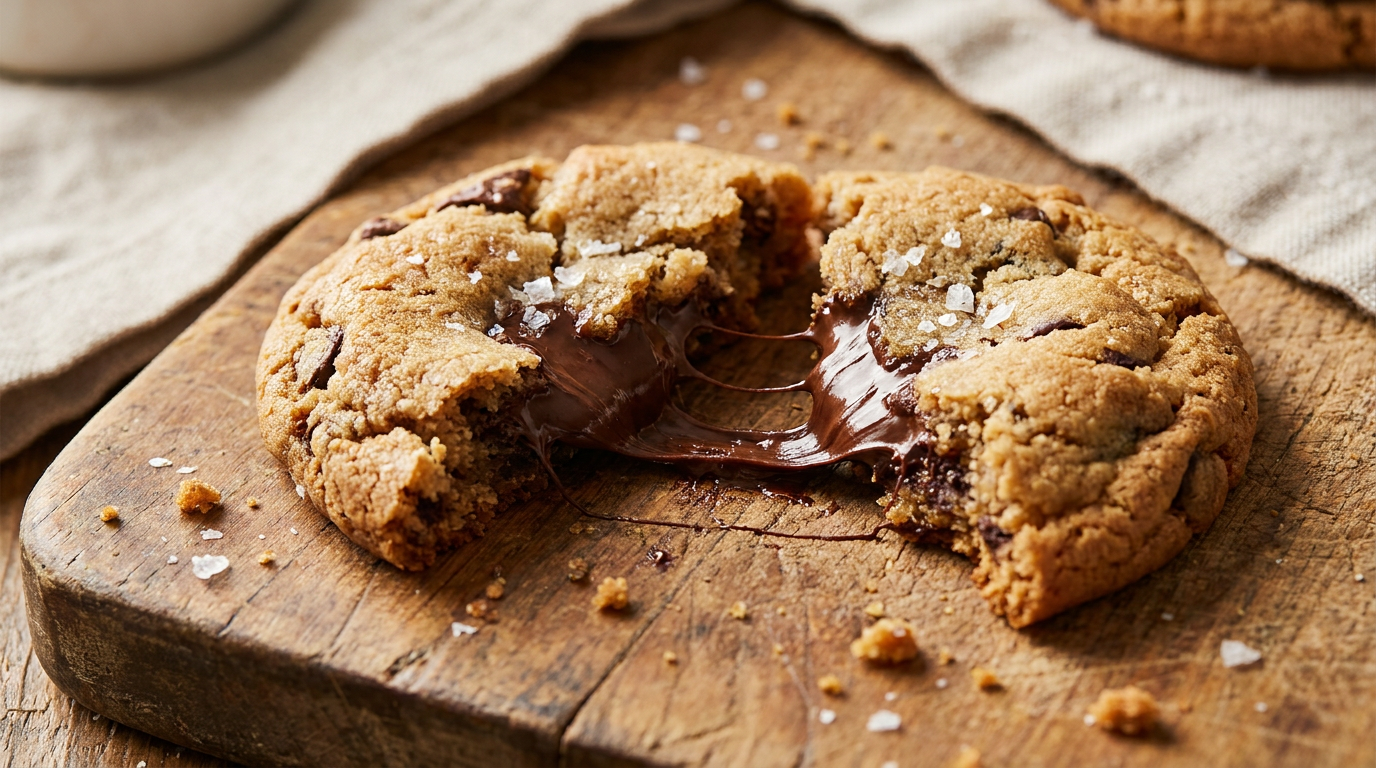
The chemical reactions do not stop the moment the cookies are pulled from the oven. As the cookies cool on the baking sheet, the liquified sugars begin to harden into a crystalline structure. The trapped steam dissipates, causing the puffed center to deflate slightly, ultimately achieving the coveted textural contrast: a crispy, caramelized edge giving way to a dense, chewy, and gooey center.[3]
How we got here
Mixing
Creaming butter and sugar traps microscopic air pockets that provide the initial structure.
Resting (24-72h)
Flour hydrates and enzymes break down complex starches into simple sugars for better browning.
92°F (Oven)
Butter melts, causing the dough to slacken and spread outward.
144°F (Oven)
Egg proteins and starches begin to set, finalizing the physical shape of the cookie.
300°F+ (Oven)
The Maillard reaction and caramelization occur, creating complex flavor compounds and a golden crust.
Viewpoints in depth
Texture Maximizers
Bakers focused on manipulating gluten and hydration to achieve the perfect physical bite.
This camp views the cookie primarily as a structural engineering challenge. By swapping standard all-purpose flour for high-protein bread flour, they increase gluten development to maximize chewiness. They also advocate for altering the egg ratio—specifically adding extra yolks—to increase the fat content and emulsifiers, yielding a denser, fudgier center while relying on white sugar to maintain a crisp outer edge.
Flavor Chemists
Food scientists who prioritize complex flavor development through thermal reactions and resting times.
For these experts, the baking process begins long before the oven. They champion techniques like browning the butter to pre-initiate the Maillard reaction in the milk solids, adding deep nutty notes. Furthermore, they insist on resting the dough for up to 72 hours, allowing enzymes to break down complex starches into simple sugars, which dramatically enhances browning and creates a rich, butterscotch flavor profile that cannot be achieved with freshly mixed dough.
Dietary Adapters
Bakers who deconstruct the traditional chemistry to substitute ingredients for vegan or allergy-friendly diets.
This perspective relies on understanding the exact chemical role of traditional ingredients to find suitable plant-based replacements. Because vegan butter often has a higher water content, these bakers must adjust flour ratios to prevent excessive spreading. They replace the binding and moisture-retaining properties of eggs with flaxseed meal or applesauce, carefully balancing the moisture to ensure the Maillard reaction can still occur without the animal proteins.
What we don't know
- While the Maillard reaction is well-documented, the exact combination of the hundreds of flavor compounds it produces in a specific cookie recipe remains highly variable and difficult to perfectly replicate.
- The precise impact of different regional butterfat percentages (e.g., European vs. American butter) on the emulsion breakdown in home ovens is still debated among baking purists.
Key terms
- Maillard Reaction
- A chemical reaction between amino acids and reducing sugars under heat that creates browned, complex, and savory flavors.
- Caramelization
- The thermal breakdown of sugar molecules at high heat, resulting in sweet, nutty, and slightly bitter flavor compounds.
- Emulsion
- A mixture of two liquids that normally do not combine, such as the water and butterfat found in butter.
- Gluten
- A network of proteins formed when wheat flour is mixed with water, providing structure and chewiness to baked goods.
- Creaming
- The process of vigorously mixing solid fat and sugar together to trap microscopic air bubbles, which helps the dough rise.
Frequently asked
Why do my cookies always come out flat?
Flat cookies usually result from butter that is too warm, too little flour, or baking on hot cookie sheets. Chilling the dough prevents premature spreading in the oven.
Can I substitute baking powder for baking soda?
Not directly. Baking soda requires an acid (like brown sugar) to activate, while baking powder contains its own acid. Swapping them alters the cookie's spread and flavor.
What does resting the dough actually do?
Resting allows the flour to fully hydrate and enzymes to break down starches into simple sugars, resulting in a chewier texture and a richer, butterscotch-like flavor.
Why use bread flour in cookies?
Bread flour has a higher protein content than all-purpose flour, which creates more gluten development. This results in a chewier, denser cookie.
Sources
Source coverage
8 outlets
4 viewpoints surfaced








[1]Serious EatsFlavor Chemists
The Science of the Best Chocolate Chip Cookies
Read on Serious Eats →[2]WikipediaFlavor Chemists
Maillard reaction
Read on Wikipedia →[3]Redpath SugarFlavor Chemists
The Science of Cookies
Read on Redpath Sugar →[4]The Bake SchoolTexture Maximizers
The Science of Chocolate Chip Cookies
Read on The Bake School →[5]Cravings of a Food ScientistHome Baking Educators
The (Food) Science of Chocolate Chip Cookies
Read on Cravings of a Food Scientist →[6]Let's Lasso the MoonHome Baking Educators
Cookie Science: How to Make Perfect Chocolate Chip Cookies
Read on Let's Lasso the Moon →[7]Enjoy Life FoodsDietary Adapters
Baking Science: Perfecting the Chocolate Chip Cookie
Read on Enjoy Life Foods →[8]Factlen Editorial Team
Synthesis by Factlen editorial team
Read on Factlen Editorial Team →

Every angle. Every day.
Get food drink stories with full source coverage and perspective breakdowns delivered to your inbox.