
LIRR Unions Ratify Contract Securing 15% Raises, Officially Ending Historic Strike Threat
The five Long Island Rail Road unions that shut down the nation's largest commuter rail network in May have formally ratified a four-year contract. The agreement secures 15% wage increases while avoiding immediate fare hikes, sending the deal to the MTA board for final approval.
By Factlen Editorial Team
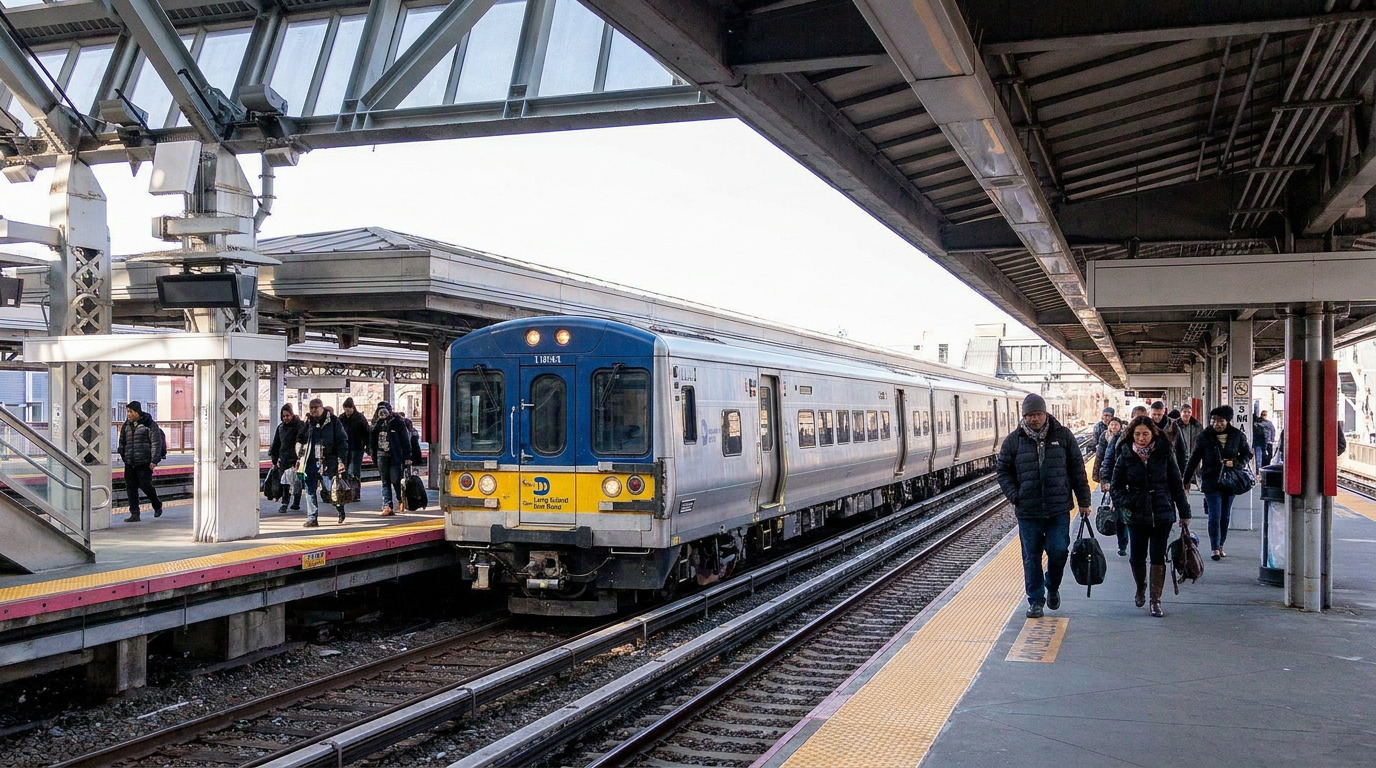
- LIRR Union Workers
- Argued the strike was necessary to secure inflation-matching wages after years without a contract.
- MTA & State Leadership
- Focused on protecting the transit budget and avoiding fare hikes while delivering raises.
- Regional Commuters
- Bore the brunt of the transit shutdown and prioritized the rapid restoration of reliable service.
What's not represented
- · Non-union MTA employees
- · Local Long Island business owners
Why this matters
The ratification permanently resolves a labor dispute that paralyzed North America's busiest commuter rail network in May. The 15% wage increase sets a new baseline for upcoming transit negotiations across the region, while the MTA's extraction of work-rule concessions signals a harder line from state officials against transit budget deficits.
Key points
- Five LIRR unions have officially ratified a four-year contract, ending the labor dispute that caused a three-day strike in May.
- The agreement provides workers with a cumulative 15% wage increase over four years, plus a $3,000 lump-sum payment.
- The MTA secured work-rule concessions, including unpaid off-hours computer training, to help offset the cost of the raises.
- The MTA board is expected to grant final approval to the ratified contract on Wednesday.
The labor dispute that brought North America's busiest commuter railroad to a standstill last month is officially over. The five Long Island Rail Road (LIRR) unions that walked off the job in mid-May have formally ratified a new four-year contract, securing cumulative wage increases of approximately 15%. The final hurdle in the contentious negotiation process was cleared late last week when the Brotherhood of Locomotive Engineers and Trainmen (BLET) voted 432 to 9 in favor of the agreement, sending the comprehensive package to the Metropolitan Transportation Authority (MTA) board for final authorization this Wednesday.[1]
The ratification permanently lifts the threat of further work stoppages for the roughly 300,000 daily riders who rely on the LIRR to commute between New York City and its sprawling eastern suburbs. The dispute boiled over on May 16, when 3,500 unionized workers—representing about half of the LIRR's organized workforce—initiated the railroad's first strike in 32 years. The walkout included locomotive engineers, signalmen, machinists, and electrical workers, effectively halting all train movement across the vast network and forcing the region into a state of logistical emergency.[1][2][3][4]
For three chaotic days, the strike paralyzed the regional transit network. Commuters were forced onto crowded MTA shuttle buses or into their personal vehicles, causing massive traffic congestion across major New York highways and bridges. The walkout followed months of stalled negotiations and the expiration of a federally mandated cooling-off period, with workers demanding compensation that kept pace with historic inflation after working without a contract since 2022. State officials had attempted to mediate the dispute, but the two sides remained too far apart on fourth-year wage figures to avert the shutdown.[3][4][5]
Under the newly ratified terms, workers will receive annual raises averaging 3.5% over the four-year life of the contract, which is applied retroactively to 2023. Specifically, the deal outlines 3% raises for the first two years, a 3.5% bump in the third year, and a significant 4.5% increase in the final year. The agreement also includes a $3,000 lump-sum payment for the striking workers, providing an immediate injection of cash to offset the years spent negotiating at stagnant wage levels.[1][6]

Union leadership framed the outcome as a major victory for organized labor and a testament to the power of cross-union solidarity. Transportation Communications Union vice president Nicholas Peluso expressed regret for the commuter disruptions but maintained that the MTA had forced their hand by initially refusing to offer raises that matched the rising cost of living in the New York metropolitan area. Teamsters General President Sean M. O'Brien praised the LIRR workers following the tentative agreement, stating that the five unions had shown the entire country what worker solidarity looks like in action.[1][3][4]
Union leadership framed the outcome as a major victory for organized labor and a testament to the power of cross-union solidarity.
On the management side, the MTA and New York Governor Kathy Hochul are claiming a fiscal victory, noting that the deal was carefully structured to avoid triggering steep fare hikes or tax increases for Long Island residents. MTA Chair Janno Lieber emphasized that the agency's primary goal was to deliver fair compensation to essential workers without blowing the MTA budget, a delicate financial balance he asserts the final contract successfully achieves despite the higher-than-budgeted fourth-year wage increase.[1][2][6]
To offset the higher wages, the MTA extracted several notable concessions from the unions that management had been pursuing for years. The agreement includes a six-week contract extension and a strict mandate that workers undergo mandatory computer training outside of their regular paid hours. This specific work-rule change is designed to significantly reduce the agency's exorbitant overtime expenditures, which have long been a point of contention for fiscal watchdogs monitoring the MTA's heavily subsidized operating budget.[1][6]

Political analysts note that the strike posed a significant test for Governor Hochul, who opted to weather a three-day transit shutdown rather than immediately capitulate to union demands ahead of an election cycle. Unlike the 2014 LIRR labor dispute, where the state government folded prior to a walkout, Hochul's administration held the line to secure the work-rule changes that management required to justify the 15% wage bump. This measured victory signals a potentially harder line from Albany regarding public-sector union negotiations moving forward.[6]
The resolution of the LIRR strike is expected to have immediate ripple effects across the broader New York transit ecosystem. The 4.5% raise in the contract's final year establishes a new high-water mark that will likely serve as the starting point for the MTA's other looming labor negotiations. Most notably, the massive contract between the New York City Transit Authority and Transport Workers Union Local 100 recently expired, setting the stage for another high-stakes bargaining period where subway and bus workers will undoubtedly point to the LIRR deal as a baseline.[6]
For now, Long Island commuters are expressing profound relief that the summer will proceed without the looming threat of transit chaos. Riders who endured the grueling shuttle bus lines in May can now rely on fully restored, hourly service across the Babylon, Huntington, Ronkonkoma, and Port Washington branches. With the picket lines dismantled and the ballots cast, the MTA board's expected approval on Wednesday will officially close one of the most disruptive chapters in New York's recent labor history.[1][3]
How we got here
2022
The previous contract for LIRR conductors and maintenance workers expires.
March 2026
A second presidential emergency board extends the mandatory cooling-off period by 60 days, temporarily averting a strike.
May 16, 2026
Five LIRR unions walk off the job, initiating the railroad's first strike since 1994.
May 18, 2026
The MTA and union leaders reach a tentative agreement, ending the three-day work stoppage.
June 18, 2026
The Brotherhood of Locomotive Engineers and Trainmen becomes the final union to ratify the contract.
Viewpoints in depth
LIRR Union Workers
The striking unions argued that the walkout was a necessary last resort to secure fair wages after years of working without a contract.
Labor leaders emphasized that their members had kept the region moving through the pandemic and subsequent inflation spikes, yet had not received a raise since 2022. By coordinating a joint walkout across five different unions—including locomotive engineers, signalmen, and machinists—they maximized their leverage. Union officials maintain that the MTA's initial offers failed to reflect the skill and sacrifice required to operate the nation's busiest commuter rail, making the three-day strike an unavoidable step to secure the 15% cumulative wage increase.
MTA & State Leadership
Transit officials focused on balancing fair compensation with the long-term fiscal health of the transit system.
Governor Kathy Hochul and MTA Chair Janno Lieber took a hardline stance against demands they believed would bankrupt the agency or force an 8% fare hike on riders. By enduring a three-day shutdown rather than capitulating immediately, management successfully extracted long-sought concessions, such as unpaid off-hours computer training to curb overtime abuse. Officials view the final agreement as a fiscally responsible compromise that rewards workers without passing unsustainable costs onto taxpayers.
Regional Commuters
Riders bore the brunt of the disruption and are primarily relieved by the return of stable service.
For the 300,000 daily passengers who rely on the LIRR, the strike was a logistical nightmare that forced them onto limited shuttle buses or into gridlocked highway traffic. While many commuters expressed sympathy for the workers' desire for better pay, the overriding sentiment was frustration at being caught in the middle of a political and financial standoff. The ratification brings immense relief to the region's workforce and businesses, who feared a prolonged summer of transit chaos.
What we don't know
- It remains unclear exactly how the 4.5% fourth-year raise will impact the MTA's long-term operating budget, despite assurances that fare hikes will be avoided.
- It is unknown how heavily the LIRR agreement will influence the ongoing contract negotiations between the MTA and the much larger Transport Workers Union Local 100.
Key terms
- Metropolitan Transportation Authority (MTA)
- The public benefit corporation responsible for public transportation in the New York City metropolitan area, including the LIRR.
- Brotherhood of Locomotive Engineers and Trainmen (BLET)
- The labor union representing the train operators and engineers who drive the LIRR trains.
- Cooling-off period
- A legally mandated timeframe under the Railway Labor Act during which unions cannot strike and management cannot lock out workers, designed to force continued mediation.
Frequently asked
How much of a raise are the LIRR workers getting?
The ratified contract provides a cumulative wage increase of approximately 15% over four years, plus a $3,000 lump-sum payment.
Will the new contract cause LIRR fares to go up?
MTA officials state that the deal was structured to fit within their budget, avoiding the need for steep fare hikes or tax increases to cover the raises.
What concessions did the unions make?
Workers agreed to a six-week contract extension and mandatory computer training outside of paid work hours, which the MTA says will save on overtime costs.
Sources
Source coverage
6 outlets
3 viewpoints surfaced





[1]NewsdayLIRR Union Workers
5 LIRR unions that went on strike ratify contract with 15% raises over 4 years
Read on Newsday →[2]CBS NewsMTA & State Leadership
The Long Island Rail Road strike is over after the Metropolitan Transportation Authority and unions reached a tentative agreement
Read on CBS News →[3]Fox 5 NYLIRR Union Workers
LIRR strike update: Deal details, service schedule
Read on Fox 5 NY →[4]The GuardianRegional Commuters
Workers at the Long Island Rail Road, serving the eastern New York metropolitan area, walked off the job
Read on The Guardian →[5]TIMERegional Commuters
What to Know About the Long Island Rail Road Strike
Read on TIME →[6]City JournalMTA & State Leadership
Hochul's Measured Victory in the LIRR Strike
Read on City Journal →



Every angle. Every day.
Get news politics stories with full source coverage and perspective breakdowns delivered to your inbox.