
Induction vs. Gas Cooktops: The 2026 Efficiency, Health, and Cost Comparison
As health concerns and energy costs reshape kitchen upgrades, induction technology offers superior efficiency and safety, while gas remains a lower-cost, familiar staple. Here is how the two compare on performance, air quality, and long-term value.
By Factlen Editorial Team
- Electrification & Health Advocates
- Prioritizes indoor air quality, decarbonization, and thermodynamic efficiency, arguing that gas combustion is an outdated health hazard.
- Traditional Culinary Enthusiasts
- Values the tactile control, visual feedback, and universal cookware compatibility of an open flame.
- Practical Remodelers
- Focuses on the immediate financial hurdles of kitchen upgrades, noting that older homes often require expensive electrical panel overhauls to support induction.
What's not represented
- · Renters who cannot modify their apartment's infrastructure
- · Professional restaurant owners managing commercial kitchen overhead
Why this matters
Choosing a cooktop is a decade-long infrastructure decision that directly impacts your household's indoor air quality, daily energy bills, and cooking speed. Understanding the precise trade-offs between magnetic induction and gas combustion prevents costly renovation mistakes.
Key points
- Induction cooktops use electromagnetic fields to heat pans directly, achieving 84-90% energy efficiency.
- Gas ranges lose over half their heat to the surrounding air but offer intuitive visual flame control.
- Studies link gas stove emissions, including nitrogen dioxide and benzene, to increased risks of respiratory issues.
- Switching to induction often requires a dedicated 240-volt electrical circuit, adding to the upfront installation cost.
- Induction requires magnetic cookware, rendering aluminum and pure copper pans incompatible.
The American kitchen is undergoing a quiet but profound infrastructure shift in 2026. For decades, the blue flame of a gas range was the undisputed symbol of a serious home chef, while electric coils were relegated to budget apartments. Today, magnetic induction has matured from a niche premium product into a thermodynamically superior cooking method that is fundamentally challenging the dominance of gas. As homeowners weigh renovations, the decision between induction and gas has escalated from a simple culinary preference to a complex calculation involving public health, energy efficiency, and upfront electrical costs.[1][2]
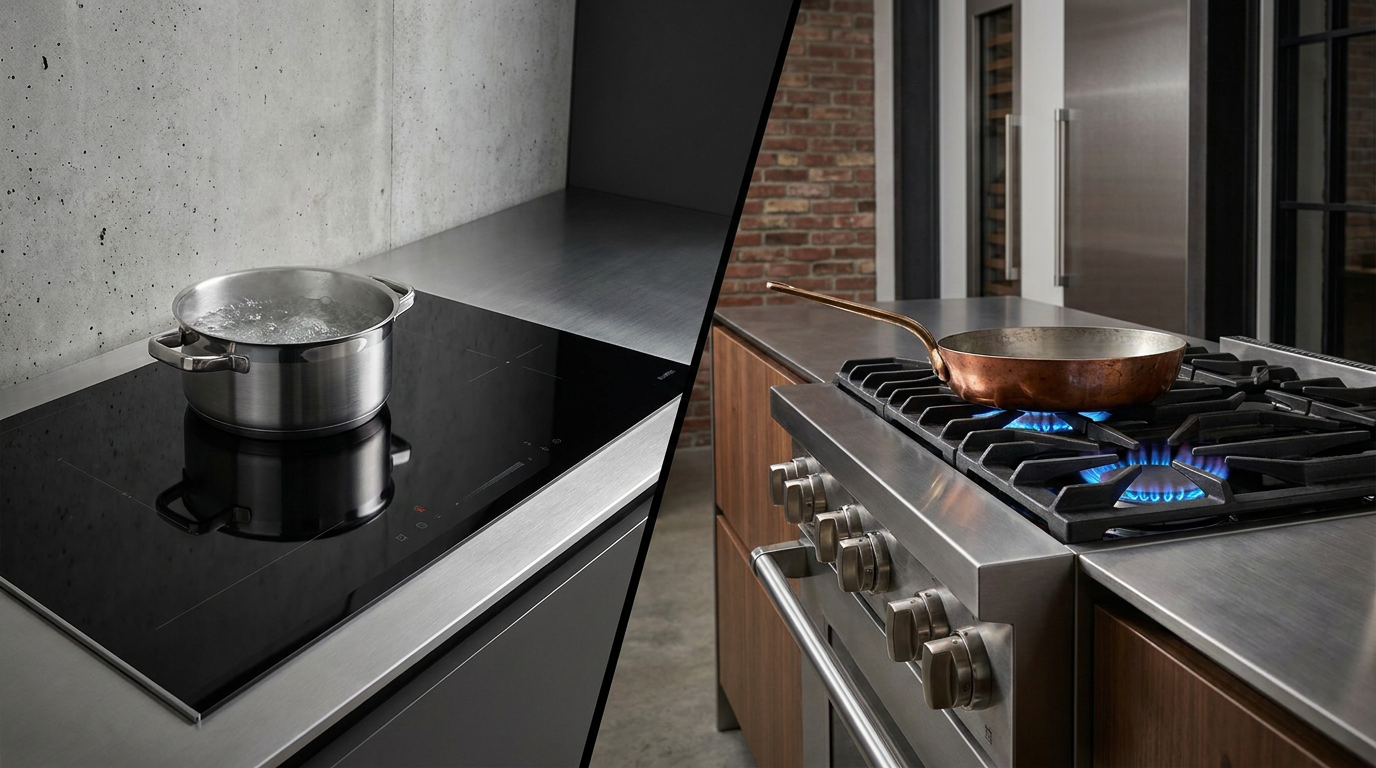
To understand the trade-offs, one must first look at how the heat is generated. Gas cooktops rely on the combustion of natural gas or propane to create an open flame, which then heats the air around the base of a pan. Induction, by contrast, uses copper coils beneath a glass-ceramic surface to generate a rapidly oscillating electromagnetic field. When a compatible ferrous pan is placed on the surface, this field induces electrical currents directly within the metal of the cookware, turning the pan itself into the heater. This fundamental difference in physics drives every subsequent advantage and disadvantage between the two platforms.[2][4]
The most striking divergence between the two technologies lies in energy efficiency and speed. The argument for induction centers on its near-total elimination of wasted heat; evidence from industry testing shows induction converts 84 to 90 percent of its energy into usable cooking heat. The argument against gas in this category is its massive thermal loss, as it manages only 32 to 40 percent efficiency, bleeding the majority of its heat into the surrounding kitchen air. Consequently, induction boils water and completes high-heat tasks up to 40 percent faster than comparable gas burners, saving the average household dozens of hours annually while keeping the kitchen significantly cooler during summer months.[2][3][4]

The debate over indoor air quality has become the primary catalyst for the induction transition. The argument against gas is rooted in respiratory health; peer-reviewed meta-analyses reveal that gas stoves emit nitrogen dioxide, carbon monoxide, and benzene—a known carcinogen—at levels that can exceed outdoor air quality standards. Evidence shows that homes utilizing gas cooking without hospital-grade ventilation face a 42 percent increased risk of childhood asthma. Conversely, the argument for induction is its zero-emission profile. Because there is no combustion, induction cooktops release no harmful byproducts into the home, making them the definitive choice for households prioritizing respiratory health and indoor air quality.[1][2][3]
However, the financial realities of installation present a strong argument for gas, particularly in older homes. Gas cooktops generally boast a lower upfront purchase price, often ranging from $800 to $1,500, and slot easily into kitchens already plumbed for natural gas. The argument against induction is the hidden infrastructure cost; while the units themselves have dropped to between $1,000 and $1,800, homes with older electrical panels may require a dedicated 240-volt circuit. This electrical upgrade can add $200 to $600—or significantly more if a total panel replacement is needed. Yet, evidence suggests induction recoups this premium over its 15-year lifespan through lower monthly energy consumption, provided local electricity rates are favorable.[2][4][5]

However, the financial realities of installation present a strong argument for gas, particularly in older homes.
In the realm of daily culinary friction, both platforms present distinct trade-offs. The argument for gas is its universal compatibility and intuitive visual feedback; cooks can instantly gauge the heat by looking at the flame, and gas grates accommodate every material from aluminum to round-bottomed copper woks. Furthermore, gas remains functional during winter power outages. The argument against induction is its strict requirement for magnetic cookware—if a magnet does not stick to the bottom of your favorite pan, it will not work. However, induction counters with unparalleled precision, offering ultra-low temperature control for melting chocolate without a double boiler, and a flat glass surface that allows for effortless wipe-down cleaning since spilled food never bakes onto the cool cooktop.[1][4][5]
Beyond daily cooking, the long-term maintenance profiles of the two platforms diverge sharply. The argument for induction's longevity rests on its solid-state electronics; with no moving parts, thermal stress is minimized, and manufacturer data indicates high 10-year functional reliability. The flat ceramic surface prevents grease buildup and burner clogs. The argument against gas involves the degradation of mechanical valves from thermal cycling and the labor-intensive chore of soaking heavy cast-iron grates and scrubbing burner caps to maintain an even flame distribution.[3][5]
From a macro-environmental perspective, the shift toward induction aligns with broader grid decarbonization efforts. As municipal grids increasingly rely on renewable energy sources like wind and solar, an induction cooktop becomes progressively cleaner over its lifespan. Gas appliances, conversely, lock a household into fossil fuel consumption and associated methane leakage for the appliance's 15-year lifecycle. This makes induction the clear preference for environmentally conscious consumers aiming to reduce their household carbon footprint.[2][3]

Ultimately, the decision hinges on the specific constraints and priorities of the household. Induction technology fits exceptionally well when a homeowner is prioritizing energy efficiency, indoor air quality, and safety around young children, given the lack of an open flame and the cool-to-the-touch surface. It is the optimal choice for new construction where high-voltage electrical lines are standard, or for buyers willing to invest in an electrical upgrade to future-proof their kitchen and eliminate fossil fuel combustion from their home.[2][5][7]
Conversely, traditional gas cooking fits well when a home already possesses active gas lines and the electrical panel is at maximum capacity, making a 240-volt upgrade prohibitively expensive. It remains the practical choice for cooks who rely heavily on non-ferrous specialty cookware, those who frequently employ aggressive pan-tossing techniques that might scratch a glass surface, or households in regions with highly unreliable electrical grids where the ability to cook during a power outage is a vital resilience measure.[4][5][7]
How we got here
Early 1900s
Gas stoves become the dominant cooking technology in urban American homes due to the expansion of municipal gas lines.
1970s
The first modern induction cooktops are introduced by Westinghouse, though high costs keep them out of mainstream kitchens.
2020–2023
A wave of peer-reviewed health studies links gas stove emissions to childhood asthma, sparking national debates over indoor air quality.
2026
Induction technology reaches price parity with high-end gas ranges, accelerating adoption in residential kitchen remodels.
Viewpoints in depth
Electrification & Health Advocates
Viewing the kitchen through the lens of public health and climate impact.
This camp points to mounting peer-reviewed evidence linking gas combustion to elevated indoor levels of nitrogen dioxide and benzene. For these advocates, the transition to induction is less about culinary preference and more about treating the home as a clean-air environment. They emphasize that the 84 to 90 percent thermal efficiency of induction not only lowers utility bills but also aligns residential infrastructure with broader grid decarbonization goals.
Traditional Culinary Enthusiasts
Defending the tactile and universal nature of open-flame cooking.
Chefs and traditionalists argue that cooking is a sensory experience that induction's digital interfaces fail to replicate. They value the instant visual feedback of a blue flame and the ability to aggressively toss pans without breaking a glass surface. Furthermore, they point out that gas accommodates legacy cookware—like rounded woks, aluminum pans, and copper pots—that are rendered useless by induction's strict magnetic requirements.
Practical Remodelers
Focusing on the hidden infrastructure costs of appliance upgrades.
For contractors and budget-conscious homeowners, the debate often begins and ends at the electrical panel. While induction units have become more affordable, older homes typically lack the dedicated 240-volt, 50-amp circuit required to run them. This camp highlights that the mandatory electrical upgrades can easily add hundreds or thousands of dollars to a renovation, making a drop-in gas replacement the only financially viable option for many families.
What we don't know
- Whether future building codes will universally ban new residential gas hookups.
- How quickly the secondary market for used gas ranges will depreciate as electrification accelerates.
Key terms
- Electromagnetic Induction
- The process of using a magnetic field to generate electrical currents directly inside a ferrous metal pan, creating heat without an open flame.
- Ferrous Cookware
- Pots and pans containing enough iron to be magnetic, which is a strict requirement for induction cooking to function.
- Thermal Transfer Efficiency
- The percentage of energy generated by a cooktop that successfully enters the food, rather than being lost to the surrounding air.
- Nitrogen Dioxide (NO2)
- A harmful gas produced as a byproduct of burning natural gas, linked to respiratory issues and asthma when concentrated indoors.
Frequently asked
Do I need to buy all new pots and pans for an induction cooktop?
Only if your current cookware is not magnetic. Cast iron, enameled cast iron, and most stainless steel work perfectly. Aluminum, copper, and glass will not work.
Is induction cooking the same as a glass-top electric stove?
No. Traditional electric stoves use radiant heating coils beneath the glass to transfer heat. Induction uses electromagnetic fields to heat the pan directly, making it significantly faster and more energy-efficient.
Can an induction cooktop interfere with pacemakers?
Because induction uses electromagnetic fields, manufacturers generally advise individuals with pacemakers to consult their cardiologist. However, the field is highly localized to the cooking zone.
Will an induction cooktop work during a power outage?
No. Unlike gas ranges, which can often be lit manually with a match during an outage, induction cooktops require electricity to function.
Sources
Source coverage
7 outlets
3 viewpoints surfaced






[1]LiveNOW from FOXTraditional Culinary Enthusiasts
Induction cooktops: What to know about the health alternative to gas
Read on LiveNOW from FOX →[2]Energy SolutionsElectrification & Health Advocates
Induction vs Gas Cooktops: The Definitive Health, Efficiency & Economic Analysis
Read on Energy Solutions →[3]Alibaba Tech BlogElectrification & Health Advocates
Induction vs Gas: Efficiency, Safety, and Real-World Energy Costs
Read on Alibaba Tech Blog →[4]Stahl KitchensTraditional Culinary Enthusiasts
Induction vs Gas Cooktops: Which One Is the Better Choice in 2026?
Read on Stahl Kitchens →[5]Van Vreede'sPractical Remodelers
Induction vs. Gas and Electric Cooktops: Which is Best?
Read on Van Vreede's →[6]FOTILEElectrification & Health Advocates
Induction vs Gas vs Electric Ranges: Stats Guide
Read on FOTILE →[7]Factlen Editorial TeamPractical Remodelers
Synthesis by Factlen editorial team
Read on Factlen Editorial Team →

More in shopping
See all 6 stories →Display Tech
OLED vs. Mini-LED: The 2026 Television Technology Comparison
7 sources

Next-Gen Materials
Evaluating the Trade-Offs Between Next-Generation Bio-Leathers and Traditional Animal Hides
9 sources

Processor Architectures
ARM vs. x86: How to Choose the Right Laptop Processor in 2026
9 sources
Smart Bassinets
Snoo vs. Cradlewise: The 2026 Smart Bassinet Trade-Off Analysis
8 sources

Every angle. Every day.
Get shopping stories with full source coverage and perspective breakdowns delivered to your inbox.