
How Airlines Are Using AI and 'Swarm Intelligence' to Solve the Turbulence Problem
Airlines are deploying advanced artificial intelligence and real-time data-sharing networks to predict and avoid turbulence, making flights smoother and safer in 2026.
By Factlen Editorial Team
- Airline Operations Teams
- Focuses on how data-sharing and AI integration optimize flight paths, reduce fuel burn, and prevent costly unscheduled maintenance.
- Meteorological Researchers
- Highlights the growing threat of climate-driven clear-air turbulence and the necessity of advanced deep-learning models to predict invisible atmospheric shifts.
- Aviation Safety Regulators & Analysts
- Emphasizes the critical need to reduce turbulence-related injuries, which account for a massive portion of all in-flight incidents.
What's not represented
- · Flight Attendant Unions
- · Air Traffic Controllers
Why this matters
Turbulence is a leading cause of in-flight injuries and passenger anxiety, and climate change is making it more frequent. By crowdsourcing real-time sensor data and applying deep learning, airlines are drastically reducing unexpected bumps, saving fuel, and giving travelers peace of mind.
Key points
- Airlines are adopting AI and crowdsourced data to predict and avoid turbulence.
- Traditional weather radar cannot detect clear-air turbulence, which is increasing due to climate change.
- IATA's Turbulence Aware program allows thousands of aircraft to share real-time turbulence metrics.
- Emirates is using iPad accelerometers to turn cockpit tablets into moving turbulence sensors.
- Japan's ANA achieved an 86% prediction accuracy rate using a deep learning AI model.
- Avoiding severe turbulence saves airlines millions in fuel and unscheduled maintenance costs.
For decades, the sudden jolt of mid-air turbulence has been the most universally dreaded aspect of commercial flying. It spills coffee, rattles nerves, and in severe cases, causes genuine injuries to passengers and crew. According to the U.S. National Transportation Safety Board (NTSB), turbulence accounts for 30 to 50 percent of all aviation incidents.[6]
The problem has been getting worse. Research from the University of Reading indicates that severe clear-air turbulence on major flight routes has increased by 55 percent over the past four decades, a trend closely linked to climate change and shifting atmospheric jet streams.[3]
Traditionally, pilots relied on onboard weather radar to navigate around rough air. However, conventional radar works by bouncing radio waves off moisture—meaning it can easily spot a towering thunderstorm but is completely blind to clear-air turbulence (CAT), which occurs in cloudless skies.[2]
In 2026, the aviation industry is undergoing a paradigm shift to solve this invisible threat. Rather than relying solely on individual aircraft radars, airlines are turning to artificial intelligence, deep learning, and global "swarm intelligence" to map the sky in real time.[4][5]

At the center of this transformation is the International Air Transport Association's (IATA) Turbulence Aware program. The platform operates on a simple but powerful premise: if one aircraft encounters a bump, every other aircraft trailing behind it should instantly know exactly where and how severe it was.[4][5]
To standardize this data, the industry uses the Eddy Dissipation Rate (EDR), an objective, universal metric for measuring atmospheric turbulence intensity. Thousands of aircraft worldwide are now equipped with software that automatically calculates EDR and beams it down to ground servers, which instantly anonymize and broadcast the data back to the global fleet.[4][5]
The network's growth has been exponential. In February 2026, the Lufthansa Group integrated the technology across its fleet, and in June 2026, Aeromexico joined the platform, adding data from 90 Boeing aircraft and boosting Latin American coverage by 25 percent—equating to 3,200 daily flights in the region alone.[4][5]
Some carriers are taking the technology even further by layering multiple AI systems. Emirates, for example, has deployed a comprehensive strategy that combines IATA's global database with a specialized AI platform called SkyPath.[2][3]
Some carriers are taking the technology even further by layering multiple AI systems.
SkyPath's ingenuity lies in its hardware approach. Rather than relying solely on built-in aircraft sensors, the platform utilizes the accelerometers inside the iPads that pilots already use in the cockpit. These tablets act as moving sensors, translating the physical movement of the aircraft into precise turbulence readings and transmitting them in real time.[2][3]

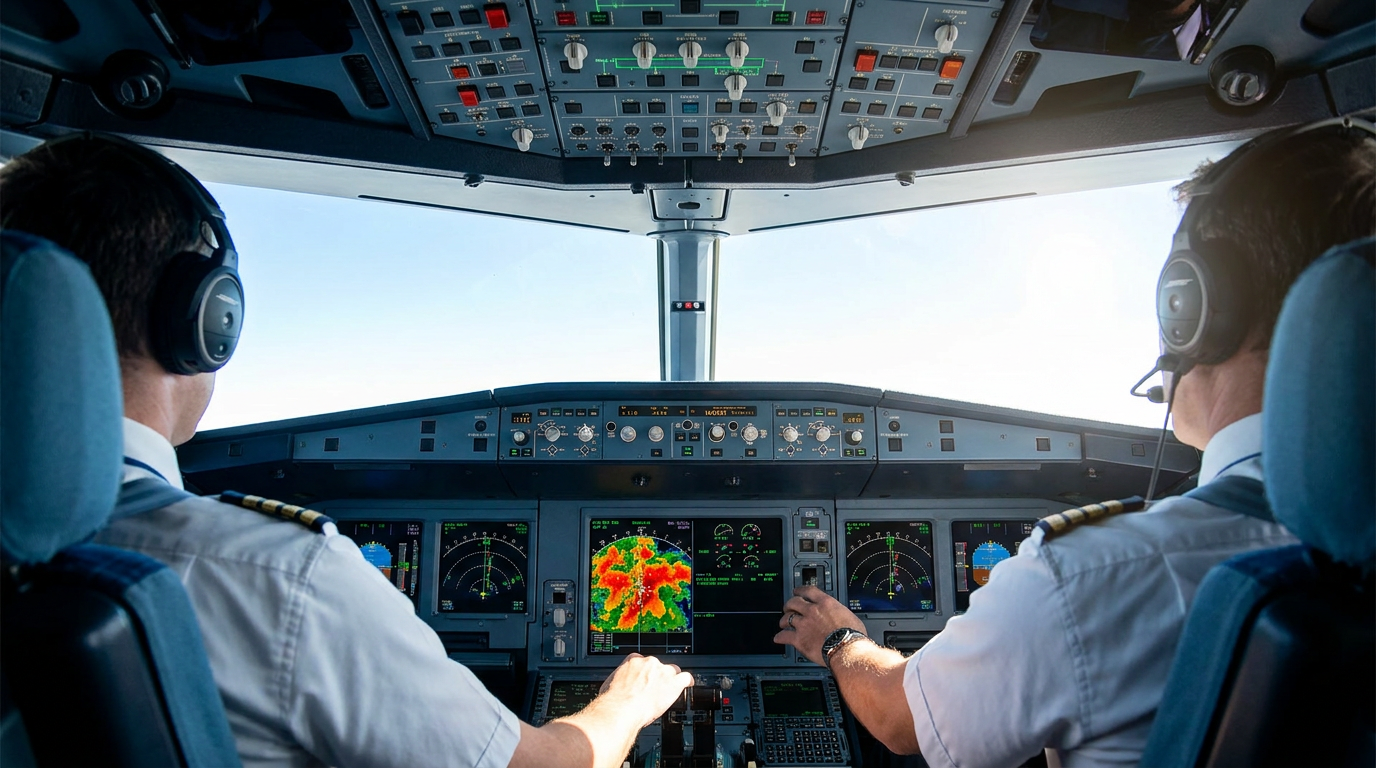
This crowdsourced data is then fed into cockpit navigation apps, such as Lufthansa Systems' Lido mPilot. Instead of guessing where the rough air might be, pilots look at a digital map overlaid with color-coded symbols indicating the exact location, altitude, and severity of turbulence ahead, allowing them to proactively request altitude changes from air traffic control.[2][5]
While real-time reporting is crucial, predicting turbulence before any aircraft flies through it is the ultimate goal. Japan's All Nippon Airways (ANA) recently became the first carrier in the world to implement a fleet-wide, AI-based turbulence prediction service.[1][6]
Developed by BlueWX—a company spun out of a joint initiative between ANA and Keio University—the system uses deep learning algorithms trained on a decade's worth of historical turbulence data and meteorological patterns.[1][6]
Following extensive operational trials involving 2,500 ANA pilots, the BlueWX model achieved an impressive 86 percent accuracy rate. Pilots reported that the AI forecasts closely matched actual flight conditions and significantly outperformed traditional meteorological prediction methods.[1][6]
The benefits of these AI systems extend far beyond passenger comfort. By knowing exactly where turbulence is, pilots can make minor, precise route adjustments rather than taking massive, fuel-heavy detours "just in case."[2][7]

Furthermore, severe turbulence encounters force airlines to ground aircraft for mandatory, unscheduled structural inspections. By avoiding these extreme jolts, carriers save millions of dollars in maintenance costs, prevent cargo damage, and keep their flight schedules intact.[6]
Looking ahead, the next generation of turbulence management will likely combine this AI data with new hardware. Researchers are currently flight-testing forward-looking UV Rayleigh lidar systems—sensors that can detect air-density fluctuations up to 10 kilometers ahead of the aircraft, giving crews a crucial 20 to 40 seconds of warning.[2]
Until those sensors become standard, the combination of AI prediction models and global data sharing is already transforming the passenger experience. By turning an unpredictable force of nature into a manageable data problem, airlines are ensuring that the skies of 2026 are the smoothest they have ever been.[3][5]
How we got here
2018
IATA launches the Turbulence Aware program to begin crowdsourcing flight data.
2019
ANA and Keio University begin joint research on deep-learning turbulence prediction.
August 2025
ANA becomes the first airline to implement fleet-wide AI turbulence prediction.
October 2025
Emirates rolls out a multi-layered AI strategy using iPad accelerometers.
February 2026
Lufthansa Group integrates IATA Turbulence Aware across its global fleet.
June 2026
Aeromexico joins the network, boosting Latin American turbulence tracking by 25 percent.
Viewpoints in depth
The Operations View
Airlines view AI turbulence prediction as a critical tool for cost savings and schedule reliability.
For airline management, turbulence is an expensive logistical headache. Severe encounters require mandatory, unscheduled structural inspections that ground aircraft and cascade delays throughout the network. By utilizing swarm intelligence and AI, carriers can avoid these zones with precise, minor adjustments rather than broad, fuel-heavy detours. This optimization protects profit margins while keeping flight schedules intact.
The Meteorological View
Climate scientists warn that atmospheric changes require entirely new forecasting paradigms.
Researchers note that traditional weather forecasting is no longer sufficient, as climate change alters jet streams and increases the frequency of clear-air turbulence. Because this rough air contains no moisture, it is invisible to standard radar. Meteorologists argue that only deep-learning models trained on decades of data, combined with real-time crowdsourced sensor readings, can accurately map these invisible atmospheric shifts.
The Safety View
Regulators prioritize AI tools to reduce the leading cause of in-flight injuries.
From a regulatory standpoint, turbulence is the most persistent threat to passenger and crew safety, accounting for up to half of all aviation incidents. Safety boards emphasize that even a few seconds of early warning—whether from a predictive AI model or a real-time iPad accelerometer alert—gives flight attendants time to secure the cabin and passengers time to buckle up, drastically reducing the risk of injury.
What we don't know
- How quickly air traffic control systems will adapt to handle thousands of AI-driven micro-route adjustments simultaneously.
- Whether the cost of deploying forward-looking lidar sensors will be viable for low-cost carriers.
Key terms
- Clear-Air Turbulence (CAT)
- Erratic air currents occurring in cloudless regions, making them invisible to conventional weather radar.
- Eddy Dissipation Rate (EDR)
- A universal, objective metric used by the aviation industry to measure the intensity of atmospheric turbulence.
- Swarm Intelligence
- The collective behavior of decentralized systems, applied in aviation by having thousands of aircraft share real-time sensor data.
- Lidar
- A remote sensing method that uses light in the form of a pulsed laser to measure ranges and detect invisible air-density fluctuations.
Frequently asked
What is clear-air turbulence?
Clear-air turbulence (CAT) is rough air that occurs in cloudless skies. Because it lacks moisture, it is completely invisible to traditional aircraft weather radar.
How do iPads help detect turbulence?
Software like SkyPath uses the built-in accelerometers in pilots' iPads to measure the physical movement of the aircraft, turning the tablet into a real-time turbulence sensor.
Will AI completely eliminate turbulence?
No, turbulence is a natural atmospheric phenomenon. However, AI allows pilots to predict and route around severe patches, significantly reducing unexpected encounters.
What is swarm intelligence in aviation?
It is a data-sharing concept where thousands of aircraft automatically broadcast their turbulence readings to a central database, instantly warning trailing aircraft of rough air.
Sources
Source coverage
7 outlets
3 viewpoints surfaced







[1]Aviation WeekAviation Safety Regulators & Analysts
All Nippon Airways Adopts AI-Based Turbulence Prediction System
Read on Aviation Week →[2]Aerospace Global NewsMeteorological Researchers
Emirates Tackles Turbulence With AI & Data-Driven Solutions
Read on Aerospace Global News →[3]GlobeTrenderMeteorological Researchers
Emirates develops advanced turbulence forecasting system
Read on GlobeTrender →[4]IATAAirline Operations Teams
IATA Turbulence Aware Coverage of Latin America Boosted
Read on IATA →[5]Lufthansa GroupAirline Operations Teams
Lufthansa introduces 'IATA Turbulence Aware' technology
Read on Lufthansa Group →[6]Future Travel ExperienceAirline Operations Teams
All Nippon Airways implements AI-based turbulence prediction service
Read on Future Travel Experience →[7]Simple FlyingAirline Operations Teams
Emirates Tackles Turbulence With AI & Data-Driven Solutions
Read on Simple Flying →
Every angle. Every day.
Get travel stories with full source coverage and perspective breakdowns delivered to your inbox.