
The Rise of Agrivoltaics: How Solar Panels and Farming Are Sharing the Same Soil
Co-locating solar panels with crops is solving the land-use conflict between clean energy and agriculture, boosting yields for shade-tolerant plants while conserving water.
By Factlen Editorial Team
- Agricultural Economists
- Focus on the financial stability agrivoltaics brings to rural communities through dual-revenue streams, while cautioning about the high initial capital costs.
- Renewable Energy Developers
- View agrivoltaics as a critical strategy to overcome local zoning opposition, acquire land, and scale grid capacity without displacing food production.
- Agronomists & Soil Scientists
- Emphasize the microclimate benefits and water retention, while stressing the strict necessity of matching shade-tolerant crops to the panel environment.
What's not represented
- · Local Zoning Boards
- · Traditional Farm Equipment Manufacturers
Why this matters
As the world races to decarbonize, land competition threatens food security and rural economies. Agrivoltaics offers a rare 'triple-gain' solution that stabilizes farmer incomes, cuts agricultural water use, and generates renewable power on the exact same acreage.
Key points
- Agrivoltaics combines solar energy generation and agriculture on the same land, solving the conflict between clean power and food production.
- Solar canopies create a microclimate that lowers ground temperatures by 3 to 5 degrees Celsius and reduces water evaporation.
- Shade-tolerant crops like berries, tomatoes, and root vegetables can see yield increases of 8% to 18% under solar panels.
- Sun-intensive crops like wheat and corn suffer yield drops, requiring careful crop matching and dynamic tracking panels.
- The dual-use model provides farmers with two income streams, though the elevated steel racking increases initial installation costs.
- Global capacity is surging, with the US, Europe, and Asia heavily investing in dual-use land strategies.
The global transition to renewable energy has long faced a geographical bottleneck: solar panels require massive amounts of land, putting clean power in direct competition with agricultural food production. As developers buy up rural acreage for utility-scale solar farms, communities often push back against the loss of active farmland and the perceived threat to local food security.[2]
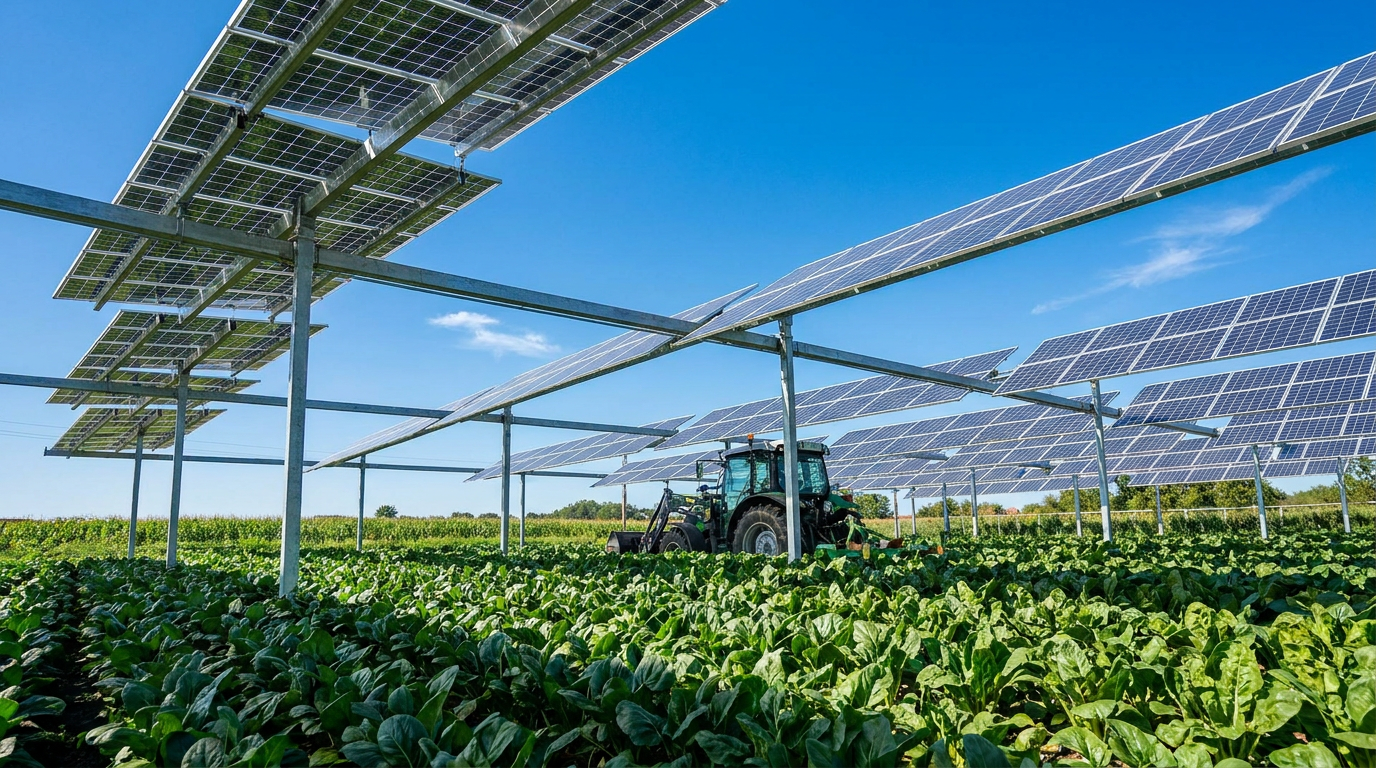
But a rapidly scaling solution known as "agrivoltaics" is proving that this does not have to be a zero-sum game. By elevating solar arrays and spacing them strategically, farmers are co-locating energy generation and crop cultivation on the exact same plots of land, fundamentally changing the economics of rural agriculture.[1][6]
The core mechanism behind agrivoltaics is the creation of a protective microclimate. Traditional open-field farming exposes crops to punishing midday heat and rapid water evaporation. When solar panels are introduced overhead, they intercept the most intense direct sunlight, lowering ground surface temperatures by an average of 3 to 5 degrees Celsius.[4][5]
This cooling effect drastically alters the hydrology of the field. By reducing evapotranspiration—the process by which water is transferred from the land to the atmosphere—the partial shading cuts irrigation water needs by 20% to 35% in arid regions, offering a lifeline to drought-stricken farming communities.[4][6]

The most surprising revelation from recent 2025 and 2026 harvest data is that solar panels do not inherently stunt plant growth; for many species, they actively enhance it. Heat-sensitive and shade-tolerant crops, including lettuces, tomatoes, root vegetables, and berries, have demonstrated yield increases of 8% to 18% when grown under agrivoltaic canopies.[4][5]
The biological mechanics behind these gains are striking. In one recent trial, strawberries grown beneath solar panels exhibited an 8% higher sugar content and 12% more chlorophyll. The moderated sunlight prevents leaf scorch and extends the optimal daily window for photosynthesis, allowing the plants to thrive without the stress of extreme heat.[6]
However, agrivoltaics is not a universal agricultural panacea. The system requires precise crop matching to be successful. Sun-intensive staple crops like wheat and corn struggle under the shaded canopies, often experiencing yield reductions of 25% to 40% when deprived of direct, sustained sunlight.[4]

However, agrivoltaics is not a universal agricultural panacea.
To mitigate these losses and optimize light distribution, the industry is rapidly adopting dynamic tracking systems. Unlike fixed-tilt panels, dynamic arrays use software and sensors to follow the sun's trajectory, adjusting their angles throughout the day to prioritize either maximum energy generation or maximum sunlight penetration for the crops below.[3][6]
Developers are also deploying bifacial solar modules, which capture both direct sunlight from above and reflected light from the ground. These advanced panels increase the proportion of diffused light reaching the plants by 20% to 30%, creating a highly efficient photosynthetic environment while boosting electricity output by up to 25%.[6]
For farmers, the economic proposition is transformative. Agrivoltaics introduces a dual-income stream, allowing landowners to harvest both cash crops and electricity. This diversification provides a vital financial buffer against volatile commodity prices, seasonal crop failures, and extreme weather events.[2][4]
The financial barrier to entry, however, remains a significant hurdle. Elevating solar panels to heights of 3.5 meters to accommodate tractors and standard farm machinery requires robust steel racking systems. This specialized infrastructure drives up the initial capital expenditure by 10% to 20% compared to traditional ground-mounted solar farms.[4]
Despite the upfront costs, global adoption is accelerating. The United States now hosts roughly 600 agrivoltaic projects, heavily concentrated in community solar initiatives where sheep grazing is paired with utility-scale arrays to manage vegetation naturally.[2]

Europe is moving even faster, driven by aggressive decarbonization targets and dense populations. Italy recently launched a €1.7 billion national funding program specifically designed to subsidize agrivoltaic deployment, while France and Germany are scaling up research-backed pilot programs to refine crop-specific panel designs.[4][5]
In regions like the Middle East, North Africa, and India, agrivoltaics is increasingly viewed as a critical tool for water conservation. By shielding crops from relentless solar irradiation, these nations can bolster their food security while simultaneously expanding their renewable energy portfolios.[1][6]

How we got here
2012
Global agrivoltaic capacity sits at a mere 5 megawatts, mostly in experimental pilot stages.
2021
Installed capacity reaches 14 gigawatts globally as Japan, China, and Europe accelerate adoption.
2023
The European Union approves €1.7 billion in funding specifically for agrivoltaic development in Italy.
2025
The US agrivoltaic footprint reaches nearly 600 projects, heavily driven by community solar and grazing initiatives.
2026
The global market surpasses 18 gigawatts, with dynamic tracking systems becoming the industry standard.
Viewpoints in depth
Agricultural Economists
Focus on the financial stability agrivoltaics brings to rural communities through dual-revenue streams.
Agricultural economists view agrivoltaics primarily as a risk-mitigation tool for rural landowners. By generating a guaranteed baseline income from electricity sales or solar leases, farmers are insulated against the volatility of global commodity markets and the increasing frequency of climate-driven crop failures. However, these experts caution that the economics only work if the initial capital expenditure—driven 10% to 20% higher by the need for elevated, reinforced steel racking—can be offset by long-term power purchase agreements and government tax incentives.
Renewable Energy Developers
View agrivoltaics as a critical strategy to overcome local zoning opposition and acquire land.
For solar developers, the primary bottleneck to the energy transition is land acquisition. Rural communities frequently block utility-scale solar projects out of fear that they will destroy local agricultural economies and alter the character of the landscape. Developers see agrivoltaics as the ultimate compromise, allowing them to secure permitting and grid access by proving that their infrastructure will keep the land in active agricultural production while generating clean power.
Agronomists & Soil Scientists
Emphasize the microclimate benefits and water retention, while stressing the strict necessity of crop matching.
Plant and soil scientists are highly optimistic about the microclimate effects of agrivoltaics, particularly the 20% to 35% reduction in evapotranspiration in arid regions. They point to the measurable increases in soil moisture and the prevention of heat stress in crops. However, they are quick to temper expectations, noting that agrivoltaics is not a blanket solution for all farming. They stress that planting sun-intensive staple crops like corn or wheat under panels will result in severe yield penalties, making rigorous crop-to-panel matching the most critical factor in a project's success.
What we don't know
- How the long-term presence of solar panels affects deep soil health and microbial activity over multiple decades.
- Whether the increased cost of dynamic tracking systems will eventually drop enough to make them standard for all small-scale farmers.
- How quickly local zoning boards will update their frameworks to easily permit dual-use agricultural-industrial land.
Key terms
- Agrivoltaics
- The simultaneous use of land for both solar photovoltaic power generation and agricultural production.
- Evapotranspiration
- The process by which water is transferred from the land to the atmosphere by evaporation from the soil and transpiration from plants.
- Bifacial Solar Panels
- Solar modules designed to capture sunlight from both their front and back sides, utilizing light reflected off the ground.
- Land Equivalent Ratio (LER)
- A metric used to measure the productivity of dual-use land compared to growing crops and generating solar power on separate, dedicated plots.
- Dynamic Tracking Systems
- Solar panel mounts that use motors and sensors to follow the sun's path, optimizing light for both energy generation and crop health.
Frequently asked
Can standard farm equipment still be used?
Yes, but the solar panels must be elevated (typically around 3.5 meters) and spaced widely enough to allow tractors and harvesters to pass underneath, which increases installation costs.
Do the solar panels block rain from reaching the crops?
While panels do intercept rainfall, the water runs off the edges and is distributed into the soil. Some advanced systems even use the panels to channel and collect rainwater for targeted irrigation.
What crops grow best under solar panels?
Shade-tolerant and heat-sensitive crops thrive best, including lettuces, tomatoes, strawberries, and root vegetables. Sun-intensive crops like corn and wheat generally see reduced yields.
Is agrivoltaics only for crops?
No. A large portion of agrivoltaic projects, particularly in the United States, pair utility-scale solar panels with livestock grazing, most commonly sheep.
Sources
Source coverage
6 outlets
3 viewpoints surfaced






[1]MDPIAgronomists & Soil Scientists
Agrivoltaics: A Climate-Smart Agriculture Approach
Read on MDPI →[2]University of PennsylvaniaAgricultural Economists
Agrivoltaics: Combining Solar and Agriculture
Read on University of Pennsylvania →[3]Fortune Business InsightsRenewable Energy Developers
Agrivoltaics Market Size & Future Outlook 2026
Read on Fortune Business Insights →[4]Energy Solutions IntelligenceAgricultural Economists
Agrivoltaics 2026: Farming & Solar Dual Income
Read on Energy Solutions Intelligence →[5]PV ProRenewable Energy Developers
New Data: Higher Crop Yields Under Solar Panels
Read on PV Pro →[6]Factlen Editorial TeamAgronomists & Soil Scientists
Synthesis by Factlen editorial team
Read on Factlen Editorial Team →
Every angle. Every day.
Get environment stories with full source coverage and perspective breakdowns delivered to your inbox.