
OLED vs. Mini-LED in 2026: The Complete Premium TV Comparison
As Tandem OLEDs push past 3,000 nits and Mini-LEDs reach 20,000 dimming zones, the gap between the two premium TV technologies has fundamentally shifted. Here is how to choose the right panel for your viewing environment.
By Factlen Editorial Team
- Living Room Pragmatists
- Consumers focused on versatility, durability, and bright-room performance.
- Home Theater Purists
- Advocates for absolute picture quality, perfect black levels, and cinematic accuracy.
- Value Maximizers
- Buyers optimizing for the largest possible screen size and immersion per dollar.
- Neutral Analysts
- Editorial synthesis balancing the trade-offs of both technologies.
What's not represented
- · Professional colorists who require reference-level mastering monitors.
- · Eco-conscious consumers prioritizing the lowest possible energy consumption.
Why this matters
Spending $2,000 to $4,000 on a flagship television is a decade-long investment for most households. Choosing the wrong panel technology for your room's lighting or your family's viewing habits can result in washed-out daytime sports or distracting blooming during evening movies.
Key points
- Tandem OLED technology has pushed OLED peak brightness past 3,000 nits, closing the historical gap with LED screens.
- Flagship Mini-LEDs now feature up to 20,000 dimming zones, significantly reducing blooming in dark scenes.
- OLED remains the superior choice for dark rooms, wide seating arrangements, and absolute contrast.
- Mini-LED excels in bright, sunlit rooms and carries zero risk of permanent image retention.
- For a fixed budget, buyers can typically purchase an 85-inch Mini-LED for the price of a 65-inch OLED.
The 2026 television market has dismantled the oldest and most reliable rule in home theater buying. For years, the guidance given to consumers was remarkably simple and binary: buy an OLED television for dark-room cinematic perfection, or buy an LED television if you have a bright living room. But a massive engineering arms race between the world's largest display manufacturers has fundamentally blurred those lines, with both technologies successfully invading each other's traditional territory. Today, the decision requires a much deeper understanding of how these panels actually generate light, how they handle sustained brightness, and how they fit into the specific architectural realities of your home.[7]
On one side of the aisle, organic light-emitting diode (OLED) technology has undergone a structural revolution that addresses its historical weaknesses. Manufacturers have introduced advanced "Tandem OLED" architectures, which stack multiple emissive organic layers on top of one another. This allows the panel to dramatically increase its peak brightness output without accelerating the degradation of the organic materials. On the other side, Mini-LED displays have evolved far beyond standard liquid crystal displays. They now utilize highly complex backlight arrays featuring tens of thousands of microscopic inorganic diodes. By dividing the screen into thousands of independent dimming zones, these panels achieve blinding peak brightness while simultaneously delivering near-perfect black levels that rival their organic counterparts.[2][3]
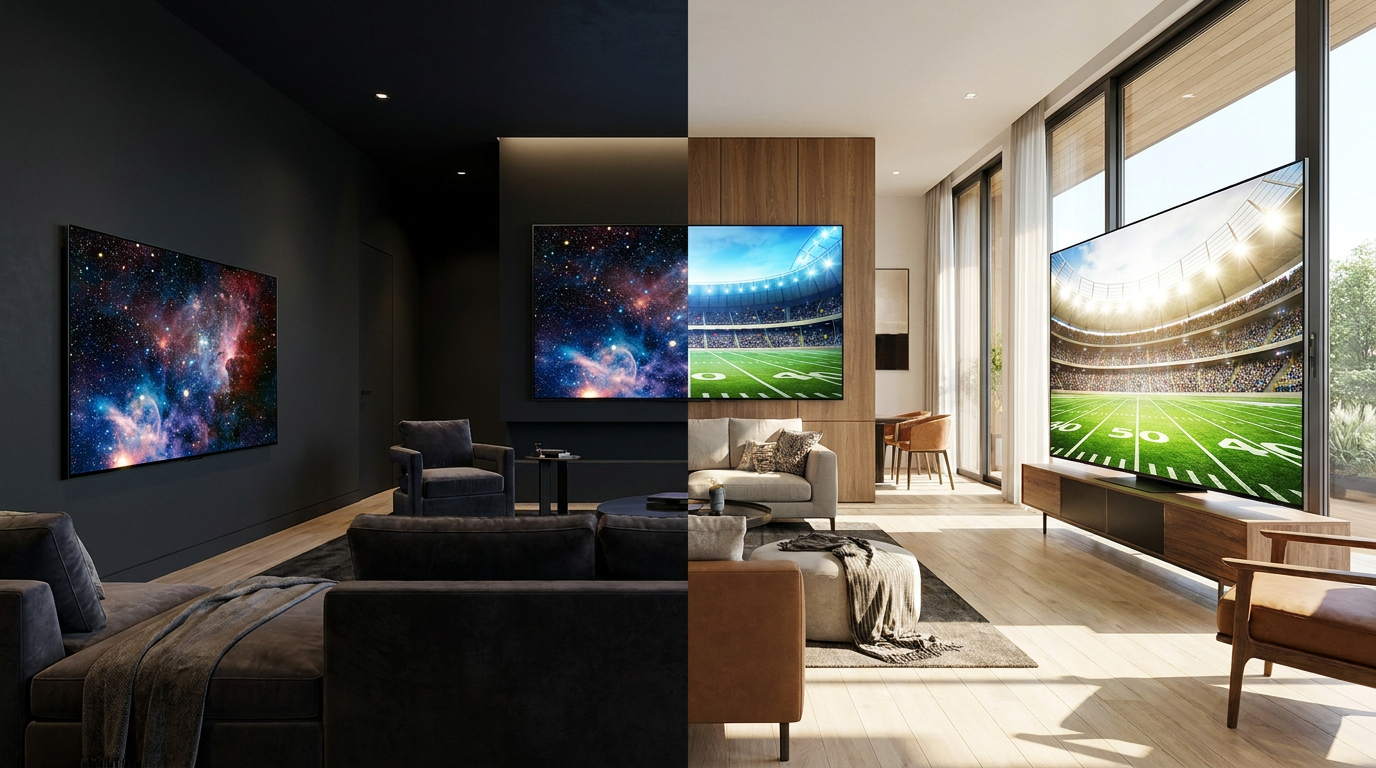
The argument for OLED has always centered on absolute pixel-level precision and infinite contrast, and that remains its strongest selling point in 2026. Because every single pixel on an OLED screen generates its own light and can turn off completely independently of its neighbors, the panel delivers perfect, inky blacks with zero light bleed. The evidence for this advantage is most immediately visible during dark-room viewing. When watching a starfield in a science fiction movie, or when bright white subtitles appear over a pitch-black background, the image remains flawlessly sharp. There are no glowing halos or elevated black levels around the text, providing a level of micro-contrast that creates a deeply immersive, three-dimensional look.[1][4]
The argument against OLED historically focused on its lack of overall brightness and the lingering risk of permanent image retention, commonly known as burn-in. In 2026, the brightness gap has narrowed significantly. Flagship models like the LG G6 utilize Hyper Radiant Color technology and Tandem OLED panels to push peak brightness past 3,000 nits in small, specular highlights. However, the underlying physics still require OLEDs to employ an Automatic Brightness Limiter (ABL). This software aggressively dims the entire screen when a large portion of the image is bright—such as a hockey rink, a snow-covered landscape, or a brightly lit news studio—to protect the organic materials from overheating and degrading.[2][4]

The argument for Mini-LED centers entirely on sustained full-screen brightness and environmental resilience. Flagship 2026 models, such as the Sony Bravia 9 II, utilize True RGB Mini-LED backlighting to reach an astonishing 4,000 nits of peak brightness. More importantly, the evidence shows that Mini-LEDs can sustain this high brightness across the entire screen without triggering any dimming algorithms. This makes them highly capable of overpowering direct sunlight and heavy glare in a bright, window-heavy living room. Furthermore, because they are constructed using inorganic gallium nitride materials, they carry absolutely zero risk of permanent burn-in from static elements like news tickers, sports scoreboards, or video game interfaces.[3][5][6]
The argument against Mini-LED focuses on the limitations of its backlight zones and its viewing angles. Even with 20,000 independent dimming zones, a Mini-LED television cannot match the per-pixel control of an OLED panel, which essentially has over eight million dimming zones. When a bright object moves rapidly across a dark background, the backlight zones must turn on and off in clusters. This can occasionally create a faint halo effect, or "blooming," in highly challenging cinematic scenes, which can be distracting to purists. Additionally, because Mini-LEDs rely on liquid crystal layers to filter the light, the image can lose contrast and color accuracy when viewed from an off-center angle in a wide seating arrangement.[1][5]
The argument against Mini-LED focuses on the limitations of its backlight zones and its viewing angles.
Gaming performance presents another distinct trade-off where both technologies offer compelling but different advantages. The evidence for OLED's gaming supremacy lies in its near-instantaneous 0.03-millisecond pixel response time. This incredibly fast transition eliminates motion blur and ghosting in fast-paced competitive titles, providing a crystal-clear image during rapid camera movements. However, the argument against using OLED for heavy, repetitive gaming involves the static heads-up displays (HUDs) present in many titles. Players who spend thousands of hours on a single game like Call of Duty or EA Sports FC may prefer the absolute peace of mind offered by Mini-LED's immunity to burn-in, even if it means accepting a slightly slower 1-millisecond response time.[4][5]
Pricing dynamics have also shifted the value equation dramatically in 2026, forcing buyers to weigh screen size against absolute picture quality. The manufacturing efficiency of OLED panels has improved steadily, making 55-inch and 65-inch models highly competitive and accessible to a broader range of consumers. However, the evidence shows that Mini-LED technology scales to massive sizes much more cost-effectively. Buyers can frequently purchase an 85-inch premium Mini-LED television for the exact same price as a 65-inch flagship OLED. For many home theaters, the sheer immersion and field-of-view provided by an 85-inch screen vastly outweighs the marginal contrast advantages of a smaller OLED panel viewed from ten feet away.[5]

Environmental and architectural factors also play a crucial role in the decision-making process. OLED panels are incredibly thin—often measuring just millimeters deep—and consume significantly less power during dark cinematic scenes, making them highly efficient and aesthetically pleasing when wall-mounted. Conversely, Mini-LED televisions require thicker chassis to house their complex backlight systems, liquid crystal layers, and internal heat sinks. This robust thermal engineering makes Mini-LEDs highly durable, particularly in warmer climates or environments with inconsistent power delivery, but they do draw substantially more wattage from the wall when displaying bright, full-screen content for extended periods.[4][5]
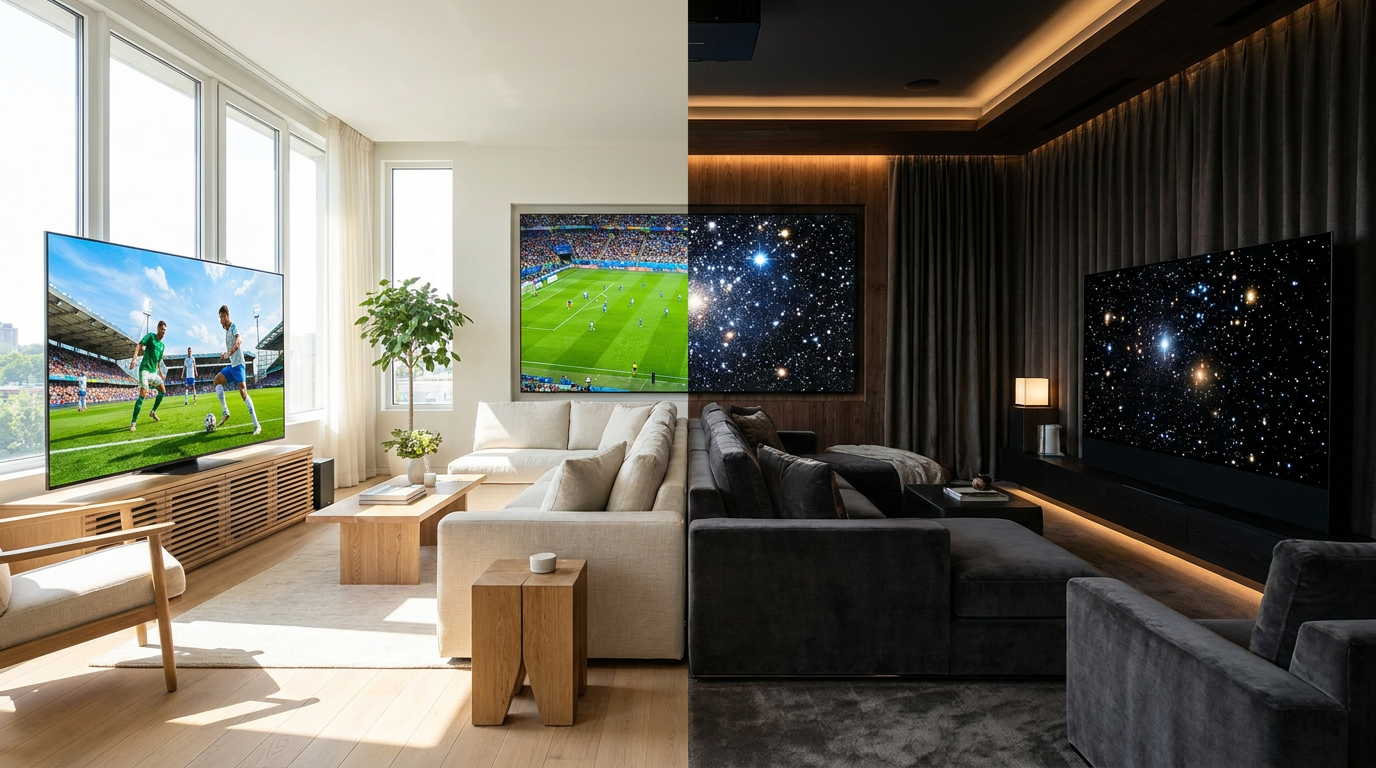
Ultimately, the choice between the two technologies comes down to matching the engineering to the specific environment and use case. Tandem OLED fits well when the television is placed in a dedicated, light-controlled room where ambient light can be managed. It is the ideal choice when the primary use is watching 4K HDR movies or prestige television in the evening, and when seating is arranged in a wide horseshoe shape that requires perfect off-angle viewing for everyone in the room. For these specific conditions, OLED remains the undisputed reference standard for absolute picture quality and micro-contrast.[4][6]
Conversely, Tandem OLED does not fit well when the television is placed in a sun-drenched room with massive, uncovered windows. It is also a suboptimal choice when the display will be used as a background television for all-day news channels, sports networks, or static productivity applications. The aggressive full-screen dimming triggered by the Automatic Brightness Limiter, combined with the lingering, albeit reduced, risk of image retention, make it less suited for high-ambient-light environments where static content is left on the screen for eight to ten hours a day.[4][6]

Premium Mini-LED fits well when the television serves as the central entertainment hub of a bright, multi-purpose family room that sees heavy daytime use. It is the superior choice for Sunday afternoon sports viewing, PC monitor usage, and buyers who want to maximize their screen size per dollar. For households with children or users who frequently leave the television paused on a video game menu or streaming interface, Mini-LED provides the ultimate peace of mind without requiring any babysitting to prevent permanent panel damage.[5][6]
However, Mini-LED does not fit well when the viewer is highly sensitive to backlight blooming in dark rooms, or when the room's seating arrangement forces viewers to sit at extreme off-center angles to the screen. While the gap between the two technologies has closed dramatically over the last few years, those seeking the absolute purest black levels for midnight movie marathons will still find the microscopic, pixel-level precision of an OLED panel impossible to beat. The decision is no longer about which technology is objectively better, but which set of trade-offs best aligns with your life.[5][7]
How we got here
2013
LG introduces the first commercially viable large-screen OLED televisions, establishing a new standard for contrast.
2019
Mini-LED technology enters the consumer market, using thousands of smaller LEDs to improve LCD local dimming.
2024
Sony shifts its flagship focus from OLED to Mini-LED with the Bravia 9, signaling confidence in advanced backlight control.
Jan 2026
LG unveils the G6 and C6 series featuring Tandem OLED panels, dramatically increasing brightness and durability.
Viewpoints in depth
Home Theater Purists
Advocates for absolute picture quality and cinematic accuracy.
This camp argues that OLED remains the only acceptable choice for true cinematic viewing. They point to the fact that Hollywood mastering monitors use dual-layer LCD or OLED technology to achieve pixel-level contrast. For purists, the occasional blooming or halo effect on a Mini-LED—even one with 20,000 zones—breaks immersion during dark scenes. They view the 2026 Tandem OLED advancements as the final nail in the coffin for LCD technology, as it solves OLED's historical brightness deficit without compromising perfect black levels.
Living Room Pragmatists
Consumers focused on versatility, durability, and bright-room performance.
This perspective prioritizes how a television performs in real-world, multi-use environments rather than pitch-black basements. They argue that Mini-LED is the superior engineering choice for 90% of households. Because Mini-LEDs can sustain massive full-screen brightness, they do not wash out during Sunday afternoon sports broadcasts. Furthermore, pragmatists value the zero-maintenance aspect of inorganic LEDs, arguing that buyers should not have to worry about burn-in from leaving a news channel or video game paused for hours.
Value Maximizers
Buyers optimizing for the largest possible screen size and immersion per dollar.
For this camp, the debate between perfect blacks and peak nits is secondary to sheer physical size. They point to the psychological impact of field-of-view: an 85-inch screen viewed from ten feet away provides a fundamentally different, more immersive experience than a 65-inch screen. Because 85-inch and 98-inch Mini-LEDs have plummeted in price while massive OLEDs remain prohibitively expensive, value maximizers argue that buying a larger Mini-LED is always a better investment than buying a smaller OLED for the same budget.
What we don't know
- The long-term degradation rate of the new 2026 Tandem OLED structures under heavy, sustained use.
- Whether micro-LED technology will become affordable enough in the next five years to render both current architectures obsolete.
Key terms
- Tandem OLED
- A display architecture that stacks multiple organic light-emitting layers to increase brightness and extend the panel's lifespan.
- Mini-LED
- An LCD television that uses tens of thousands of microscopic LEDs for its backlight, allowing for highly precise brightness control.
- Blooming
- A visual artifact where light from a bright object bleeds into the surrounding dark areas of the screen, creating a halo effect.
- Automatic Brightness Limiter (ABL)
- A safety feature in OLED TVs that automatically dims the screen when a large portion of the image is bright, preventing overheating.
- Dimming Zones
- Specific areas of a TV's backlight that can be independently brightened or darkened to improve contrast.
Frequently asked
Will an OLED TV get burn-in from video games?
While the risk has been significantly reduced by 2026 Tandem OLED technology and built-in pixel refreshers, playing the exact same game with static HUDs for thousands of hours still carries a minor risk of permanent image retention.
Is Mini-LED the same as Micro-LED?
No. Mini-LED is an advanced backlight for traditional LCD TVs. Micro-LED is a completely different, highly expensive technology where each microscopic pixel produces its own light, similar to OLED but using inorganic materials.
Which TV is better for a bright living room?
Mini-LED is generally better for bright rooms because it can sustain high full-screen brightness without dimming, easily overpowering glare from direct sunlight.
Do I need a soundbar with these flagship TVs?
While flagship TVs feature improved built-in audio, their ultra-thin designs physically limit speaker size. A dedicated soundbar or home theater system is highly recommended to match the premium picture quality.
Sources
Source coverage
7 outlets
4 viewpoints surfaced







[1]RTINGSHome Theater Purists
LG G6 OLED vs LG C6 OLED 2026
Read on RTINGS →[2]FlatpanelsHDHome Theater Purists
LG unveils 2026 OLED TVs: G6 and C6 with Tandem OLED
Read on FlatpanelsHD →[3]CE CriticLiving Room Pragmatists
Sony BRAVIA 9 II True RGB Mini-LED Specifications
Read on CE Critic →[4]KTC PlayLiving Room Pragmatists
Tandem OLED vs. Mini-LED: Choosing the Best HDR Panel in 2026
Read on KTC Play →[5]Let Sal ExplainValue Maximizers
OLED vs Mini-LED in 2026 — The Truth They Don't Tell You
Read on Let Sal Explain →[6]Datawire SolutionsValue Maximizers
Tandem OLED vs QD-OLED vs Mini-LED
Read on Datawire Solutions →[7]Factlen Editorial TeamNeutral Analysts
Synthesis by Factlen editorial team
Read on Factlen Editorial Team →
More in shopping
See all 6 stories →E-Bike Tech
Buying an E-Bike in 2026: The Ultimate Explainer Guide
9 sources

Wi-Fi Tech
Wi-Fi 7 Explained: Is the Upgrade Worth It in 2026?
8 sources
Display Tech
OLED vs. Mini-LED in 2026: Which TV Panel Technology Actually Wins?
6 sources
Motorcycle Safety
The Tech Revolution in Beginner Motorcycles: Why 2026 is the Safest Time to Start Riding
6 sources

Every angle. Every day.
Get shopping stories with full source coverage and perspective breakdowns delivered to your inbox.