
How Hall Effect Sensors Are Eradicating Controller Stick Drift
By replacing physical friction with magnetic fields, Hall Effect joysticks are eliminating hardware degradation and setting a new standard for gaming controllers.
By Factlen Editorial Team
- Hardware Enthusiasts & Repair Advocates
- Champions the technology as a victory against planned obsolescence and e-waste.
- Competitive Gamers
- Values the technology for its zero deadzones, hyper-precision, and consistent input reliability during tournaments.
- Third-Party Manufacturers
- Leverages Hall Effect sensors as a premium selling point to disrupt the first-party console hardware market.
What's not represented
- · First-party console manufacturers (Sony, Microsoft, Nintendo)
Why this matters
For years, gamers have been forced to repeatedly replace expensive controllers due to inevitable hardware failure. The mainstream adoption of Hall Effect sensors ends this cycle of planned obsolescence, saving consumers money while delivering superior competitive precision.
Key points
- Stick drift is caused by the physical degradation of carbon tracks inside traditional potentiometer joysticks.
- Hall Effect sensors eliminate physical friction by using magnets to measure joystick movement contactlessly.
- The technology extends controller lifespans by years and drastically reduces electronic waste.
- Competitive players benefit from zero deadzones, allowing for instantaneous and hyper-precise in-game inputs.
For anyone who has ever watched their character slowly walk off a cliff while their hands were completely off the controller, the frustration is a universal rite of passage. Joystick drift—the hardware phenomenon where a controller registers movement without being touched—has ruined countless competitive matches, speedruns, and casual gaming sessions. Whether playing a high-stakes tournament in a first-person shooter or simply trying to navigate a menu screen, the unpredictable phantom inputs caused by degrading hardware have plagued players across every major console generation. It is a problem that unites the gaming community in shared annoyance, turning premium hardware into a source of constant unreliability.[1][3]
For the better part of a decade, this specific hardware failure was largely accepted by the gaming community as an inevitable, fatal flaw of modern technology. Players simply factored the cost of a replacement controller into their annual gaming budget, resigning themselves to the frustrating reality that their expensive hardware had a strict, unavoidable expiration date. Class-action lawsuits were filed, and temporary software fixes were deployed, but the underlying mechanical issue remained unresolved in the base hardware provided by the industry's biggest players.[4][7]
But in 2026, a massive technological shift is sweeping the gaming hardware industry, rendering stick drift entirely obsolete and changing consumer expectations forever. A new standard has rapidly emerged from the enthusiast space into the mainstream, promising to save consumers hundreds of dollars over a console's lifespan while drastically improving input precision across all major platforms. This is not merely a software patch or a minor revision; it is a fundamental redesign of how player inputs are captured and translated into digital environments.[5][7]
The definitive solution to this decade-long problem lies in the widespread adoption of the "Hall Effect" sensor. By replacing physical friction with magnetic fields, this technology directly addresses the root cause of hardware degradation, fundamentally changing how controllers are built, utilized, and maintained. What was once considered a premium, niche feature reserved for expensive custom builds has now become the baseline expectation for anyone purchasing a new gamepad in the modern era.[2][3]
To truly understand why this shift is so revolutionary for the industry, it is essential to first examine the outdated standard it is actively replacing: the potentiometer. For decades, almost all first-party console controllers relied on this analog technology to translate a player's thumb movements into digital actions on the screen. It was a cost-effective, reliable enough solution for early 3D gaming, but it harbored a mechanical weakness that would eventually become the bane of modern gamers.[2][6]

A traditional potentiometer operates through direct, continuous physical contact. Inside the joystick module, a small metal wiper constantly scrapes across a resistive carbon track. As the player moves the stick to aim or walk, the wiper changes its physical position on the track, which alters the electrical resistance. The controller's internal processor reads this changing resistance and tells the console exactly where the stick is pointing on an X and Y axis.[4][6]
The fatal flaw of the potentiometer design is inescapable physical friction. Every single flick, rotation, and click of the joystick grinds away microscopic layers of that internal carbon track. Over time, the track inevitably wears down, creating loose carbon dust and uneven surfaces that send false, erratic electrical signals to the console. This physical degradation is the exact mechanism that results in the dreaded stick drift, and because it is a physical wearing away of material, it cannot be permanently fixed with software updates.[1][3]
The Hall Effect offers an elegant, physics-based alternative that bypasses mechanical wear entirely. Discovered in 1879 by American physicist Edwin Hall, the scientific principle describes how a magnetic field can alter the flow of electricity, or voltage, across a conductor. While the physics concept is over a century old, its application in consumer gaming hardware represents a modern engineering triumph that perfectly solves the potentiometer's friction problem once and for all.[1][2]
The Hall Effect offers an elegant, physics-based alternative that bypasses mechanical wear entirely.
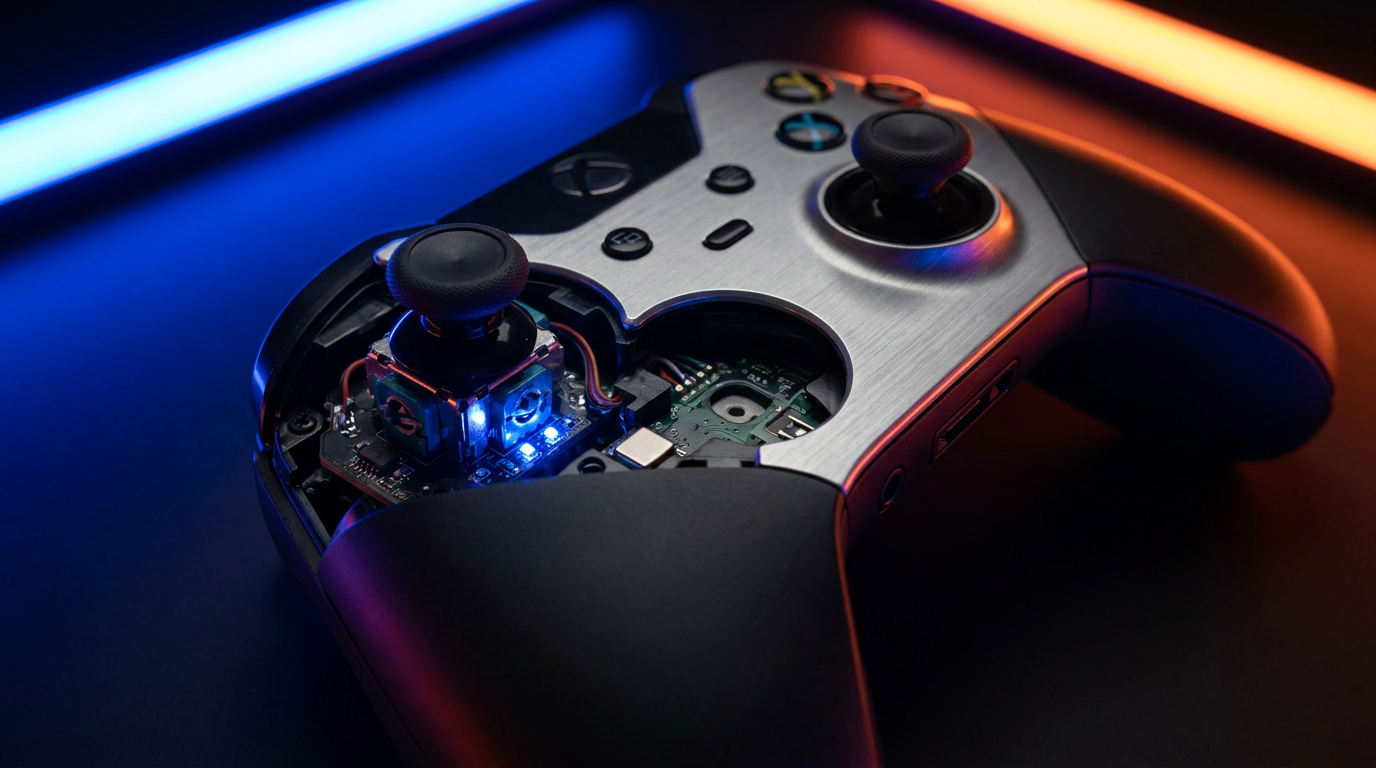
In a modern Hall Effect joystick, the mechanical wiper and the degradable carbon track are completely removed from the equation. Instead, a small, powerful permanent magnet is mounted directly to the base of the joystick shaft. This magnet hovers just millimeters above a specialized semiconductor sensor mounted on the controller's printed circuit board, creating a localized magnetic field that moves in tandem with the player's thumb.[3][6]
As the player manipulates the joystick during gameplay, the magnet shifts its position in three-dimensional space above the board. The sensor below detects these minute, continuous changes in the magnetic field's strength and angle, instantly translating them into a precise voltage signal. The controller's firmware then reads this voltage to determine the exact position of the stick, sending that data to the game engine with zero physical interference.[2][3]

Because the magnet and the sensor never physically touch one another, there is absolutely zero friction involved in the measurement process. The primary mechanical wear-and-tear that causes stick drift is entirely eliminated at the source. While the plastic housing or the metal centering springs might eventually wear out after years of heavy abuse, the actual sensor responsible for reading the player's input remains pristine and perfectly accurate indefinitely.[1][4]
This contactless design does not just extend a controller's lifespan from a few short months to several years; it fundamentally improves the precision, fluidity, and reliability of the gameplay experience. Gamers no longer have to fight their own hardware to make precise movements, allowing for a level of consistency that traditional potentiometers simply cannot maintain over long periods of active use in demanding titles.[5][6]
With traditional potentiometers, game developers and players are forced to rely heavily on software "deadzones." A deadzone is an artificial software buffer near the physical center of the joystick that intentionally ignores small inputs. This setting is designed specifically to mask the inevitable onset of hardware drift, ensuring that a slightly worn stick doesn't cause the camera to slowly pan when the player's thumb is resting.[1][2]
Because Hall Effect sticks maintain their perfect physical and magnetic center indefinitely without degrading, they do not require these artificial software buffers. Players can safely dive into their game settings and reduce their in-game deadzones to near zero without any fear of their character moving autonomously or their camera spinning out of control during a crucial, high-stakes moment.[2][4]

This lack of a deadzone results in a hyper-responsive, instantaneous feel that fundamentally changes how games control. For competitive players in first-person shooters, fighting games, and high-speed racing simulators, the ability to translate a millimeter of thumb movement into immediate, 1:1 on-screen action provides a tangible microsecond advantage that can be the difference between a tournament victory and a loss.[2][6]
The transition to this superior technology was initially pioneered by agile, innovative third-party manufacturers like GuliKit, 8BitDo, and GameSir. By offering drift-proof controllers at highly competitive prices, they successfully disrupted a peripheral market that had long been dominated by official, first-party console hardware. Their success proved to the industry that consumers were hungry for durable, high-quality alternatives.[1][4]
Now, premium peripheral brands have fully embraced the technology, cementing its status as the new industry standard. High-end 2026 models from established companies like Turtle Beach and SCUF feature Hall Effect modules as a mandatory standard inclusion, making it the baseline expectation for any serious PC or console gamer looking to upgrade their competitive setup.[2][5]

Beyond individual player performance, this industry-wide shift represents a massive, long-overdue victory for consumer rights and environmental sustainability. By eliminating the primary point of failure in gaming peripherals, the industry is drastically reducing the millions of pounds of electronic waste generated by discarded controllers each year, aligning with broader global pushes for repairability and longevity.[7]
As manufacturing costs for magnetic sensors continue to drop and the technology scales globally, the era of treating game controllers as disposable, temporary hardware is finally coming to an end. Gamers can now invest in their equipment with the absolute confidence that their inputs will remain flawless, precise, and drift-free for years to come, marking one of the most universally positive hardware evolutions in modern gaming history.[5][7]
How we got here
1879
Physicist Edwin Hall discovers the electromagnetic phenomenon that bears his name.
1998
Sega releases the Dreamcast, featuring an early implementation of Hall Effect sensors in its controller.
2017-2022
Widespread class-action lawsuits target major console manufacturers over severe stick drift issues.
2023-2024
Third-party brands like GuliKit and 8BitDo popularize affordable Hall Effect controllers for PC and Switch.
2026
Hall Effect modules become the baseline expectation for competitive and premium gaming hardware.
Viewpoints in depth
Hardware Enthusiasts & Repair Advocates
Champions the technology as a victory against planned obsolescence and e-waste.
For years, the repair community has criticized major console manufacturers for relying on cheap, disposable potentiometers that inevitably fail. Repair advocates view the widespread adoption of Hall Effect sensors as a major victory for consumer rights. By eliminating the primary point of mechanical failure, these controllers drastically reduce the amount of electronic waste generated by gamers forced to replace their hardware every six to twelve months.
Competitive Gamers
Values the technology for its zero deadzones, hyper-precision, and consistent input reliability.
In the esports arena, a microsecond delay or a millimeter of unwanted drift can cost a player a match. Competitive gamers favor Hall Effect technology not just for its durability, but for its absolute precision. Because the sticks maintain a perfect physical center without degrading, players can reduce their software deadzones to zero. This allows for instantaneous, 1:1 translation of thumb movement to on-screen action, providing a tangible advantage in high-stakes tournaments.
Third-Party Manufacturers
Leverages Hall Effect sensors as a premium selling point to disrupt the first-party console hardware market.
Brands like GameSir, 8BitDo, and Turtle Beach have used Hall Effect technology as a wedge to break the dominance of official first-party controllers. By offering a permanent solution to a problem that major console makers have largely ignored, these companies have successfully repositioned themselves from 'budget alternatives' to 'premium upgrades.' This strategy has forced the entire industry to elevate its hardware standards in 2026.
What we don't know
- Whether first-party console manufacturers will officially adopt Hall Effect sensors in their next-generation base controllers.
- How long the physical centering springs will last before requiring replacement, even with frictionless sensors.
Key terms
- Stick Drift
- A hardware failure where a controller registers movement even when the joystick is completely stationary.
- Potentiometer
- A traditional sensor that measures joystick movement by scraping a metal wiper across a resistive carbon track.
- Hall Effect
- A physics principle where a magnetic field alters the voltage across an electrical conductor.
- Deadzone
- A software setting that ignores small joystick movements near the center to prevent accidental inputs or mask stick drift.
- Polling Rate
- How often a controller reports its inputs to the console or PC, measured in Hertz (Hz).
Frequently asked
What causes stick drift in standard controllers?
Standard controllers use potentiometers, which rely on physical friction. Over time, the carbon tracks wear down and create false inputs.
Do Hall Effect controllers work on all consoles?
Yes. Third-party manufacturers produce Hall Effect controllers compatible with PC, Xbox, PlayStation, and Nintendo Switch.
Are Hall Effect controllers more expensive?
Initially they were a premium feature, but by 2026, many budget-friendly third-party controllers include Hall Effect sensors as a standard feature.
Can Hall Effect joysticks still break?
While the sensors themselves don't wear out from friction, the plastic housing or the centering springs can still degrade over years of heavy use.
Sources
Source coverage
7 outlets
3 viewpoints surfaced







[1]Windows CentralThird-Party Manufacturers
What is a Hall Effect controller anyway, and do I really need one?
Read on Windows Central →[2]Turtle BeachThird-Party Manufacturers
Hall-Effect vs Traditional Joysticks: End Drift Forever
Read on Turtle Beach →[3]ELO GamingCompetitive Gamers
What Are Hall Effect Joysticks? The Complete Guide for Gamers
Read on ELO Gaming →[4]GamePad TesterHardware Enthusiasts & Repair Advocates
Best Hall Effect Controllers (Drift Proof) in 2026
Read on GamePad Tester →[5]ElectronicsHubThird-Party Manufacturers
PC Controller for Gaming Guide: How to Choose in 2026
Read on ElectronicsHub →[6]AimControllersCompetitive Gamers
The Benefits of Hall Effect Sensors in Controllers
Read on AimControllers →[7]Factlen Editorial TeamHardware Enthusiasts & Repair Advocates
Synthesis by Factlen editorial team
Read on Factlen Editorial Team →
Every angle. Every day.
Get gaming esports stories with full source coverage and perspective breakdowns delivered to your inbox.